Egypt’s Pre-Election Pulse

In the lead-up to Egypt’s presidential election next week, Max Rodenbeck examines the findings of a recent Pew survey, which puts putative winner Abdel Fatah Al-Sisi’s favorability at 54 percent and shows “declining faith in democracy”:

In the heady days of 2011, 54% favoured “democracy, even with some risk of political instability”, over stable government without full democracy. Those proportions have now reversed, a factor that has clearly played to Mr Sisi’s electoral advantage.Egypt

But Egypt’s new leader should take little comfort from other trends. Trust in national institutions, including the army, the media, religious leaders and the courts has slumped to an all-time low; in the case of the military from 88% approval in 2011 to just 56% now. This is an indication that the post-coup-regime’s use of harsh policing and harsher justice has carried a heavy cost in public support. Significantly, some 63% or respondents said the government now “does not respect” personal freedoms, up from 44% under Mr Morsi.

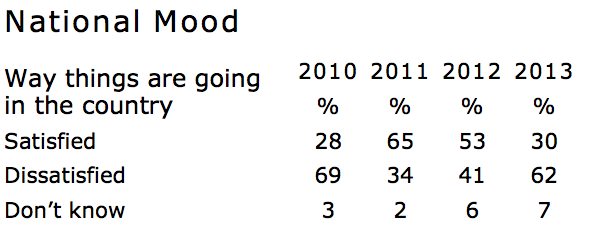
Perhaps most ominously, a solid 72% of respondents say they are dissatisfied with the country’s general direction. That is a higher proportion than in 2010, the year before Egyptians rose up and overthrew Hosni Mubarak, their dictator for three decades.

Richard Wike focuses on what Pew found out about the Muslim Brotherhood:

Back in 2011, just after the revolution, three-quarters of Egyptians had a favorable opinion of the Muslim Brotherhood, and even in the spring of 2013 a solid majority (63 percent) still expressed a positive view. In the new survey, however, just 38 percent give the Brotherhood a positive rating. Still, the fact that roughly four in 10 Egyptians continue to have a favorable opinion of the Islamist organization, which the Egyptian state has declared a terrorist group, means that Sisi will come to office facing significant opposition to his rule.

In some ways, the Brotherhood’s resilience shouldn’t be a surprise: The organization has been around for nearly nine decades and has survived varying levels of repression over time, adapting and transforming itself as the political context changes. Egypt remains a country where many Islamist positions enjoy a great deal of acceptance, providing groups like the Brotherhood an ongoing base of support.

Meanwhile, Eric Trager interviews Sisi’s quixotic challenger Hamdeen Sabahi:

Sabahi, who finished a strong third in the 13-candidate 2012 presidential election, knows that the odds are severely stacked against him. “I think the political atmosphere says that there is a state candidate,” he said, referring to Sisi, during an interview at his Giza-based office in early April. “I think this atmosphere does not give an equal competitive opportunity in this election.” … Yet despite the hopelessness of his relatively small campaign, Sabahi is making one important contribution to Egypt’s political landscape. In an otherwise repressive political environment, he is working to preserve Egyptians’ ability to challenge Sisi’s emerging regime. …

Yet despite the hopelessness of his relatively small campaign, Sabahi is making one important contribution to Egypt’s political landscape. In an otherwise repressive political environment, he is working to preserve Egyptians’ ability to challenge Sisi’s emerging regime. “I am not an idealist who stays at home waiting for this state to be neutral,” he told me. “For this reason, I believe in running for this presidential election so that democracy becomes a right.”

About That 15-Hour Workweek …

by Jonah Shepp

Reviewing Brigid Schulte’s Overwhelmed, Elizabeth Kolbert ties Schulte’s exploration of American busyness back to John Maynard Keynes’s famously incorrect prediction that dramatic increases in productivity would lead to less work and more leisure time in the 21st century:

Eighty years after Keynes first composed “Economic Possibilities,” a pair of Italian economists, Lorenzo Pecchi and Gustavo Piga, got to chatting about it. How could “a man of Keynes’s intelligence,” they wondered, have been “so right in predicting a future of economic growth and improving living standards” and so wrong about the future of leisure? They decided to pose this question to colleagues in Europe and the United States. Perhaps some of those they asked were women; in any event, all those who responded were men. The result, “Revisiting Keynes” (2008), suggests that Nobel Prize-winning economists, too, are perplexed by “the overwhelm.”

Several contributors to the volume attribute Keynes’s error to a misreading of human nature. Keynes assumed that people work in order to earn enough to buy what they need. And so, he reasoned, as incomes rose, those needs could be fulfilled in ever fewer hours. Workers would knock off earlier and earlier, until eventually they’d be going home by lunchtime. But that isn’t what people are like. Instead of quitting early, they find new things to need.

But Derek Thompson pushes back on the notion that Americans are busier than ever:

For much of the essay, this premise survives unchallenged. Obviously, we’re working more than ever, because it feels like we are. Right? Actually, no, we’re not.

As a country, we’re working less than we did in the 1960s and 1980s and considerably less than we did in the agrarian-industrial economy when Keynes foresaw a future of leisure. It’s not until the end of Kolbert’s essay that the reader steals a glimpse of the cold hard statistical truth: Every advanced economy in the world is working considerably fewer hours on average than it used to. …

For many Americans, particularly less-educated men and women, Keynes’ crystal ball has correctly foretold a future of historically high leisure time. But single parents in the U.S. report the most hours worked and severe time shortage in the developed world, and higher-educated men and women are actually working more than they were 50 years, bucking the global trend. Economists call this the “leisure gap,” and it’s a mirror reflection of the income gap. When it comes to leisure, the rich have less, and the poor have more.

He thinks this leisure gap reveals Schulte’s and Kolbert’s biases:

It’s appropriate that both Brigid Schulte and Elizabeth Kolbert are successful working moms, since this category of workers has seen its leisure time fall despite rising incomes. Since 1950, young married women’s work hours have tripled while married men’s hours have declined, according to the Philadelphia Fed. The well-educated rich, married, working mother is overwhelmed. But there are a lot of Americans who are neither well-educated, nor rich, nor working, nor parents. For them, there are probably more pressing concerns than belonging to (in the words of Swedish economist Staffan Linder) a “Harried Leisure Class.”

Previous Dish on Overwhelmed here.

Why Airplane Food Has Gotten Worse

by Jonah Shepp

Yes, airlines have scaled back their offerings, but as Julie Beck explains, there’s another, less obvious reason:

Today’s planes, which reach altitudes of 35,000 feet or more, are pressurized so you only feel like you’re about 6,000 to 8,000 feet above sea level. This helps keep you, you know, breathing at those high altitudes, but it also numbs your taste buds, making food taste blander. Older aircraft didn’t fly as high, meaning the prime cuts of steak being served on those early flights tasted more like they would have on the ground.

Other aspects of the airplane environment make it less than gastronomically ideal—cabin humidity is typically lower than 20 percent (as opposed to the 30 percent or more that is normal in homes), which can dry out your nose, weakening your sense of smell. And smell is inextricably linked to taste. (The dryness of the cabin makes you thirsty, too.) Also, the air in the cabin is recycled about every two to three minutes. That, plus air conditioning, can dry up and cool down food very quickly, according to [airline food historian Guillaume] de Syon.

“If you were to serve a nice breast of chicken, which you can do on board, within a minute or two, the chicken would be like sawdust,” he says.

Can Conservatives Help The Poor? Will They?

by Jonah Shepp

Earlier this week, Ramesh Ponnuru urged Republicans to embrace alternatives to the minimum wage that he believes would better help low-wage workers and the middle class, such as raising the Earned Income Tax Credit and addressing rising costs of living:

Republicans should attack both ends of the problem. Rising health-insurance premiums are a big reason wages have stagnated. Scaling back the tax break for the most expensive policies, as part of a market-based reform of health care, could help wages rise again. And wages would stretch further if costs were lower. Higher education seems ripe for reforms that make financing easier and create lower-cost alternatives to a traditional four-year degree. Energy costs could be restrained through increased exploration and decreased regulatory mandates. The cost of raising children would fall if the tax code did more to recognize it as an investment in the future.

Chait responds that the Republicans of Ponnuru’s idyll are not the ones who actually sit in Congress:

One problem with this plan to get Republicans to increase the Earned Income Tax Credit is that, as Ezra Klein points out, they’re currently fighting extremely hard to cut the Earned Income Tax Credit. Ponnuru’s column doesn’t mention this highly relevant detail.

What’s more, one of the main reasons the Earned Income Tax Credit exists is to cushion the impact of state taxes, which often force workers on the bottom half of the income spectrum to pay higher rates than the rich. And why are state taxes so regressive? Well, a main reason is that Republicans want it this way. The states that raise the highest proportion of their taxes from the poor are Republican states. The EITC is in large part a way of using the federal tax code to cancel out Republican-led policies of taking money from poor people, so naturally Republicans at the national level oppose it, too.

Ramesh fires back, and Ross Douthat comes to his aid with an argument that Republican tax policy has helped the poor:

If you look at this table, for instance, you’ll see that federal income tax liability for the poorest 10 percent declined pretty steadily from the 1986 tax reform onward — quite often thanks to policy changes that Republicans either accepted or actively endorsed. Or again, if you look at this chart, you’ll see that we cut taxes on low-wage workers three times (relying on the EITC and child tax credits) in the twenty years before the Obama era: first in the ’86 tax reform, under Reagan; then in 1997, in a Clinton-Gingrich deal, and finally in 2001, in the Bush tax cuts. Those were not policies supported by all Republicans and conservatives by any means — hence the internal party debate, which swung in more Randian direction in 2009-2012 — but they were ideas that many Republican leaders embraced, pushed for, and signed into law.

And of course they were accompanied, as in many of today’s reformist proposals, by changes and cuts to existing welfare programs, with the overall goal of changing the incentive structures facing the poor, so that work would become more rewarding and attractive and idleness less so. Reasonable people can disagree about the consequences of these reforms, but there’s a pretty plausible case that this combination of increased take-home pay and lower guaranteed benefits, rather than punishing the poor, tended to help them: At the very least, we seemed to make more progress reducing child poverty from the 1990s onward, as Scott Winship argued earlier this year in Politico, then we did in the years before the EITC/welfare reform/child tax credit combination became federal policy.

Chait remains convinced that “the reformers are massively understating the obstacles before them”:

There are reasons Republicans have fought so hard to claw back subsidies for the least fortunate. Active philosophical opposition to redistribution is one. A general detachment from the poor is another. The unforgiving zero-sum math of budgets, which means a dollar spent on helping a Walmart mom is a dollar in higher taxes or lower defense or politically painful cuts in retirement benefits, is a third. I do think the Republican reformers can nudge their party to a better, or at least less terrible, place. But I don’t think they’re being very straight about it.

This Is Like So Totally A Coup

by Jonah Shepp

Francis Wade updates us on the situation in Thailand, where the military finally admitted yesterday that it had, in fact, carried out a coup d’etat:

Thais awoke this morning to their first full day of military rule, with top political leaders detained and television stations taken off air following a coup yesterday led by the powerful army chief, General Prayuth Chan-ocha.

More politicians are expected to report to the army headquarters in Bangkok today, with the recently deposed Prime Minister Yingluck Shinawatra having already turned herself in, according to the BBC. They face possible arrest, while scores of politicians and activists have been banned from leaving the country. Commentators questioned the grounds for the coup in light of the fact that the ongoing political turmoil had been limited mainly to Bangkok. The U.S., a strong ally of Thailand, sharply criticized the army’s intervention, with Secretary of State John Kerry asserting that “there is no justification for this military coup.”

Lennox Samuels takes the pulse of Bangkok under curfew:

TV screens were dark or adorned with royal and military symbols, with military and patriotic music playing on a loop and “National Peace and Order Maintaining Council”—the euphemistic name the generals have assigned to the coup administration—prominently displayed in Thai and English. Local stations, from Thairath to Voice TV, Nation TV, TNN24 and THV, are shut down. The government is blocking CNN, BBC, Bloomberg and other foreign networks; Al Jazeera English, curiously, remains on the air.

Even normally eager-to-talk sources have gone to ground, unsure how punitive the military might be in its actions against critics. No sources answered their phones. One sent a terse text message in response to voicemails: “Really sorry can’t talk right now.”

Keating examines why Thailand is “as prone to coups as some of the world’s most unstable failed states”:

Thailand’s coup culture preceded the red-yellow divide, and may have its roots in the unique role the monarchy plays in Thai politics. While Thai politics are bitterly divided, both sides venerate King Bhumibol with an ardor that’s a little difficult for foreigners to grasp, and has on a number of occasions landed them in jail. In comparison with the monarchy, electoral institutions in Thailand tend to be viewed as a bit more transitory.

The king has personally intervened to end Thai political crises in the past, and the fact that his intervention is often sought as a kid of deus ex machina when the country’s political forces are at a loggerheads likely doesn’t really help the legitimacy of civilian political institutions. The Australian scholar Nicholas Farrelly argues that “Thailand has largely accommodated military interventionism, especially by accepting the defence of the monarchy as a justification for toppling elected government.”

William Pesek doubts this will end well:

With no exit strategy visible for the generals, this coup could easily prove to be an unmitigated disaster, even a prelude to full-blown civil war. The odds of a credible election that heals Thailand’s wounds over the next few years are in the single digits right now. Yet there is no other means of establishing a stable government that both the international community and the Red Shirts will accept. The 0.6 percent drop in gross domestic product in the three months through March is only the beginning of economic fallout to come.

Asian markets are largely ignoring this week’s events in Bangkok, figuring we’ve seen this before. They’re being complacent. Thursday’s coup demonstrates a debilitating level of political dysfunction that’s gradually pulling Thailand in the direction of Egypt and Tunisia, not South Korea. Rather than end Thailand’s political nightmare, this coup could drive the country toward whole new levels of chaos.

But Heather Timmons takes the market’s reaction at face value:

Thailand’s twelfth military coup has ushered in a news blackout and a nationwide curfew, but some investors are actually cheering the move, which they say could bring much-needed stability to the divided country, and lift the stock market and currency after months of protests. Seasoned Thai investors have plenty of experience with coups—there has been one every 4.5 years, on average, since 1932. “We view the current military coup as likely overall positive as it creates a more stable environment,” Mark Mobius of Templeton Emerging Markets Group, told Bloomberg. “The prognosis for Thailand is good.”

How the US has responded:

In a stark contrast to its handling of the military takeover in Egypt earlier this year, the U.S. government swiftly ruled the Thai action a coup, beginning a review of U.S. aid to Thailand. At least $10 million in American funding may be withdrawn under federal laws that prohibit American aid to countries where democratic governments have been overthrown. State Department spokeswoman Jen Psaki wouldn’t elaborate on why the U.S. government did not rule the Egyptian takeover a coup after weeks of review but could make the Thailand decision within hours of the takeover.

Adam Taylor finds that distinction suspicious:

So what exactly is different about Thailand and Egypt? According to Jay Ulfelder, an American political scientist who focuses on political instability, not as much as the State Department hopes. “State is assiduously resisting efforts to draw it into explicitly comparing the two cases, and with good reason,” Ulfelder explains. “Under all the major definitions used by political scientists, both today’s events in Thailand and last summer’s events in Cairo qualify as successful coups. So based on the facts alone, there’s no coherent way to conclude that the two cases wind up in different categories.”

Coup is dirty word, as Thailand’s military are well aware (“This is definitely not a coup,” one army official told the AP on Tuesday). But while academics don’t totally agree on the details, Ulfelder points out that most academic definitions of a coup have three main points: 1) The use or threat of force 2) by people inside the government or security forces 3) with the aim of seizing control over national political authority. Sometimes a fourth point is added to these: 4) by illegal or extra-constitutional means. After the attempts of Thursday, Thailand meets at least three of the categories, and the events in Egypt last year meet all.

And Elias Groll adds that what happened in Bangkok definitely doesn’t qualify as a “democratic coup”:

[Ozan] Varol defines a “democratic coup” according to the following criteria:

(1) the coup is staged against an authoritarian or totalitarian regime; (2) the military responds to persistent popular opposition against that regime; (3) the authoritarian or totalitarian regime refuses to step down in response to the popular uprising; (4) the coup is staged by a military that is highly respected within the nation, ordinarily because of mandatory conscription; (5) the military stages the coup to overthrow the authoritarian or totalitarian regime; (6) the military facilitates free and fair elections within a short span of time; and (7) the coup ends with the transfer of power to democratically elected leaders

On point one, it fails for Thailand: The ousted government was democratically elected and had taken steps to reconcile with the protest movement by promising new elections. And while the military certainly responded to popular opposition, the governing coalition’s ability to consistently win popular elections would point to their support among the people. On point three, the government had called for new elections in response to the protests. On point four, it depends on whom you ask. On the fifth criteria, the answer is an obvious no. And on points six and seven, it remains to be seen — and the country’s long history of coups certainly doesn’t point toward an answer in the affirmative.
India’s Gun Control

by Jonah Shepp

Vivekananda Nemana and Ankita Rao explore the gun rights movement in India, where the law requires gun owners to temporarily surrender their firearms before every election:

Even outside election season, it’s difficult and expensive to buy a gun in India. To procure a license, regular citizens must give evidence that their lives are threatened and require extra security, as legislated in the 1959 Arms Act and the 1962 Arms Rules. In 1986, the central government banned all imports of firearms in response to a violent insurgency in the northwestern state of Punjab. Today, most Indians looking to buy legal guns must choose between arms imported before the law went into effect and the basic handguns and rifles manufactured by the state-run Indian Ordnance Factories, which [secretary-general of the National Association for Gun Rights India Rakshit] Sharma says are low quality and overpriced. A used Walther PPK — James Bond’s weapon of choice, which costs around $300 in the United States — can fetch as much as $15,000 in India, Sharma said. His Smith & Wesson revolver cost him half a million rupees, or about $10,000 at the current exchange rate — about nine times what it would cost in the United States. “The owner’s nightmare is to see them rust at a police station for two months,” he said.

How many guns are there in India, anyway? Nobody really knows:

The best estimate, from a 2011 survey by the India Armed Violence Assessment, a New Delhi-based research organization, says the country has 40 million privately owned guns — the second most in the world, after the United States — with only 6 million of them legal. That’s why Sonal Marwah, a researcher with the India Armed Violence Assessment, which works to measure and analyze the arms industry, thinks taking guns away from licensed holders could be counterproductive. Marwah said that during elections — especially in thinly policed rural areas — politically connected gangs buy up cheap, often makeshift, guns from illegal workshops. The guns are then used to intimidate voters into supporting a certain candidate — though rarely, she added, for injuring or killing people. “It is the old rationale: criminal behavior,” she said, pointing to police reports of gun seizures. “It enforces demand, and you would expect it to peak during election season.”

Reihan Salam’s War On Public School Spending

by Jonah Shepp

Here, he floats the idea that private schools improve the public education system by keeping costs down:

By foregoing a public education for their children, private school parents relieve a financial burden on taxpayers. Without private schools, [economist Andrew] Samwick estimates that U.S. public K-12 schools would have to spend $660 billion rather than $600 billion per annum. If this positive externality interpretation is correct, Samwick suggests that parents could be underutilizing private schools because they fail to appreciate the benefit they provide others by making use of them.

To address this problem, he proposes treating the decision on the part of parents to send their children to private schools and to forego a public education as, in effect, a charitable contribution equivalent to the per pupil expenditure in their local public schools. The idea is that today’s school districts offer a “voucher” that can only be redeemed at local public schools, and private school parents are effectively donating these vouchers to their school districts so that the money can be spread among public school enrollees.

And in another piece, he argues that public schools have an obligation to improve their efficiency:

If you really care about public education, calling for more spending is exactly the wrong thing to do.

Pouring more money into dysfunctional schools gives incompetent administrators the excuse they need to avoid trimming bureaucratic fat and shedding underutilized facilities and underperforming personnel. It spares them the need to focus on the essentials, or to rethink familiar models. The promise of constant spending increases is what keeps lousy schools lousy. When private businesses keep failing their customers year after year, they eventually go out of business. When public schools do the same, they dupe taxpayers, and the occasional tech billionaire, into forking over more money. If you really, really care about The Children, call for a system in which the most cost-effective schools expand while the least cost-effective schools shrink, and school leaders are given the freedom to figure out what works best for their teachers and their students.

In response, Freddie deBoer loses it, calling the above “an awful piece that marries broad ignorance about its subject matter to the condescending Slate house style”:

Now it happens that there is no such thing as private school pedagogy that’s distinct from public school pedagogy. Private school teachers often attend the same college programs as public school teachers, teach from the same collection of textbooks, give the same sort of tests. They are often exempt from the manic standardized testing that public school teachers have to participate in, freeing up class time, so there’s that, I guess. But it’s not like there’s some secret lesson plans that get passed around only between private schools. And here’s another dirty secret: there frequently isn’t a big difference in the day-to-day administrations of private schools, either. Oh, you can fire a teacher easier in your average private school. But there’s absolutely no reputable evidence to suggest that this is why private schools seem to have better educational outcomes than public schools. There is, on the other hand, an argument that has been supported by decades of responsible studies from thousands of responsible researchers: student demographics are more powerful determinants of educational outcomes than teachers or schools. And private schools systematically exclude the hardest-to-educate students, through high tuitions, entrance exams, and opaque selection processes. For these schools, the fact that the hardest-to-educate kids can’t attend is a feature, not a bug.

“Clarity Comes At A Cost”

by Jonah Shepp

James E. McWilliams considers the expenses that mandatory GMO labeling would likely impose on the food industry. “One change seems absolutely certain,” he writes, that the “food system’s foundation would tectonically shift to accommodate dual ingredient streams (if not multiple streams)”:

Understanding the economic threat of segregation requires understanding the ubiquity of GMOs in our food supply. Eighty-five percent of U.S. corn, 95 percent of U.S. sugar beets and canola, and 91 percent of U.S. soy are genetically modified. Up to 75 percent of the processed foods on the market contain genetically modified ingredients. A GMO label—again, assuming at least some change in consumer choice—means that food producers would have to cleave the food system’s supply chain to segregate and audit GMO and non-GMO ingredients.

This would require them to prevent cross-pollination between GMO and non-GMO crops, store GMO and non-GMO ingredients in different locations, establish exclusive cleaning and transportation systems for both commodities, and hire contractors to audit storage facilities, processing plants, and final food products. Surveying the potential compliance expenses based on a failed 2002 Oregon labeling initiative (Prop. 27), the Washington State report estimated that annual costs today would range from $150 million to $920 million. The administrative expenses of auditing alone could reach $1 million. And as for the legal expenses that would arise from suits over contamination: Let’s just say the vultures are already circling.

But what’s especially daunting is that these costs wouldn’t be fixed.

Recent Dish on the GMO labeling controversy here.

A “Meep Meep” Moment In The Gulf?

by Jonah Shepp

News that Iran’s foreign minister Mohammad Javad Zarif has been invited to Saudi Arabia is music to Paul Pillar’s ears. He attributes the emerging thaw between the two regional giants in large part to American leadership, though the usual suspects will deny it:

Rapprochement between Iran and its Arab neighbors is good for the neighbors as well as for Iranians, good for stability in the Persian roadrunnerGulf, and good for U.S. interests in the region.

Secretary of State Kerry’s comments welcoming the Saudi move are doubly appropriate, given that the United States can claim some of the credit because of its role in currently negotiating an agreement with Iran to keep its nuclear program peaceful.  The Saudis’ invitation is very likely being made partly in anticipation of successful completion of those negotiations and the prospect of Iran and the United States taking a step toward a more normal relationship.  This is the sequence that should be expected: the superpower leads, and lesser allies follow.  It is the sequence that should have been obvious to anyone who hasn’t been trying to spin Arab reactions to the negotiations to cast doubts on where the negotiations are going.

To Juan Cole, this overture indicates that the Saudis are copping to the ugly reality in Syria:

Bashar al-Assad has for about a year been winning the Syria war, and the rebels may not seem a very attractive investment any more.

Moreover, the most effective fighting forces have declared themselves a branch of al-Qaeda. Saudi Arabia is deathly afraid of the latter. Riyadh recently discovered a terrorist plot in which the major group fighting in Syria (the Islamic State of Iraq and the Levant) became a threat to their own Saudi backers. That episode may soured Riyadh on the most hawkish strategy in Syria. Indeed, you could imagine a Saudi-Iran alliance against al-Qaeda affiliates, now holding territory in northern Iraq and northern Syria.

But Lina Khatib expects Iran to throw Assad under the bus for the sake of better relations with Riyadh:

The dominant wisdom has been that Iran has thrown its full weight behind Assad and that it would not abandon this ally because Assad guarantees Iran’s strategic interests in the Levant. But Assad himself is less valuable to Iran than the much-coveted nuclear arms deal. Talks between the United States and Iran appear to be heading towards a settlement, while Saudi Arabia’s softened stance towards Iran means that Iran must give Saudi Arabia something in return for cordial relations, because Saudi Arabia remains the stronger regional player in the Gulf. Assad is likely to be the least costly compromise for Iran on both fronts.

Maybe if both countries give up on their unsavory clients, it will force a settlement of the conflict that allows the sane middle to come to the fore. I’m not too sanguine that any good immediate outcome is possible for Syria (or Lebanon) after three years of perpetual disaster, but getting these major regional players to talk about cleaning up the mess in their neighborhood is crucial to end the violence, which in turn is a necessary first step toward rebuilding the shattered Levant. And it would prove that a patient, as opposed to reactive, American foreign policy pays dividends. Obama won’t get much credit—least of all from the neocons, as Pillar rightly points out—because his hand in this isn’t visible enough, but that’s sort of the point, isn’t it?

Mixing Commerce With Consecration, Ctd

by Jonah Shepp

Matthew Hutson offers a theory as to why people are so offended that the 9/11 museum has a gift shop:

What people see in the 9/11 gift shop is a taboo trade-off. On one side of the exchange is cash, and on the other is not just a mug or a hoodie but something much larger. These items stand in for all the suffering they commemorate. The equation is quite simple: “They’re making money off my dead son,” one man told the Washington Post. Some people have a problem not with the merch per se — 9/11 T-shirts were not invented over the weekend — but with the location of their sale. I suspect they see a leveraging of museum visitors’ mourning into commercial gain.

We find taboo trade-offs offensive because secular goods are fungible and sacred ones are not. A hundred dollar bill or a new stereo or bike can be reduced to a single dollar figure, and can be traded for each other based on these values. But we consider certain qualities of life too rich and unique to undergo such valuation without significant loss. How do you put a price on your child’s life? Even to suggest such a thing—that perhaps your son’s bundle of charms and qualms and loves and drives could be squashed into one dollar figure — outrages us. By putting something on sale, “money becomes the most frightful leveler,” the German sociologist Georg Simmel wrote in 1903. “It hollows out the core of things, their individuality, their specific value, and their incomparability.”

Hutson doesn’t mention the unidentified remains of 9/11 victims housed at the site, which lend it a grim solemnity that many believe make it an inappropriate venue for selling kitschy souvenirs or holding boozy donor galas. Jessica Goldstein points out, however, that even among museums that exist to document tragedies, it would be unprecedented if the 9/11 museum didn’t have a gift shop. She compares it to the Oklahoma City National Memorial Museum, whose gift shop drew little controversy when it opened in 2001:

Kari Watkins, executive director of the Oklahoma City Museum, said the gift shops serve two important purposes. They help visitors commemorate the event, and they make a museum fiscally possible. “People come from around the world. They want to remember. They want a token to take back with them,” she said. In the case of her museum, “The store is 25% of our museum revenue.”

There’s been a gift shop at the Oklahoma City Museum since it opened, she said. “We had people who didn’t like it,” she added, even though everything that’s sold there has to be “very mission-related. We’re heavy on the books, postcards, apparel, some things that kids can relate to.” Today, the store at the Oklahoma City Museum offers the same type of merchandise as the 9/11 store: stuffed puppies in rescue dog vests, “Survivor Tree” Christmas ornaments, mugs, charms, apparel.

I grew up in New York and lived through 9/11, and though I was fortunate enough not to lose any friends or relatives on that day, I know people who did – I think most New Yorkers are only a degree or two removed from a 9/11 victim. I haven’t visited the museum, so I’m hesitant to form too strong an opinion, but my gut reaction is to see the museum’s commercial side as a profanation of a place that continues to hold deeply painful and traumatic personal associations for tens or even hundreds of thousands of people.

On the other hand, the museum will need to sustain itself, and people who travel to New York to see it will want to take home mementos of their visit. And this isn’t exactly new, either: I remember taking some friends from Virginia downtown in October 2001 to bear witness to the tragedy, and I could hardly count how many souvenir stands had already popped up on the sidewalk, mere blocks from the rubble. At the time, we were all too shocked to be offended, and grateful, for that matter, that people were coming to New York and spending money here.

But when all is said and done, I think what is really driving the outrage here is that this museum exists in such close proximity to the unidentified remains of a thousand dead human beings whose families are still grieving and will probably never experience the closure that comes with burying their loved ones. Even though the repository is separate from the museum and not open to the public, I can see why victims’ family members would find it troublesome that NYPD t-shirts and commemorative bookmarks are being sold a stone’s throw away.