Ukraine Stumbles Toward The Polls, Ctd

by Jonah Shepp

Steven Pifer surveys the political landscape in the lead-up to Sunday’s presidential elections in Ukraine:

In the final week before the vote, oligarch Petro Poroshenko appears to hold a commanding lead, polling over 30 percent. His nearest competitors, former Prime Minister Yuliya Tymoshenko and former banker Serhiy Tyhypko, each poll in single digits. If anything, Poroshenko’s lead has grown over the past two months, and it appears almost insurmountable. Some analysts project that Poroshenko will win outright on Sunday. That would require that he win virtually all of the undecided vote in the opinion polls. If he does win outright on Sunday, it would be a first for a Ukrainian presidential election; every previous election has gone to a run-off.

Whether or not the election is decided in one round or two, a democratic election process and clear winner will be a big plus for Ukraine. It will remove the cloud of illegitimacy that hangs over the government as seen in the eastern part of the country. It could give a boost to the OSCE-initiated roundtable process that seeks to promote a peaceful settlement of the country’s internal differences.

What would a Poroshenko presidency look like? Annabelle Chapman ponders the question:

Poroshenko has also vowed that one of his first moves will be to dismantle Ukraine’s oligarchic system.

He has pledged to get rid of the “uncompetitive, corrupt benefits” the old authorities created for “families” of businessmen and has promised “zero tolerance for corruption.” This is also a message to voters. In one recent poll, 51 percent of respondents put “untainted by corruption” at the top of the list of criteria they’d like to see in the country’s future president.

Needless to say, this is just what Ukraine needs — but these are strange words, coming from someone who made his career, and his fortune, in just the environment he now condemns. Eight years ago, when Poroshenko took a senior political position in the aftermath of the Orange Revolution, analyst Andreas Umland considered the ironies entailed by replacing old oligarchs with new ones. Fast-forward to 2014, and another revolution in Kiev, and that assessment remains current.

Daniel Berman analyzes Putin’s approach to the elections:

Putin’s changing behavior towards the elections reflects frustration over their outcome. At the time of the agreement with Yanukovych, Putin had reason to believe that a runoff between a Party of Regions-backed candidate and former Prime Minister Yulia Tymoshenko was plausible. Such a runoff would have ensured that no matter who won, Putin would have a friendly face in Kiev. …

If either Tymoshenko or a Party of Regions candidate were to have a chance of victory, they would need the votes of the very Eastern Ukrainian regions were Pro-Russian separatists are threatening to disrupt voting, and where turnout will almost certainly be sporadic and low. Hence Putin’s decision to “release the hounds” in Donetsk and Luhansk indicates that has by and large given up any hope of a victory by either of them, and decided to proceed with other plans even if they would hurt the chances of his own proxies within the Ukraine.

Rajan Menon, on the other hand, expects Russia to be OK with a Poroshenko victory:

Petro Poroshenko will likely win the presidential poll. Yulia Tymoshenko will make a strong showing and continue playing an important part in politics. Neither has ever been aligned with Ukraine’s far right, the Kremlin’s bête noire. Both have a long history of dealing with Russia and are familiar figures to Moscow. Poroshenko, the “Chocolate King,” is a tycoon with substantial business interests in Russia and understands that Ukraine will be ill served by getting caught in a conflict spiral with Russia. And Putin knows that the next president won’t come from the Party of Regions, whose electoral base is in the Donbass, and that Poroshenko is a man with whom he can work.

The election will also help calm easterners’ fears about the right-wing nationalist parties and movements, particularly Right Sector and Svoboda, rooted in western Ukraine. It would be a big mistake for Kyiv and the West to dismiss these apprehensions as nothing more than the product of a Kremlin-run misinformation campaign (not that there hasn’t been one). A sensible policy toward the Donbass requires that they be taken seriously.
Will Europe Vote Against Itself?

by Jonah Shepp

Party Leaders Vote In European and Local Elections

Elisabeth Zerofsky examines the Eurosceptic coalition that Marine Le Pen, Nigel Farage, and other right-wing leaders have formed in the European Parliament. They they are expected to make significant gains in the EU-wide elections beginning today:

Le Pen fille has tried to distance herself and the Party from the racist associations of her father. She has also been clear about her vision for Europe, telling a group of reporters earlier this year that she is “only looking for one thing from the European Union, and that is that it explode.” In an interview published in Time last week, she declared, “The E.U. has become a totalitarian structure.” She has sought out other Euroskeptic parties across the Continent and in the U.K. to form the strangest of entities: a pan-European, anti-Europe bloc in the Parliament.

“A self-hating parliament,” is how Mark Leonard, the director of the European Council on Foreign Relations, has characterized it. (Others have spoken of the coalition as a “European Tea Party.”) Leonard told me that the perfect conditions for a popular backlash across the Continent had been laid in the wake of the euro crisis. On the one hand, the debtor countries resent the deeper E.U. interference into internal affairs that austerity has wrought. On the other, countries like Germany, Finland, and the Netherlands, which are providing bailout money, blame the E.U. for not shielding them from fiscal laxity in states that lied about their finances. Now, Leonard says, the Union, which already has the reputation for being a pipe dream of élites, risks “acting out the critique that is often made against it.”

Marc Champion worries about what these parties will do to the union:

There are at least two things to say here. One is that these parties will disagree on many policies, making them a less potent force than their numbers in the next parliament may threaten. The more important message, though, is that the typical recourse of Europe’s mainstream parties — to steal from the policies of the far right in an attempt to prevent more voters from leaking away to them — might give them substantial influence anyhow.

A future molded by these populist parties would create an EU that is increasingly atomized, protectionist, xenophobic, militarily weak, ambivalent about Europe’s most important economic project (the euro) and strategic alliance (with the U.S.), and easily manipulated by powers such as Russia and China. What Europe’s actual leaders need to keep in focus is that even the people who vote for populist parties don’t necessarily want such a future: They’re protesting against the failure of the mainstream parties — and of the EU — to manage the effects of globalization and the financial crisis. They feel unrepresented, and the populists are perceived to be listening and offering simple solutions.ju

Much like the Tea Party, Tracy McNicoll points out, these right-wing populists don’t even need to win elections to have a major impact:

Some argue that whether Europe’s surging populists manage to play nice with one another is beside the point. The real danger is their impact nationally, as their strong showing individually forces governing parties’ hands. After all, David Cameron—left in UKIP’s dust with his Conservatives poised to finish third in Britain this week—has already conceded to a national referendum on Europe by the end of 2017.

In France, where the National Front’s projected victory is deeply embarrassing to mainstream parties, the center-right opposition UMP has fissured over its Europe stance. And France’s ruling Socialists, on the hook to cut a gaping deficit, last week suddenly doled out 1 billion euros in emergency tax breaks for low-income earners, just the crowd Le Pen has successfully courted.

Moreover, with the EU’s credibility on the wane, Euroskeptics need only be nuisances to dig the hole deeper. They don’t need a majority or even tight groups for that; blustery chaos will do.

Simon Shuster notes that Russia will be watching the elections closely:

“I’m certain that the rise of the Eurosceptics will force a change in the architecture of the European Union,” says Sergei Baburin, a nationalist politician in Russia involved in talks with Europe’s right-wing parties. “The European people are feeling a desire to defend their homes, their families, their towns and their nations from this supranational idea of Europe that has been forced upon them by the Americans.”

That desire has found champions among Europe’s fringe politicians. In March, several of them even went to Crimea to add legitimacy to the referendum that allowed Russia to annex that region of Ukraine, and their parties will become part of a strong bloc of Russian apologists within the European Parliament after these elections. One of them, the Ataka party in Bulgaria, even launched its campaign for the European Parliament in Moscow.

But Keating thinks “it’s possible to overstate the connection” between the European far-right and Putinism:

I think it’s safe to say that far-right voters, and indeed most far-right politicians, in Europe are motivated less by events in Ukraine, Eastern Europe, or Syria than by domestic concerns over the economy and immigration. There doesn’t seem to be any conspiracy here. With the combination of a devastating economic crisis and an uptick in immigration, the far right has plenty of ammunition without any Russian involvement. And as former German Chancellor Gerhard Schroeder demonstrates, fawning support for Putinism is hardly limited to the far right.

Daniel Berman, meanwhile, sees the parliament as an ineffectual institution, and isn’t that worried about who leads it:

As noted, the EU Parliament is powerless, what power it does have is diffused by weak party groups with little unity, and unity is even more tenuous among the Far-Right parties, many of which feature parties that are racist against each other. A previous Neo-Fascist grouping fell apart when Romanian members left after Alessandra Mussolini called Romanians “habitual lawbreakers”. So their is little chance of them enacting policy.

The problem is their is little chance of anyone enacting policy either. The EU’s problem fundamentally is that elections cannot be held across dozens of language barriers and be expected to produce a strong government. Voters have too little knowledge of their own candidates, much less anyone else’s. Presidential-style debates as have been tried this year are not a bad idea, but of little consequence when three of the four candidates will likely be in coalition. What Europe needs is a Presidential-style government with a strong executive. Elections for a single office are comprehensible to ordinary voters, and are the only system by which they can exercise control over Europe. As it is, the Parliament just reproduces the European national governments in miniature with has-been politicians while the real power remains in the hands of the professional bureaucracy in Brussels.

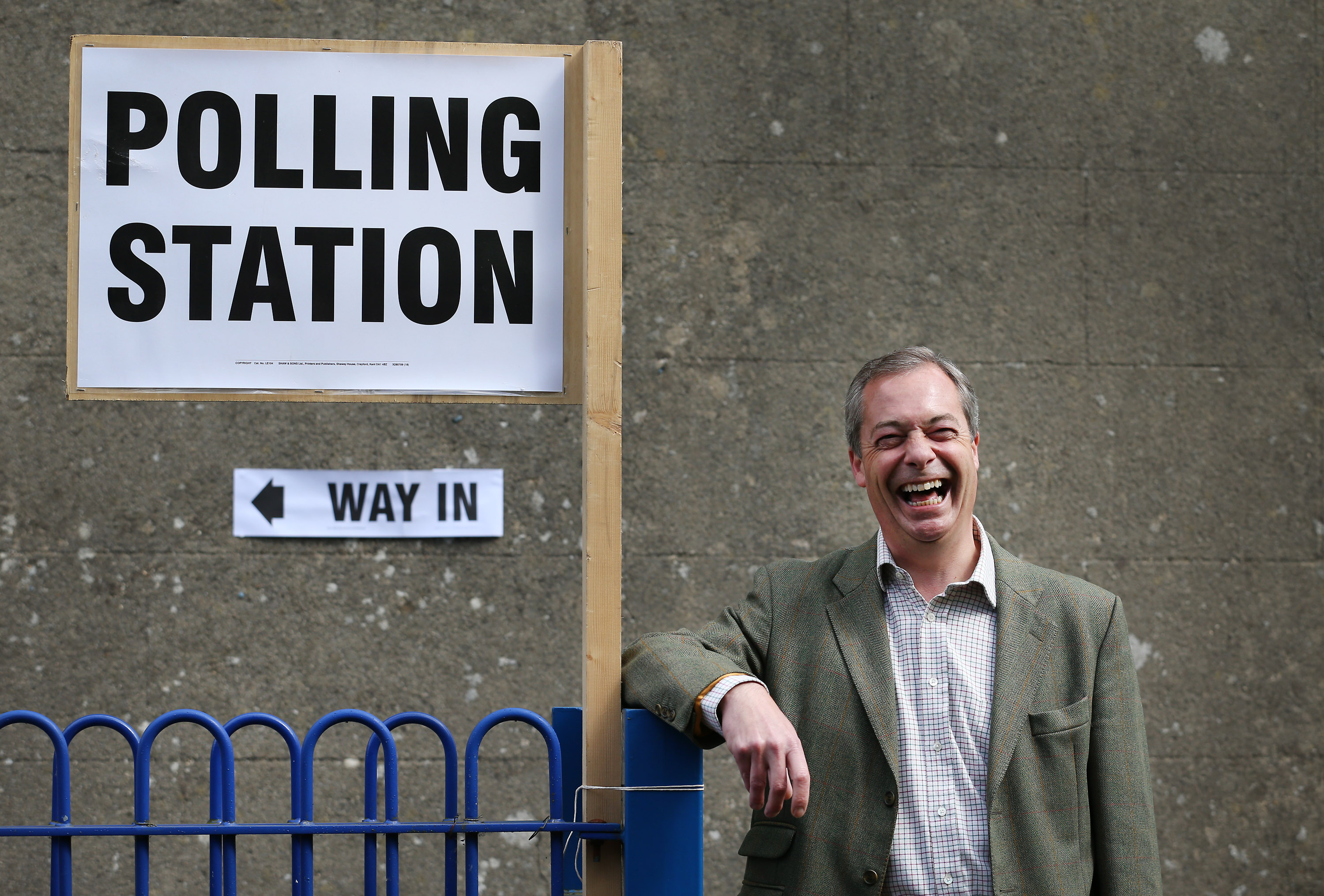
(Photo: United Kingdom Independence Party (UKIP) leader Nigel Farage poses for photographs as he leaves a polling station on May 22, 2014 near Biggin Hill, England. Millions of voters are going to the polls today in local and European elections. By Peter Macdiarmid/Getty Images)

Who’s To Blame For The VA Scandal? Ctd

by Jonah Shepp

Drum defends Obama’s handling of the problems with the Veterans Health Administration:

Under the Obama administration, the patient load of the VHA has increased by over a million. Partly this is because of the large number of combat vets returning from the Afghanistan and Iraq wars, and partly it’s because Obama kept his promise to expand access to the VHA. It was inevitable that this would increase wait times, and the VHA’s claims backlog did indeed increase during the first three years of Obama’s presidency. Over the past couple of years, however, wait times have shrunk dramatically. A digital claims system has finally been put in place, and the claims backlog today is less than half what it was at the beginning of 2013.

What’s more, despite its backlog problems, the VHA still gets high marks from vets. Overall, satisfaction with VHA care is higher than satisfaction with civilian hospitals.

Mark Thompson argues that things aren’t as bad at VA hospitals as the scandal makes them seem:

Perspective is an important element in understanding any problem. “Over the past two weeks, the American Legion has received over 500 calls, emails, and online contacts from veterans struggling with the healthcare system nationwide,” Daniel Dellinger, the Legion’s national commander, told the Senate Veterans Affairs Committee on Thursday. Over that same period, the VA saw a total of about 3.2 million patients. That works out to a complaint rate of 0.015%. Including a wider date range drops that share even lower.

Carl Blake of the Paralyzed Veterans of America suggested the Senate panel go undercover. “If the committee wants to get the truth about the quality of VA health care, spend a day walking around in a major VA medical facility,” he said. “We can guarantee that you will likely hear complaints about how long it took to be seen, but rare is the complaint about the actual quality of care … It is no secret that wait times for appointments for specialty care in the private sector tend to be extremely long.” The public, he says, has gotten a distorted view of the quality of VA care at various field hearings where a handful of those with poor experiences have taken center stage.

Also, as Jonathan Cohn points out, “some of the problems… have very little to do with the VA and a whole lot to do with American health care”:

As Phil Longman, author of Best Care Anywhere, noted in his own congressional testimony last week, long waits for services are actually pretty common in the U.S.even for people with serious medical conditionsbecause the demand for services exceeds the supply of physicians. (“It took me two-and-a-half years to find a primary care physician in Northwest Washington who was still taking patients,” he noted.) The difference is that the VA actually set guidelines for waiting times and monitors compliance, however poorly. That doesn’t happen in the private sector. The victims of those waits suffer, too. They just don’t get the same attention.

It’s no surprise, though, that Obama is taking the blame here; he is the president, after all. Furthermore, Elias Groll writes, “The scandal is only made more politically potent by the fact that Obama has spent most of his career as politician describing himself as an advocate for veterans and has repeatedly promised to reform the VA”:

During the 2007 speech, delivered while serving as a senator and a member of the Veterans Affairs Committee, Obama pledged to deliver better service to American veterans and to overhaul a system that has all too often become shorthand for waste, inefficiency, and staggering wait times. “We know that the sacred trust cannot expire when the uniform comes off,” he said. “When we fail to keep faith with our veterans, the bond between our nation and our nation’s heroes becomes frayed. When a veteran is denied care, we are all dishonored.”

Two years later, in 2009, Obama was back before the VFW delivering a similar pledge: “cut those backlogs, slash those wait times, deliver your benefits sooner.” … By the time he returned to the VFW in the midst of his 2012 re-election campaign, Obama’s frustration had only grown. What was once a sense of invigorating optimism had been replaced in part by a weariness and anger at the VA’s practices.  “When I hear about servicemembers and veterans who had the courage to seek help but didn’t get it, who died waiting, that’s an outrage,” Obama said.

In Waldman’s view, Obama can and should turn the scandal around 180°:

As troubling as some of these allegations are, this controversy presents an opportunity for the administration. This isn’t some kind of phony scandal like Benghazi: it’s a real issue with real consequences. But it’s also a set of problems that can be solved, even if some of those problems go back decades. Two and a half years from now, this presidency will be over. If by then officials can say that every veteran who needs care is getting it without having to wait an unreasonably long time, and that every disability claim is being processed quickly, and that the agency as a whole is capable of handling the enormous task it confronts, then they’ll be able to claim an important victory.

That wouldn’t be just a victory for this administration. More broadly, it would be a victory for the liberal vision of effective government. Sometimes it takes some bad news to provide the incentive people need.

Joe Klein suggests he begin by sacking Eric Shinseki:

The question is, How do we change this situation? The simple answer is leadership, which is why some have called (as I did last year) for VA Secretary Eric Shinseki to resign. By all accounts, Shinseki is a fine man who has spent nearly six years lost in the system. An effective leader would have gone to Phoenix as soon as the scandal broke, expressed his outrage, held a town meeting for local VA outpatients and their families—dealt with their fury face-to-face—and let it be known that he was taking charge and heads were going to roll. Instead, Shinseki intoned the words “mad as hell” at a congressional hearing. And White House chief of staff Denis McDonough said the President was “madder than hell” about the situation. Does anyone actually find this convincing?

Previous Dish on the VA scandal here and here.

Nanohazards

by Jonah Shepp

The first documented case of a nanotechnology-related workplace injury is raising questions about how little we understand the health risks of nanoparticles:

There is no requirement to label nano stuff as nano even though these extraordinarily small things have extraordinary properties which makes them useful and valuable. Nor are there nano-specific regulations about how to safely handle many of them. Within a week of simply measuring out the one or two grams of powder, the chemist’s throat became congested, her nose dripped and face became flushed. Then her skin began to react to her earrings and belt buckle. Her symptoms continued even after she stopped working with the material and moved to another floor. Once outside her workplace the symptoms improved.

“She can never work inside that building again,” said Dr. Shane Journeay, a medical doctor and nanotoxicologist at the University of Toronto. Journeay coauthored the case study with Dr Rose Goldman of the Harvard School of Public Health. It was just published in the American Journal of Industrial Medicine.

Andrew Maynard thinks the case study overstates its own significance:

For more than a decade now, there has been a massive global investment in research into the health and environmental impacts of engineered nanomaterials. Between 2004 and 2013 more than 6,000 academic papers were published on how these materials possibly cause harm, and how it might be averted. And for decades before this, researchers were studying the health impacts of nanoscale particles arising from natural processes, and as by-products of industrial processes. As a result, we now know quite a lot about how nanoscale materials behave in the human body and how to reduce the chances of harm occurring.

We know, for instance, that inhaled or injected nanoparticles can get to places in the body that larger particles cannot go; that the surface of nanoparticles is important in determining how harmful they are; and that nanoparticles are sometimes less harmful than the chemicals they’re made of. We also know that our bodies have evolved over millennia to handle nanoparticles, and that fine particles are integral to many biological and environmental systems. These studies have also indicated how much we don’t know, which is why research in this area remains a priority. And one area we know less about than many would like is: How dangerous is the stuff people are actually exposed to, as opposed to the pure materials that researchers often use in their studies?

Lab Meat For Locavores

by Jonah Shepp

Scientists have proposed a way to make lab-grown meat commercially viable:

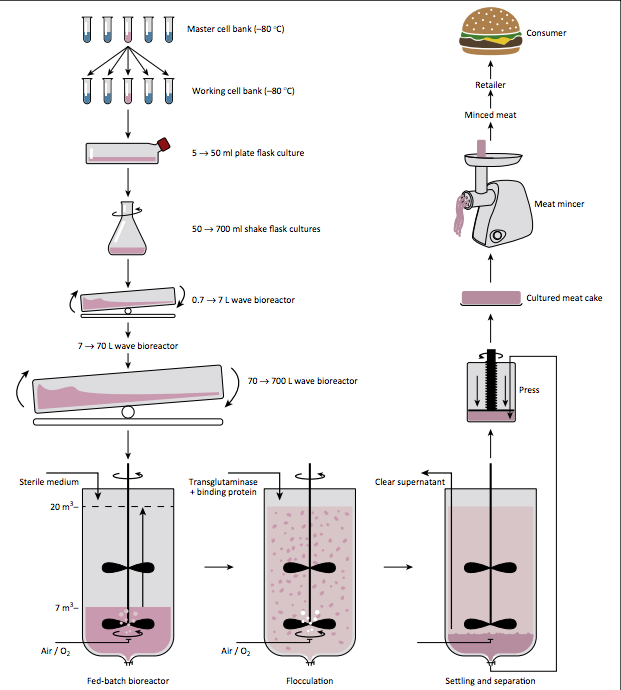
1400604327774477As noted, it’s already possible to make meat from stem cells. The technique was devised by Maastricht University physiologist Mark Post, who assembled a 5-oz beef patty from thousands of tiny meat strips cultured from the stem cells of a single cow. It’s a technological advance that ScienceNow‘s Kai Kupferschmidt believes could kickstart “the biggest agricultural revolution since the domestication of livestock.”

But according to biologists Cor van der Weele and Johannes Tramper in a new Science & Society paper, though the potential advantages of cultured meat are clear, there’s no guarantee that people will want to eat it. The mode of production, they argue, makes a difference for appreciation. To that end, they’ve developed an eco-friendly model for producing greener, ethical meat — one that involves small-scale local factories that are not only technologically feasible, but also socially acceptable. As per the title of their paper, they’re hoping to see “every village [with] its own factory.”

Jason Koebler would eat that meat:

Tramper estimates that a normal 20-cubic meter bioreactor, which is the standard for growing cultured animal cells, could easily supply a village of roughly 2,560 people with meat for a year. But creating and selling the meat at the Netherlands’ price of about €5 per kilogram would only yield €128,000 a year “hardly enough to pay the salary of one ‘butcher’ and his/her assistant.” Adding in costs of of growth medium and lab equipment, the price for cultured minced meat would go up to at least €8 per kilogram, which complicates things further.

But at the end of the day, you’re looking at paying roughly $5 a pound for hamburger meat—that’s not totally insane, and that’s with current technology. Cultivating and growing animal muscle cells is a well-understood process, and the technical challenges have been mostly surmounted. It’s also a far superior option to factory-farmed meat, morally speaken. Given all that that, is there any doubt that someone in Brooklyn sets up a lab-grown meat club in the next couple years? I’d be down, and I’d bet that 2,500 other New Yorkers would be, too.

Not everyone is on board with the lab-meat movement, though:

Some critics of industrial livestock operations are intensely skeptical that cultured meat is the solution. Food activist Danielle Nierenberg thinks the “huge yuck factor” is going to limit the future of “petri dish meat.”

“People who wouldn’t eat tofu a few years ago, now they’re going to eat meat grown in a lab?” she asks. A better future, Nierenberg and others argue, would require some degree of returning to the past—eating less meat, as we used to, and producing it in a less intensive way, on farms rather than feedlots.

Where Happiness Is A Crime

by Jonah Shepp

In case you missed the meme, young people around the world have taken to making videos of themselves dancing around their cities and countries to the tune of Pharrell Williams’s “Happy” and posting them on YouTube. Anyone who isn’t already sick of the song can watch kids dance and lip-sync to it in Paris, in Okinawa, in Amman… Cute and eminently harmless, right? But apparently not in Tehran, where some kids got arrested for it:

Iran‘s state-run national TV on Tuesday broadcast a programme showing men and women, apparently Pharrell fans from Tehran, confessing on camera. They were supposedly involved in a video clip based on Pharrell’s song. The original has been viewed almost 250m times on YouTube and has inspired people from all over the world to make their own version of the video, which shows people dancing in the street to the song.

Human rights activists have repeatedly condemned what they see as the state TV’s common fashion of airing confessions made under duress, usually misrepresented as interviews. It was not clear if Pharrell’s fans in jail in Iran had access to their lawyer before appearing on television. They have not yet been tried. In recent years, many activists and political prisoners have appeared on the Iranian national TV making confessions.

John Allen Gay notes that the reaction to the video is part and parcel of Iran’s culture war:

Many had noted the risks taken in the original video—women without veils (though wearing wigs), men and women dancing together. And while the Rouhani administration has tried to strike a conciliatory tone on the culture front, full openness has not been forthcoming. A very active band of conservative agitators has been busy pushing against any sign of change. Just this week, Iranian actress Leila Hatami (star of the Oscar-winning A Separationwas in hot water after she shook hands with, and then was kissed on the cheek by, the president of the Cannes Film Festival. Senior Iranian leaders regularly speak of the central importance of culture in the Islamic Republic’s survival. That’s a perpetual source of friction in a country with thousands of years of rich civilizational history (stretching back long before the arrival of Islam) and a strong literary tradition. Iranian art once plumbed the depths of the mind and the soul. Now it’s risky to make a music video whose message is simple, almost childish: that joy is still possible in Iran.

Jason Rezaian examines how this squares with Rouhani’s professed desire to give a little on freedom of expression:

By making these arrests, other centers of power could be sending a reminder to Rouhani that controls on media are likely to stay in place and are not under the executive’s power. According to his own words, if it were up to Rouhani, social media and other communication outlets that are currently blocked would be opened up. But it is not up to him. While many think of Iran’s power structure as a monolith, it is anything but, with many checks and balances, some of them official and some blurrier.

While the video seems innocuous enough, several laws of the Islamic Republic of Iran were apparently broken. Among them: women appearing without hijab head coverings, dancing to Western pop music, and using an illegal Web site to disseminate an unlicensed video. All of these offenses regularly go ignored in Iran. But this time around, it could be the fact that the video is part of a global pop culture trend and it that it had taken off, with tens of thousands of views, that prompted Iranian authorities to take action.

Recent Dish on censorship in Iran here.

Who’s To Blame For The VA Scandal?

by Jonah Shepp

Jordain Carney and Stacy Kaper call the broken veterans’ health system “a failure with many silent fathers,” including Congress, the VA leadership, and the past ten presidential administrations:

In many ways, the Obama administration is paying for the negligence of past administrations, dating all the way back to President John F. Kennedy, who authorized the decade-long use of Agent Orange in Vietnam. But it wasn’t just Kennedy. Under President Johnson, Agent Orange was the dominant chemical used during the war. President Nixon halted its use, but a long line of presidents either refused to acknowledge the damage done or failed to address it.

President Carter’s VA created the Agent Orange registry, where veterans who were worried about potential side effects could be examined. But four years later, a GAO report found that 55 percent of respondents felt that the VA’s Agent Orange examinations either weren’t thorough or they received little or no information on what long-term health impacts exposure could cause. … The government’s long-standing failure to address the damage done to veterans by Agent Orange mirrors the larger failure of the VA. It spans generations and party affiliations, and every effort to fix it comes with unintended consequences.

But Tuccille claims that the VA hospitals’ wait list problem is just what happens when you have socialized medicine:

This should surprise nobody. Canada’s government-run single-payer health system has long suffered waiting times for care. The country’s Fraser Institute estimates “the national median waiting time from specialist appointment to treatment increased from 9.3 weeks in 2010 to 9.5 weeks in 2011.”

Likewise, once famously social democratic Sweden has seen a rise in private health coverage in parallel to the state system because of long delays to receive care. “It’s quicker to get a colleague back to work if you have an operation in two weeks’ time rather than having to wait for a year,” privately insured Anna Norlander told Sveriges Radio[.] An article in The Local noted that “visitors are sometimes surprised to learn about year-long waiting times for cancer patients.”

Joan Walsh finds it pretty rich that Republicans in Congress are trying to make political hay out of the VA’s problems while doing nothing to fix them:

There’s real trouble at the VA, but there’s bigger trouble for the Republican Party, which purports to love veterans but does little to help them. Thom Hartman recently ran down the list of pro-veteran measures the GOP has blocked. Earlier this year Senate Republicans filibustered a bill to boost VA funding by $21 billion and restore military pensions cut in the Murray-Ryan budget deal. They opposed President Obama’s $1 billion jobs bill to put unemployed vets to work in 2012. They’ve killed bills to help homeless veterans and promote vets’ entrepreneurship.

And in the current crisis, there’s yet to be a genuine GOP answer to the problems at the VA, beyond anti-Obama grandstanding. Do they want to voucherize veterans’ health care, like they do Medicare? Abolish the VA entirely? “Privatize” it, whatever that would mean?

John Dickerson also asks, “Does anyone have faith that this outrage will be answered by serious action?”

One primary reason to despair is that we’re already living at peak outrage. Fake umbrage taking and outrage production are our most plentiful political products, not legislation and certainly not interesting solutions to complicated issues. We are in a new political season, too—that means an extra dose of hot, high stakes outrage over the slightest thing that might move votes. How does something get recognized as beyond the pale when we live beyond the pale?

What makes the VA scandal different is not only that it affected people at their most desperate moment of need—and continues to affect them at subpar facilities. It’s also a failure of one of the most basic transactions government is supposed to perform: keeping a promise to those who were asked to protect our very form of government. … In this time of political purity tests, let’s require a purity test for the constant state of alarm. The next time someone turns their meter up to 11—whether it’s a politician, a pundit, or your aunt on Facebook—their outrage should be measured against what has already happened at the VA.

A $1.8bn Slap On The Wrist

by Jonah Shepp

David Dayen is livid at how easy Credit Suisse is getting off after it became the first bank in 25 years to plead guilty to a felony in US court:

In the agreement, Credit Suisse pleaded guilty to one count of aiding tax evasion. The Justice Department made sure to check with New York’s banking regulator, the Securities and Exchange Commission and the Federal Reserve to eliminate any unwanted consequences from the guilty plea, like the revocation of Credit Suisse’s banking charter or investment-adviser license. (Incidentally, there are fewer of these collateral consequences with foreign banks, which gives away why Credit Suisse, and not JPMorgan Chase or Bank of America, was forced to plead guilty.) Instead of a corporate death penalty, Credit Suisse will pay $1.8 billion in fines to DOJ, $715 million to New York’s Department of Financial Services, and $100 million to the Fed. In addition, the bank will have an independent monitor overseeing its activities for two years.

This makes any fallout from the scandal mostly one of reputation, which means not much fallout at all.

Matt Levine finds something for everyone to hate:

If you’re a critic of bank impunity, you think this is dumb because no top executives will go to jail, or even be fired, and really there are no negative consequences beyond what you’d get from civil charges or a deferred prosecution agreement. If you’re a defender of banks, you worry that the Justice Department has missed some unintended consequences, and that Credit Suisse’s guilty plea will cause a colossal and accidental financial crisis.

Either way, the point is that the only consequences of the guilty plea — as opposed to a deferred prosecution, etc. — are the ones prosecutors forgot. Those consequences might be catastrophic, or they might be nonexistent, but if they exist, they exist because no one thought of them. It’s deterrence by accident: Prosecutors did their best to avert everything bad that might come from a guilty plea, but the deterrence value comes from the fact that their best might not be enough.

James Kwak thinks a more appropriate punishment would be to shut down Credit Suisse’s US operations entirely:

There are two main ways to really punish criminals and deter wrongdoing in the future. One is criminal prosecutions of the individuals involved, ideally getting lower-level employees to cooperate and gathering evidence as far up the management hierarchy as possible. (There are ongoing prosecutions against several Credit Suisse employees.) The other is putting a bank out of business by revoking its license. Even if he escapes jail, no CEO wants that on his résumé. And it seems entirely appropriate for a bank that engages in a decades-long criminal conspiracy that costs U.S. taxpayers billions of dollars.

The conventional wisdom, however, is that you can’t revoke a large bank’s license because of potential systemic consequences. (That’s why prosecutors only pressed for the guilty plea after receiving assurances that regulators would not revoke Credit Suisse’s licenses.) If this is true, of course, that’s an overwhelming argument that such “too big to jail” banks shouldn’t exist in the first place. We don’t want a financial system dominated by banks that can willfully flout the law.

Kevin Roose doubts the guilty plea will mollify those who are still angry that nobody went to jail for causing the financial crisis:

What we’ve learned since 2009 is that the prosecution of complex financial crimes is a zero-sum game. With limited resources and a ticking clock, every case you choose to prosecute fully has to be carefully selected, with the most important determinant questions being “will I win this?” and “how long will it take?” Insider trading cases are easier to convict on than mortgage fraud cases; accordingly, they get more attention. Tax evasion is lower-hanging fruit than CEO misbehavior, so it’s naturally where prosecutors want to direct their attention.

That’s understandable, and forcing guilty pleas on lesser charges is perhaps better than the alternative. But let’s not conflate issues here. “Too big to jail” isn’t a controversy about how banks will be treated in the future. It’s a scandal about how they’ve been treated in the recent past. And no number of guilty pleas is likely to calm the public down, especially when the pleas seem to have so few real-world consequences.

Russia And China’s Big Deal

by Jonah Shepp

Putin closed a huge natural gas agreement with his Chinese counterpart Xi Jinping today:

The contract is worth $400 billion in total over the 30-year period, during which Gazprom will supply 38 billion cubic feet of gas per year. The details are still hazy at this point, including the most important fact of all: the price at which Russia is selling its eastern neighbor the vast supply of natural gas. Sources close to the deal seem to think the lowest the Russians would go would be around $350 per thousand cubic feet of gas, which is on the low end of the $350-$380 price range paid by their European customers.

But if that’s the lowest the Russians would go, it was likely the agreed-upon price; China was holding most of the leverage in this discussion, if only because Putin needed this more than Xi did. Negotiations reportedly went on until four in the morning, and Putin admitted that “our Chinese friends are difficult, hard negotiators.”

Mark Adomanis, however, is reluctant to read too much into this:

Although I think that Russia-China partnership is a very important story, I would advocate extreme caution in analyzing the significance of this particular natural gas deal. Why? Well when dealing with “state capitalist” entities a contract is never really a contract:

if, 10 years from now, Gazprom realizes that it is subsidizing Chinese gas imports it will do what it has always done and threaten to cut off the flow unless it gets more money. The Chinese side will act similarly: if the leadership at CNPC realizes that they are paying a significant premium for Russia gas, they will switch to other suppliers as quickly as possible. The ability to quickly enter into or revoke contracts is simultaneously state capitalism’s greatest strength and its most glaring weakness. When necessary, companies like Gazprom and CNPC can move extremely quickly and enter into agreements without the need for shareholder meetings or discussions with boards of directors. They can take advantage of opportunities ruthlessly and with little warning. And, when they feel the need to exit a contract, they do not need to worry themselves with legal niceties: they simply do what they need to.

Richard Connolly also discourages over-interpreting Putin’s “pivot to Asia”:

Even after a number of high profile energy and infrastructure deals, China, South Korea and Japan account for just over 1% of foreign investment in Russia. So while Russia may be importing a growing volume of goods from Asia, it still turns overwhelmingly to Europe for capital.

Such dense trade links between Russia and Europe took decades to form, dating in many cases back to the height of the Cold War. If the two managed to trade amicably during the Cuban Missile Crisis, they shouldn’t have a problem now. So Europe will most likely remain Russia’s key economic partner for years to come as it continues to provide capital, technology and demand for Russian energy. While the economic pivot to Asia is real, this is Russia looking for some more friends, not an entirely new set of friends.

But Dmitri Trenin picks up on another sign that may point to growing military cooperation with China:

Putin’s visit to China will coincide with the joint Sino-Russian naval exercises. These are held regularly, with the last being in the Sea of Japan off Vladivostok. This time, the venue is the East China Sea, where the territorial dispute between Beijing and Tokyo over the Diaoyu Islands (Senkaku Islands in Japanese) has heated up.

The Russians, by not objecting to the area where the maneuvers will be held, are sending a message to Japan that signing up for US-ordered sanctions against Russia would entail a cost. In a public statement in March, Putin made it clear that Moscow does not intend to conclude a military alliance with Beijing, but the mere invocation of that possibility is a signal that the vector of Russian foreign policy has changed dramatically. Only four years ago, then president Dmitry Medvedev – with then prime minister Putin squarely behind him – were offering a “joint defense perimeter” to NATO. Today, NATO again considers Russia an adversary, and vice-versa.

And Simon Denyer notices that Xi and Putin seem pretty simpatico:

The two men have a few things in common: both are strong, authoritarian leaders, fiercely nationalistic and keen to counter Washington’s influence in the region, albeit in different ways: but they also found something else they shared this week, a desire to commemorate World War II. In their joint statement, the two men talked about celebrating the 70th anniversary of the end of the war, an anniversary that does not even fall until next year. A strange priority you might think, except that both men have been intent for some time on making as much political capital as possible about their respective country’s roles in defeating fascism. …

But Xi was reported as having told Putin the two men had similar personalities last year, and the pair seem to have found common ground on at least one other pressing issue. In Russia, Putin has been ramping up censorship of the Internet to muzzle his critics, something that Xi already knows an awful lot about. In their joint statement, the two leaders expressed concern that information and communication technology was being used in ways that “go against the goal of maintaining international stability and security, and violate national sovereignty and individual privacy.”

Egypt Prepares To Elect Sisi

by Jonah Shepp

https://twitter.com/PatrickKingsley/statuses/469122068236492801

Anna Newby sums up the state of play in the lead-up to next week’s presidential election in Egypt, whose outcome has already been determined:

The country’s upcoming presidential contest will pit the former head of the Egyptian Armed Forces, Abdel Fattah al-Sisi, against leftist politician and dissident Hamdeen Sabahi. Sisi promises firm leadership, security, and the close regulation of protests. Sabahi stands for social justice, Arab unity, and an independent foreign policy.

Opinion polls show Sisi far ahead. The most recent survey, conducted by the Egyptian Center for Public Opinion Research (Baseera) in March, found that 72 percent of respondents would vote for Sisi and only 2 percent had chosen Sabahi. The remaining quarter reported to be undecided. Sisi is effectively the “president-in-waiting,” as Egypt expert Nathan Brown writes.

Ursula Lindsey notices that Sisi’s “campaign” has opted for sentimentality over specifics:

El Sisi prefers to wax poetic about the extraordinary personal qualities of the Egyptian people, and his boundless love for them, rather than to address specific policy questions. He is clearly well-aware of his popularity with women, which he constantly plays to (although he seems incapable of imagining working women — his idealized Egyptian Woman is adamantly domestic, anxiously watching over her home and wisely encouraging her man to action outside it).

El Sisi is charismatic; he is also terribly aware of it. He radiates self-regard. His soft-spoken delivery is that of a man never used to being interrupted. But his veneer of kindliness and patience rubs off awfully quickly, the moment he is challenged. The unspoken message of his entire campaign is that he is actually above competing for the position — it is already rightfully his, and he is accepting it as a patriotic sacrifice.

Dov Zakheim suggests that we use the election as an opportunity to “reinvigorate” our relationship with Egypt, which he points out is “a long-standing and reliable ally” with or without democracy:

Those who argue that Egypt does not fully adhere to Western democratic standards should recognize that many other American allies in the region have far less open societies. Moreover, given the tumultuous recent past that has disrupted their lives, Egyptians, like most people, yearn for stability. Stability means, first and foremost, security, a roof over people’s heads and food in their bellies, an education, and a future for their children. Stability and democracy are not necessarily synonymous; stability, even more than a vibrant civil society, is a precondition for true democracy. While democracy can function in an unstable environment, even where there is a functioning civil society, it will always struggle. Pakistan, for example, has an active civil society. Yet one hardly would call it stable and accordingly, in light of its history of military coups, and the challenge of Islamic extremists, the longer term prospects for its current democratic governance are far from assured.

Meanwhile, Eric Trager checks up on the hopelessly deadlocked efforts at reconciliation between the Muslim Brotherhood and the military government:

While the Brotherhood often downplays its demand that Morsi return to power, it still emphasizes the restoration of “legitimacy,” which effectively means the same thing. “The return of Morsi, continuing his rule, is not what we want,” Mohamed Touson, a former Brotherhood parliamentarian and a member of Morsi’s legal team, told me, before adding: “Morsi should come back just to take the decision for new elections and leave office.”  The Brotherhood is also demanding “transitional justice”a phrase that Brotherhood leaders deliberately borrowed from post-apartheid South Africa, but then stripped of its conciliatory significance. …

The military’s demands are similarly non-starters for the Brotherhood. According to Emad Abdel Ghafour, a former Morsi adviser who serves as a liaison between the Brotherhood and top generals, the military is willing to release all but 300 of the Muslim Brothers that have been arrested. On paper, this is a major concession, because it would mean that over 10,000 detained Muslim Brothers could go home. But the 300 Muslim Brothers whom the military wants to keep imprisoned are likely top leaders, and given the Brotherhood’s hierarchical command-chain, this would mean accepting its own decapitation.