Pay Attention To Benghazi

by Jonah Shepp

No, not #Benghazi the pseudo-scandal, but the Libyan city itself, where fresh fighting broke out last week between militias loyal to the current government and forces led by a rogue ex-general who wants to excise Islamist extremists from the country’s political life:

Two camps are taking shape: The Islamist politicians who dominate Libya’s interim parliament, and their rivals, who are gradually amassing behind Khalifa Haftar, the retired general. His forces have attacked Islamist militias in Benghazi and claimed credit for an attack on the General National Congress (GNC), as parliament is called. In a bid [Monday] to diffuse the crisis, acting prime minister Abdullah Al-Thinni called on the GNC to vote immediately on a 2014 budget and to confirm his successor, the prime minister-elect, before a recess and elections for a new interim legislature. …

Last Friday forces under Mr. Haftar attacked Islamist militias in Benghazi that he said authorities had failed to rein in. On Sunday, militiamen apparently aligned with Haftar attacked the GNC building in Tripoli. He is demanding that the parliament cede its role to a constitutional drafting committee elected in February; he insists that he does not aspire to lead Libya.

Juan Cole takes a closer look at the sequence of events. Ishaan Tharoor provides some background on the militias:

According to a recent RAND Corp. report, Libya’s militias number in the “low hundreds” — and that’s a conservative estimate. The rebels who fought the Gaddafi regime were never a united, cohesive force. They were at best a loose alliance of various, motley factions: tribal bands, army and regime defectors, armed groups that emerged during certain intense uprisings — such as those in the port city of Misrata and the towns of the Nafusa Mountains, for example — which then became power brokers with guns in the chaotic aftermath that followed Gaddafi’s overthrow. Meanwhile, in the security vacuum, Islamist groups once repressed or marginalized gained traction, launching a string of attacks and assassinations on government officials and other factional rivals in major centers such as Tripoli and Benghazi.

Keating thinks Qaddafi’s paranoid style made the current situation more or less inevitable:

As Robert Haddick of Small Wars Journal wrote in 2011, Qaddafi’s army was likely weak by design. The late leader was always more concerned about coups and internal uprisings than international threats. A strong military with a well-developed command structure could have created a situation in which—as with Hosni Mubarak in Egypt—the commanders pushed him aside in the face of popular discontent. For security, he relied instead on institutions like the Khamis Brigade, a special operations forces “Praetorian Guard” commanded by his son. …

What Qaddafi’s paranoia essentially created was a country with a disorganized and underdeveloped central military that was nonetheless flooded with heavy weaponry. In other words, once a power vacuum emerged, there was a perfect mix in place for violence and chaos.

And yes, by the way, America has learned a thing or two from the 2012 attack:

[P]ost-Benghazi considerations appear to have played a role in precautionary security steps taken by the Pentagon this week as inter-faction fighting has escalated across Libya and in the capital, Tripoli, in particular. The Pentagon has moved aircraft and dozens of Marines to a US naval air station at a NATO base on Sicily in Sigonella, Italy. The Marines were dispatched from a US crisis response team based in Spain that was created in response to the Benghazi attacks.

The State Department says the US is watching Libya closely with the security of Americans there in mind, but that no evacuation decision has been made. “The situation on the ground, obviously, could change quickly, and so we’ll continue to evaluate and update our posture as needed,” spokeswoman Jen Psaki said Monday.

Losing Your Home Can Be Deadly

by Jonah Shepp

suicide-foreclosure-graph

John Upton reviews new research that finds a link between foreclosures and suicides, particularly among middle-aged adults:

To search for relationships between foreclosure and suicide rates, the researchers controlled for certain variables like the unemployment rate, and then honed in on intrastate data. … These steps led the researchers to a grim discovery—one that implicates banks’ irresponsible lending practices in more than just the death of middle-class prosperity.

“Our results suggest that the foreclosure crisis significantly contributed to the increase in suicides in the Great Recession,” the researchers write in their paper.

A statistically significant within-state foreclosure effect on suicide rates was detected between 2005 and 2010 for two age groups studied—30- to 45-year-olds, and 46- to 64-year-olds. The effect for 30- to 45-year-olds was small. It was vast for those who were still of working age but approaching retirement, helping explain the 18 percent suicide rate among 46- to 64-year-olds. [Dartmouth sociologist Jason] Houle says the findings help explain the puzzling rise in middle-aged suicide rates in a recession-wrecked nation.

Must We Tax The Rich To Help The Poor?

by Jonah Shepp

Jared Bernstein argues that we can’t have it both ways:

[T]here are three reliable ways to help or “lift” the bottom: subsidies that increase the poor’s economic security today; investment in their future productivity; and targeted job opportunities at decent wages. The first two are more closely related than you might think, because researchers are discovering that anti-poverty consumption programs such as nutritional and income supports have long-lasting benefits to children in families that receive them. None of these three approaches are free.  …. All of the above — the expanded earned-income tax credit, universal preschool, job-creating infrastructure — will take more tax revenue, and much of that new revenue will need to come from those at the top of the wealth scale.

Douthat objects:

1) I don’t think even Bernstein believes that it’s actually impossible to improve the situation of the poor without directly raising taxes on the rich.

What about, to pick two ideas favored by various thinkers on the left and right, a one-two punch of criminal justice reform to reduce incarceration rates and urban upzoning to lower the cost of living and working in wealthy cities? Both would probably improve opportunity for the poor and the lower-middle class; neither would require a higher top marginal tax rate or massive new public outlays. Do these kind of ideas just not count?

2)  It’s possible to favor increasing redistribution along something like the lines Bernstein suggests — through an expanded earned income tax credit, for instance — while disagreeing that we need a higher top marginal rate or a Piketty-style wealth tax in order to do it. Given that our existing tax code, like the zoning policies mentioned above, has a heavy pro-rentier and pro-rich bias, why couldn’t we start by cutting or capping existing tax subsidies — for expensive homes, for expensive health insurance, for being a wealthy taxpayer in a high tax state — and put that money to work first? This would involve “new revenue,” in a sense, but you wouldn’t have to raise tax rates (as we already just did) in order to get it, and you would be redistributing unearned, effectively-subsidized riches rather than just hacking away more indiscriminately at the idle and entrepreneurial alike.

A Russian Pullback Won’t Save Ukraine

by Jonah Shepp

Analyzing Russia’s most recent announcement that it will withdraw troops from the Ukrainian border, Linda Kinstler stresses that, even if it’s true, the Ukrainians are still sitting ducks:

[I]f Russian troops do retreat to their “usual garrisons,” plenty of Russian forces will still be well within striking distance of Ukraine. There are multiple Russian bases along the Ukrainian border, so for troops to move back to their permanent stations might not mean all that much as far as de-escalation goes. “It seems that [Putin’s] agents are having more problems [in eastern Ukraine] than they bargained for, and he is now perhaps looking to minimize his overexposure,” said Stephen Blank, senior fellow at the American Foreign Policy Council. “But the fact of the matter is they could withdraw five miles and then they could come right back.” Russian forces, Finch says, “are not that far from the Ukrainian border to begin with. For them to turn around wouldn’t be that big of a move.”

Even more dangerous, as Ukraine discovered in Crimea, was the presence of Russian soldiers on their soil. Dmitry Gorenburg draws lessons from that experience:

First of all, having Russian bases on the territory of one’s state makes an invasion much easier to carry out. Russian naval bases in Crimea were used as a beachhead for covertly moving Russian forces into Ukraine. Since the number of troops actually based in Crimea was significantly lower than the maximum of 25,000 agreed to between Russia and Ukraine in the 1997 treaty that regulated the status of the Black Sea Fleet, Russia could even claim that the increase in the number of Russian troops in Crimea did not violate the relevant treaty.* This precedent should be a concern to Moldova, Kyrgyzstan, Armenia, and other states with Russian troops stationed on their territory.

Second, former Soviet states need to watch out for Russian agents and collaborators working in their security and military forces. One of the reasons for the ineffectiveness of Ukraine’s military and security response in Crimea and subsequent covert activities in the country’s east is that that Ukraine’s secure communications channels are almost certainly compromised by Russian agents. Most other former Soviet states most likely have similar problems, though perhaps not to the same extent.

Meanwhile, Sarah Chayes examines how corruption left Ukraine militarily unprepared for Russian aggression:

Chronic underfunding “enhanced the role of the human factor” in choosing among operational priorities. Ostensibly outdated equipment was sold “at unreasonably understated prices” in return for kickbacks. Officers even auctioned off defense ministry land. Gradually, Kyiv began requiring the military to cover more of its own costs, forcing senior officers into business, “which is…inconsistent with the armed forces’ mission,” and opened multiple avenues for corruption. Commanders took to “using military equipment, infrastructure, and…personnel [to] build private houses, [or] make repairs in their apartments.” Procurement fraud was rife, as were bribes to get into and through military academies, and for desirable assignments.

Meanwhile, Ukrainian factories kept on turning out high-quality materiel that was exported for cash to China, Ethiopia, Pakistan, and Russia. The results have been on display for the past two months: helicopters and armored vehicles immobile for lack of fuel or missing parts; soldiers in Crimea turning in their uniforms for promises of a Russian salary five times the paltry $200 per month Ukraine was paying. Ordinary citizens donating some $2 million to the defense budget by texting 565 on their mobile phones.

Previous Dish on Ukraine’s strategic vulnerability here.

Wireless Electricity For Your Heart

by Jonah Shepp

Scientists gave a rabbit a tiny, wireless pacemaker:

A rabbit’s beating heart has been regulated using a tiny pacemaker that beams in energy from outside its body. It is the first time this kind of wireless energy transfer has been demonstrated in a living animal. If such wirelessly powered medical implants can work in people too, it would reduce the seriousness of the procedures required to get them fitted.

“Our device is small, so it will be much easier to deliver into the body,” says Ada Poon of Stanford University in California, who led the team that implanted the tiny pacemaker. Being fitted with a pacemaker currently requires surgery plus another operation when the battery eventually runs down. So Poon and her colleagues outfitted a rabbit with a pacemaker that has no battery and is just 3 millimetres long.

Olivia Solon explains how it works:

The system works on the principle that waves travel in different ways when they come into contact with different materials.

This is highlighted by the fact that you can hear the vibration of train wheels if you put your ear to the railway track much earlier than you would hear the train with your ears. It involves using a flat, credit card-sized power source positioned outside of the body over the device that can interact with the body’s tissue to induce propagating waves that converge on a micro-device implanted in the body.

The 2mm-long microdevice consists of a power harvesting coil, integrated circuits, electrodes and fixation structures. Such devices can be used as “electroceuticals” to strategically stimulate or silence nerves to treat a range of conditions including Parkinson’s, depression and chronic pain. The same devices could also be used to strategically deliver drugs or monitor vital functions deep inside the body. Power could either be delivered directly from outside of the body or the power could be sent to periodically recharge small, embedded batteries.

Cassandra Khaw looks at where this development could lead:

Poon believes that her work could lead to programmable microimplants like sensors that monitor vital functions, electrostimulators that alter neural signals in the brain, and drug delivery systems that apply medicine directly where needed. All without the bulk of batteries and recharging systems required today. Her endeavours could also help expedite the development of medical treatments that utilize electronics instead of drugs. Stanford Neurosciences Institute director William Newsome said that “the Poon lab has solved a significant piece of the puzzle for safely powering implantable microdevices.” So far, the wireless charging system has been tested in a pig and also used to power a pacemaker in a rabbit. The next step is human trials. Should those prove successful, it will likely take a few years before the system is authorized for commercial usage.

Shame On NYU

by Jonah Shepp

The cover story in yesterday’s NYT exposed the deplorable conditions of the laborers who built New York University’s new satellite campus in Abu Dhabi, where Bill Clinton will address the first graduating class this Sunday. Overworked, underpaid, living in squalor, with their passports confiscated, no rights or recourse to justice… gee, they sound just like other migrant workers in the Gulf. But NYU had claimed they would do better. Joe Coscarelli sums up the university’s lame response:

A spokesperson for NYU said this was the first they’d heard about unrest among the workers and that the school is “working with our partners to have it investigated.” The executive director of campus operations for NYU Abu Dhabi added, “We’re not involved in the negotiation of the contracts that the partners are doing, just as they’re not in the negotiation of the contracts that we’re doing. We have a relationship with our partners, and so we have to trust that what they’re coming up with are the reasonable wages on their end.”

“I just don’t think that universities and museums should be working like Wal-Mart,” one NYU professor told BuzzFeed, speaking for the many critical of the long-planned expansion. “I think the opportunity for students to be in the Middle East and North Africa, you know, is wonderful. I believe in global education. But I think you also need to question the terms of production.”

That the NYU administration thinks anyone will buy the line that they just “have to trust” their contractors not to exploit workers is laughable. It’s called due diligence, and they clearly didn’t bother with it. But I’m also a bit shocked that anyone is shocked by this; as Keating points out, it is depressingly common for international institutions that do business in the Gulf to take advantage of these countries’ lack of labor protections:

When internationally renowned architect Zaha Hadid, designer of the largest of Qatar’s World Cup stadiums, was asked to respond to reports that over 382 Nepali migrant workers had died in construction related to the World Cup on top of the more than 500 Indian migrants who have died in the country in 2012, she replied, “I have nothing to do with the workers. I think that’s an issue the government—if there’s a problem—should pick up.”

Most of the large institutions setting up shop in the Gulf probably wouldn’t be quite so callous as to say that working conditions simply aren’t their problem, but it’s nonetheless the case that as the United Arab Emirates and Qatar have given free reign and enormous resources to cultural institutions like NYU, the Louvre, the Guggenheim, and FIFA, and turned themselves into architectural playgrounds for the likes of Hadid, Frank Gehry, Norman Foster, and I.M. Pei. The well-known fact that the Gulf’s construction boom depends on foreign migrant workers enticed by false promises into near-slave labor conditions has often been conveniently brushed to the side.

The administration has since apologized, but Coscarelli is not impressed:

NYU President John Sexton, the man who struck up a partnership with Abu Dhabi’s royal family, called the treatment “if true as reported, troubling and unacceptable … They are out-of-line with the labor standards we deliberately set for those constructing the ‘turn-key’ campus being built for us on Saadiyat Island and inconsistent with what we understood to be happening on the ground for those workers.” (Most worked for contractors, not the university directly.)

The apologies are all well and good on the PR front, but as one worker, waiting more than a year for his last six months of pay, told the Times, “When will the money come? If the money comes it will be O.K.” Sorry doesn’t feed a family.

Neither is Erik Loomis:

NYU could have had someone on site monitoring the labor conditions that would actually try to find out what was going on rather one who papered over problems to make the client happy. It could employ these workers directly and be the responsible party for paying them. It could have constructed its own dormitories for these workers. But of course it did none of these things. NYU administrators were just following the cash. It contracted out the labor and completely forgot about it until the news reports about the exploitation came out. If NYU wants to take real responsibility, it will take on liability for these workers. Otherwise, this falls into the empty “I’m sorry we were caught” category of apology.

And neither am I.

A Landslide Against A $25 Minimum Wage

by Jonah Shepp

untitled1

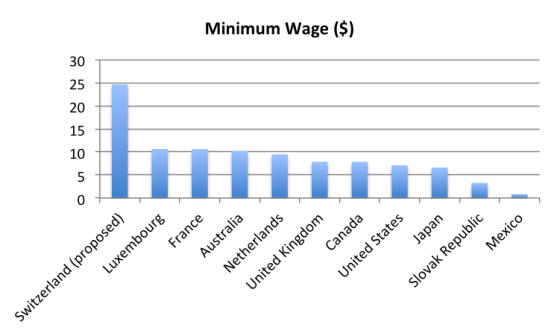
Jordan Weissmann is “kind of bummed” that Swiss voters rejected a referendum this weekend that would have enacted a minimum wage of 22 francs (about $25, or $14 adjusted for purchasing power—the highest in the world by either measure):

As I’ve written here before, one reason we should all be at least a little wary of efforts to push the minimum up to $15 in places like Seattle is that there isn’t a whole lot of historical precedent, either here in America or abroad. According to the OECD, Luxembourg currently has the world’s highest minimum wage, adjusted for purchasing power, at $10.70 per hour. With it’s enviably low 3.2 percent unemployment rate, Switzerland would have been a pretty safe place to test-run something more ambitious. After all, you’re talking about a generally high-pay country—only a tenth of Swiss workers earn less than the proposed minimum—where, even with some job losses, you’d still have a remarkably robust labor market. Alas, it’s not to be. The economics profession can only mourn.

Dan Kedmey thinks the vote helps define the limits of the minimum wage debate:

In the US, 71% of voters back President Barack Obama’s proposal for a minimum wage hike. In Germany, 81% of voters supported a similar proposal from German Chancellor Angela Merkel. But the scale of Switzerland’s proposed hike, vaulting it two times ahead of the most generous minimum wage rate in the world ($10.66 an hour, compliments of Luxembourg), clearly had Swiss voters on edge.

The referendum offers an interesting test case of where in the voters’ mind a wage hike leaves the realm of economic reality and soars into Alpine-high levels of wishful thinking. After all, if the Swiss bill became U.S. law tomorrow, it would require instant wage renegotiations for 620 occupations across the country, all of which pay less than $25 an hour on average.

Leonid Bershidsky calls Switzerland a poster child for direct democracy:

The Swiss have proved their wisdom by throwing out most crazy ideas, such as the abolition of the armed forces or price controls on books, as well as politically charged ultraconservative proposals such as ending health-insurance coverage for abortions. They are down-to-earth people who recently approved extra investment in rail infrastructure but voted down the purchase of new fighter planes. If a political party had their voting record, it would have been a reasonably liberal, moderate, centrist one.

I suspect people in most countries would vote as cautiously and reasonably as the Swiss if they knew their decisions would be immediately put into practice. Like any middlemen, politicians are hanging on to their intermediary role, talking of the populist threat and ordinary people’s lack of specialized knowledge. There is, however, nothing special about the Swiss: They are no smarter than Germans, Thais or Ukrainians, just wealthier — and wealth, according to Bonoli and Haeusermann, is not a good predictor of voting patterns. If they can vote responsibly, there is no reason why direct democracy shouldn’t work elsewhere.

This Is Like So Totally Not A Coup

by Jonah Shepp

The Guardian has been live-blogging from Thailand, where the military declared a state of emergency and imposed martial law this morning, but claims it is not carrying out a coup:

Army chief General Prayuth Chan-ocha said the military had stepped in to restore order and build investor confidence, and warned that troops would take action against anyone who threatened security. At a press conference he said martial law would continue as long as necessary. The army offered to mediate between pro and anti government protesters after a six months of demonstrations and a stand off between the two sides. “We ask all sides to come and talk to find a way out for the country,” General Prayuth said.

Caretaker prime minister, Niwattumrong Boonsongpaisan, who had refused to protesters’ demands to step down on Monday, called for an election on 3 August. He said martial law could help the elections take place and said he was seeking talks with the generals.

Charlie Campbell calls out the army on that claim:

“The public do not need to panic but can still live their lives as normal — this is not a coup,” said an announcer Tuesday on military-run television, while soldiers took up positions at key intersections in the tourist-thronged Thai capital. However, Pavin Chachavalpongpun, associate professor at the Centre for Southeast Asian Studies at Kyoto University, says, “I think you can call this a coup … because this is about taking away power from the people, taking control of the political situation and human rights.”

Military intervention is endemic in Thailand. Since the end of absolute monarchy in 1932, the country has seen 11 successful coups, 23 military governments and nine military-dominated governments. The current coup, Pavin says, “is a move preserving the political position of the country’s elite.”

The Economist weighs the possible outcomes:

One idea is that martial law will create a face-saving exit for Suthep Thaugsuban, the leader of the anti-government protests. He has led the movement for six months now and so far failed to topple the elected government. His plan to have it replaced by an appointed government was going nowhere; there is no constitutional basis for toppling Thailand’s electoral democracy.

While Mr Suthep might welcome a break after six months of marching in the sun, this is surely not what motivated the imposition of martial law. The better bet is that martial law is something like a last ditch effort on the part of Mr Suthep’s sponsors. He had been playing the role of a front man for the old Thai establishment—representing the street-level id of the civil service, the army, the judiciary and the monarchy—and he has failed to deliver.

In this scenario, today’s move might then be a more forceful bid to dislodge the government and appoint a new one with the aim of rewriting rules of the game. The point would be to depose Thailand’s democracy and with it the chances of electing yet another government loyal to Thaksin Shinawatra, the one figure who has united democratic majorities in recent years.

Adam Pasick analyzes the situation from an economic standpoint:

Thailand has weathered many political upheavals and natural disasters, earning it the sobriquet “Teflon Thailand,” but as Quartz has reported, the nonstick surface is showing some heavy scratches: GDP fell 0.6% in the first quarter as consumer confidence and foreign investment plummeted. It’s unclear whether the declaration of martial law will exacerbate those fears, or create a stable starting point for the country to move forward.

“The imposition of martial law is not, in itself, negative for Thailand’s ratings, although clearly we are keeping the situation under close review,” said Fitch Ratings analyst Andrew Colquhoun in a note to clients. “It may even help to break Thailand out of the political deadlock of the past six months, by which the two sides have failed to agree on arrangements for new elections.”

Previous Dish on Thailand’s political crisis here, here, and here.

Going After China’s Cyber-Spies

by Jonah Shepp

The Justice Department has indicted five Chinese military officers on charges of cyber-espionage, accusing them of stealing American companies’ trade secrets:

The five members of the People’s Liberation Army — Wang Dong, Sun Kailiang, Wen Xinyu, Huang Zhenyu and Gu Chunhui — belong to Unit 61398 of the 3rd Department of the People’s Liberation Army, based out of a building in Shanghai. All of them have been accused of conspiring to hack into the computers of six American entities. The companies identified as victims of the hacking are Westinghouse Electric; U.S. subsidiaries of SolarWorld; U.S. Steel; Allegheny Technologies; the United Steel, Paper and Forestry, Rubber, Manufacturing, Energy, Allied Industrial and Service Workers International Union; and Alcoa.

There’s no chance that they’ll ever appear in court, but the diplomatic consequences are obvious. Jacob Siegel and Josh Rogin note that the move comes at an awkward time in US-China relations:

The decision to expose Unit 61398 comes less than a week after a top Chinese general toured the U.S. on what many believed was a diplomatic trip intended to give U.S. officials the chance to deescalate tensions in China’s territorial disputes with its neighbors. But the visit failed to produce the hoped-for deescalation. Instead, Defense Secretary Chuck Hagel sparred publicly with Chinese Defense Minister Gen. Chang Wanquan over Chinese actions in the East China Sea, including China’s recent declaration of an air defense zone that spans disputed territories. Hagel was reportedly rebuffed in his plea to the Chinese military for greater transparency during a visit there last month.

Brian Merchant situates Unit 61398 within China’s massive cyber-spying operation:

Unit 61398 has in the past been tied to a hacking group the Comment Crew, most decisively by a 2013 Mandiant cyber security report. The New York Times explained that, according to the research, the Comment Crew “has drained terabytes of data from companies like Coca-Cola” but that “increasingly its focus is on companies involved in the critical infrastructure of the United States — its electrical power grid, gas lines and waterworks. According to the security researchers, one target was a company with remote access to more than 60 percent of oil and gas pipelines in North America.”

P.W. Singer explains what China’s cyber-spies are after:

[T]he targets of it range from across the spectrum: everything from jet fighter designs to oil company equipment designs to the designs of chairs made by small furniture makers. Or the theft of negotiating strategies: what everything from oil companies to soft drink companies were going to bid in competition with Chinese companies. Its been going after academic and scientific research; going even after personal cell phones. They’ve gone after journalists, [as in] the famous New York Times affair where a Chinese military-linked unit entered into the Times. It wasn’t after the secret recipe for New York Times newspaper ink, it wasn’t after readers’ credit card numbers, it was after who inside China was speaking to New York Times editors about corruption in China.

Adam Taylor notes that the Chinese are citing Snowden to dismiss the charges as hypocritical:

Monday’s statement [from the Chinese Foreign Ministry] appeared to make direct reference to Snowden’s revelation again. “It is a fact known to all that relevant US institutions have long been involved in large-scale and organized cyber theft as well as wiretapping and surveillance activities against foreign political leaders, companies and individuals,” the statement read. “China is a victim of severe US cyber theft, wiretapping and surveillance activities. Large amounts of publicly disclosed information show that relevant US institutions have been conducting cyber intrusion, wiretapping and surveillance activities against Chinese government departments, institutions, companies, universities and individuals.”

But Ambers distinguishes our espionage operations from what China has been doing:

The U.S. does not steal proprietary secrets to help U.S. corporations compete in the world. It does steal secrets to help the U.S., broadly, compete in the world. …

The U.S. does invade the internet servers and computers of foreign countries, looking to collect intelligence that will add value to American policy-makers’ decisions about trade deals, sanctions, counter-narcotics, counter-trafficking, and counter-terrorism. It does so with the help of American countries. It does not, at least explicitly, steal secrets from, say, Chinese companies in order to directly benefit American companies working with the same technology. But it does create backdoors into state-owned or operated companies in order to spy. Maybe it is a distinction without a difference, at least in terms of how the world perceives U.S. spying.

The editors at Bloomberg applaud the indictment:

Cybercrime targeting trade secrets and intellectual property is a booming business, one that costs U.S. companies billions each year. It’s been called the greatest transfer of wealth in human history. And China’s legions of cyberspies are, by general consensus, the world’s worst offenders. The U.S. has now signaled that it will protect companies against such intrusions after years of private warnings to the Chinese. And, more important, the indictment will hopefully remind China that curtailing this kind of abuse is in its own economic interest. On the first score, the indictment amounts to a defense of a long-established principle of espionage: While governments can spy to protect national security, as the U.S. does, they shouldn’t steal corporate secrets to benefit their own businesses. The Chinese government has been ostentatiously flouting this norm for years.

Color me unpersuaded on this point. Would we somehow be more OK with Chinese agents hacking the DoD because they could claim they were protecting their national security interests? I doubt it. Face it, guys: we’re a lot cooler with us spying on them than with them spying on us. That’s just national loyalty talking—don’t try and chalk it up to general principle. Gwynn Guilford also isn’t so sure this “long-established principle of espionage” argument will fly in other countries, especially since, y’know, we violate it too:

[T]he push to define the relative degrees of cyberspying nefariousness might not be all that persuasive abroad, says Adam Segal, a senior fellow at Council on Foreign Relations. “[US Attorney General Eric] Holder tried in his introductory statements to say ‘we’re going after economic espionage,’ and the US continually says we don’t engage in that,” Segal tells Quartz. “But Huawei and Petrobras [foreign companies the US government’s been caught spying on] are clearly economic targets. So I don’t see [this latest effort] gaining traction internationally.”

It certainly hasn’t convinced many in China:

On the Chinese web, users largely dismissed the U.S. accusations as a case of “a thief crying ‘stop the thief!’” and wondered whether China shouldn’t pursue charges of its own against U.S. officials for government-sponsored cyber spying.” So this means China can just charge U.S. military officers in the same way,” wrote one user on the Weibo microblogging platform. Another called the accusations “ridiculous; the United States has the whole world in its fist, but it’s not okay for others to want to listen in on what you’re doing.” Many also wondered aloud whether Beijing shouldn’t charge the U.S. National Security Agency for spying on Chinese telecommunications giant Huawei.

Meanwhile, Daniel Ikenson is unsympathetic to the affected companies:

[L]et’s not let the victims off the hook so easily.  Under the doctrine of “fool me once shame on you, fool me twice shame on me,” how is it possible for profit-maximizing U.S. companies to be so reckless and cavalier about protecting their assets, especially when these alleged losses accrued over a period of time? Theft – including intellectual property theft – is a fact of life, and it is the responsibility of property owners to do their parts to reduce the incidence of theft.  If that means incurring greater private costs to make illegal downloading or duplication more difficult, so be it.  If it means investing in extra cybersecurity measures to protect trade secrets, do it.  If it means taking executive communications off the main server and onto a dedicated, impenetrable network without access to the internet, c’est la vie.

Lazy, Happy Americans

by Jonah Shepp

exceptionalism-02

Perusing the latest World Values Survey, Christopher Ingraham highlights some of the findings about how Americans compare to the rest of the world. One shocker:

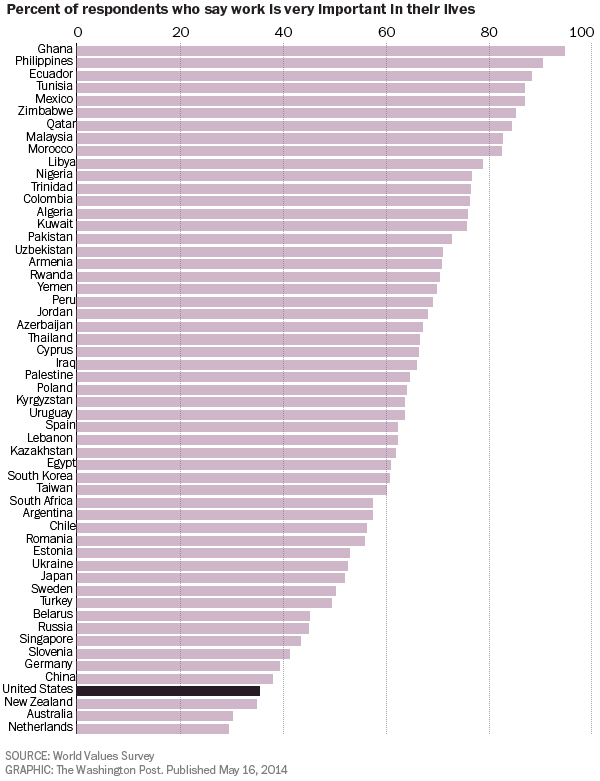
While we have a reputation for being a country of workaholics, we actually rank the importance of work quite low (36 percent) compared to other countries. Ghanians, Filipinos and Ecuadorians are the biggest workaholics, while again the Dutch are at the bottom of the list. The most important thing, according to Americans? Family. Sure, we may not fully trust that one sketchy uncle, but we love him anyway.

Charles Kenny points to another somewhat surprising finding: most Americans say they are happy:

Americans still report themselves happy, if not quite as much as in the past. The proportion reporting that they are either very happy or rather happy was 91 percent in 1981, climbed to 93 percent in 1999, and fell back to 89 percent in 2011.  In some ways, this suggests remarkable resilience in the face of stagnant incomes and an unemployment rate that almost doubled between the second and third surveys. Unemployment and the related uncertainty has a strong relationship with lower reported wellbeing across the rich world.

On the whole, the global average for people living in surveyed countries has risen. Among the global sample whose data goes back to the early 1980s, the proportion saying they are rather happy or very happy climbed from 71 percent to 84 percent. In the larger sample using data from the early 2000s, the global average reporting happiness climbed from 75 percent to 83 percent.

Zach Beauchamp notices that Germany, Japan, Ukraine, and Taiwan stand out for their citizens’ relative lack of pride, with fewer than 70 percent saying they were proud of their country and fewer than 30 percent saying they were very proud:

Each of those four countries where pride was unusually low has something interesting to it. For Germany and Japan, it suggests that the post-World War II hangups about nationalism may have not quite gone away. Since their defeats, both countries have developed a much more complicated relationship with national pride — in some ways, German and Japanese nationalism run amok were responsible for the whole thing. This sense of national guilt, or at least a wariness of too much national pride, might be making it harder for German and Japanese folk to feel immense amounts of national pride.

In Ukraine, the issue may be the country’s ethno-linguistic divides. … Then there’s Taiwan, whose results are almost certainly about tension with mainland China. 20 percent of Taiwanese outright favor reunification with China, and 43.5 percent of Taiwanese also identify as Chinese (“Zhongguo ren,” which could mean Taiwanese, mainland Chinese, or both). This complicated relationship with the People’s Republic probably explains why Taiwanese people aren’t quite as proud of their country as other peoples are.