The Hole In The Safety Net

by Jonah Shepp

140516_$BOX_Transfers.png.CROP.promovar-mediumlarge

Weissmann looks at how welfare benefits for the very poor have shrunk over the past 30 years:

Looked at as a whole, the entire safety net has clearly gotten wider, even when you remove programs like Social Security retirement benefits, Medicare, and Medicaid from the equation. [Robert] Moffitt shows that per-capita spending on means-tested programs, such as food stamps, Supplemental Security Income, and the Earned Income Tax Credit, increased 89 percent between 1986 and 2007.

But Moffitt shows how that overall expansion masks key changes that have cut benefits for families with incomes that amount to less than 50 percent of the poverty line. Most important was the end of welfare as America knew it. In order to encourage more single mothers to enter the workforce, the Clinton administration eliminated the old Aid to Families With Dependent Children, which had served as an open-ended federal commitment to help poor parents. Its replacement, Temporary Assistance for Needy Families, includes work requirements, and only gives states annual grants that don’t grow with inflation. As a result, welfare spending, which traditionally reached the poorest of America’s poor, has plummeted, and has been redirected to mothers who are employed.

A Push For Gender Equality In The Lab

by Jonah Shepp

No, not the scientists: the animals. Francie Diep explains:

The U.S. National Institutes of Health—one of the biggest funders of biomedical research in the U.S. and the world—will now require the studies it funds to have equal numbers of male and female lab animals. It’s even requiring gender balance in studies done in cells in petri dishes. Yep, that means female and male lab rats will now have equal opportunity to die for science.

All kidding aside, this is actually an important moment for the way medicines are developed in America. All new drugs and treatments are first tested in cells in a petri dish, as well as lab mice, rats, monkeys and other animals. If those studies go well, then they’re tested in people. Late-stage human studies of medicines in the U.S. are now required to recruit at least some women. (This wasn’t always true and, on the whole, it’s still not 50-50.) Gender parity in clinical trials is important because men and women are known to react differently to some medications. Just check out this example, or this one, or all these ones.

Marcotte adds:

That you shouldn’t exclude half a species in your testing seems obvious, but there are understandable, if not really defensible, reasons that scientists have typically stuck to male-only studies.

Roni Caryn Rabin at the New York Times explains: “Researchers avoided using female animals for fear that their reproductive cycles and hormone fluctuations would confound the results of delicately calibrated experiments.” But while this tradition makes it easier to come up with clean results, the long-term effect is that drugs are being released that women are going to take without researchers always knowing exactly how those drugs will work on them. (After all, human females have reproductive cycles and hormone fluctuations, too.)

Feminists in science have long been advocating for an end to the habit of male-only studies for just this reason. That’s part of why the University of Wisconsin started a feminist biology program to help critique and improve biology by targeting some of the unquestioned gender bias that sadly continues to flourish in the field.

Safer Smack?

by Jonah Shepp

John Knefel explores the controversy over harm reduction as an approach to heroin addiction:

Though some advocates in the U.S. express hope that their country will one day have supervised injection facilities, even less controversial methods are by no means universally accepted. Needle exchanges, for example, are still effectively illegal in about half of the states, and federal money can’t be used to fund them. President Obama lifted that ban in 2009, but Republicans in 2011 fought successfully to reinstate it. …

Other observers criticize exchange programs for not being aggressive in promoting detox and rehab for heroin users, and suggest a harsher approach.

“Using the criminal justice system to force them to go into treatment has proven to be very productive,” David Evans, special adviser to the Drug Free America Foundation, tells me. “The drug courts that do that have an outstanding record of success of freeing people from their addictions.” (Critics of drug courts argue coerced rehabilitation actually expands, rather than lessens, a punitive approach to drug treatment.)

Some opponents of harm reduction also express skepticism about expanding naloxone access to family and friends of drug users. “Naloxone can save lives in an overdose situation, but many opioid users do not use with their family,” John Walters, who was drug czar under President George W. Bush, writes in an email. “[T]hey may use alone or in the company of other users, who may not be a reliable source of emergency medical care.” Using alone is dangerous, without question, but available data largely contradicts fears that other users can’t administer naloxone effectively. A 2013 scholarly study found that overdoses are overwhelmingly witnessed by other users, and, in the study, administration of naloxone was 98% effective in reversing the overdose.

Creepy Ad Watch

by Jonah Shepp

https://www.youtube.com/watch?v=zlA9tXYxD8g

Vauhini Vara flags a new campaign by Coca-Cola featuring guest workers in Dubai:

In March, Coke installed five special phone booths in Dubai labor camps that accepted Coca-Cola bottle caps instead of coins. In exchange for the cap from a bottle of Coke—which costs about fifty-four cents—migrant workers could make a three-minute international call. The ad shows laborers in hard hats and reflective vests lining up to use the machine—and grinning, for the first time in the video, as they wait. “I’ve saved one more cap, so I can talk to my wife again tomorrow,” one man tells the camera. More than forty thousand people made calls using the machines. Then, in April, after the booths had been up for about a month, the company dismantled them.

At first glance, the ad may seem innocuous, even sweet, until you consider how Coke is exploiting these workers’ misery to burnish its friendly image:

I sent links to the ads to Nicholas McGeehan, a Gulf researcher for Human Rights Watch who has studied labor conditions in Dubai. I was interested in his take on the questions of appropriateness and ethics that some viewers had raised. The videos, he said, were “odious.” For one thing, he said, Coke is not only using these low-income workers to advertise its product, it is also requiring them to buy soft drinks themselves—at nearly a tenth of their typical daily wages, he pointed out—to use the special phone booth. On top of that, he feels that the ads normalize and even glorify the hardship faced by migrant workers—at least some of whom may be working against their will. “If this was two hundred years ago, would it be appropriate for Coke to do adverts in the plantations of the Deep South, showing slaves holding cans of Coke?” he asked. “It is a normalization of a system of structural violence, of a state-sanctioned trafficking system.”

The Dish recently looked at the conditions of guest workers in Dubai and other Gulf states here.

Can You Teach A Robot Right From Wrong?

by Jonah Shepp

The Office of Naval Research is spending $7.5 million to find out:

“Even though today’s unmanned systems are ‘dumb’ in comparison to a human counterpart, strides are being made quickly to incorporate more automation at a faster pace than we’ve seen before,” Paul Bello, director of the cognitive science program at the Office of Naval Research told Defense One. “For example, Google’s self-driving cars are legal and in-use in several states at this point. As researchers, we are playing catch-up trying to figure out the ethical and legal implications. We do not want to be caught similarly flat-footed in any kind of military domain where lives are at stake.”

The United States military prohibits lethal fully autonomous robots. And semi-autonomous robots can’t “select and engage individual targets or specific target groups that have not been previously selected by an authorized human operator,” even in the event that contact with the operator is cut off, according to a 2012 Department of Defense policy directive. “Even if such systems aren’t armed, they may still be forced to make moral decisions,” Bello said.

Since the robotic future of warfare has to some extent already arrived, and the danger of getting it wrong is so great, this seems worth the money to me, but Suderman doesn’t see how an ethical military robot is possible:

Obviously Asimov’s Three Laws wouldn’t work on a machine designed to kill. Would any moral or ethical system? It seems plausible that you could build in rules that work basically like the safety functions of many machines today, in which the specific conditions result in safety behaviors or shut down orders. But it’s hard to imagine, say, an attack drone with an ethical system that allows it to make decisions about right and wrong in a battlefield context.

What would that even look like? Programming problems aside, the moral calculus involved in [waging] war is too murky and too widely disputed to install in a machine. You can’t even get people to come to any sort of agreement on the morality of using drones for targeted killing today, when they are almost entirely human controlled. An artificial intelligence designed to do the same thing would just muddy the moral waters even further. Indeed, it’s hard to imagine even a non-lethal military robot with a meaningful moral mental system, especially if we’re pushing into the realm of artificial intelligence.

Meghan Neal entertains the argument that killer robots might actually be more ethical than human soldiers:

For one, killer bots won’t be hindered by trying not to die, and will have all kinds of superhero-esque capabilities we can program into machines. But the more salient point is that lethal robots could actually be more “humane” than humans in combat because of the distinctly human quality the mechanical warfighters lack: emotions.

Without judgment clouded by fear, rage, revenge, and the horrors of war that toy with the human psyche, an intelligent machine could avoid emotion-driven error, and limit the atrocities humans have committed in wartime over and over through history, [roboethicist Ronald] Arkin argues.  “I believe that simply being human is the weakest point in the kill chain, i.e., our biology works against us,” Arkin wrote in a paper titled “Lethal Autonomous Systems and the Plight of the Non-combatant.”

But, of course, as Zack Beauchamp points out, that same lack of emotion prevents a robot from disobeying orders to commit an atrocity:

Charli Carpenter, a political scientist at the University of Massachussetts-Amherst, makes a compelling argument that robots could commit war crimes — because war crimes, contrary to what we might prefer to believe, are often not committed by rogue soldiers as crimes of passion but as deliberate tools of terror engineered by top commanders. In the Bosnian War, for example, Bosnian Serb soldiers were ordered by their commanders to use rape as a tool of terror, and soldiers who refused were threatened with castration.

Robots, unlike people, always do what they’re told. Carpenter’s point is that human-rights abusing governments could program robot warriors to do whatever they’d want, and they’d do it, without compunction or thought. If the reality of war-time atrocities is that they tend to be intentional, not crimes of passion, then that’s a huge count in favor of banning military robots today.

Filip Spagnoli engages both sides of the moral dilemma:

It’s true that robots can be programmed to kill indiscriminately or to kill all brown people. But history is full of human commanders giving exactly the same kind of orders. If robots are programmed in immoral ways, then that’s an easier problem to solve than the prejudices or emotional failures of scores of individual soldiers and commanders. Of course we’ll have to monitor the people who will program the robots. But is this more difficult than monitoring the immoral orders by human leaders? Obviously it’s not. It’s true that monitoring will be easier in democracies, but if dictators want killer robots there’s not a lot we can do to stop them or to convince them to use robots in a ethical manner.

Mariam The Martyr

by Jonah Shepp

Sudan has sentenced a Christian woman to death for apostasy:

A pregnant 27-year-old Sudanese woman was sentenced to death by hanging Thursday for apostasy after marrying a Christian man and refusing to convert to Islam. Mariam Yahia Ibrahim Ishag also faces charges of adultery. Ibrahim, who was born to a Muslim father but raised Orthodox Christian by her mother, was first sentenced on Sunday, but she was given until Thursday to change her mind and convert. She refused to do so, Al Jazeera reports.

“I am a Christian and I never committed apostasy,” Ibrahim said.

Ibrahim was found guilty of apostasy — the abandonment of one’s religious faith – because she was born to a Muslim father and married a Christian man. The adultery charge came as Islamic law prohibits Muslim women from marrying outside of their religion, a rule which effectively voided the marriage.

Here’s hoping that international outrage over this ruling will see it overturned. Harris Zafar stresses that executing apostates has no genuine basis in Islam:

In Demystifying Islam: Tackling the Tough Questions, I dedicate an entire chapter to explaining Shariah and another chapter to tackling the question of religious freedom and the supposed punishment of death for apostasy. A close study of Islam and its scripture reveals that Islam neither prescribes religion to be legislated nor prescribes any punishment for apostasy.

But in many Muslim-majority countries, apostasy is considered a crime punishable by the state, endorsing the view that Islam calls for death of any Muslim who renounces his or her faith. A growing number of Muslims, however, reject this belief on the basis of Islam, arguing there is no Islamic punishment prescribed for one who renounces their faith. This is because the concept of killing a person for choosing a different faith is, in fact, a violation of the teachings of Islam. Simply put, Islam does not prohibit freedom of conscience and religion and does not prescribe punishments for matters such as apostasy.

But Dreher thinks Islam has to answer for this sort of barbarism, doctrinal basis or none:

Hey Brandeis, this is the kind of thing that Ayaan Hirsi Ali speaks out against. Yet you wanted nothing to do with her, because somebody might call you anti-Muslim. You privileged Americans wouldn’t even have her on your campus. Well, look, not all Muslims in the world support this despicable stuff, but if what Sudan is doing to this Christian woman, and what traditional sharia-loving Muslims do to women and girls in Sudan, in Nigeria, and elsewhere is “Muslim,” then being pro-human means you had better be “anti-Muslim” in the sense I mean here.

If, God forbid, she goes to her death, Mariam Yahia Ibrahim Ishag will be a powerful witness to Christianity. And the cruel men who will have murdered her will be powerful witnesses to Islam, whether anyone likes it or not.

Kimberly Smith argues that the real story here is about Sudan’s “complete disregard for the dignity of life, especially female life”:

I know Muslim women in South Sudan who the Islamic Janjaweed raped with sticks as they mocked, “This is so you cannot make black babies.” I know men who’ve been beaten, had their teeth knocked out and forced to swallow them and had limbs hacked off as they watched their wives and children dragged behind the tail of a horse into slavery because their skin was black instead of the beautiful bronze color of their Arab-descendant fellow countrymen. I know a beautiful young schoolteacher whose father forced her to leave her job to marry a man who already had four wives so that he could garner a few more cows. I’ve sat through bomb blitzes targeted at the indigenous people of the Nuba Mountains, which is largely Islamic, simply because they are black and yet dare to proclaim their right to life, liberty and the use of their homeland’s natural resources.

The depravity of the Sudanese government extends far beyond religion and deep into the heart of humanity. A people will not truly have freedom of religion unless it is built upon a foundation of the sanctity of life.

Ukraine Stumbles Toward The Polls

by Jonah Shepp

With less than a week to go before Ukraine attempts to elect a new president, Putin claims that he has ordered Russian troops to pull away from the borders—again:

The president made a similar pronouncement on May 7, which was met with the same skepticism by global leaders when NATO officials on the ground said that there appeared to be no reduction in troops. Now, also, an unnamed NATO officer told Reuters that “We haven’t seen any movement to validate (the report).” But this time, it seems that Putin may have an actual incentive to ease some pressure off of its neighbor. According to the New York Times, one candidate running for office in Kiev has caught the Kremlin’s attention, and could become something of an ally if he is voted the country’s next president. Petro Poroshenko, a wealthy pro-Western candidate who has business interests in Russia, is now a favorite to win the May 25 election.

The Dish took a look at Poroshenko last month here. Previewing the elections, Erik Herron wonders whether Kiev will be able to pull them off:

The May 11 “referendums” held in Donetsk and Luhansk further complicate the implementation of presidential elections. Polling places and election equipment (e.g., ballot boxes) were commandeered by groups conducting the vote, and some separatists have indicated that they will not permit the presidential election to take place.

Large-scale violent demonstrations in the cities of Odesa and Mariupol, as well as active combat between separatist and pro-government forces in the Donetsk and Luhansk regions, threatens the security of citizens who want to participate in the polls and threats are likely to further undermine turnout. Based on data from the last presidential election, impediments to voting in Crimea, Donetsk, and Luhansk alone could affect around 5 million voters, or 20 percent of the voting population. These regions border other large population areas, and if instability spreads, the impact on the voting-age population could be intensified.

Joshua Yaffa expects the pro-Russian separatists to attempt to sabotage the elections, but doubts they will be successful:

The separatists have enough fighters to disrupt voting and keep some polling stations from opening, especially in areas where they’re strong such as the military stronghold of Slaviansk. But they lack the numbers to take over every school, cultural center, and administrative building where voting will occur. They will probably focus on preemptive intimidation, targeting electoral officials and other local administrators for threats and attacks. In Luhansk, for example, separatist fighters kidnapped an election commissioner. Voting day may be a flashpoint for violence, because pro-Kiev paramilitary groups are expected to deploy to ensure voting while anti-Kiev fighters may fan out to do the opposite. Civilians could be the ones who suffer, as they did on May 11 during the separatist referendum, when a pro-Kiev battalion of unclear authority fired into an angry crowd in Krasnoarmeysk, killing two people.

In any event, the threat of war is being taken very seriously. In Kiev, David Patrikarakos reports that “the atmosphere has darkened”:

Maidan remains cosmetically militarisedringed by barricades of tyres and sandbags – but it has become little more than a tourist trap, selling souvenirs of the revolution to the trickle of foreigners who still visit. Now the barricades are being reinforced and expanded. On 5 May, access into the square via a neighbouring street was controlled by a blonde militia girl of no more than 17, who manned a makeshift gate allowing vehicles access in and out. The armoured personnel carrier parked incongruously in the middle of the streetwhich some of the more enterprising militiamen had been charging people 50 hryvnias a turn to sit in and have their photo takenwas being cleaned and tested.

Both sides are adopting a war mentality, the most obviousand ominousaspect of which is the dehumanisation of the enemy. Pro-Russians describe the Odessa fire as “inhumanity … last seen by the Nazis in the Second World War,” while the more extreme pro-Ukrainian elements post memes that mock those who died. A collective psychosis, born of machismo and paranoia and fuelled by rumour, is taking hold. The latest story gaining traction in the capital is that thousands of Russianssolitary males of military agehave begun to appear in Kyiv, renting rooms and just waiting. “Let them come,” says Maksym, my wiry and intense landlord. “I’ve got body armour and I’m cleaning all my guns.”

And, in Odessa, Kirchick profiles Brighter Future for Ukraine, a recently formed civil defense group that opposes both Russian intervention and the new government:

Given the 40,000 or so Russian troops still amassed on Ukraine’s eastern border, and the active subversion efforts aimed at destabilizing the government, I ask the men why they have not joined the Ukrainian military or national guard. “There is no real chain of command in the army,” Baba tells me. They have helped the government as necessary, like when, last month, they captured, an alleged spy with a Russian passport and dozens of bank cards (purportedly for paying provocateurs). They turned him over to the Ukrainian intelligence service. But their aversion to signing up for their country’s defense forces goes beyond mere disappointment with organizational dysfunction, and strikes at the heart of why they established parallel structures to carry out what should be state functions in the first place. “So-called state leaders are not interested in the state,” Baba says.

Recent Dish on the crisis in Ukraine here, here, and here.

What The Hell Is Happening In Vietnam?

by Jonah Shepp

After anti-China protests in Hanoi escalated into rioting and arson last week, Per Liljas reports on the aftermath of Beijing’s latest provocation in the South China Sea:

Two Chinese passenger ships arrived early on Monday at the central-Vietnamese port of Vung Ang to evacuate Chinese nationals, who are fearing for their safety after anti-Chinese riots last week saw foreign businesses attacked, two Chinese killed and about 140 people injured. More than 3,000 Chinese have already been helped to leave the country following protests that flared up across Vietnam over a Chinese oil rig that is drilling in waters claimed by both sides. Beijing has announced a 4.8-km exclusion zone around the rig, and Hanoi claims that there are 119 Chinese vessels in the area, including warships.

Public protests are a rarity in communist Vietnam. The security forces have been deployed in Ho Chi Minh City to quell new waves of demonstrations, and mobile carriers have sent repeated texts to subscribers with a message from Prime Minister Nguyen Tan Dung asking people to stay away from further protests. However, small groups of peaceful protesters continued to gather on Sunday, and neither side has shown any real sign of backing down over the territorial conflict, which has revived a long-standing enmity between Beijing and Hanoi.

Zooming out, Sean Mirski analyzes the Chinese leadership’s strategic calculations:

Beijing seeks to control the South China Sea in order to manage national security threats and advance its economic objectives. The Sea represents a strategic vulnerability for China, both as a historical invasion route and as a modern threat to its energy security and export-oriented economy. Controlling the South China Sea would also offer many tangible benefits. The Sea teems with bountiful fishing stocks, a mainstay of many regional economies. Beneath the ocean floor, even more valuable assets wait. Although experts differ about the size of the potential bonanza, they all agree that there is enough petroleum and natural gas to make any bordering state covetous.

These strategic imperatives are reinforced by China’s domestic politics. … So even if China’s leaders were inclined to surrender Chinese claims in the South China Sea, they would be deterred from doing so by the inevitable domestic backlash. Instead of compromising, Beijing feels increasingly pressured by a nationalist public to act assertively in its relations with the other claimants.

Vikram Singh thinks China’s aggressiveness could backfire:

Beijing’s actions carry significant risk, and mask a tension between China’s short and long-term goals. Sailors or airmen in tense standoffs could miscalculate and spark an incident that demands military escalation. Countries like Vietnam could also decide to take a stand and choose to fight rather than give in to Chinese pressure. Yet that decision would be calamitous: the last time China and Vietnam went to war, in 1979, about 60,000 people were killed. China would not benefit from such conflict in Asia, especially if it took the blame for derailing Asia’s long run of peace and progress.

Even if it avoids war, China can overplay this hand to such a degree that Southeast Asian nations defy history and join together to resist domination by a resurgent Middle Kingdom. The 10 members of the Association of Southeast Asian Nations (ASEAN) are far from forming an alliance and have no tradition of such banding together, but ASEAN has grown stronger and is welcoming a greater U.S. role in the region, in part because of China’s assertiveness.

Zack Beauchamp assesses the likelihood of a full-blown conflict as fairly low:

The case for the possibility of war is simple: it’s happened before. In the late 70s, Vietnam aligned itself with the Soviet part of the Communist bloc rather than the Chinese one (the two had, at the time, parted political ways). China wanted to punish Vietnam for the deviationism, and they fought a somewhat pointless, but fairly bloody, war in 1979.

That’s not likely to repeat itself today. For one thing, China is exponentially more powerful than Vietnam, and so Vietnam knows risking a conflict is risking a crushing defeat. For another, China contributes a lot of money to Vietnam’s economy, particularly through tourism. Vietnam wouldn’t want to risk losing that. Finally, as [Jonathan] London notes, Vietnam’s core leadership — its general party secretary, president, and leader of the National Assembly — have a well-known pro-China tack. “Their loyalty,” London writes, “is to the enduring illusion that Beijing is a partner.”

A Historic Victory For India’s Nationalists?

By Jonah Shepp

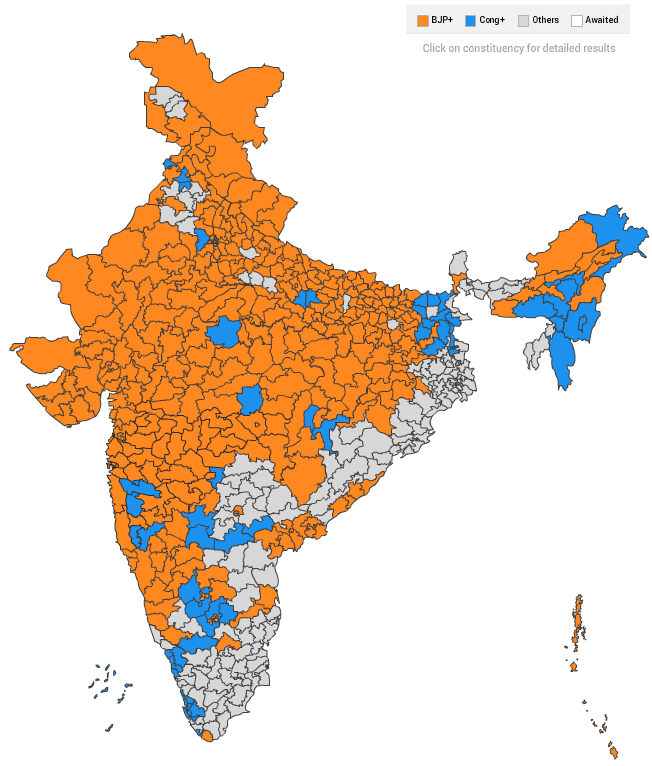
Screen_Shot_2014-05-16_at_11.23.16_AM

Passing along this map of India’s election results, Max Fisher comments on just how big the Bharatiya Janata Party’s victory was:

We knew from polls that BJP was almost certainly going to win. And it’s been clear for a few years that the Congress Party, as India’s economy slowed and middle-class Indians suffered, was losing popularity. But the extent of orange on this map, and the dearth of blue, is just stunning. Doug Saunders, a respected international affairs columnist at the Globe and Mail, called it “one of the biggest electoral routs I’ve ever seen.”

The results aren’t completely in yet [as of Friday afternoon] and BJP has already won an outright majority of 280 out of 545 seats. Typically, several parties have to form coalitions to get a majority, so the fact that BJP has a majority all on its own is a big deal.

But Adam Ziegfeld disputes this narrative, attributing the BJP’s lopsided majority in parliament to India’s electoral system:

First, as of the most recent counting, almost 70 percent of Indians did not vote for the BJP.

Commentators such as Max Fisher at Vox claim that the BJP “dramatically … swept the vote.” In fact, the BJP won about 31 percent of the vote, a new high for the party. Although this is the first national election in which the BJP has ever won more votes than any other party, less than a third of Indians voted for it. The BJP’s legislative majority is largely a function of India’s single-member district (SMD) electoral system, the same system used in American, British, and Canadian legislative elections. In an SMD system, votes rarely translate proportionally into seats. This system rewards parties that are the largest in each electoral district. The BJP’s vote is patchily distributed across India, which works to its advantage. …

Meanwhile, in states where the BJP won few seats, it did quite poorly. Thus, relatively few of the BJP’s votes were wasted—that is, cast in electoral districts where the party ultimately failed to win a legislative seat. As a result, the party won a legislative majority on a fairly small vote share.

Taking a long look at Prime Minister-elect Narendra Modi’s career, William Dalrymple comes away with some concerns:

Today Modi remains the most polarising figure in Indian politics. Many intellectuals and urban liberals view him as an almost satanic figure pushing India towards fascism. They point to his record with dissent: journalists from the Times of India who wrote against his government had sedition charges brought against them; Rahul Sharma, a policeman who helped convict many of the 2002 rioters, had his promotion blocked (“due to misspellings”); Teesta Setalvad, the lawyer who brought riot cases against him, had charges of embezzlement slapped on her. Most sinister of all, Haren Pandya, Modi’s former home minister, who agreed to give evidence against him to an independent commission of inquiry into the riots, was first made to resign his position, then deprived of his seat and finally murdered in mysterious circumstances in 2003. Modi, the argument goes, displays all the signs of becoming an Indian Putin.

Despite his image as a successful economic reformer, John Cassidy points out that this is not a fact universally acknowledged:

Many, though not all, economists believe the Indian economy needs another wave of liberalization that builds upon the one that Singh introduced in the nineteen-nineties, when he was minister of finance. Those measures cut the budget deficit, stripped away some of the country’s infamous licensing restrictions, and made it easier for foreigners to invest in Indian companies. Jagdish Bhagwati, the Columbia University economist who is one of Modi’s most prominent supporters, has criticized Singh for not following up on these reforms during his time as Prime Minister.

It has been widely reported that Bhagwati and his Columbia colleague Arvind Panagariya, another supporter of free-market reforms, will play some role in the new Indian government. Modi, however, also has his critics in the academy. Some studies suggest that Gujarat, despite enjoying stronger than average growth, has a questionable record relative to other Indian states in reducing poverty, improving child nutrition, and promoting education and social inclusion. Last year, Amartya Sen, perhaps India’s most famous economist, came out strongly against Modi’s candidacy, criticizing his failure to protect religious minorities, and saying, “His record in education and health care is pretty bad.”

Daniel Twining sees Modi’s pro-growth agenda as good news for Indian-American ties:

The greatest momentum in U.S.-Indian relations came during the 2000s, when India was growing at rates approaching 10 percent. The growth Modi promises should restore energy to the bilateral relationship. A flourishing India undergoing vigorous reform will be a better business partner for American firms than one limping along under state socialism. A dynamic India is more likely to have the confidence to engage the United States as a diplomatic partner, rather than retreating into the old shibboleths of non-alignment and third-worldism. A surging India is also more likely to pursue the kind of activist foreign policy that makes it a shaper, rather than a victim, of world events.

But comparing Modi’s worldview with Obama’s, Tunku Varadarajan doubts the two will get chummy:

Obama and Modi are from two different planets, and each, in his heart, is likely to have vigorous contempt for the other. The former is an exquisitely calibrated product of American liberalism, ever attentive to such notions as “inclusiveness.” He is the acme of political correctness (notwithstanding the odd drone directed at “AfPak”). Modi, by contrast, is a blunt-spoken nationalist, opposed to welfare, and to the “appeasement” of minorities. …

Modi’s keenest ally—potentially his BFF—is likely to be Japan’s Shinzo Abe, who was one of the first to send his congratulations to the Indian politician when it became apparent that he would be the next prime minister. Abe and Modi are, in many ways, made for each other: Ardent nationalists yearning to break free from their respective nations’ patterns of international passivity, they both face the terrifying challenge of a China that plays by its own unyielding rules, a maximalist hegemon which has the economic and military heft to dispense with diplomacy as the primary means of dispute resolution.

And Tanvi Madan considers what issues are likely to define Modi’s foreign policy:

The relationship with Pakistan is perhaps the biggest wild card. It is not known whether Modi will essentially take the line that India needs stability in its neighborhood to ensure economic growth and development, which is the primary and perhaps sole objective for which he will have a clear public mandate. Such an assessment could mean Modi would reach out to Pakistani Prime Minister Nawaz Sharif and take confidence-building measures further, especially in the economic realm. There are some who think he’ll go further—in the Nixon-going-to-China vein. …

There’s a possibility that Modi will take a more hawkish line instead. This is especially likely if, in the first six months or so of his government, there is a major terrorist attack in India or on Indians abroad that can be traced to elements in Pakistan. This is not a far-fetched scenario—terrorist groups might see the period of political transition as an opportunity to derail any chance for peace. And in the event of such an attack it is unlikely that any Indian government will sit back and do nothing or essentially act in a post-Mumbai-like manner—especially if there is little cooperation from the Pakistani government.

Previous Dish on Modi and the election results here and here.

Iran’s Lifesaving Drone Program

by Jonah Shepp

Eat your heart out, John McCain. Motherboard takes a look at what these Iranian scientists are up to:

We’ve seen how drones can be a crucial asset to search and rescue operations, but Iran’s RTS Lab has taken an entirely new angle. RTS’s Pars drone carries a payload of life preservers that can be delivered to a drowning swimmer far faster than a lifeguard. As we saw in testing in the Caspian Sea, the drone can also work at night, using bright lights, thermal sensors, and a built-in camera to stream video to rescuers on shore.

The concept works well, and it’s an excellent example of how powerful drones—which are cheaper and easier to use than just about any other aerial delivery vehicle—can actually be.