An Underrated Classic

by Jessie Roberts

Loris Stein commemorates John O’Hara, whose novels, he says, “deserve to be much more famous than they are.” He describes the heroine of BUtterfield 8:

This heroine, Gloria Wandrous, is one of O’Hara’s true originals: a young woman endowed with beauty, a strong libido, and large sexual experience, who is neither a pornographic fantasy nor a femme fatale. To put it simplistically, Gloria is a sexual subject, not dish_Butterfield8 an object. Over the course of BUtterfield 8, we hear about threesomes, orgies, “Lesbians,” “fairies,” consensual rough sex, brutal sadism, abortions, even the new technique of artificial insemination—all from her point of view. Even more striking, we see Gloria in a close, erotically charged friendship with a man, Eddie Brunner, who loves her and is not her lover. Theirs is not the only such friendship in American fiction, but it is one of many touches that make the novel seem uncannily up-to-date, much more up-to-date than the “modernized” 1960 movie starring Elizabeth Taylor.

In the movie, Gloria is a call girl who wants to “go straight” and get married. But the Gloria of O’Hara’s novel is, crucially, not a prostitute, and she considers the prospect of marriage with deep ambivalence. Based on a real-life acquaintance of O’Hara’s named Starr Faithfull, Gloria is a creature of the great sexual revolution of the twentieth century—the one that occurred in the twenties, thanks to cars and speakeasies. To read O’Hara is to discover how much more people used to say and do, in private, than most novelists, even daring ones, could bring themselves to write. The publishers of BUtterfield 8 made O’Hara remove the word “fuck” from his manuscript (they seem to have replaced it with the phrase “stay with”). Even so, even now, you could hardly place the book on a high school syllabus.
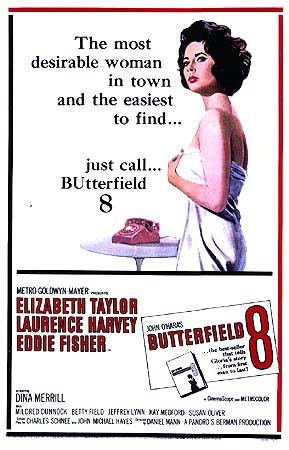
(Image: movie poster for BUtterfield 8, via Wikimedia Commons)

Talking With Ray Bradbury

by Jessie Roberts

Maria Popova digs up a 1974 interview with Ray Bradbury, above. One highlight, on writing:

I never went to college — I don’t believe in college for writers. The thing is very dangerous. I believe too many professors are too opinionated and too snobbish and too intellectual, and the intellect is a great danger to creativity … because you begin to rationalize and make up reasons for things, instead of staying with your own basic truth — who you are, what you are, what you want to be. I’ve had a sign over my typewriter for over 25 years now, which reads “Don’t think!” You must never think at the typewriter — you must feel. Your intellect is always buried in that feeling anyway.

Drinking As The Romans Did

by Jessie Roberts

Italian archaeologists are borrowing a page from Virgil and the ancient winemaker Columella in an attempt to make wine that tastes like it did in antiquity:

At the group’s vineyard, which should produce 70 litres at the first harvest, modern chemicals will be banned and vines will be planted using wooden Roman tools and will be fastened with canes and broom, as the Romans did.

Instead of fermenting in barrels, the wine will be placed in large terracotta pots – traditionally big enough to hold a man – which are buried to the neck in the ground, lined inside with beeswax to make them impermeable and left open during fermentation before being sealed shut with clay or resin.

“We will not use fermenting agents, but rely on the fermentation of the grapes themselves, which will make it as hit and miss as it was then – you can call this experimental archaeology,” said researcher Mario Indelicato, who is managing the programme.

Weeding Out Weak Women

by Jessie Roberts

Elizabeth L. Silver advocates the death of the ingénue in fiction:

I recently went to hear Isabel Allende speak about her latest novel, Maya’s Notebook. At the Q&A, a young aspiring female writer rose to ask a question that surprised a majority of the audience. “You write a lot of strong women in your books,” she said, before asking, “Has there been anyone who has influenced you?” Allende either didn’t understand the question or wanted to emphasize the lunacy of it, and after three attempts replied: “Do you know any weak women?” Needless to say, a resounding uproar of applause emerged from the previously unobtrusive audience. This is not a topic that is far from the consciousness of the literary establishment, nor is it one that should be. It is so prevalent on people minds and hearts precisely because of its relevance. Readers don’t want to see any more ingénues or stock characters. They want to see the people that they know, the strong women who populate their lives, because, as Isabel Allende so bluntly and perfectly stated, there really aren’t weak women.

I’m not naively suggesting that contemporary fiction has conclusively banished the ingénue from its pages; nor am I claiming that the character is close to her coffin in certain genres, but I am suggesting that that she should be. Fiction, as any vital art form, serves a purpose to reflect society in its emotional, environmental, and political nuances. It informs us, teaches us, reflects humanity in its reverie. If the ingénue, which may be dying in literary fiction, begins to fade in all genres of contemporary literature, if we accept the evolution of the young female protagonist in literature, we may stop expecting women off the page to play that stock role, as well. By exiling the word to the trash bin or perhaps feeling a little bit guilty whenever used, we might continue to represent women as they are – likeable or not. Powerful characters who sometimes want love, sometimes want power, ache with ambition and passion, refuse to be called ingénues, or any other pile of stock stereotypes. They are merely women who need no other label.

Update from a female reader:

Are Silver and Allende honestly trying to maintain that there are no weak women in the world? And therefore that modern writers know better than to create weak fictional women? My, my. I personally know a lot of weak women. Some of the even act like ingénues. To call them off-fictional limits is to degrade faction. And it doesn’t help women either. It’s not empowering; it’s patronizing, and I’m a little embarrassed that spokespersons like Silver and Allende are so lacking in confidence that they need to insist on valorized fictional females.

Real-Life Fictions

by Jessie Roberts

Mike Jay examines how culture and technology affect our understanding of psychotic delusions:

Persecutory delusions, for example, can be found throughout history and across cultures; but within this category a desert nomad is more likely to believe that he is being buried alive in sand by a djinn, and an urban American that he has been implanted with a microchip and is being monitored by the CIA. ‘For an illness that is often characterised as a break with reality,’ [researchers Joel and Ian Gold] observe, ‘psychosis keeps remarkably up to date.’ Rather than being estranged from the culture around them, psychotic subjects can be seen as consumed by it: unable to establish the boundaries of the self, they are at the mercy of their often heightened sensitivity to social threats.

Jay notes that, for Evelyn Waugh, the experiences of fiction-writing and paranoid delusions were not mutually exclusive:

In 1954, the English novelist Evelyn Waugh suffered a psychotic episode during which he thought he was persecuted by a cast of disembodied voices who were discussing his personality defects and spreading malicious rumours about him. He became convinced that the voices were being orchestrated by the producers of a recent BBC radio interview, whose questions he had found impertinent; he explained their ability to follow him wherever he went by invoking some hidden technology along the lines of a radionics ‘black box’, an enthusiasm of one of his neighbours. His delusions became increasingly florid but, as Waugh described it later, ‘it was not in the least like losing one’s reason… I was rationalising all the time, it was simply one’s reason working hard on the wrong premises.’

Waugh turned the experience into a brilliant comic novel, The Ordeal of Gilbert Pinfold (1957). Its protagonist is a pompous but brittle writer in late middle age, whose paranoia about the modern world is fed by an escalating regime of liqueurs and sedatives until it erupts in full-blown persecution mania (a familiar companion for Waugh, who abbreviated it discreetly to ‘pm’ in letters to his wife). Although the novel smoothes the edges of Waugh’s bizarre associations and winks knowingly at Pinfold’s surreal predicament, the fictionalisation blurs into the narrative that emerged during Waugh’s psychosis: even for his close friends, it was impossible to tell exactly where the first ended and the second began.

The “Birdman” On Film

by Jessie Roberts

This embed is invalid


Jessie Auritt explains how she came to make the above short documentary, The Birdman, about the owner of the copiously-stocked Rainbow Music shop in Manhattan’s East Village:

I had been wanting to do a short film, and was thinking about something I could do locally, and was curious — how do all of these, or at least what remains out of these, music stores stay in business? So I just poked my head into Rainbow Music — that was the first place I visited because I figured that would be a good place to start because the store itself, you can see … it’s a disaster. … So I just poked my head in there, told him I was interested in doing a documentary and at first his response was “no, I don’t want you to show my face. You can film the store and you can interview me but you can’t show my face.” And then once I got in there he totally warmed up and I just kind of plopped the camera down and he started talking. So I didn’t necessarily have a story outlined before I started, but it was just more of a subject I was interested in. I was initially planning on going around the neighborhood and interviewing different owners of music stores, but then The Birdman was such a fascinating character to me that I felt like he deserved his own film.

Fighting To Learn In Pakistan

by Jessie Roberts

http://youtu.be/AjoG2ozdlS0

Rahul Bhattacharya profiles Humaira Bachal, a woman who has devoted her life to educating her community in Pakistan:

What would become the Dream Model Street School began in 2001, with one blackboard, at home. Humaira taught ten friends of her age, seven of them girls. She started with the alphabet, in Urdu and English, and proceeded to the names of things. She supplied blank pages from her own notebooks, until it got her into trouble with her teachers. Then the friends went round asking people to donate paper, or bought scrap.

Soon, Tahira, who was 11, and three other girls were teaching alongside Humaira. “We were militant about time. Time for study, time for play, time to eat—and time to go out and recruit. We didn’t have the sense to realise we didn’t have space, books, teachers, money. We went around to houses, telling people, ‘We’ve opened a school, send your children, you must send your children!'”

A short film released on YouTube this year, “Humaira, Dreamcatcher”, demonstrates the challenges of this recruitment.

It’s the work of an Oscar-winning Pakistani-Canadian documentary-maker, Sharmeen Obaid-Chinoy, whose crew have been following the lives of Pakistani women fighting for change. Twelve years after the school started, the film shows local men still making their points: for girls to study is not our culture; they will be stared at while going to school; what use is educating a girl when she is only going to marry and run a house? Permissions, given reluctantly, are withdrawn easily.

Yet by 2003 Humaira’s team had enrolled over 150 children. The students could no longer fit into the Bachals’ home, so the young teachers decided to rent. They took a 240-square-foot plot with two sorry rooms surrounded by mounds of mud. They levelled the ground themselves, erected wooden poles and strung up discarded flour sacks for shade. These collapsed in the rain. Someone suggested they use Panaflex signboards in place of the sacks. But the wooden poles would not take the weight. Somebody else suggested they use iron pipes, so they found a welder who helped rig them up. Finally, the shelter stood.

A Whale Of A Book

by Jessie Roberts

& Sons author David Gilbert lovingly describes his favorite chapter from Moby-Dick, “The Grand Armada”:

I know it makes no sense, or comes across as pretentious nonsense, but so often when reading this book I find myself on the verge of tears and I have no idea why. A lost world perhaps? A striving for connection? A certain secular religiosity. No matter, the whales are doomed. They form a circle, circles within circles, like a clockwork mechanism in fin and tale, and the smaller boats lower into the water and go about their true business, the killing of whales, darting the weaker ones, taking advantage of mammalian affinities and loyalties, maiming as many as possible. And it is within this shoal that Starbuck and Queequeg and Ishmael find their boat inadvertently pushed into the very innermost circle, what Ishmael compares to a valley lake, “the enchanted calm which they say lurks at the heart of every commotion,” and it is this moment in Moby-Dick that I reflect on most often, that living wall of whales and the pastoral scenes glimpsed beneath.

All this violence, all this blood, and yet, for a moment, small tame cows and calves, “the women and children of this routed host,” visit the side of the unexpected boat and accept pats and scratches from Queequeg and Starbuck. They are the innocent, the cherished, the ones being protected by the larger herd from “learning the precise cause of its stopping.” And then Ishmael looks down into the water and

…far beneath this wondrous world upon the surface, another and still stranger world met our eyes…for, suspended in those watery vaults, floated the forms of the nursing mothers of the whales, and those that by their enormous girth seemed shortly to be mother. The lake, as I have hinted, was to a considerable depth exceedingly transparent; and as human infants while suckling will calmly and fixedly gaze away from the breast, as if leading two different lives at the time; and while yet drawing mortal nourishment, be still spiritually feasting upon some unearthly reminiscence; — even so did the young of these whales seem looking up towards us, but not at us, as if we were but a bit of Gulfweed in their new-born sight.

A bit of Gulfweed, that’s what they are — what we are. It is that moment of calm and metaphysical understanding, the divide between the spirit and the body and the near constant human attempt to bring those polarities together, that plus the sentimentality of the scene, of these mothers and children, these whales, resigned yet not uncaring, making due with the cruelty of the distant stars, just slays me.

A Suspicious Character?

by Jessie Roberts

William T. Vollmann reveals in Harper’s (subscription required) that the FBI investigated him as “Unabomber Suspect Number S-2047.” Annalisa Quinn summarizes:

Vollmann’s heavily redacted FBI file, which he obtained under the Freedom of Information Act, reveals that he became “Unabomber Suspect Number S-2047” based on a tip from an anonymous citizen, whom Vollmann dubs “Ratfink.” “UNABOMBER, not unlike VOLLMANN has pride of authorship and insists his book be published without editing,” part of the file states. Other sections link his appearance to composite sketches of the bomber and suggest that “anti-growth and anti-progress themes persist throughout each VOLLMANN work.” A source told the FBI that Vollmann “reportedly owns many guns and a flame-thrower.” (“I would love to own a flamethrower,” he notes cheerfully.) After the real Unabomber was caught, Vollmann was listed among the suspects in the 2001 anthrax attacks.

Though Vollmann writes that he was initially flattered to be labeled “ARMED AND DANGEROUS,” he became alarmed over the privacy violations the file suggests. He writes: “I was accused, secretly. I was spied on … I have no redress. To be sure, I am not a victim; my worries are not for me, but for the American Way of Life.” Vollmann spoke to Morning Edition’s David Greene in an interview Thursday morning and said he minded the FBI’s secrecy almost as much as the invasion of his privacy: “If we’re not allowed to know what they’re doing with this information, I can’t help but think that we are headed for really serious trouble.”

Inattention Please

by Jessie Roberts

Wayne Curtis praises Serendipitor, a navigation app that encourages you to embrace happenstance:

“Serendipitor is an alternative navigation app for the iPhone that helps you find something by looking for something else,” the developers explain, although not very helpfully. But their explanation gets better: “In the near future, finding our way from point A to point B will not be the problem. Maintaining consciousness of what happens along the way might be more difficult.” Toward that end, the app is “designed to introduce small slippages and minor displacements within an otherwise optimized and efficient route.” Using Google maps as a base, Serendipitor plots random walks for you, from wherever you happen to be to, well, wherever you happen to end up. Along the way “small detours and minor interruptions” pop up, with instructions such as: “Turn left on Chestnut Street and then follow a pigeon until it flies away. Take a photo of it flying.”

I’ve used this app a number of times. And in an obscure kind of way, it actually helps me stop and pay attention. It’s especially handy when I’m traveling. It serves as a sort of anti-guidebook, prodding me out of the deeply worn routes past the usual landmarks, and making me look around. I have yet to take a picture of a pigeon, but Serendipitor once by happenstance had me walk around a school where I watched the tightly choreographed ritual of picking up children at day’s [end] (it was so precisely orchestrated Merce Cunningham could have been behind it). It also once directed me through a sketchy neighborhood where elderly men sat on stoops and watched me with grave suspicion before greeting me with waves and smiles and small conversations. Serendipitor has introduced some minor adventures into otherwise mundane days.

Curtis quotes Walker Percy:

“The search is what anyone would undertake if he were not sunk in the everydayness of his own life,” said Walker Percy’s protagonist in The Moveigoer. “This morning for example, I felt as if I had come to myself on a strange island. And what does such a castaway do? Why, he pokes around the neighborhood and he doesn’t miss a trick. To become aware of the possibility of the search is to be into something. Not to be onto something is to be in despair.”