In Defense Of Poor Grammar

by Jessie Roberts

dish_grammar
A self-described “recovering grammar snob” explains why she overcame her rigor:

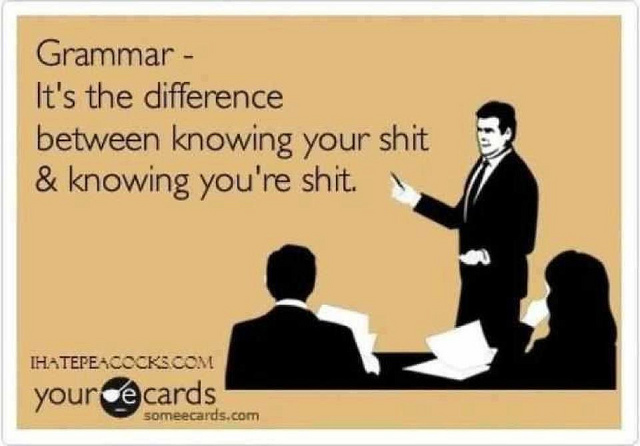
[T]here are two schools of thought when it comes to how we should use language. One is “prescriptive” and it’s backed by grammar snobs and the kind of people who froth at the mouth over the decline of “the King’s English”. The other is “descriptive” and it’s more about accepting that how people use language is how language works. A prescriptivist believes in the idea of standard English and sees mistakes everywhere. A descriptivist sees many englishes, and none of them are standard. …

The way people speak and write is based on a lot of factors. Geography, for one.

The various communities you belong to are also a big influence. Most of us belong to several communities and speak a little differently in the context of each one, whether that community is found at work, on a sports team, in a particular ethnic group, or in a religious community. We’re all fluent in more than one english, for example the language of our peer group and the language of our parents’ generation.

And then there are the two factors that have possibly the biggest impact on how we use language: education and socioeconomic status. When you judge people for what you consider to be poor grammar, you’re judging them for not being as good as you at something that might be a challenge because they didn’t have the advantages or experience you did. Maybe they haven’t had the luxury of worrying about their grammar. Maybe their use of language is right in line with their community. Maybe you’re just being a pedantic, prescriptivist jerk.

(Photo by Flickr user dullhunk)

Beauty In Physics

by Jessie Roberts

dish_covariance1

Particle physicist Ben Still collaborated with artist Lyndall Phelps on Covariance, the installation for the Superposition project seen above:

The pair were introduced by the Institute [of Physics] and given the brief of creating a physics installation for public display. Rather than focusing on one particular area of physics, they decided instead to look at the machines that make the science happen — particle physics detectors.

“These [are] massive machines used to see the smallest bits of nature,” Still tells Wired.co.uk. The installation aims to show the way in which the detectors build up a picture of how these tiny particles interact with each other on a larger scale, as well as reflecting the way the electronic data collected by the detectors is then used to create plots on computers. …

“I showed [Phelps] some of the plots I was making for an analysis I was developing and again she was quite struck by how we took data from this massive machine and made these colourful plots to try and extract information,” [says Still]. The colour running through the installation, says Still represents “the way in which the data is presented finally”.

Here’s a close-up of the work, which consists of 28,000 glass beads arranged into 20 different designs:

dish_covariance2

Covariance is on display in the former ice wells of London’s Canal Museum through October 20th.

(Photos by Richard Davies, whose most recent photography and book project is Wooden Churches)

PEDs And Writing

by Jessie Roberts

In light of recent controversies over performance enhancing drugs (PEDs) in sports, Brian Michael Murphy considers the role of drugs in literature:

All of my writing heroes used PEDs. I still respect them; I would still shake their hands; dish_absinthe I would never boo them as they took the podium to read, just returned from a stint in rehab or a drunk tank. I’m thinking of Allen Ginsburg’s acid. Baudelaire’s absinthe. Alice Walker’s magic mushrooms. Graham Greene’s Benzedrine. Legend has it that Gabriel García Márquez smoked up to 10 packs of cigarettes a day while holed up in his writing room for a year and a half like José Arcadio Buendía with his astrolabe and crucible. I once read that Balzac drank 50 cups of coffee daily and died of heart failure; another account said his personal record was 200 cups in a day, and that he died of a perforated ulcer.

I don’t use PEDs myself, aside from a demitasse of espresso here and there. Perhaps the impurity in me is not the caffeine, however. Perhaps it’s that very desire to be the best writer, to outshine my peers and gather accolades from people I don’t know, the willingness to sacrifice my time, energy, and relationships in order to accomplish it. Real life–a game of racquetball with my best friend, sharing a meal with my wife and daughter, teaching–tempers this impure ambition and keeps me connected to reality.

(Image: Portrait of Angel Fernández de Soto, or The Absinthe Drinker, by Picasso, via Wikipedia)

Curating The Intangible

by Jessie Roberts

This embed is invalid

The iPad app Planetary, as visualized above, “turns exploring your music collection into a sci-fi adventure — albums are turned into planets, which orbit around suns representing artists.”  The Smithsonian’s National Design Museum, Cooper-Hewitt, recently acquired the app as well as its source code, marking “the museum’s first foray into intangible items”:

“The impetus for the acquisition,” says Sebastian Chan, Cooper-Hewitt’s director of digital and emerging media, “is that software has become one of the most significant arenas of design.” Code, the underpinning of any app, may be digital and insubstantial; you can’t touch it. Yet we interact with apps daily and their design affects our behavior.  …

Cooper-Hewitt curators plan to create a new version of Planetary containing information on the museum’s 217,000 artifacts. A majority of the holdings are in storage, about half of which are viewable as images on the museum’s website. Chan foresees Planetary as a tool allowing visitors virtual access to the entire collection.

Andrew Webster elaborates:

This is the first time the museum has acquired a piece of code, and it has also worked with the original creators to make the source code available to everyone, in an attempt to preserve software as if it was a living thing. … The museum hopes that the decision to add both the software and the code to its collection will not only help with issues of preservation, but also potentially change the way similar institutions view software in general. “We liken this situation to that of a specimen in a zoo,” says Chan. “Open sourcing the code is akin to a panda-breeding program.”

Why We Read

by Jessie Roberts

Adam Gopnik contemplates the role of readers in society:

So: Why should English majors exist? Well, there really are no whys to such things, anymore than there are to why we wear clothes or paint good pictures or live in more than hovels and huts or send flowers to our beloved on their birthday. No sane person proposes or has ever proposed an entirely utilitarian, production-oriented view of human purpose. We cannot merely produce goods and services as efficiently as we can, sell them to each other as cheaply as possible, and die. Some idea of symbolic purpose, of pleasure-seeking rather than rent seeking, of Doing Something Else, is essential to human existence. That’s why we pass out tax breaks to churches, zoning remissions to parks, subsidize new ballparks and point to the density of theatres and galleries as signs of urban life, to be encouraged if at all possible. When a man makes a few billion dollars, he still starts looking around for a museum to build a gallery for or a newspaper to buy. No civilization we think worth studying, or whose relics we think worth visiting, existed without what amounts to an English department—texts that mattered, people who argued about them as if they mattered, and a sense of shame among the wealthy if they couldn’t talk about them, at least a little, too. It’s what we call civilization.

Even if we read books and talk about them for four years, and then do something else more obviously remunerative, it won’t be time wasted. We need the humanities not because they will produce shrewder entrepreneurs or kinder C.E.O.s but because, as that first professor said, they help us enjoy life more and endure it better. The reason we need the humanities is because we’re human. That’s enough.

Previous Dish on English majors here.

Face Of The Day

by Jessie Roberts

Lorraine

For her photo series “Suburban Dreams,” photographer Beth Yarnelle Edwards documented family life in the suburbs of Silicon Valley:

“I think of my images as being like genre paintings because they’re intended to depict a typical event in the home rather than a decisive moment,” Edwards explained via email. “And like genre paintings, I strive to include as much information about the people and the place as possible.”

The images are the result of collaboration between Edwards and the families she photographs. She interviews them, takes a tour of their home, and then recreates events from the family’s daily life. Rather than pose them, she sets up improvisations. “When I see a gesture or action that rings true, I’ll ask the person to freeze because my shutter speeds are fairly slow; this leads to a slightly frozen look, which I love,” Edwards said. …

“I call my series and monograph Suburban Dreams because it depicts a way of life that many Americans live and even more aspire to,” she said. “To me personally, the American Dreams means the freedom to believe and act as one wishes as long as that doesn’t impinge on the rights of others.”

(Photo by Beth Yarnelle EdwardsSuburban Dreams was recently exhibited at The Oakland Museum of California. The series is available as a monograph.)

The Tiny Shrines Of Greece

by Jessie Roberts

MessyNessy provides a virtual tour of the miniature roadside chapels of Greece:

Some are elaborate little things made of terracotta or even marble, plonked in the dish_tinyshrine middle of nowhere, high up in the mountains; no village or houses for miles, and yet impossibly, most of them are faithfully maintained with a candle always burning inside.

There’s a number of reasons for these heartfelt shrines, some as old as the roads themselves. Placed by the roadside, an initial assumption is that they’re built to remember a victim of a traffic accident victim, and sometimes this is exactly the case. But just as often, shrines will be built by survivors of accidents, thanking a saint at the location of their ordeal. While each one might tell a different story, they all share the same purpose– to ultimately provide a passing traveler with a moment of rest and spiritual reflection.

(Photo by Bob Linsdell)

Writing In The Gray

by Matt Sitman

In an interview about her debut novel, The Love Affairs of Nathaniel P., Adelle Waldman describes how she approached developing the book’s central character, a 30-ish male writer living in Brooklyn named Nate:

I tried to come up with a plausible psychology for him because Nate, and some of the men I’ve dated and that my friends have dated don’t hurt other people for fun, but nor do they feel that the chance of hurting someone is so horrible that they should run the other direction. They must be torn between feeling bad but feeling also tempted to keep doing the things that lead, eventually, to heartbreak. I think it’s a predicament; there’s not exactly an answer. I don’t feel like I can say, “This is what’s wrong with Nate.” Human relationships are hard…

[H]is concern is justifying himself in his own eyes. That’s not quite the right concern; [the right concern] is the effect on other people. I wanted the book to reflect what life is like, and that there are ways in which people are not at all villains or in possession of some very obvious character flaw that makes them difficult to deal with in life. I wanted Nate to be more self-justifying than empathetic; it seems more true to the experience I’ve had in that you don’t come across that many people who are just really bad. I wanted to write in that gray area of life.

Sasha Weiss elaborates on the predicament Waldman’s exploring:

The pleasures of this novel—its lucidity and wry humor—are mixed with the sting of recognizing the essential unfairness of the sexual mores of our moment: after years of liberated fun, many women begin to feel terribly lonely when realize they want a commitment; men, who seem to have all the power to choose, are also stuck with an unasked-for power to inflict hurt. We’ll have to keep searching for an arrangement that works better, and monogamous coupledom may not be it, Waldman suggests. But she offers no balm, no solution—and tacitly resists a culture that offers sunny advice and reassurance to women.

Marc Tracy expands on the point:

[Nate] must resolve the contradiction between having his pick of women (and having a part of himself that would like to exploit this privilege) and knowing that if he just blithely sleeps with every one available to him, his values dictate that he must hate himself in the morning. “Men in New York—far outnumbered by women, and with time on their side—sometimes seem to hold all the cards,” is how The New Yorker’s Sasha Weiss describes Nate’s situation. To some extent, that is an unchangeable truism—indeed, as with all those 19th-century girls in trouble, it is partly rooted in biology itself, including gender-specific fertility clocks set at two different speeds. And it collides with the feminist mores of a liberal 21st-century city and, much more dramatically, with the feminist beliefs of this liberal 21st-century city-dweller.

What makes this predicament particularly tricky is its extremely personal nature. While bien-pensant liberals are horrified when the privileges men enjoy over women—or white people enjoy over people of color, or wealthy people enjoy over poor people—are abused in the aggregate, everyone tends to be a little more tolerant at the individual level, where the stakes are more personal, the power is more diffuse, and the rules are unwritten.
Mental Health Break

by Jessie Roberts

Long-exposure photography captures a “real-time” view of the Milky Way:

This embed is invalid


DL Cade elaborates:

The “video” — which seems to be a cross between video and stop-motion photography — was possible because of the jump in low-light capabilities that cameras have experienced over the past several years. Combine those advances with some “tools and techniques” that the production company is keeping close to the vest for now, and you get real-time video of the Milky Way.

How To Approach Mortality

by Jessie Roberts

In an interview, philosopher and Immortality author Stephen Cave discusses ways to manage a fear of death:

Thinking less about yourself, more about other people and other causes, so your own death doesn’t seem as important to you, because these other causes and people will live on. Those other things will help you come to terms with death.

Bertrand Russell wrote about this. He lived to be 97. A man who lived this incredibly rich life, incredibly engaged, a philosopher, a writer. His life clearly had a lot of meaning for him. But also writing then already as a very old man about this, he wrote, ‘fear of death is not a noble thing, and the best way to deal with it is to break down the walls of the self, to emerge your ideas into the great stream of humanity.’ Care more about other things, and less about yourself, and your own death will seem less important. There are ways to combine a meaningful life without being afraid of it ending.

Various Buddhist traditions have excellent strategies for dealing with this. The Buddhist tradition realizes that the fear is so deep within us that we have to remind ourselves every day. I once heard that Dalai Lama wakes up at 4 am and meditates for 3 hours on the fact he’s going to die. It’s part of the Buddhist tradition to contemplate one’s mortality. Doing that will help give you the right focus. Help you decide what’s important and not important, to help you live with meaning but without fear.