A Zoolander Award?

by Phoebe Maltz Bovy

Allow me to humbly nominate a new award for the Dish, or at least for my time guest-blogging: a Zoolander Award for fashion absurdity. We have two contenders:

First, from Gwyneth Paltrow’s lifestyle website GOOP, a nondescript pair of $795 sneakers that may evoke – in an abstract way – a blood-splattered military uniform.

Second, a pair of merely $175 sneakers that arrive already looking like you’ve stepped in mud:

The problem with making things look covered in splotchy mud is… obvious.

Do you have any good nominees? Email dish@andrewsullivan.com.

“One Must Respect These Old Names”

by Phoebe Maltz Bovy

As a college student on study-abroad in France, I was riding a commuter train, when suddenly I noticed I’d been sitting under some graffiti that read, “Mort aux juifs.” At the time, I took this to be anti-Semitic graffiti – after all, it translates to “Death to the Jews” – and was somewhat unnerved. But it turns out I had no reason to be concerned. It was probably just hometown nostalgia on the part of someone from La Mort aux juifs, the town. Yes, the town.

Dylan Matthews flags the story of current efforts to change that name:

The Simon Wiesenthal Center’s director of international affairs, according to Agence France-Presse, has sent a letter to France’s interior minister demanding the name be changed. But Courtemaux’s deputy mayor Marie-Elizabeth Secretand told AFP it’s unlikely the municipal council would agree to a change. Anti-racism activists tried to change it in 1992, and came up short.

The closest thing to a reason for continuing to name a town “Death to the Jews” in the year 2014 that Secretand offers is that it “goes back to the Middle Ages or even further.” It’s not really clear how this supports her case, given that Middle Ages France was, like the rest of the Christian world at that time, extremely anti-Semitic.

So two things jump out here immediately. First, that this effort comes from outside France – the account in Le Monde emphasizes that the Center is “aux Etats-Unis,” in the US – and not from petitioning on the part of French Jews, of whom there are several hundred thousand. It’s wrong – I mean, painfully and obviously so – that the town has this name, but still worth considering why and how this has come up. On this, Rick Noack sheds some light:

The outrage of the Wiesenthal Center comes at a sensitive time for French Jews. European Jews in general and French Jews in particular are increasingly worried about strong anti-Semitic tendencies that are related not just to the ongoing Gaza conflict. According to a 2013 survey by the European Union Agency for Fundamental Rights, about 30 percent of European Jews have thought about emigrating because of a general feeling of insecurity. In June, The Post reported that no nation in Western Europe has seen the climate for Jews deteriorate more than France. While anti-Jewish protests had previously often been linked to the Israeli-Palestinian conflict, Jewish leaders now fear a more fundamental shift tied to homegrown anti-Semitism.

The second striking thing in the passage from Matthews, though, is point about medieval France – he later includes “19th century, Dreyfus-era France” – being “extremely anti-Semitic.” I feel obliged, given the years I spent in grad school studying this topic, to point out that scholars in this area have long sought to dismiss the notion that all of French-Jewish history amounted to fending off anti-Jewish bigotry.

In 1791, France was the first country to emancipate its Jewish population. When conducting dissertation research, I found that the nineteenth-century French-Jewish press was full of sad-but-slightly-smug (or just nationalistic) tales of just how horrible things were for their coreligionists in Germany and elsewhere in Europe. And scholars have even found a positive spin on the Dreyfus Affair (1894-1906). Sure, there were anti-Jewish riots, but at least a Jew could become a captain in the French military, and at least Dreyfus was ultimately exonerated. While my own interpretations are somewhat less rosy than that of the field at large, there’s a reason French Jews were understood even beyond French borders to have it good.

But as Matthews points out, researching the town’s name leads to layer upon layer of French anti-Semitism. First there’s the origin of the name, which may relate to a medieval king’s attempt to “save” the town from Jewish usurers, which is to say, to slaughter the town’s Jews. (What was I saying about how anti-Semites always have a pretext?) Then is the calm discussion, from 1883, of whether the town was or was not named in reference to Jews who had “oppressed the populace.”

Ultimately, though, what concerns me here is less that France of yore was not always delightful for the Jews, and more the deputy mayor’s reasons for brushing off the concern. Matthews writes that Marie-Elizabeth Secretand wants to keep the name because it’s from the Middle Ages, which is indeed part of what she says. But consider the following sentence of her statement, as quoted in Le Monde: “Il faut respecter ces vieux noms,” or, “One must respect these old names.” It’s pretty amazing, really – what she’s doing is spinning around the issue, making it so that the problem isn’t a town name that demands the genocide of a still-significant part of the French population, but rather that the great terroir of old French place names has been disrespected. While I think if anyone’s going to challenge the name, it should ideally be French Jews, it’s hard not to look at that response and figure that if the Center’s goal was to highlight everyday French anti-Semitism, they succeeded.

Semi-Professional Journalism

by Phoebe Maltz Bovy

Dan SavageSamantha Allen, and others have either linked or – so as not to link – alluded to Gavin McInnes’s recent Thought Catalog hate-rant against the transgender. I tend to agree with Allen, who writes:

I refuse to link to it—that’s how bad it is. McInnes willfully misgenders all transgender people, Janet Mock included, while pathologizing them as “nuts” and fixating at great length on the state of their genitals. It’s repulsive.

McInnes’ piece doesn’t deserve a formal response.

Yep. McInnes does not simply make an argument about gender identity that falls outside conventional liberal (and, as Allen notes, medical) norms. Such an argument might be buried below what it is he did write, but it’s hard to say, given the muck surrounding any possible substance. I’m also not keen to drive traffic to something odious, but it’s viral already, and not linking just invites curiosity, so by all means, judge for yourself whether a piece containing such sentences as, “You will be totally comfortable when your daughter marries a post-op dude and you should have no problems with her smoking his blintz” is, in fact, a thoughtful dissent worthy of consideration.

This scandal reminded me of another recent one on a totally different topic, namely the one that erupted when the Times of Israel – such an authoritative title! – hosted Yochanan Gordon’s oh-so-insightful intervention, “When Genocide Is Permissible.” What do these two items have in common? Here’s a hint, from the Times of Israel’s note regarding their decision to close down Gordon’s blog:

The Times of Israel maintains an open blog platform: Once we have accepted bloggers, we allow them to post their own items. This trust has rarely been abused. We are angry and appalled that it was in this case, and will take steps to prevent a recurrence.

Now check out Thought Catalog’s “About” page:

Thought Catalog works for the same reason that the Internet works: We’re an open and non-hierarchal platform. Anyone can use Thought Catalog to articulate their ideas and stories to the world. No one is excluded from the conversation. The “all thinking is relevant” slogan embodies our networked approach to writing and content production. If you think something and want to tell the world, then it’s relevant and appropriate for Thought Catalog.

What both of these cases have in common, then, isn’t simply that an unedited, unchecked piece of writing (in one case by a well-known writer, in the other not) made it to an audience. Rather, it’s that both posts made it to their audiences in a format virtually indistinguishable from what one might quaintly call published material. Material that at least one other person read, vetted, maybe even made some changes to. This is a combination that, yes, allows some good writing to make it to the audience it deserves, but that also allows everyone who wishes to do so to formulate their most hateful thoughts as “this is what everyone’s really thinking but afraid to say”, and to do so not on a Facebook page or personal blog, but in a format that screams Real Article.

Apart from this formula leading seamlessly to things that sure sound like publications signing off on hate-filled blather, it also screws over the merely naive. The aspiring writers whose musings (almost inevitably on “privilege”) are ripe for mockery on other websites, and who may end up finding that an observation that would have done well to stay between friends has gone viral.

Have your own thoughts on Thought Catalog? Email us at dish@andrewsullivan.com.

Should We Know Where Our Food Comes From?

by Phoebe Maltz Bovy

As someone who’s long been skeptical on that front, I got a kick out of James Ramsden’s response to the food-knowledge pseudo-crisis in Britain:

[A] new survey by BBC Good Food Magazine has found our knowledge of the seasons to be pitiful. Of the 2,000 people polled, only 5% could say when blackberries were plump and juicy. And 4% guessed accurately at when plums were at their best. One in 10 could pinpoint the season for gooseberries. All of this is despite 86% professing to believe in the importance of seasonality, and 78% claiming to shop seasonally.

In the great scheme of our foodish shortcomings – the obesity, the steady rise of ready meals, our unwillingness to cook – does it really matter if people don’t know when a broad bean is in season?

“Know where your food comes from,” though, is the standby answer of what would make us improve our diets. But is that the case? Should individual consumers of food (that is, all of us) become experts in food production? Is that even possible? And what if a little – but insufficient – knowledge leads us to the wrong choices, “wrong” defined as the opposite of what we think we’re accomplishing when (ugh) voting with our dollars? Farmer Bren Smith recently cast doubt on consumers’ abilities in this area (NYT):

Especially in urban areas, supporting your local farmer may actually mean buying produce from former hedge fund managers or tax lawyers who have quit the rat race to get some dirt under their fingernails.

We call it hobby farming, where recreational “farms” are allowed to sell their products at the same farmers’ markets as commercial farms. It’s all about property taxes, not food production. As Forbes magazine suggested to its readers in its 2012 Investment Guide, now is the time to “farm like a billionaire,” because even a small amount of retail sales — as low as $500 a year in New Jersey — allows landowners to harvest more tax breaks than tomatoes.

Knowing where your food comes from may seem like a harmless-enough activity, at least if the worst that comes of it is, you’ve accidentally bought a tomato from a retired 35-year-old financier. And there’s something to be said for knowing that your food isn’t tainted, that neither workers nor animals were abused, although ideally (IMHO, as they say), this is something the state would take care of, not individual consumers conducting individual research projects.

The problem comes when it shifts from hobby to moral necessity, and when – as Emily Matchar has convincingly argued – the burden of dietary expertise ends up falling on women. The food-movement refrain – that we don’t think enough about what goes into our digestive tracts – also ignores that many women already think about this plenty, a point made most eloquently in a newspaper comment from a while back. Commenter Anath White wrote:

I adore Mark Bittman (and even received his boxed cookbooks last Christmas) but surely he must mean MEN when he writes “a time when few of us thought about what we ate?” A bit younger than he is, I’ve been aware of what I eat since my teens – in other words, most of my life. And I’d wager most of the women he knows would say the same thing.

Indeed.

Kimono Cardigans

by Phoebe Maltz Bovy

A Tokyo style blogger recently took issue with a mislabeled kimono:

While it seems like the accompanying photo of a sundress was unintentional and due to the awkwardness of Twitter image selection (the linked Telegraph article includes story-appropriate images), this tweet started a conversation about the various non-kimono items currently going by “kimono”:

Indeed, there’s “kimono” everything, even, from Kate Spade of all places, a kimono-themed iPad cover.

Graham Ruddick explains the pseudo-kimono trend in Britain:

The kimono is a traditional Japanese garment that has been historically known as a thin full-length robe influenced by the east Asian culture However, it has been reimagined for western shoppers in a similar form to a casual cardigan and is flying off the shelves of fashion retailers. New Look is selling a kimono every five seconds, the equivalent of 1,440 a day, and claims to have been the first major fashion chain to sell them in the UK.

Things did not go so well the last time a traditional garment was “reimagined for western shoppers in a similar form to a casual cardigan.” Remember Navajo-chic-gate of 2011-2012?

What often happens, in such conversations, is a descent into utter confusion. It’s not clear where the line falls between the cultures one can and cannot dress as. A generic “British” is presumably fine – by all means, take Hyacinth Bucket as your style inspiration. (Some of those floral dressed weren’t bad, in a kind of Elaine Benes way…) But how about the traditional dress of Estonia? Is the line whiteness-or-not, the wealth of the country, or both? It seems not all that exploitative – if still Orientalist – to go out and buy all Korean skincare products after reading a blog post about how Korean women get “poreless skin.” (Yes, I do believe that positive stereotypes about East Asian women’s skin were Edward Said’s main concern.)

Now for some first-person-as-second-person:

If you happen to be a bit of a Francophile and a Japanophile, is one of these acceptable but not the other? Is a Breton-inspired shirt from Muji or Uniqlo (says someone who owns both) different than a kimono-inspired cardigan from a Western European company? If you yourself are of an ethnicity (Eastern European Jewish) that was, until relatively recently, thought to be in disguise if in Western attire, aren’t you sort of always culturally appropriating (unless in Hasidic garb), or is this just like everything else to do with white privilege – all that matters is the time you live in? My ancestors would have been defined as ‘Oriental,’ but I am not.

Discussions of cultural appropriation, at least in the first person, tend to inspire such sinkholes. Consider the following, from Jarune Uwujaren’s 2013 post:

Is the Asian fusion takeout I order every week culturally appropriative? Even though I’m Black, is wearing dreadlocks appropriating forms of religious expression that really don’t belong to me? Is meditating cultural appropriation? Is Western yoga appropriation? Is eating a burrito, cosplaying, being truly fascinated by another culture, decorating with Shoji screens, or wearing a headscarf cultural appropriation?

Each, then, to her own, culturally-specific sinkhole.

The best I can conclude is as follows: If people of the group in question are offended, then you have to at least consider that you’ve crossed a line. I mean, you don’t have to. I suppose one could take the approach that the offended are in the wrong, but in such cases, why? There are times when violating rules of PC is courageous, but wearing a headdress to a music festival after learning that this offends many American Indians isn’t one of them. As for the kimono cardigans, it seems as if the offensiveness comes not from Westerners wearing traditional Japanese dress because they find it attractive, but rather from things that are not kimonos being labeled as such. And – speaking still more generally – if the culture you’re appropriating from looks down its nose at you, someone from what they view as an inferior culture, trying to imitate theirs (hi, France!), you’re in the clear.

Tavi And Age-Milestone Anxieties

by Phoebe Maltz Bovy

This week’s New York Magazine cover story is further affirmation that Tavi Gevinson – still a teenager! – has accomplished more than you ever will. Writes Amy Larocca:

As even casual prowlers of the internet worlds of fashion and style are aware, there’s been quite a lot in Gevinson’s life so far to separate her from her peers, from everyone, really, because she became famous at 11 years old, when a friend’s older sister told her about fashion bloggers and she began walking to a fancy bookshop that carried i-D and Lula magazines and taking pictures of herself in her backyard styled in the spirit of her hero, Rei Kawakubo of Comme des Garçons. When Kawakubo released a capsule collection at the mass retailer H&M while Tavi was in seventh grade, she wrote a nerdy rap tribute (“Rei Kawakubo for H&M / Rei Kawakubo, can I be your friend? / Rei Kawakubo, stalker fan letters I will send …”) and posted it online. The indie queen Miranda July saw it and showed it to her friends Laura and Kate Mulleavy, who design the art-fashion brand Rodarte, and then everyone saw it.

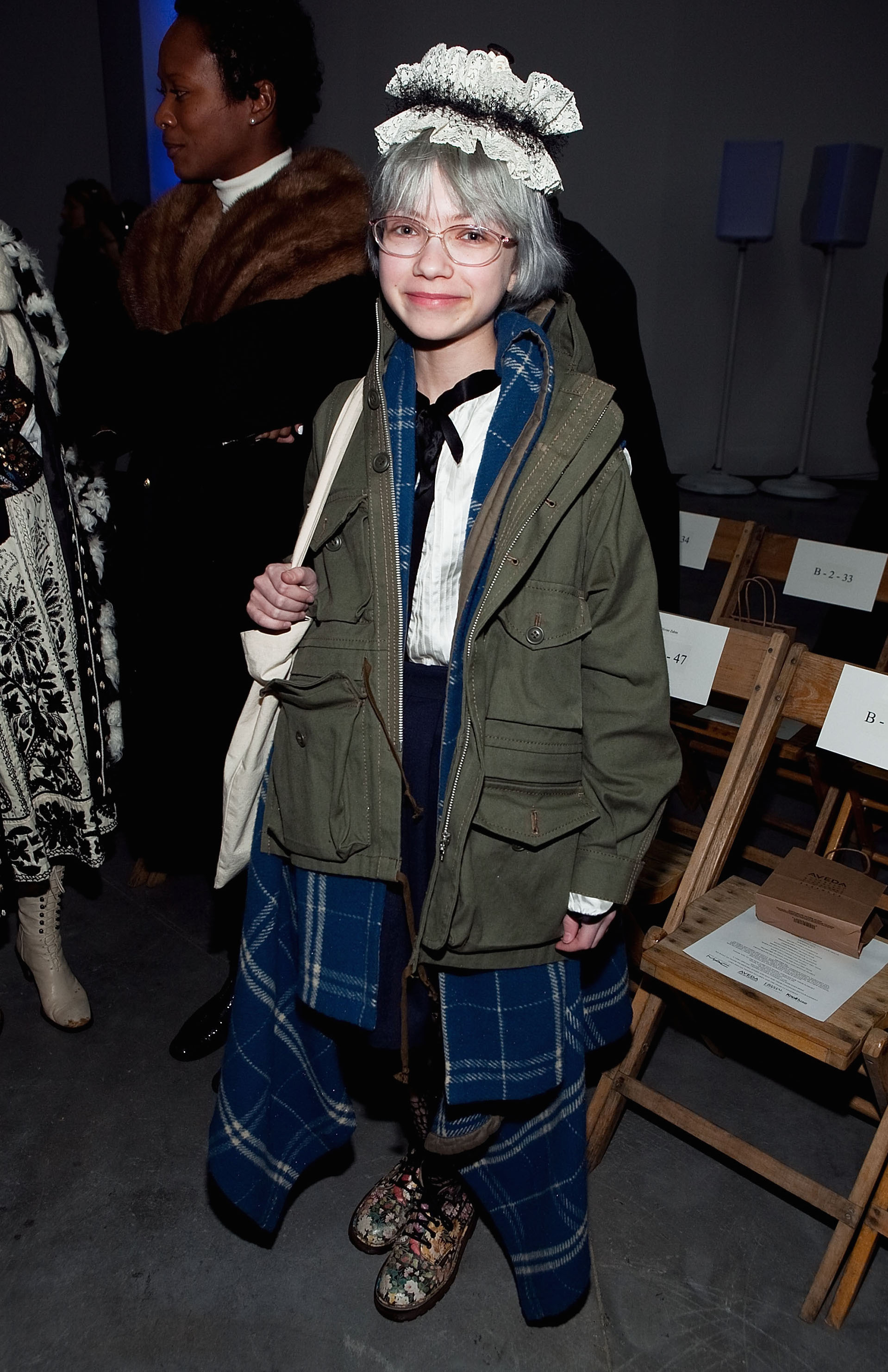
Mercedes-Benz Fashion Week Fall 2010 - Rodarte - Front Row And BackstageGevinson was flown (with her father) to London to make a zine for Pop magazine, but then Dasha Zhukova, at the time the editor of Pop, liked her style—which, at that point, was an avant-garde-granny kind of thing—so much that she ended up on the cover. Next she was in New York at a Fashion Week party at the Gagosian Gallery while Cindy Sherman complimented her self-portraits and Björk wandered by and then Richard Prince did too. …

In anticipation of everything new, she broke up with her boyfriend “totally out of love and respect. You can’t stay with your high-school sweetheart forever,” she says. “People do, but you shouldn’t.” They’d broken up once before, but it didn’t stick. “I flew straight to New York for a wedding,” she says, “and then I visited Taylor Swift at her home in Rhode Island. I hate being heartbroken, but who better to discuss it with than Taylor Swift?” Next was a visit to her friend Lena Dunham on the set of Girls, then it was back to Oak Park, where she and the boyfriend reunited. But it didn’t last.

If you’re over 18 and have yet to cry on Taylor Swift’s shoulder about lost love, you may need to rethink your life choices. While you’re doing that, you may find yourself elsewhere in NYMag, specifically Ann Friedman’s celebration of the age 29:

My 29th year was when things started to click for me, personally and professionally.

I finally found the courage to quit a job I’d long hated and leave a city I liked even less. I was still working really hard, but felt like I was finally gaining some traction. It was around age 29 that the number of fucks I gave about other people’s opinions dipped to critically low levels. Which freed up all kinds of mental and emotional space for the stuff I was really passionate about.

I don’t think I’m the only one. The late 20s and early 30s seem to be a turning point in many modern women’s lives. For a while I’ve been taking note of creative women I admire who come into their own and start producing amazing work on the cusp of 30.Margaret Atwood and Joan Didion published their first books at age 29. Patti Smith recorded Horses at 29. Tina Fey was 29 when she was named head writer of Saturday Night Live. bell hooks published her first major work, Ain’t I a Woman?: Black Women and Feminism, when she was 29.

Friedman clarifies that impending-30-ness doesn’t necessarily equal stardom:

[E]ven for women who realize they still have a lot of things to figure out, around age 30 a sense of acceptance begins to settle in. It’s when many of us experience our first big career payoffs, and allow ourselves to exhale a little because for once it doesn’t feel like we’re building our lives from scratch. On the cusp of 30 — in stark contrast with prior milestones like college graduation — you’re set up to finally start living your best life, or at least a realistic approximation of it. You realize you’ll never be a wunderkind, and you’re okay with that. In general, you give way fewer fucks.

Like probably most women over the age of 25, I’ve read my share of ’30’ pieces, of which Friedman’s is one, even if it’s technically about 29, as a nod to the recent, highly scientific finding that we – and that’s men and women – peak at 29. What women-oriented 30-pieces seem to have in common is that they’re about providing a silver lining to the presumed over-the-hill status of women no longer in their 20s. And that silver lining is always some variant of, you may not be nubile, but you have your life together! You may get called ‘ma’am’, but you’re past the point of caring about such trivial matters!

The trouble with these pieces is that, while it’s of course possible to generalize about any population, the individual women reading these stories are unlikely to relate – a problem because being relatable is their very purpose. By any age milestone, most of us are going to have exceeded some of the markers and fallen short of others. And the ones we’re going to worry about are the ones we haven’t met. If you’re single and wish you weren’t, advice along the lines of, now that you’re 30, your dating life is in order, and you’re so over caring what you look like? Not so helpful. So, too, if you’re reading about how established you surely are in your career, but you’re unemployed, staying home with kids, or in your fourth – or fourteenth – year of grad school.

The reassurance, in other words, always ends up provoking still more anxieties. It’s strangely more reassuring to read about Tavi – at least there, there’s the solidarity shared by all of us who are not as accomplished as she is.

(Photo: Blogger Tavi attends Rodarte Fall 2010 during Mercedes-Benz Fashion Week in New York City on February 16, 2010. By Paul Morigi/WireImage)

Trend Anticipation

by Phoebe Maltz Bovy

Rachel Hodin at Into The Gloss declares delicate jewelry so last season:

As someone who’s skilled in the art of falling (and then breaking those falls with her hands), a change from the popular dainty ring scenario feels in order. However, it wasn’t until I stumbled on Erin Wasson’s Instagram (“stumbled” being an exalted term for my stalking habits these days) that I could finally visualize it: thick gold rings. Paired with nothing more than plain pants and a basic white tee, Erin’s ring game looks fresh in comparison to ‘gram upon ‘gram of dainty finger stacks (though it’s probably mostly vintage).

This is a real shame, because the dainty rings Hodin finds insufficiently “fresh” are much prettier than the clunky ones that barely manage to work on Erin Wasson, the model-about-town wearing them. While I’m not super into rings myself, and only wear the ones that may cause others to question my feminist principles, for other jewelry, or jewelry on other people, I suppose I’m Team Dainty. But that is not our principle concern.

So, back to Hodin: The ‘grams in question refer not (just) to the weight of a really tiny ring, but to Instagram. As every last Dish reader surely knows, for some time now, all the fashion-blogger-types were posting pictures of themselves with dainty rings, sometimes stacked, often worn in addition to wedding and engagement rings. Sometimes worn, bafflingly, at the knuckle. (How do those stay on? Answer, from the infinitely stylish Garance Doré: They don’t.) This was the look of 2013, which explains why, in 2014, the NYT style pages have announced that dainty is so very now. As has Forbes.

A cynic would consider the possibility that someone trying to sell clunky rings has PR’d said jewelry onto Wasson, hoping that enough shots of this edgy-gorgeous woman glaring, smoking, and giving the finger in a certain sort of ring would convince us plebs to go out and buy the same kind of ring. (Learned the hard way: Just because a look works on Alexa Chung, it may not work on you. Presumably this principle carries over to models and it-girls more generally.) But of course something along those lines must have been what brought us delicate rings as a thing. Still, that something is being marketed to us doesn’t mean it’s not appealing in its own right.

What was so brilliant about this ITG post was its timing. “Delicate” has been the thing for quite some time, which explains why the notoriously late-to-the-game NYT style pates only just now took notice. The NYT pieces suggest a knuckle-ringed finger to the pulse, but for whatever reason (a stodgy editorial process?), they’ve arrived once the moment’s over. That, or their arrival means that the moment’s over.

All of which gets us to the secret formula of trend anticipation. It involves identifying current trends once they’ve reached their peak and declaring the opposite look the hot new thing. Has the NYT discovered skinny jeans? Mom jeans are the thing. They just feel fresh.

While trend anticipation skills probably do have some financial use I have yet to harness, they don’t by any means need to determine our own sartorial choices. I will leave mom jeans and enormous gold rings to those at the cutting edge, and will stick with daintier denim and accessory options for my own trips to such glamorous places as the Wegmans parking lot.

Trolling And The Confessional Essay

by Phoebe Maltz Bovy

Alyssa Rosenberg looks at the implications of Jezebel’s troll crisis:

The Jezebel staffers’ complaint [that their parent company isn’t blocking porn-bearing trolls] raises a broader issue. As publications have struggled to figure out what will reliably draw in both readers and advertisers on the Internet, feminist posts have emerged as a clear success story, one that provokes a unique response, both positive and negative. Feminist political commentary, feminist cultural criticism and women’s first-person narratives and personal essays have all done well in this challenging new ecosystem, even as they have inspired a particularly ferocious backlash. Many online publications have been willing to profit from these positive responses, but they have been slow to protect the writers and editors who must deal with ugly responses.

Rosenberg expands on the economics of women-oriented journalism:

One of the attractions of feminist writing is that it can be inexpensive to produce. XOJane, a women’s site that specializes in personal essays and first-person narratives pays $50 for such pieces. Bustle, a women’s site from Bleacher Report founder Bryan Goldberg, garnered derision last year when, on its launch, it advertised a part-time job that would pay the person who landed it $100 a day, at least three days a week, to produce between four and six posts each day.

I’d expand this further still, moving away from the persistent but seemingly blanket spamming Jezebel is evidently facing, and focusing instead on the sort Jessica Valenti and other female writers contend with: Personal insults, often of a deeply personal nature.

It’s not just that, as the Jezebel case indicates, female women’s-topics-type writers aren’t receiving proper support when it comes to the responses their work ends up eliciting. We also need to consider the sort of pieces women are encouraged to write in the first place: The more personal, the better. It’s not simply, here is woman journalist, here is woman’s issue – which is its own concern, but a separate one. The post or article often has to be about the woman. It needs to be about her contraceptive choices, her feelings about her cellulite and oh, perhaps a visual of that cellulite to go with?

Rosenberg’s article hints at the relationship between mandatory overshare and the industry but assumes that the writers who share are doing so readily:

Unfortunately, it sometimes seems like burnout is part of the business model. If one staffer is exhausted by a tidal wave of sexist e-mail and comments, another one will be eager to take her place, confident in her own imperviousness. If a writer becomes uncomfortable with using her own life for material – or, like Hannah Horvath on “Girls,” runs out of life experiences to turn into stories – there will be someone else out there who is invigorated by the possibilities of the personal essay.

We shouldn’t look at this as women simply liking to overshare. This is what gets page-views, and what’s the easiest for the most writers to produce. The desire here is about getting published, not (in most cases) about sharing something personal with the world. Personal sells, but it’s also what attracts the most painful sort of trolling.

The thing is, it’s not so difficult to accept divergent viewpoints from readers, even if the occasional UR WRONG can sting. But a contrarian take on, say, your IUD, your self-image in that bathing suit, is different from the same on birth control or body-image generally.

It’s not any more acceptable for a personal-essay writer to be subject to abuse than for any other sort of writer. The point here isn’t to blame the victim, but rather to question how we’ve even arrived at this hyperpersonal form of women-oriented journalism. It’s been sold to female writers as a sort of liberation. Speak your truth! And it can be just that, but only if the writer is sophisticated enough to handle whichever backlash, and established enough to be adding the personal details intentionally (as I’d assume was the case when Valenti shared the story of her first period), and not trying to trade the story for a professional contact or $50.

How Sexually Fluid Are Women Really? Ctd

by Phoebe Maltz Bovy

More readers have reacted to my post on the great, cascading river that female sexuality is, or isn’t, as the case may be. One makes the fine point that, even if bachelorhood goes unremarked in some locales, that’s not always the case:

I have to dissent. Since the stigma against being gay is more intense for men, I suspect there are still more gay men who are covering it up by getting into relationships with women. Especially in small towns across America.

This same reader goes on to agree with Savage that the problem is monogamy:

I don’t dispute your point about women having far more pressure to project desirability and to pair up; but as for the woman in Dan’s podcast, isn’t it just as likely that she’s simply bored of monogamous straight sex with this particular guy? Maybe she’s thinking of women 90 percent of the time because every instance of bland sex with her boyfriend reminds her that there’s another kind of experience she’s depriving herself of.

I can’t listen to the podcast, since I’m at work, but I’m assuming the boyfriend knew she was bi when they started dating? If so, then the boyfriend knows there’s a dimension of her sexual appetite he is utterly powerless to satisfy. I’d be curious to know how bisexuals get around this issue. Because while the boyfriend sounds selfish, he has reason to fear that his girlfriend’s sex with another woman will develop into much more than that. On the other hand, if he gives the affair his blessing, then would it be fair for him to expect to indulge based on his attraction to a physical trait he desires but his girlfriend lacks?

Of course, these are the absurdities that come with our society’s imposing sexual monogamy on creatures who don’t really want it. As more of us straights talk candidly with gay men who are in open relationships that last, you’ll see polygamy go mainstream. In 50 years, there will be a Mad Men-type show set in the early aughts, and the next generation will mock us for being Puritans. (Also, for being fat and haphazardly destroying the planet, but that’s an email for another day.)

Another reader thinks that not just bisexual women but straight ones, too, feel the occasional or more-than-occasional tingle for a woman:

You wrote, “Savage, in his response, likens her persistent desire to be with women to kinks and fetishes people try to repress over the years (he mentions foot fetishes), and it’s like, gah, this woman is a lesbian!”

Nope. She’s not.

I came out as bisexual in my late teens because hey, most of the time (maybe not 90%, but definitely more than 50%) I fantasized about women. But then, at university, I tried dating some girls, and the reality was way different from the fantasy. Not my thing at all. This wasn’t a fear of the social consequences of not being straight; I had already come out to all my friends. This was me being faced with the reality that vaginas, in person, are not my thing. I’ve been married to a guy for a few years now, and my fantasies haven’t changed, but my in-person sexual preference is definitely for penises. I bet this is not uncommon among straight women.

I’m still waiting to feel something other than envy when I see pictures of Natalia Vodianova, but who knows, that day may come! And I’ll leave it to the trans activists (not the bisexual activists this time) to offer up the obvious suggestion for where someone might turn if they’re into women but not vaginas. Or, I’ll save them the trouble: Not all women have vaginas.

Yet another reader dissents, and might have something to contribute to a certain hit TV show:

I’m following your thread on female sexual fluidity with interest for I was a Federal female inmate for over 11 years and believe me, it is real.

In my experience, well over half of the general prison population and probably more than 75% of long-timers, paired off – got girl friends. (Sex outside of a relationship happened but wasn’t the norm.) These pairings were not merely high school-type, best-friend stuff. A few, due to religious scruple or fear of breaking rules were chaste, albeit with lot of smooching. Most were sexual … or as sexual as was possible in an overcrowded institution where caught-in-the-act meant weeks in the hole.

From what I could gather, most of the women did not think of themselves as lesbian or even particularly bisexual. Many were not sufficiently sophisticated to know what they were but if they’d had to select, most would have probably chosen “straight.” Often they maintained relationships with lovers or husbands on the streets and I would watch at mail call as an ardently committed couple swooned over pics of each other’s boyfriends. Now that’s pretty fluid. So I’m here to profess that, lock us up at least, and we’re a sexually fluid gender.Behind the walls we even gave it a name. We called it being “gay for the stay.”

The real question is, what does Natasha Lyonne think about all this? But the relevant question here, which is probably answerable, is how this compares with what goes on in men’s prisons. A lack of opposite-sex options has been known to cause a kind of fluidity in both sexes, but I’m not sure what that says about life in the coed world at large.

And then there’s a reader who agrees with me, and who shares the following anecdote:

I have a female friend who was with her boyfriend exclusively since high school.  She thought sex with her boyfriend was OK.  No complaints.  Then one night when she was in her late 20s, she had an extremely vivid sexual dream involving a female celebrity and everything changed.  Up to that point, she had never even considered sex with a woman, now she had become obsessed with it. Luckily, her boyfriend was very supportive and helped her explore these thoughts (and not in a creepy way) by renting lesbian movies, reading books about lesbian sexuality, going to group discussions at the local LGBT Center about questioning your sexuality, etc…

It took over a year, but she was eventually sure that she was a lesbian even though she hadn’t actually been with a woman sexually (or even kissed a woman) up to that point.  So she and her boyfriend officially split (they remained very close friends) and she started going on dates with women she met online or through events at the LGBT Center.  She eventually met a woman through some mutual friends, fell in love, and went to Vermont to get a civil union. They’re still happily together today.  They went back to Vermont on their 10-year anniversary and got married.

I’ve talked with her at length about the whole crazy roller coaster ride.  She says that she never even considered that being gay was an option when she was growing up. Never crossed her mind.  You don’t really know what other people are feeling or what’s normal.  It’s kind of like being a kid who is nearsighted and not knowing that you need glasses.  You just assume that things are blurry because they’re far away and that everyone else is seeing the same thing.

So, in at least once case, a woman who identified as straight stopped over at bi before arriving at lesbian. Doesn’t mean all bisexual women will do so.

And finally, a reader gets at the essential:

I think that the “female fluidity” thing is a male fantasy superimposed on flimsy evidence just because, as I said earlier, men think they know it all. They know how to be men and they know how to be women too. And yeah, Dan is gay but that doesn’t make him immune to the socialization and stereotypes. Males are taught to believe a lot of nonsense about women. Just as we are taught to believe nonsense about them.

Ultimately, I’m not particularly concerned with how sexually fluid the typical woman turns out to be, and am far more interested in the reasons we keep hearing the ‘women are sexually fluid’ refrain. It is, as this reader notes, partly about how neatly this matches up with something many straight men have long hoped to hear: A threesome’s in the cards, not for me, oh, no, she’s the one who wants it! Not, of course, that that’s what it actually means for a woman to be bisexual, or sexually fluid, but it does help explain why there’s such a receptive audience for every scrap of evidence that this is just how women are wired.

But the bigger issue, for me, is that ‘women are sexually fluid’ is used as a way to affirm what many already believe about female sexuality of all stripes: That it’s basically nonexistent. That women care about relationships, but don’t experience intense physical desire. The way it’s often framed, this allegedly fluid female sexuality isn’t so much about lusting after men and women at various points in one’s life or one’s afternoon, but rather, about women never lusting after anyone, and thus being equally content with a male or female best friend.

The Myth Of Pretext-Free Anti-Semitism

by Phoebe Maltz Bovy

Protests on Al-Quds Day in Berlin

Alongside the coverage of Gaza, on the Dish and beyond, has been a steady stream of coverage of a kind of shadow issue: European anti-Semitism. Writes Jon Henley:

Across Europe, the conflict in Gaza is breathing new life into some very old, and very ugly, demons. This is not unusual; police and Jewish civil rights organisations have long observed a noticeable spike in antisemitic incidents each time the Israeli-Palestinian conflict flares. During the three weeks of Israel’s Operation Cast Lead in late 2008 and early 2009, France recorded 66 antisemitic incidents, including attacks on Jewish-owned restaurants and synagogues and a sharp increase in anti-Jewish graffiti. But according to academics and Jewish leaders, this time it is different. More than simply a reaction to the conflict, they say, the threats, hate speech and violent attacks feel like the expression of a much deeper and more widespread antisemitism, fuelled by a wide range of factors, that has been growing now for more than a decade.

“These are the worst times since the Nazi era,” Dieter Graumann, president of Germany’s Central Council of Jews, told the Guardian. “On the streets, you hear things like ‘the Jews should be gassed’, ‘the Jews should be burned’ – we haven’t had that in Germany for decades. Anyone saying those slogans isn’t criticising Israeli politics, it’s just pure hatred against Jews: nothing else. And it’s not just a German phenomenon. It’s an outbreak of hatred against Jews so intense that it’s very clear indeed.”

Observers who don’t happen to be Jewish may see this and think, hmm. At a time when there are all these people being killed by Jews, is anti-Semitism really worth discussing? Indeed, it’s quite possible to be Jewish and to share this entirely understandable sentiment. (I’m Jewish and don’t share it, but more on that in a moment.) While right-thinking people balk when anti-Zionism crosses the line, it can seem just… odd, as if one is conflating the armchair bigotry Jews are experiencing on the continent that, yes, yes, hosted a genocide against them, but ages ago, when right now, there are dead Palestinian children. When Hadley Freeman, who normally writes about fashion, took on this issue, writing, “Clearly, a film festival being cancelled is not on a par with civilian deaths,” while I didn’t share the Guardian commenters’ collective eye-roll, I did understand it.

Yet anti-Semitism is intricately tied up with the situation in the Middle East, just not in quite the ways people seem to think.

Here’s what the popular conception of anti-Semitism gets wrong: The assumption seems to be that once upon a time – Nazi Germany, the Spanish Inquisition – Jew-hatred existed absent any particular justification. It was religious bigotry! Racial pseudoscience! Or, if the Jews in question were poor immigrants, hatred of the underdog! It was, people imagine, just this kind of generic bad, like racism, sexism, and homophobia, with innocent victims of ignorance. Whereas now, well, we can’t possibly be witnessing any anti-Semitism, because… look at Israel!

We see a version of this in Owen Jones’s intervention on the topic. Jones acknowledges that there are occasional snippets of anti-Semitism posing as anti-Zionism, but is dismissive of those, insisting, “The vast majority of pro-Palestinian sentiment is driven by a sense of solidarity with an oppressed people subjected to occupation, siege and a brutal military onslaught.” The real anti-Semitism comes from… basically anywhere other than the Western European left:

Take Greece, where the neo-Nazi Golden Dawn has thrived amid economic trauma. Back in May, 16% of Athenian voters opted for the Golden Dawn candidate for the city’s mayor. According to a recent study, 69% of Greeks had antisemitic views; in Poland – despite suffering some of the Nazis’ worst horrors – it was 48%, Spain 53%. In Hungary the antisemitic party Jobbik won a fifth of the vote in April’s parliamentary elections. Like most of Europe’s far right, France’s Front National focuses its bile against Muslims, but the party’s roots are deep in antisemitism; and a few months ago it topped the country’s European parliamentary elections.

While my knowledge of Jobbik’s exact platform is limited, I suspect that Hungarian anti-Semites don’t hate Jews for the heck of it, but that they, like other anti-Semites (including those whose interest in the ‘Palestinian cause’ far outweighs any interest in the Palestinian cause), have their reasons. Such as… well what do you know?

Anti-Semitism has always been about the notion of Jews having too much power. This has nothing specifically to do with Israel, let alone with anything this particular Israeli government has done. I’m quite sure the 1840s French writers holding forth about the Rothschilds weren’t reacting to anything the not-yet-existent Israel would do more than a century later. And it typically points – selectively – to real instances of Jews behaving badly. No, the deal with anti-Semitism is, it’s about highlighting Jews’ bad behavior; seeing only that; inventing some more; while at the same time ignoring good Jewish behavior as well as bad behavior on the part of non-Jews. We all know the refrain: Not all criticism of Israel is anti-Semitism. But the presence of legitimate criticisms often hangs out within a broader ideology that puts The Jew at the center of absolutely everything terrible that’s ever happened.

Palestinians’ actual enemies thus overlap substantially with anti-Semites’ imagined ones, but this doesn’t make Palestinians who fight for their own cause anti-Semites. If you’re Palestinian, and you have objections to Israeli policies, chances are this is not because of some ambient anti-Jewish sentiment you’ve absorbed, but rather because you don’t enjoy occupation, bombing, and discrimination. (For exact ratios of how much one is to blame Israel, how much Hamas, one or two other people have addressed the topic; I’ll pass.) If you’re not convinced by ‘there are greater tragedies in the world’ arguments, it’s not because you’re putting Israel at the center of everything. It’s because Israel is rather central to your own situation.

At the same time, there’s this preexisting set of people who aren’t Palestinian, who may have nothing to do with any Jews, Israeli or otherwise, but who imagine Jews are responsible for everything that’s gone wrong in their lives, and who sit waiting for their aha! moment. For the moment when Jew-bashing and nodding approvingly and synagogue-vandalizing becomes acceptable in polite society.

All of this, then, puts Palestinians in a bind. They honest-to-goodness are being oppressed in a Jewish state. And they have this built-in base of support in anti-Semites the world over. Those who call Hamas “anti-Semitic” sort of miss the point. It’s not that Hamas hasn’t embraced whichever tropes, playing at the above-mentioned audience. But the more relevant issue is that the Palestinian cause needs to be truly separated from the ‘Palestinian cause’ for real progress to occur.

(Photo: Members of the German riot police allegedly confiscated an Israeli flag while it was waved to protest against a demonstration for Al-Quds Day, an event intended to express solidarity with the Palestinian people, on July 25, 2014 in Berlin, Germany. By Carsten Koall/Getty Images)