Ding Dong

300_delay0403

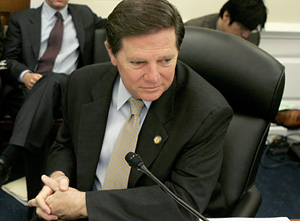
You know it’s bad for the GOP when National Review and Instapundit barely mention the big news of the day. Tom DeLay’s resignation from elective politics, barely a year and a half after the triumphant Republican re-election campaign of 2004, is a remarkable fall from grace. It happened because the bankruptcy of contemporary Republicanism is increasingly unmissable. And it happened because of obvious corruption, sleaze and a complete lack of broad public appeal. DeLay’s skills were not retail; they were back-door: the schemes and deals and handshakes that are inextricable from effective government but not pretty in daylight. DeLay took that ruthlessness too far, got exposed, and now fairly taints the GOP’s broad national image. It’s probably good news for the Republicans in the short term. They get some time to distance themselves from the architect of their Congressional hegemony. But he was the architect, as integral to contemporary Republicanism as Karl Rove; and the product of the same Southern/Texan Christianist movement that has turned the Republican party into a religious sect, with some business interests along for the ride. Should DeLay have an epitaph? I think so. Let it be his astonishing speech of merely a week ago to a Christianist conference in Washington DC:

"Sides are being chosen, and the future of man hangs in the balance! The enemies of virtue may be on the march, but they have not won, and if we put our trust in Christ, they never will … It is for us then to do as our heroes have always done and put our faith in the perfect redeeming love of Jesus Christ."

In the end, even the Republican candidate from the Congressional district of Galilee couldn’t save him.

(Photo: Mark Wilson/Getty)

Nietzsche and the Theocons

There is a world in Nietzsche. And he foresaw the theocons. In the same work, he wrote about the attempt to reverse what has evolved in Western consciousness:

"Whispered to the conservatives. — What was not known formerly, what is known, or might be known, today: a reversion, a return in any sense or degree is simply not possible. We physiologists know that. Yet all priests and moralists have believed the opposite — they wanted to take mankind back, to screw it back, to a former measure of virtue. Morality was always a bed of Procrustes. Even the politicians have aped the preachers of virtue at this point: today too there are still parties whose dream it is that all things might walk backwards like crabs. But no one is free to be a crab. Nothing avails: one must go forward — step by step further into decadence (that is my definition of modern "progress"). One can check this development and thus dam up degeneration, gather it and make it more vehement and sudden: one can do no more."

And which of these options best describe Richard John Neuhaus? One suspects the latter.

Nietzsche and Marriage

A reader sends me the following quote from Nietzsche about what he regarded as the collapse of marriage as an institution over a century ago. What strikes me is how theoconservative he sounds to a contemporary ear. His rhetoric is very close to that of Stanley Kurtz and other anti-modernists on the far right. The loathing of Western Europe, the elevating of more primitive, patriarchal forms of marriage, the celebration of manliness, the defense of torture, the insistence on marital procreation: all these are now integral parts of theo-conservatism, which, in so many ways, is an attempt to resurrect Aquinas in the light of Nietzsche. Here’s a quote that could well have come from Stanley Kurtz, as expressed in Nietzsche’s "Twilight of the Idols":

"Witness modern marriage. All rationality has clearly vanished from modern marriage; yet that is no objection to marriage, but to modernity. The rationality of marriage – that lay in the husband’s sole juridical responsibility, which gave marriage a center of gravity, while today it limps on both legs. The rationality of marriage – that lay in its indissolubility in principle, which lent it an accent that could be heard above the accident of feeling, passion, and what is merely momentary. It also lay in the family’s responsibility for the choice of a spouse.

With the growing indulgence of love matches, the very foundation of marriage has been eliminated, that which alone makes an institution of it. Never, absolutely never, can an institution be founded on an idiosyncrasy; one cannot, as I have said, found marriage on "love" – it can be founded on the sex drive, on the property drive (wife and child as property), on the drive to dominate, which continually organizes for itself the smallest structure of domination, the family, and which needs children and heirs to hold fast – physiologically too – to an attained measure of power, influence, and wealth, in order to prepare for long-range tasks, for a solidarity of instinct between the centuries. Marriage as an institution involves the affirmation of the largest and most enduring form of organization: when society cannot affirm itself as a whole, down to the most distant generations, then marriage has altogether no meaning. Modern marriage has lost its meaning – consequently one abolishes it."

Or reinvents it, as we have in the West – and long before gays sought to join it. I’m much more at home in modernity than Nietzsche was. In fact, I celebrate many aspects of it. And in that celebration of modernity lies the faultline in current conservatism. I’m for it, with multiple qualifications. They’re against it – with varying degrees of regret.

Email of the Day

A reader writes:

"The person making a big stink over Pianka, Mims, is a creationist with an anti-science agenda. If you read the article, you’ll note that Pianka was basically presenting his research on dangerous diseases in a silly way, and not actually seriously advocating anything at all. But such goofy over-thetop hyperbole is no longer contextual: in a world of internet context-stripping it was ripe fodder for the latest faux outrage scandal. Please, step out of the chain, and take things with a few more grains of salt. Stop and think for a second: you REALLY think that Pianka or any of his students seriously wants the end of the world? Just like end-of-times people? Come on. Trying to find phony equivalences just to look more even-handed is silly."

More context here.

Left Behind

Drudge’s expose of a wacko environmentalist looking forward to the end of humanity through massive plagues was telling to me. In the long run, right-wing fundamentalism and left-wing fundamentalism end up in the same place. A core aspect of most such ideologies is their expectation of a moment in the future where all that they currently despise will be done away with and all will be well. So you have the eschatology of the early Christians, which eventually morphed into the nineteenth century doctrine of pre-millennialism, which is the forefather of the astonishingly successful dispensationalist fiction series, "Left Behind." You have Ahmadinejad forseeing the return of the Twelfth Imam and doing what he can to accelerate it. You have John McCain’s new best friends, Jerry Falwell and Pat Robertson, seeing the End-Times approach, when every homosexual, feminist and Jew will be roasted alive by Jesus. You have Marxists expecting the Communist revolution when all alienation will be dispelled. And you have the fundie enviro-left eagerly anticipating species annihilation. To my mind, it’s a very good indicator of whether someone is worth listening to from a political stand-point. Those who expect the end of the world relatively soon should be kept as far away from public office as possible. They can keep their apocalypses to themselves.