Large inflatable rabbit sculptures go on display at the Southbank Centre in London, England on December 4, 2014. The seven-metre-high inflatable sculptures by Australian artist Amanda Parer entitled “Intrude” form part of the Southbank Centre’s Winter Festival that opened in November and runs until January 11, 2015. By Peter Macdiarmid/Getty Images.
Author: Andrew Sullivan
Getting Out The Vote By Any Means Necessary
Tomasky ponders the Republicans’ midterm advantage:
The turnout problem, I suspect, runs deeper than the message of the moment. Republican voters, being older and somewhat wealthier and more likely to own property, are more apt to see politics as a continuing conflict of interests that roll over from one election to the next—they can always be convinced that some undeserving person is coming to take away what they’ve earned. Voters who are overall younger and have fewer assets are less likely to view politics in such stark terms. The thundering high and crashing low of these voters’ experience with Obama—“I had such hope in him, I thought he could really change things”—reflect this.
Ambinder wonders if Dems will come “to view the Republicans like the Republicans view the Democrats: as an enemy”:
For good-government, consensus, let’s-get-along, politics-can-be-pure types, this is a horrible message. Can it be true that the only way for Democrats to vote their true strength is to treat the opposing party just as poorly as the opposing party treats the Democrats? Can it be true that the only way to break the logjam is to embrace a politics that is even more loathsome, more unctuous and more uncivil than it is today?nMaybe, yes.
The Parent-Friendship Trap
Tracy Moore reflects on friendships rooted in parenthood:
I know what you’re thinking: Wow, do I even want to make parent friends!? Aren’t my old regular friends good enough? The answer is: yes you do and no they are not.
Try as your old friends might to adjust to you plus baby, they can and should only have to adjust so much. There is nothing better than commiserating over an annoying teacher or childhood development phase with someone staring it down on the same lack of sleep as you. If you discover that you both actually like even a few of the same new bands, restaurants or movies, lock that shit down. Because when you find other parents who are as laid back as you are (or aren’t), as flexible as you are (or aren’t), and as approximately cool as you are (or aren’t), it’s easy and fun and it reminds you how friendships work anyway: You get together sometimes, you like their company, and it’s pretty fun.
My real advice is this: Stay open-minded, lower your expectations, and remember that it’s really about your kids. So do make the effort to expose yourself and your kid to as many types of people that are out there, while also understanding that if your kid doesn’t like the kids of your parent friends, the whole situation is hosed. Try also to compartmentalize the friendships the way you might “friends with benefits,” aka, “play date with good snacks” or “play date with Pinterest mom” or “playdate with free stock market discussion.”
The View From Your Window
Thoughts On Affirmative Action, Ctd
Many readers are agitated over this post:
Regarding the comments from the “Asian-American reader and Harvard grad with a JD and MPH” on rhetoric and composition, my field of discourse, I guess I never thought to consider Aristotle, Cicero, Campbell, Blair, John Quincy Adams, Nietzsche, Burke, etc., as “squishy” scholars. I suppose I could make some rude comment about the unenlightened, unethical, anti-humanities discourse of the commentator. However, I will just let his own remarks stand and undermine his own ethos and that of his argument.
Another has Freddie’s back:
I’ve enjoyed the dialogue between you and Freddie deBoer, and I am genuinely conflicted on the merits of the policy in question. While I appreciate your dedication to airing dissents, the recent reply from the Asian-American Harvard grad is both misinformed and mean-spirited toward Freddie. I think it’s worth noting a few things:
1. Freddie’s Ph.D. program in Rhetoric and Composition (he does not yet have his degree) is extremely rigorous and empirical; I’d love for your reader to read this article and explain how it typifies “squishy” humanities thinking: “Evaluating the Comparability of Two Measures of Lexical Diversity”
2. The idea that Freddie can be lumped in with any group of “happy talk” liberals (especially the anti-intellectual strawmen this reader depicts) is pretty laughable.
3. To the larger argument: MIT is about 24% black and Latino and about 24% Asian. CalTech has chosen not to use affirmative action; that’s fine. But it is a choice, and the idea that they would be unable to put together a more diverse class should they choose to do so is not supported by any evidence at all.
4. The final anecdote about the risky brain surgery at the hospital that rewards diversity and not merit is a ridiculous false choice. Your reader went to Harvard, which has been open about trying to diversify its student body since the mid-1940s. Should your reader’s diploma have an asterisk on it? Forget brain surgery – I wouldn’t let this particular reader feed my cat.
Freddie also responds to the Harvard grad, in an email to the Dish:
My research interests are diverse, but most of my time is spent looking at spreadsheets, using algorithms used in natural language processing and corpus linguistics, typing away in R Studio. I do quantitative work, myself, computerized, quantitative work. I personally don’t think that makes my study more rigorous or meaningful, but clearly, the emailer does. Even a minute of genuine research would make this aspect of my research identity clear. Instead, the emailer Googled my name, spent 15 seconds, and did no other research to confirm his or her presumptions. I would call that remarkably lacking in merit, myself.
One more:
Your reader, his credentials aside, seems to forget that his alma matter has, according the US News, the third best chemistry department in the country, the second best physics department, the best biology department, the third best math department, and the seventh best statistics department in the country. Now, while I’m well aware that Cal Tech doesn’t use affirmative action, Harvard seems to be doing just fine using affirmative action, and in some cases, better than Cal Tech. Remember, Cal Tech is the anomaly here – all the Ivies and other elite colleges (MIT, Stanford, etc.) practicing affirmative action admit just as qualified students as Cal Tech, not worse ones. So to come out swinging with an argument that affirmative action is somehow harming scholarship or impeding human progress by prioritizing “jargon and happy-talk” over “traditional notions of academic rigor” is grossly inaccurate.
I also want to tie in this story over at the Upshot about how 80 percent of high-achieving students get into elite colleges. I think it’s important to remember that, while Asian-American students may be “underrepresented” at Harvard, they are not underrepresented in the college-educated population. In fact, the majority of adult Asians have college degrees. So it isn’t as though Asians are systematically being denied higher education in this country – they are in fact achieving it at a greater pace than the rest of us. To abolish affirmative action, aimed to help under-represented minorities in the entire education system, under the guise of helping the group that is honestly exceeding everyone else, seems wrong to me.
Mental Health Break
The Universal Appeal Of Uber
Felix Salmon sees Uber’s international reach as its key advantage:
This might not be obvious to people in San Francisco, who are spoiled with dozens of hopeful and well-funded startups, many of which are doing much the same thing that Uber is aspiring to. But leave the Bay Area, and the fears and frustrations of trying to get a cab start getting magnified — especially when you’re in a foreign country. The value of Uber is only partially in the service it provides; increasingly, it’s also in the global ubiquity of that service.
I just got back from Rome; I took a standard white cab from the airport, and then took an Uber back to it. The Uber was much a much more pleasant ride, as well as being cheaper. But most importantly, it came without any of the anxieties that generally accompany getting into a stranger’s car in a foreign country. Such anxieties are generally small, in a country like Italy, but even the locals will warn you against hailing a cab in a place like Mexico City.
He remarks that Uber is “the first app which can deliver a three-ton glass-and-steel machine to wherever you happen to be, in any of 200 cities around the world, in minutes”
That’s why Uber’s bulls think of it as a logistics company rather than a taxi company: it’s fundamentally about being able to move things (initially passengers, but that’s already expanding), within city boundaries, with unprecedented levels of efficiency. Most impressively, Uber has managed to do this within a single app: it doesn’t have a different version for every country that it’s in. Anybody with an Uber account, no matter where they’re from, can automatically use Uber in any city in the world where Uber operates. This is non-trivial, and not at all easy to replicate.
Godard’s Eternal Youth
In honor of their centennial, last week TNR reposted a classic 1966 piece by the great critic Pauline Kael. In the essay, she reserves special praise for Jean-Luc Godard, whom she hails as a hero to a new generation of independent-minded filmmakers:
There is a disturbing quality in Godard’s work that perhaps helps to explain why the young are drawn to his films and identify with them, and why so many older people call him a “coterie” artist and don’t think his films are important. His characters don’t seem to have any future. They are most alive (and most appealing) just because they don’t conceive of the day after tomorrow; they have no careers, no plans, only fantasies of the roles they could play, of careers, thefts, romance, politics, adventure, pleasure, a life like in the movies.
Even his world of the future, Alphaville, is, photographically, a documentary of Paris in the present. (All of his films are in that sense documentaries—as were also, and also by necessity, the grade B American gangster films that influenced him.) And even before Alphaville, the people in The Married Woman were already science fiction—so blank and affectless no mad scientist was required to destroy their souls.
His characters are young; unrelated to families and background. Whether deliberately or unconsciously he makes his characters orphans who, like the students in the theaters, feel only attachments to friends, to lovers—attachments that will end with a chance word or the close of the semester. They’re orphans, by extension, in a larger sense, too, unconnected with the world, feeling out of relationship to it. They’re a generation of familiar strangers.
An elderly gentleman recently wrote me, “Oh, they’re such a bore, bore, bore, modern youth!! All attitudes and nothing behind the attitudes. When I was in my twenties, I didn’t just loaf around, being a rebel, I went places and did things. The reason they all hate the squares is because the squares remind them of the one thing they are trying to forget: there is a Future and you must build for it.”
(Video: Trailer for The Married Woman)
GE Brings Vox To Life
The enmeshment of the new media site with corporate interests – in which Vox writes ad-copy for big companies, while also claiming to cover them objectively – is not new to Ezra Klein:
GE provided crucial support for media startup Vox.com, an explanatory-journalism site launched by former Washington Post blogger Ezra Klein, with whom it already had a working relationship. While Mr. Klein was still at the Post, GE courted him and others for a news website and marketing campaign in development. When Mr. Klein left to join Vox, GE and its ad dollars followed. The GE site, launched after Mr. Klein left the Post, aggregated video clips and content featuring the blogger, along with Fox News’s Bret Baier, Politico’s Mike Allen and others, discussing and expounding on the news.
The advertiser had “absolutely zero influence” on Vox.com’s editorial content, said Jim Bankoff, chief executive of parent company Vox Media. But both GE and Vox have a similar audience in mind: young, relatively affluent and policy savvy. For GE, the purpose of the relationship was to get GE in the minds of policy makers and lawmakers on Capitol Hill. “We want to target the DC millennials,” said Linda Boff, who heads GE’s global brand marketing. The Vox sponsorship ended in August.
The merger of corporate interests and what’s left of journalism is only getting deeper. And the younger generation of liberal journalists is leading the way, and is shocked, shocked that anyone might question the appearance of blatant conflicts of interest. But a reader wants to make a distinction:
In your post “Ezra Sells Out“, you seem to be confusing Vox, which is Ezra Klein & Co’s media venture, with Vox Media, the overarching company that owns Vox.com along with a number of other media outlets like Polygon and Curbed.
I don’t disagree with the brunt of your post, but it seems a bit underhanded to title the post “Ezra Sell Out” when it is likely that Ezra Klein probably does not have much agency in the story here. I just think using Ezra’s name here implies that he’s responsible for this, when really this decision is being made by Nelson and Bankoff, who run Vox Media at large.
Fair point. Another reader:
Sure, you may have confused Vox Media with Ezra’s Vox news venture. But perhaps you should dig a bit deeper into Vox Media. Forget the CEO; he’s just a hired gun. Who really owns Vox Media? Who, to put it a better way, is the Andrew Sullivan of the Vox Media empire? Perhaps not Ezra (though both he and Mathew Yglesia are listed on the Vox Media leadership page as Vox Founders) but rather … Jerome “MyDD” Armstrong and Markos “Daily Kos” Moulitsas. For all their screaming, shrieking, progressive liberal “corporations are not people” expose the truth reputations, they ought to know better.
And of course, is it not just a hair bit ironic that in one company you have perhaps the four giants (Kos, MyDD, Ezra, Yglesias) of the early progressive blogosphere? One could only imagine the feigned outrage they would project if, say, Glenn Reynolds and PJ Media started drafting ad copy for the Koch Brothers, Halliburton, and the NRA and then claimed to be completely unbiased.
Meanwhile, it’s worth looking back at our coverage of Vox when it was first announced back in January:
[Vox Media CEO Jim] Bankoff told Ad Age that he has no intention of “tricking anyone” with alternative forms of advertising such as sponsored content or “native” ads — which other new-media growth stories such as BuzzFeed have said they believe are a key part of the future of content. Instead, the Vox CEO said he is counting on Vox’s ability to produce better-quality display ads that will bring in more revenue than the standard banner or site takeover. As he described it:
“We really are in the process of reinventing what brand advertising can be on the web… we believe it can be engaging and beautiful and well integrated [and] fully transparent — we’re not trying to trick anyone like some native ads do…
The beat, it goes on …

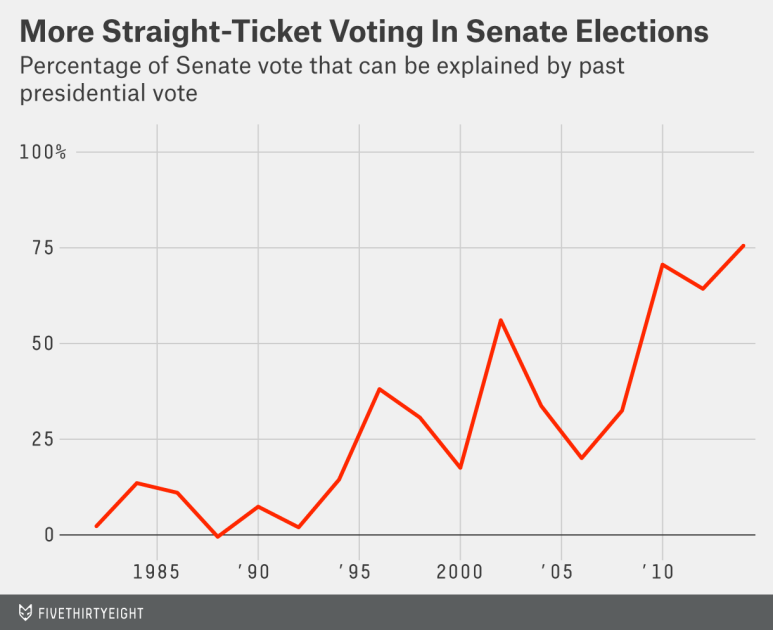
Fewer Voters Are Crossing Party Lines
Straight-ticket voting has spiked:
Prior to 2010, 2002 was the only year in which the predictive power of past presidential results was over 40 percent. In other words, voters who favor Republican presidential candidates are now very likely to favor Republican Senate candidates. U.S. House and gubernatorial elections can be increasingly predicted by past presidential voting as well. The latter is especially interesting considering that governors are state, not federal, politicians.
The question going forward is whether the link between presidential and Senate results will increase, decrease or stay the same. If the straight-ticket effect doesn’t weaken, it could be bad news for Democrats, assuming we’re a 50-50 nation over the long haul. By our presidential vote metric, 54 Senate seats are in states that are more Republican-leaning than the nation on the presidential level, and 46 are in states that are more Democratic-leaning.