“Breaking Bad” By Niccolo Machiavelli


In some ways, Breaking Bad was, for me, a hymn to Machiavelli. Walter White – in order to secure his honor as well as his survival – leaves traditional morality and virtues in the desert to seek power and money and respect. And he does so with such brilliance and fortitude and elan that Old Nick himself would have marveled at the spectacle of untrammeled evil and empire building. If a man is truly a man through force and fraud and nerve, then Walter becomes the man he always wanted to be. He trounces every foe; he gains a huge fortune; he dies a natural death. Compared with being a high school chemistry teacher? Niccolo would scoff at the comparison. “I did it for me.”

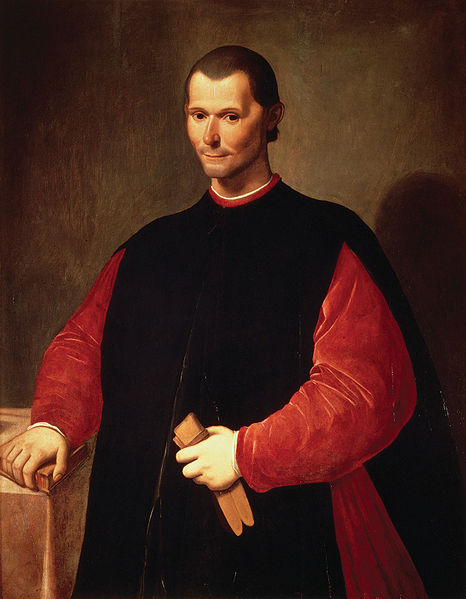
Like Richard III or Richard Nixon, Walt is consumed all along by justified resentment of the success others stole from him, and by a rage that his superior mind was out-foxed by unscrupulous colleagues. He therefore lived and died his final years for human honor – for what 466px-Portrait_of_Niccolò_Machiavelli_by_Santi_di_TitoMachiavelli calls virtu, a caustic, brutal inversion of Christian virtue. And there is some worldly justice in this – he was cheated, he was diminished, his skills were eventually proven beyond any measure in ways that would never have happened if he had never broken bad. And breaking bad cannot mean putting a limit on what you are capable of doing. What Machiavelli insisted upon was that a successful power-broker know how to be “altogether bad.” You have to leave a woman choking on her own vomit to her death. You have to murder a child on a toy scooter.
But the script cheats. Why? Because Walter is already dying. The calculations you make about your future do depend very much on how far you can see ahead. And the cost-benefit analysis of “breaking bad” when the alternative is imminently “dying alone” is rigged in favor of the very short term, i.e. zero-sum evil. If Walt had had to weigh a long, unpredictable lifetime of unending fear and constant danger for his family and himself, he would have stopped cooking meth. As, indeed, he did, when finally given the chance – only to be yanked back into the life of a mobster by his brother-in-law, bored, sitting on a john. Nice Shakespearean touch that, I thought.

And was he happy? Yes, but in a way that never really reflects any inner peace. He is happy in a way that all millionaires and tyrants are happy. His will is done. But we know that this does not lead to actual, enduring happiness. Which is why, for me, Machiavelli’s great flaw is that the life of such a brutally powerful figure, ruling by force and fraud, is a mug’s game. Isn’t the consequence of his proud immorality a never-ending insecurity? Do not most mob bosses live in fear every day and die by the same methods they employ? Did we not see that happen to Gus? Even to Mike? Did Saddam have a happy ending? Or Richard III? These are lives mesmerizing in action but miserably, existentially insecure. Remember Mike’s face as he took a last look at his grand-daughter. You call that happiness?

So for me, Breaking Bad should be taught alongside Machiavelli – as a riveting companion piece.

It should be taught because it really does convey the egoist appeal of evil, of acting ruthlessly in the world, of becoming a man in a battle of wills and lies, of seeing even a murdered innocent child as a necessary unpleasantness. It should be taught because it reveals the power of nerve, of deception, and of courage. But it should be taught also because it reveals Machiavelli’s fundamental, soul-destroying, life-hollowing emptiness.

The benefits only work if your life is nasty, brutish and short. The costs are seen in the exhausted, broken eyes of Skyler, the betrayal of an only painfully faithful son, the murder of a brother-in-law, the grisly massacre of dozens, the endless nervous need to be on the alert, to run and hide and lie and lie and lie again, until life itself becomes merely a means to achieve temporary security. In the end, this is not living. It is running, running, in the end, from yourself. There is no resting place there, no peace, no day after. There is only always the day before. The day before you are killed by the forces you unleashed to kill others.

Stewart Patrick explains further:

Machiavelli differs from later realists like Hobbes—and more contemporary “neorealists” like the late Kenneth Waltz—in recognizing that human agency matters as much as the structural fact of international anarchy in determining both foreign policy behavior and ultimate outcomes in world politics. Through historical examples of successes and failures, Machiavelli reminds us that individuals matter. Yes, the world is perpetually changing, buffeting the state in all directions. But even if “there’s a Providence that shapes our ends”—as Shakespeare’s Hamlet observes—a leader’s choices can have a pivotal impact on politics, both domestic and international.

Machiavelli explores the interplay between material forces and human agency through the concepts of fortuna and virtu.

All princes (and indeed, all people) are subject to societal and natural factors larger than themselves. Still, “free will cannot be denied,” Machiavelli insists. “Even if fortune is the arbiter of half our actions, she still allows us to control the other half, or thereabouts.” Though fortune be capricious and history contingent, the able leader may shape his fate and that of his state through the exercise of virtu. This is not to be mistaken for “virtue”, as defined by Christian moral teaching (implying integrity, charity, humility, and the like). Rather, it denotes the human qualities prized in classical antiquity, including knowledge, courage, cunning, pride, and strength.

Walter possessed all in abundance. And he used them to destroy countless bodies and souls, including the only ones he truly loved, including, in the end, his own.

Recent Dish on Machiavelli here and here.

UPDATE: Reader feedback on this post here.

Grandstand Of The Day

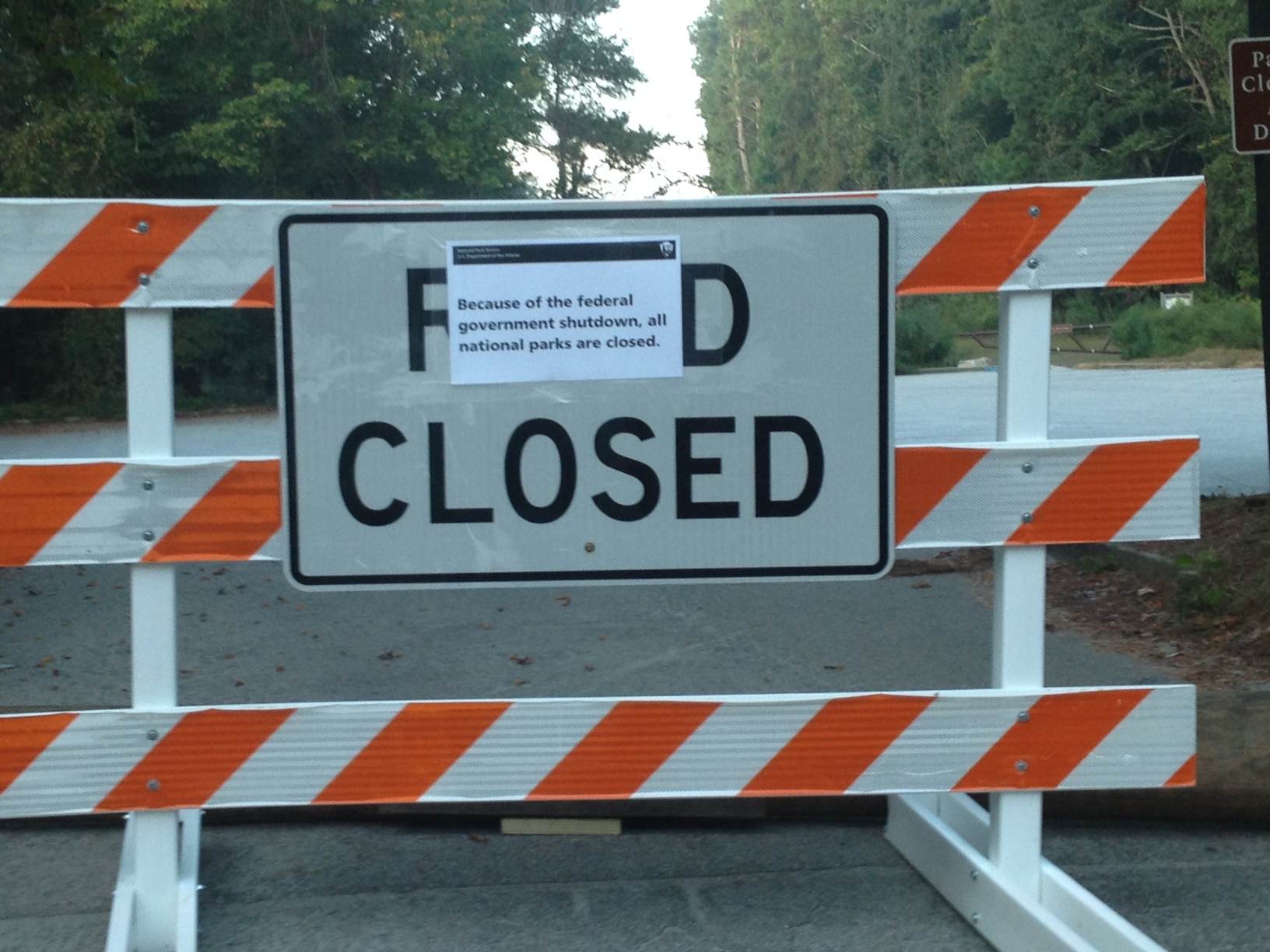
A reader recoils at Congressman Randy Neugebauer (R-TX), who forced a park ranger to apologize for something he’s partly responsible for:

This is disgusting. Harassing federal employees who are just doing their jobs, unlike the GOP in Congress.

And the ranger is most likely not getting paid today, while the congressman continues to collect his $174,000 salary. With health insurance of course.

The Republicans’ “Job-Killing Blackmail”

The Tea Party propaganda outlets have not let up on one particular moniker over the years. Obamacare is, we are constantly told, “job-killing.” John Boehner has used that phrase so often even Frank Luntz’s eyeballs must be slipping backward toward his tenuous toupee. The trouble is: since Obamacare just effectively started, and since the GOP has managed to cut off its provisions from the working poor – and particularly the African-American working poor – it’s somewhat hard to judge the validity of these claims:

“The script is still being written,” said Mark Zandi of Moody’s Analytics. “I don’t see any evidence Obamacare is impacting the job market.” N. Gregory Mankiw, a Harvard economist who worked in President George W. Bush’s administration, agreed. Asked how much the Affordable Care Act had affected the economy so far, he said, “Probably not a whole lot.”

Compare that with the likely job-killing effects of a continued government shutdown and a federal default. There is no doubt about how many jobs they would kill. Economists are not saying things like “Probably not a whole lot.” They are saying the following:

Goldman estimates that a two-day shutdown would reduce growth in the fourth quarter by 0.1 percentage points at an annualized rate, while a week-long shutdown would cost 0.3 percentage points … Now consider the debt ceiling … Analysts at Bank of America Merrill Lynch argue that hitting the ceiling would require the US to balance its budget at once, cutting spending by about 20 per cent, or 4 per cent of GDP. That would push the US into another recession–even if there were no default. The consequences of an actual default, particularly one that lasted for some time, are beyond prediction….

And this, if the GOP gets the default it is now recklessly threatening:

Expect nothing less than near panic in the global financial order.

The former chief economist of the International Monetary Fund, Simon Johnson, describes the repeated face-off over the debt ceiling and prospects for default as an act of “collective insanity,” noting that such irresponsibility in 2011, “put more pressure on European sovereign debt at an inopportune moment, pushing up yields across the troubled euro zone (including, but not limited to Greece).” Consequently, not just America’s recovery suffered. The risk substantially increased that Europe will now face a “lost decade” similar to that suffered by Japan with little or no economic growth.

The Republicans are not only threatening the mother of all job-killing recessions in America; they are threatening the rest of the developed world with a second Great Depression, the end of the dollar as a global reserve currency, a massive jump in interest rates and a sky-rocketing unemployment rate. In their fetid partisan brains, they may think this will hurt president Obama, and it surely would.

But it would also destroy countless lives, families, jobs, industries and American credibility. When will these people learn to love their country more than they hate their president?

A Poem For Thursday

dish_joy

“Joy” by Denise Levertov:

You must love the crust of the earth
on which you dwell. You must be
able to extract nutriment out of a
sandheap. You must have so good
an appetite as this, else you will live
in vain.                                — Thoreau

Joy, the ‘well … joyfulness of
joy’—‘many years
I had not known it,’ the woman of eighty
said, ‘only remembered, till now.’

Traherne
in dark fields.
On Tremont Street,
on the Common, a raw dusk, Emerson
‘glad to the brink of fear.’
It is objective,

stands founded, a roofed gateway;
we cloud-wander

away from it, stumble
again towards it not seeing it,

enter cast-down, discover ourselves
‘in joy’ as ‘in love.’

(POEMS 1960-1967, copyright ©1966 by Denise Levertov. Reprinted by permission of New Directions Publishing Corp. Levertov’s work is available in ebook format.  Photo by Flickr user rainerstropek)

We Must Not Negotiate With Economic Terrorists

US-POLITICS-ECONOMY-BUDGET

Boehner reportedly wants “to craft a ‘grand bargain’ on fiscal issues as part of the debt-limit deliberations.” But any serious Grand Bargain would require serious revenue increases in return for lower and flatter rates – and the GOP has simply refused to countenance any whatsoever, and certainly doesn’t appear to be ready to do so now. It’s an obvious way, it seems to me, to try and salvage the situation by changing the subject and making the blackmail seem at least faintly related to fiscal matters … but I can see why Chait is dismissing the idea:

The thing to keep in mind is that there is essentially zero institutional support within the conservative movement for negotiating a budget deal with Obama. Even the “pragmatic” conservatives who pleaded against the shutdown, like Grover Norquist and The Wall Street Journal editorial page, adamantly oppose closing any tax loopholes, regardless of what spending cuts come along with it.

So: What happens when the defunders realize the budget deal is not going to destroy Obamacare, and the anti-defunders realize it is going to include higher taxes? The answer is that John Boehner gets run out of town on a rail. There’s nothing a deal like that could include — not even a provision impeaching Obama and deporting him to Kenya — that could make it acceptable to the right-wing base.

Barro agrees:

A grand bargain would have to entail entitlement reform about which Republicans are lukewarm, plus offsetting Democratic demands, plus raising the debt ceiling and reopening the government. Yet the Republicans floating the idea of a “grand bargain” don’t seem prepared for the “bargain” part. On what planet is this route easier than a deal that is limited to resolving the government shutdown?

It isn’t. It’s a transparent effort to play for time and shift the blame. What matters now above everything else is that the president wavers not a jot or tittle in demanding a clean CR, raising the debt ceiling and then, if the GOP is prepared to raise revenues, a Grand Bargain.

What matters in this present crisis is that we do not negotiate with economic terrorists. Everything else is irrelevant to that fundamental goal.

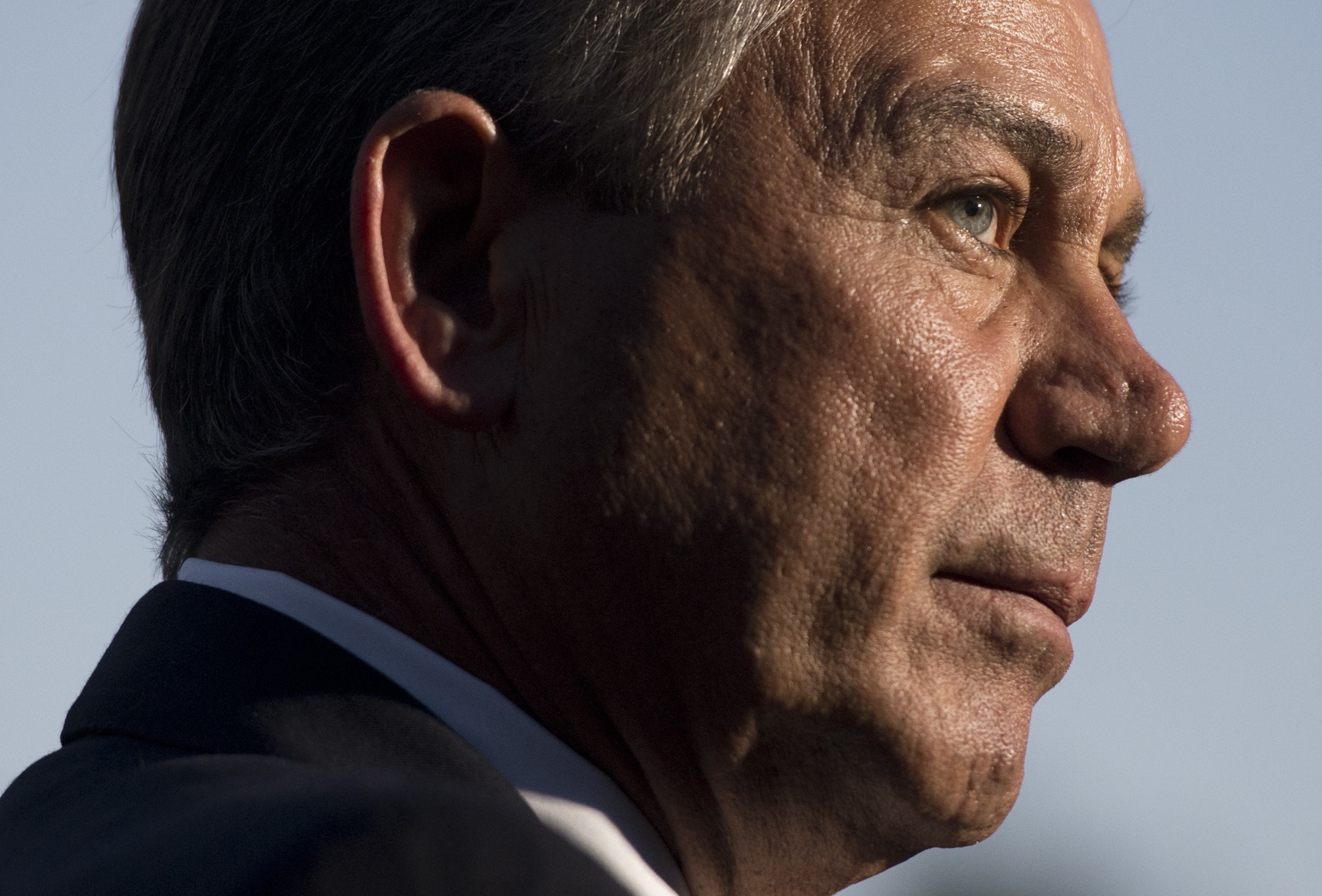
(Photo: Speaker John Boehner by Saul Loeb/Getty.)

About That “Job-Killing Obamacare”

News flash:

Wal-Mart, the nation’s largest employer, announced Monday that 35,000 part-time employees will soon be moved to full-time status, entitling them to the full healthcare benefits that were scheduled to be denied them as a result of Wal-Mart’s efforts to avoid the requirements of Obamacare.

Not a p.r. move. Apparently, Wal-Mart is struggling with its model of basement-level wages and piss-poor service. Having a workforce that is healthy, they are finally recognizing, can be an economic advantage. Imagine that!

Update from a reader:

Wal-Mart is not the nation’s largest employer … the federal government is.

The Democrats Won’t Be Fooled Again

The GOP House is passing bills that would undo the most visible consequences of the shutdown. Beutler explains why Democrats aren’t biting:

[Republicans] ran a version of this play after the sequestration order went out earlier this year. They pushed for special flexibility for the FAA, so that business travelers wouldn’t be inconvenienced by flight delays and Dems gave it to them. It was an error. In so doing, they placated a powerful lobby they could have marshaled to rescind all of the cuts. Poor people had no such recourse, and sequestration continues to harm the programs they rely on to this day.

Democrats aren’t falling for it this time. They passed a bill to secure military pay, but have so far rejected all other piecemeal shutdown fixes. Not because they’re craven or want the shutdown, and not even really because they care about the principle of equal treatment, though I suppose they do. Democrats aren’t letting Republicans make the shutdown they caused painless for themselves to endure. And that’s set off a massive fight for narrative control. Who’s really pro-shutdown, if Republicans are at least trying to open parts of it? Republicans want to enlist the press in its campaign to flip the script on Democrats, and have even had some success.

Scheiber imagines a possible endgame:

If the GOP can essentially fold on everything Obama insists they fold on, but come away with some deficit-related totem that gives the Tea Partiers the impression they won something—well, that wouldn’t look so much like a pure retreat. That’s where Boehner appears to be headed, even if he won’t admit it yet.

What would that totem look like? In essence, I think Obama can basically give Republicans a trumped-up, impressive-sounding version of what he’s already offered: You guys reopen the government and raise the debt limit, and then I will dispatch my vice president and my entire economic team to negotiate face-to-face with Paul Ryan over a long-term deficit deal every week for two months (or whatever), after which they will report back to me, and John Boehner and I will discuss what they’ve come up with. Obama would have essentially offered no concessions for the reopening of the government and the raising of the debt limit. He will have committed to no cuts and no deficit-reduction targets of any kind. But he will have given Boehner a fig leaf that he can show his rank and file to persuade them that this whole suicide mission wasn’t entirely futile.

The View From Your Shutdown

A reader writes:

I thought I’d share my small frustration with the shutdown, though it absolutely pales in comparison to the full-time workers who are now going without a paycheck. I’m a full-time student and a drilling National Guard officer. What I don’t think is being widely photo-28reported yet is that in a bunch of states, Guard monthly drills and training assemblies are being cancelled, despite the stopgap bill that was pushed through funding the military through the shutdown.

My state has tentatively cancelled all regular training and drill until the shutdown is over, save for the folks already activated for named operations (Enduring Freedom, etc). All of the state’s National Guard technicians, full-time Guard soldiers who maintain our equipment and weapons, have been furloughed. That really messes with our readiness; we have vehicles in need of repair from training last month that won’t get fixed. Imagine if there was a real emergency like Sandy and a critical unit’s vehicles were inoperable.

It also screws with any full-time Guard technician airmen or soldiers out of a paycheck they may be depending on. So when it’s being reported that soldiers and airmen aren’t being affected by this shutdown, that’s just not true.

On a personal level too, I rely on the GI Bill and my monthly drill pay to pay my rent. The VA has said they have enough appropriations to pay out the check I’m due for September, but if the shutdown continues through October, I won’t get paid next time. Couple that with me missing out on that critical training we’re supposed to have been doing, and I may be in a little trouble come November 2nd. Luckily I have family to turn to.

I want to echo what your writer in Afghanistan said. And I would serve for free. But this isn’t fair to younger Guard/Reserve soldiers and airmen who don’t have the same amount of support that I do. A lot of my soldiers are young college kids who fully depend on drill pay and the GI Bill for 100% of their income while they’re in school. If this thing lasts long enough to get past one paycheck, it’s time for concern for those soldiers, because if they’re like me, they live paycheck-to-paycheck.

(My views and opinions are personal ones that should in no way be read as reflecting the views, official or otherwise, of the Army, the National Guard, or my unnamed state.)

Update from a reader:

From a current National Guardsman who is also trying to complete law school, missing drills for one month or two could make it difficult to get a “good year”. You need a certain number of drill points per year to make a year count toward retirement. As someone who only started a year ago, I struggled to make the minimum number while maintaining my schooling. Now, going into the next FY, if I am starting out four drills behind, I may miss out on a good year. Two months of shut-down could lead toward a full year later retirement for me should I choose to stay in.

Another:

I’m a DoD civilian working for a Major Command of the Air Force. I’ve just filed for unemployment. On Oct. 21, I’ll be undergoing a major operation which my federally subsidized health insurance will cover. The confluence of events and the timing for me are pretty bad. But I’ve had this job since 2009, when I graduated college. I’ve been furloughed eight days total this year, and been threatened with no less than three shutdowns since starting in 2009.

I believed then and believe now that I’m lucky to be working for the fed. I can’t name many people I went to high school or university with who have been putting away for retirement for four years. I can’t name many people who got jobs out of college who have kept them, and had the opportunity for advancement, pay raises and travel like I have.

When we were asked to sign our furlough notifications on Tuesday, my organization gathered all civilians together to answer questions and field concerns. The loudest people in the room were federal civilians with prior military service who will be receiving retirement checks during furlough from their previous careers as servicemembers. I don’t know how to feel about that, because they should be paid, in full, on time, for the time they served and protected us.

I’ve always been the type of citizen and voter happy to pay my taxes and enjoy the fruits of those taxes in the form of public transportation, safe streets and stop signs. I take medications which were almost all the result of NIH research or federal grants. I love the Smithsonians. If taking this one on the chin ensures that more people get more affordable healthcare through ACA, then I’ll live with it.

My overall conclusion is that this shutdown does, indeed, blow. I need it to end, because I want to keep believing that the downsides of federal employment are vastly outweighed by the upsides. If they keep this up, the federal workforce will lose its most experienced employees, and its youngest and most creative, who came into the job looking for a stability that no longer exists.

A final note: I’m glad I subscribed to The Dish for a full year back when I was getting full paychecks. Sound investment.

Read all of the testimonials in our “View From Your Shutdown” series here. And send us your own.

The Innocent Faces Of Organized Crime

More Beg Children Were Rescued In China

Jillian Keenan describes organized begging as “one of the most visible forms of human trafficking – and [one] largely financed and enabled by good-hearted people who just want to help”:

In India, roughly 60,000 children disappear each year, according to official statistics. (Some human rights groups estimate that the actual number is much higher than that.) Many of these children are kidnapped and forced to work as beggars for organized, mafia-like criminal groups. According to UNICEF, Human Rights Watch, and the U.S. State Department, these children aren’t allowed to keep their earnings or go to school, and are often starved so that they will look gaunt and cry, thereby eliciting more sympathy – and donations – from tourists.

It’s not just India:

According to one U.S. State Department report, a man in Shenzhen, China, can earn as much as $40,000 per year by forcing enslaved children to beg. Horrific examples of trafficking in children (and the elderly) for the purposes of organized begging have been found in countries all over the world: Bolivia, the Philippines, Bangladesh, Senegal, Pakistan – even Austria, other European countries, and the United States. No country is immune to human trafficking. … So when we, well-intentioned tourists, give money directly to child beggars, there’s a decent chance we’re actually lining the pockets of criminals who will turn around and use that money to abduct, enslave, rape, torture, and maim even more kids.

(Photo: Three beg children are seen at a rescue station after they were rescued by police on February 13, 2011 in Guiyang, Guizhou province of China. More than 9,300 kidnapped children in China have been rescued since April 2009, when a nationwide campaign was launched to crack down on human trafficking. In less than three weeks, a Chinese microblog called ‘Street Photos to Rescue Child Beggars’ attracted 175,000 followers and posted more than 2,500 images of begging children online for parents to identify. By ChinaFotoPress/Getty Images)

Why’d We Shut Down The Government, Again?

The Republicans have already forgotten:

Sometimes fights become so intense and so tangled that the original cause becomes obscured. In the government funding battle, the issue that sparked it all, Obamacare, was no longer center stage less than 24 hours after the shutdown began. The fight is now about the shutdown itself, and Obamacare has been pushed to the side.

This incredible quote says it all:

“We’re not going to be disrespected,” conservative Rep. Marlin Stutzman, R-Ind., added. “We have to get something out of this. And I don’t know what that even is.”