The Literary Approach Toward Death

A 1977 essay by George Plimpton explored how men of letters imagined the end of life:

Allen Ginsberg, who wrote that he was spending an increasing amount of time in the “company of Buddhists,” allowed that for him there was very little difference between death and the deeper levels of meditation; he made it sound like a form of relaxation. “Dying,” he told me, “I do that every time I sit down on my Zafree [which turned out to be a meditation pillow, thank Heavens], abandon my mind, observe thought-form fading, and the gaps between thought-forms, and breathe out my preoccupations. At the moment, one ideal death would be sitting on a pillow with empty mind.”

John Updike also rather liked the idea of suspension. “Thoughts on dying? I can’t decide if I’d rather go after the thirteenth or the fourteenth line of a sonnet; the thirteenth would give you something to do in the afterlife. By the same reasoning, while the ball is in the air, off the face of a perfectly swung five-iron, and yet has not hit the green where it is certain to fall.”

The Sacred Role Of Sleuths

Jason Webster asks if the detective is the “priestly” figure of modern literature:

Miss-07One only needs to look at the names of famous sleuths to see how deeply they draw on the authority of religion. The most obvious example is John Rhode’s forensic scientist Dr Priestley in the 1920s, followed in the 1950s by John Creasey’s Commander George Gideon (think hotel Bibles). Even among contemporary characters, names with religious connotations are common: Adrian Monk and John Luther have both been recent hits on television, while Michael Dibdin’s Aurelio Zen, James Patterson’s Alex Cross and Leslie Charteris’s Simon Templar, alias ‘The Saint’, are hugely popular literary creations.

It isn’t only the names that give the game away. Consider Holmes, the greatest fictional detective of them all. He is (probably) celibate. He acts in the ordinary world, but his natural habitat is a mystical retreat in which he isolates himself for weeks, emerging with insights that can resolve the perplexities of those around him. His London address at 221B Baker Street is a kind of monastery in the heart of the metropolis. ‘For days on end,’ Dr Watson reports, ‘he would lie upon the sofa in the sitting-room, hardly uttering a word or moving a muscle from morning to night.’ Holmes is like a Franciscan, periodically leaving the friary to offer wisdom to the wider community. Or perhaps he is a shaman, locked in his refuge, taking powerful drugs and communing with spirits before returning to ordinary life with mysterious powers and solutions.

(Image of Sherlock Holmes in “The Adventure of the Missing Three-Quarter” via Wikimedia)

The Soul Of The Everyday

Adam Leith Gollner assesses Whitman’s take on the divine:

He finds God in the tiniest, most ordinary places. Some barns, any old gnat, the breeze; all revelations. Whitman wasn’t religious in the sense of belonging to an institutional organization, but nor could he accept the limitations of atheism or agnosticism. A little mouse “is miracle enough to stagger sextillions of infidels.” Unbelievers merely have to look around to be convinced, he wrote. Trees, seaweed, squirrels—everything is immortal: “I swear I see now that every thing has an eternal soul!”

This truth is omnigenous, Whitman felt, meaning it is in all things. We can find it anywhere, in the hollows at the bottom of the sea, in rocky riverbeds, in dust. If we ever lose sight of it, we can find it simply by looking under our boots, Whitman assured us. The message is all around us. “Failing to fetch me at first keep encouraged, missing me one place search another, I stop somewhere waiting for you.” So even if we can’t see it right away, we have the ability to see it. Finding it doesn’t mean understanding it. “I hear and behold God in every object,” Whitman admits, “yet understand God not in the least.”

A Poem For Sunday

dish_tulips

“The Tulips,” by Denise Levertov:

Red tulips
living into their death
flushed with a wild blue

tulips
becoming wings
ears of the wind
jackrabbits rolling their eyes

west wind
shaking the loose pane

some petals fall
with that sound one
listens for

(POEMS 1960-1967, copyright ©1966 by Denise Levertov. Reprinted by permission of New Directions Publishing Corp. Levertov’s work is available in ebook format.  Photo by Flickr user erikwestrum)

Quote For The Day

“I work with a great deal of discipline, although I usually take on more than I can handle and often have to extend due dates. I have always been appalled by bohemianism because of its laziness, disorder, and moral weakness. I understand that this way of living is a response to the fact of human frailty, but it leans too far in one direction. Being a little more buttoned up doesn’t mean that you’ll get so brittle that you’ll break. Nor does it mean that you don’t understand tragedy, loss, and, most of all, human limitation.

I am more than well aware of those things and I feel very strongly, but on the other hand I like to run ten miles and return to a spotless well-ordered room, and I like my shirts heavily starched. When I used to go on a long run on Sunday morning when I lived on the Upper West Side, I would pass thousands and thousands of people in restaurants eating . . . (I won’t say this word, because I hate it so much, but it rhymes with hunch, and it’s a disgusting meal that is supposed to be both breakfast and lunch). There they were—having slept for five hours while I was doing calisthenics and running—unshaven (the women too), bleary eyed, surrounded by newspapers scattered as if in a hamster cage, smoking noxious French cigarettes, and drinking Bloody Marys while they ate huge quantities of fat. They looked to me like a movie version of South American bandits. I would never want to be like that. I prefer to live like a British soldier,” – Mark Helprin.

“The Voice Of God – In Human Form”

Reviewing John Eliot Gardner’s forthcoming book about Bach, Music in the Castle of Heaven, Daniel Johnson claims that the composer’s “humanity is inseparable from his faith in God’s mercy.” His concluding meditation on the last years of Bach’s life – and the religious vision that informed it:

Blind, crippled by a stroke and dying, he dictated his “deathbed” chorale BWV 668a, Wenn wir in höchsten Nöten sein (“When we are in desperate straits”), which directly addresses God: “Turn not Thy gracious countenance / From me, a poor sinner.” Nothing, it is safe to say, could be less congenial to the “Olympian” mentality of modern man. “It is Bach,” Gardiner defiantly declares, “making music in the Castle of Heaven, who gives us the voice of God — in human form.”

For that reason Bach must remain a closed book to those for whom the category of divinity is meaningless, and hence deny that it is possible “to make divine things human and human things divine”. Music — even Bach’s music — cannot be “divine” unless God is a presence, unseen and perhaps unconscious, in our lives. We instinctively reach for theological metaphors when we experience the numinous quality of sacred art and music. But for these words to mean anything, we must have at least some confidence that the universe itself has meaning. Bach puts us back in touch with that numinous, on occasion even visceral, presence of the divine. And this involuntary response tells us that there is something transcendental within us, at the very core of our being, that recognises itself in this music. We are made in the image of God, the Bible tells us; in the same way, our music is a distant echo of Paradise.

Grieving Godlessly

After attempting to comfort a friend in mourning, Tiffany White wonders if atheists can come up with language as comforting as spiritual platitudes:

“I’m sorry for your loss” felt too impersonal. That’s what you say to acquaintances, not best friends. “I’m here for you”, I told her, which still didn’t feel like enough.

I felt like I should have been saying the usual things: “God is with her now”, “She’s now in heaven” or “You’re in my prayers”. These phrases sound better because these are the phrases we’re used to saying. “She’s in a better place” provides a sense of hope and optimism. “You’re in my prayers” shows caring and understanding. But that day, as I stood there on the phone struggling to think of the right things to say, I realized I couldn’t say those phrases anymore. I couldn’t tell her I was praying for her because I wasn’t. I couldn’t tell her I thought her mother was in “a better place” because to me that place was a hollow grave.

I started to realize that the life of an atheist was a tad bleak. The more I spoke, the darker the conversation became. As I drawled on about how “there was nothing you could have done” and “it is what it is”, I started to feel like a black hole. When did atheism transform me into Daria?

A Secular Defense of Religious Freedom

Reviewing the late Ronald Dworkin’s posthumously published book, Religion without God, Jonathan Ree details the legal theorist’s idiosyncratic appreciation of statutes protecting religious liberty, such as the First Amendment to the U.S. Constitution and Article 18 of the UN Declaration of Human Rights:

[T]heir real justification, according to Dworkin, has nothing specifically to do with religion: there is no special right to religious freedom, but only what he calls a “general right to ethical independence” – or, to put it differently, a restraint on any government activity based on the assumption that one conception of the good life is superior to another. He admits that it may be hard to decide what this principle implies, but has no doubt that it rules out any attempts to criminalise homosexual acts or early abortions, outlaw same-sex marriage or force schools to teach intelligent design.

Dworkin’s secularist defence of religious freedom is thus not as paradoxical as it might seem: for him, it is no more than specific application of a purely secular right – the right to “ethical independence”. But he puts a double lock on his doctrine with an argument to the effect that, strange as it may sound, religion should not be defined in terms of belief in God, and that secular atheism of the kind he espouses should be treated by the law as a form of religion.

The Bible’s Attempted Murder Mystery

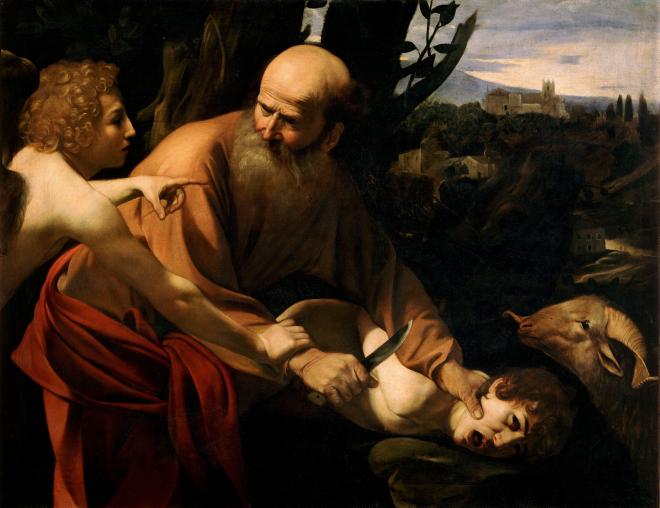
Sacrifice_of_Isaac-Caravaggio_Uffizi3

James Goodman, author of the new book, But Where is the Lamb? Imagining the Story of Abraham and Isaac, unpacks “perhaps the most debated 19 lines in the Bible.” How he describes the three great monotheistic faiths’ approach to the story in Genesis of God’s commanding Abraham to kill his son, Isaac, only to offer a reprieve at the last minute:

In antiquity, Jews understood the story as one of obedience, Abraham’s obedience, on account of which the Jewish people received God’s special blessing.

The early Christians, while hardly gainsaying obedience, folded it into faith: Abraham’s faith that God would keep his promise to make Abraham great through Isaac, even if it meant bringing Isaac back from the dead. In Christian minds, Abraham’s faith prefigured their own, Abraham’s willingness to sacrifice his son prefigured God’s sacrifice of Jesus, and Abraham’s actual sacrifice, the lamb, prefigured Jesus, who became the true heir of God’s blessing and promise.

Muslims returned to obedience. Their Abraham was the first to submit to God, the exemplar of the Islamic faith. The great Islamic innovation was to imagine that Ishmael not Isaac was the nearly sacrificed son. Not all Muslims accepted that revision, but its virtue should be obvious: Ishmael was the progenitor of the Arab people. Like the Jews and Christians before them, they wanted God’s blessing running their way.

Why the story continues to fascinate:

One reason is surely that so many Jews, then Christians, and Muslims came to believe that the story recounts an actual event, a foundational event, essential to who they are what they believe. But fascination with the story has not been limited to the believers. That’s because the story is remarkable as a story. In a mere nineteen lines, there is both explicit drama and great mystery. Thoughts, feelings, motives, meanings, even dialog lay between the lines, unexpressed. We know what people do, but not why. We ask questions about the relationship between God and men, parents and children, self and sacrifice, authority and disobedience, fear and love, reason and faith. We answer them with new interpretations and new versions of the story. The story sustains itself by turning readers into writers.

(Caravaggio’s Sacrifice of Isaac, 1603, via Wikimedia Commons)