“Like a light switch flipping on, Ted Cruz and Mike Lee are casting light on the scurrying of Republican roaches in and out of the Capitol,” – Erick Erickson, bemoaning any attempt to fix Obamacare rather than repealing it (which cannot happen).
Author: Andrew Sullivan
The Un-Thatcher, Ctd
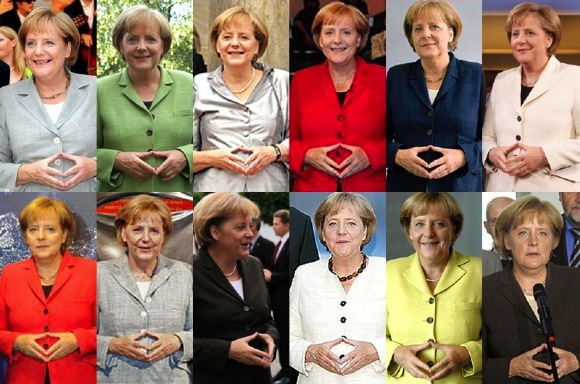
Anne Applebaum delivers some backhanded praise for the reelected Merkel:
Her very dullness, her middle-aged frumpiness, and her lack of emotion must actually represent something that Germans want: leadership without drama. It’s not just that she’s a “safe pair of hands”: Merkel provokes no jealousy, no anxiety, and no fear, either in Germany or in Germany’s immediate neighborhood.
Nobody writes about Merkel as the leader of the “Fourth Reich,” after all, and nobody compares her to Hitler or Bismarck. The eastern neighbors treat Germany as a benign partner. The southern neighbors are resentful but can’t really complain. Everyone else imports German products and feels relieved that at least one large European country still has decent economic growth and good prospects for the immediate future. Merkel makes it possible for Germany to be the dominant power in Europe without anybody really noticing, in other words. That suits her countrymen. And for the moment, it seems to suit other Europeans as well.
Maybe not the Greeks:
Greece is stuck in its sixth year of recession, but this has not stopped Prime Minister Antonis Samaras from declaring this month that “Greece is turning the page,” when the national statistics agency reported that the Greek economy shrank by “only” 3.8 percent in the second quarter, less than the expected 4.6 percent.
By the term “Un-Thatcher”, I meant the lack of polarizing drama – not a relentless pursuit of fiscal retrenchment. After all, what Merkel has done to Europe in the last few years is largely what Thatcher did to her own country in the early 1980s. But Thatcher was able to use the British parliamentary system to dominate politics in a way that Germany’s coalition-style polity cannot. Catherine Mayer wonders if Merkel will be able to form a stable government on her current course:
Merkel’s options for coalition partners are limited.
The Free Democrats, who served with her during her last term, crashed spectacularly at the election, failing even to achieve the 5% of votes necessary to enter parliament. Merkel governed in her first term in a grand coalition with her largest rivals, the Social Democrats (SPD). They too suffered at the ballot box after their association with Merkel and fear that a return to coalition with her will damage their party in the long term. They may be right. Proximity to Merkel has proved politically fatal to rivals within her own party, including her mentor, former Chancellor Helmut Kohl, whom she was key to ousting when scandal damaged the CDU’s ratings. Her popularity is also such that her supporter base—which extends far beyond the ranks of traditional CDU voters—tends to attribute every success to her and blame every failing on the government of the day.
(Image thanks to the Internet)
From The Annals Of The Bleeding Obvious
“The only real way to repeal the healthcare law is to win elections,” – The Wall Street Journal.
What Does White Smell Like?
Anthropologist David Howes explores cultural synesthesia:
In China, the color white is often identified with a harsh, foul odor. In the West, white is usually identified with soft, sweet smells. Such cultural associations can change over time. Mint was perceived as heating and drying in Western cultures prior to the modern era; now it’s more likely to be perceived as cooling and refreshing. And some associations may be universal. To take a well-documented example, most people would say that the word “maluma” sounds like a curvy shape, while “takete” sounds like a sharp-edged one.
Sci-Fi As An Early Warning System
MIT’s Dan Novy thinks speculative fiction can help tech innovators make better products:
Frederick Pohl once said that it wasn’t the job of science fiction authors to create the automobile
but to describe the traffic jam. It follows that it is our job as technologists not to avoid creating the automobile, but to look at the traffic jam and design so that doesn’t happen. Thinking about these things at the beginning and iteratively throughout the process allows us to create better technology. Just as storytelling gives you more lives to live, speculative design or science fiction prototyping gives you more iterations to consider before your creation goes out into the wild and becomes hard to control. Once a genie is out of the bottle, it isn’t inclined to allow itself to be stuffed back in.

Previous Dish on the growing field of space law here.
Francis And Liberation Theology
Ezra Fieser finds that the current Pope, who was ordained as a priest “in 1969, during the height of the Latin American-born church movement,” has had a complex relationship with the school of thought:
While liberation theology influenced generations of Catholic clergy, especially Jesuit priests, Pope Francis never adopted the most left-leaning strands of the movement, according to Argentine Jesuit priest Juan Carlos Scannone, one of Pope Francis’s teachers. In [the] recently published book, Pope Francis: Our Brother, Our Friend, Mr. Scannone wrote, “social Marxists analysis is not used” in Argentine liberation theology. Father [Father José María Cantó, who holds Francis’ former position as rector of the Faculty of Philosophy and Theology at Colegio Máximo in Buenos Aires], says Pope Francis was more influenced by a current within liberation theology based on popular concerns, culture, and historical context. “It is more in line with what the Southern Cone of South America preferred,” he says.
However, Pope Francis has shown an openness to liberation theology, despite years of criticism from the Vatican toward the movement. Earlier this month, he held an audience with [founder of liberation theology Gustavo] Gutiérrez himself, who [historian of religion Jennifer] Hughes calls “one of the most important theological figures of the 20th century.” It remains unclear as to how much the pope is willing to open the Vatican to reconciliation with liberation theologians.
A Flat-Screen Sculpture
How artist Benjamin Muzzin describes his work:
With this project I wanted to explore the notion of the third dimension, with the desire to try to get out of the usual frame of a flat screen. For this, my work mainly consisted in exploring and experimenting a different device for displaying images, trying to give animations volume in space. The resulting machine works with the rotation of two screens placed back to back, creating a three-dimensional animated sequence that can be seen at 360 degrees. Due to the persistence of vision, the shapes that appear on the screen turn into kinetic light sculptures.
(Hat tip: The Verge)
What Is The Function Of Fiction?
Literary critic Charles Baxter dismisses any attempt to answer the question definitively:
I’d never want to say that there’s only one purpose to literature. I’m not even sure that literature has a purpose, other than to give pleasure and, possibly, enlightenment. Ours is a pragmatic culture, and we’re always trying to justify something by saying what its purpose is. But sometimes art has no clear purpose, apart from the pleasure it gives. What’s the purpose of Debussy’s Preludes? And do novels really make us care deeply about others? If they did, English departments would be full of generous, humane, and sweet-tempered people. Joseph Goebbels wrote a novel, and Hitler loved Wagner’s operas. Art does not always make us better people. We have to remember that.
Is Driving With A Cell Phone Really That Dangerous? Ctd
Last month we highlighted a study from Carnegie Mellon and the LES suggesting that cell-phone use doesn’t cause more car crashes. Readers pushed back with other findings. Now Kevin Drum digests a new study (pdf) from the University of Utah:
In general, the authors conclude that hands-free talking isn’t worse than talking on a handset, but neither is it any better: “Taken together, the data demonstrate that
conversing on a cell phone impaired driving performance and that the distracting effects of cell-phone conversations were equivalent for hand-held and hands-free devices. Compared to single-task conditions, cell-phone drivers’ brake reaction times were slower and they took longer to recover the speed that was lost following braking.”
The problem with cell phones has never been primarily about taking your eyes off the road to dial, or about the dexterity required to hold a handset to your ear. It’s all about cognitive distraction, and the study’s authors report that drivers who do a lot of talking on cell phones don’t get any better at it: “Real-world experience using a cell phone while driving did not make the so-called experts any better at multitasking than the novices.”

Michael O’Hare’s take on the findings:
The danger is in the conversation itself, and to understand the reason, consider driving while (i) listening to the radio as I was (ii) conversing with an adult passenger (iii) transporting a four-year-old (iv) sharing the front seat with a largish dog. Why are the first two not dangerous, and the last two make you tense up just thinking about them?
The radio is not a person, and you subconsciously know that you may miss something if you attend to something in the road ahead, but also that you won’t insult it if you “listen away,” and it won’t suffer, much less indicate unease. The adult passenger can see out the windshield and also catch very subtle changes in your tone of voice or body language. If you stop talking to attend to the car braking up ahead, the passenger knows why instantly, and accommodates, and because you know this, you aren’t anxious about interrupting the conversation.
The dog and the child, in contrast, are completely unaware of what’s coming up on the road or what you need to pay attention to; the former is happy to jump in your lap if it seems like a good idea at any moment, and the child demands attention on her own schedule and at her will.
The Ambivalent Anglican
Brian Miller reviews Roger Scruton’s Our Church: A Personal History of the Church of England. Here he explores the British philosopher’s complicated embrace of his nation’s church:
According to Scruton, “any church must have two dominant duties: to inspire religious sentiment, and also to contain it.” A question that then arises, and one which Scruton himself notes, is whether the Church has proved so successful in the latter that it eliminates the existence of former. To illustrate this problem he points to the examples of John Wesley and John Henry Newman, who he calls the greatest apostles of Christ that the Church of England has produced, yet admits the Church was incapable of containing either of them.
The duty to constrain religion arises from the belief that nothing is more important to civil society than civil peace. Scruton traces this belief to Thomas Hobbes, who concluded that religion could prove a danger to civil peace, and that it therefore must be constrained by civil government. Scruton goes to on to confess that “Like Hobbes I remain attached to the idea of civil government and believe it to be superior in every way to the rule of priests.”
He further confesses that “The English know in their hearts that faith is in large part a human invention.” This view is given legitimacy by the Church’s very history, which, as Scruton points out, was born in controversy and has continued in such through the years.

