Obama Cancels On Putin

Fisher asks, “How is it that U.S. and Soviet leaders went ahead with decades of summits despite disagreements so severe they implied a threat of World War III, while today a summit falls apart over a single NSA contractor and the slow progress in some minor security and trade cooperation measures?”:

It may actually be the case that the reset was doomed not by high tensions but by low stakes. Obama and Xi feel compelled to force a smile for the camera at Sunnylands in large part because the U.S. and China have arguably the most important bilateral relationship in the world; neither can afford to let it fall apart. The same was true of Washington-Moscow summits during the Cold War, when leaders who might despise one another would meet not despite but because of the very real threat of mutual nuclear annihilation.

Today, though, the United States and Russia have found themselves in a not-so-sweet spot in which they have enough overlapping areas of interest to spark bitter disagreements, but not enough that either wants to commit the necessary resources to get along. It’s just not the priority.

Ioffe provides the view from Moscow:

[F]or all the Kremlin’s pouting, there’s also a consensus in Moscow that, well, there’s not much left to talk about.

“Obviously, Obama just can’t come to Moscow with Snowden there, but they made clear they’re not totally shuttering the relationship,” says Fyodr Lukyanov, editor of Russia in Global Affairs, a voice that, traditionally, is not far from the Kremlin’s line. “Okay, well now, the score is now 1-1, but the other problem is that the relationship has no content now. Even if Obama came to Moscow, it’s not really clear what they’d talk about.”

Kimberly Marten believes that “Obama did exactly the right thing”:

Obama had made it clear that the Snowden case was his line in the sand, and Putin crossed that line unnecessarily. Putin could have chosen instead to give the Snowden request the 3-month administrative consideration period that the Kremlin originally mentioned when he originally made his asylum application, rather than granting Snowden the yearlong temporary asylum straight off. It looks like the meeting in Washington tomorrow between Secretary of State Kerry and Secretary of Defense Hagel and their Russian counterparts is still on, and that is the truly substantive part of the diplomatic interaction anyway. Assuming that the Russian side doesn’t cancel their participation in that meeting, then there has been no real change in the quality of the relationship.

Larison sees the issue differently:

As rebukes go, Obama’s cancellation of the bilateral summit meeting with Putin isn’t that strong, but it could and probably will be used as a pretext for greater antagonism on some issue. It goes without saying that the decision to cancel will have no positive effect on Moscow’s internal conduct, its asylum decision on Snowden, or any other outstanding disagreement between Washington and Moscow, but then it isn’t intended to have that effect. This is a decision primarily meant to placate American critics of Russia, who predictably won’t be satisfied with this gesture, and to save Obama the trouble of a meeting that would likely have been fruitless anyway.

Greenwald fumes:

The US constantly refuses requests to extradite – even where (unlike Russia) they have an extradition treaty with the requesting country and even where (unlike Snowden) the request involves actual, serious crimes, such as genocide, kidnapping, and terrorism. Maybe those facts should be part of whatever media commentary there is on Putin’s refusal to extradite Snowden and Obama’s rather extreme reaction to it. … I think it’s becoming increasingly clear here who the rogue and lawless nation is in this case.

Kaplan, on the other hand, supports the cancellation:

Given the random pointlessness of the last Obama-Putin session and the risk that a high-profile reprise might aggravate the growing sense of despondence, it’s best, at this point, to turn the task of recasting relations to the diplomats.
Jumping The Shark Week

This year, Discovery’s “Shark Week” started off with a program (teaser here) offering “evidence” that there are still prehistoric Megalodon super-sharks living today. But except for a short, vaguely-worded disclaimer at the end of the show, its producers failed to point out that the program is essentially fiction. Christie Wilcox fumes:

No whale with a giant bite taken out of it has ever washed up here in Hawaii. No fishing vessel went mysteriously missing off of South Africa in April. No one has ever found unfossilized Megalodon teeth. Collin Drake? Doesn’t exist. The evidence was faked, the stories fabricated, and the scientists portrayed on it were actors. The idea that Megalodon could still be roaming the ocean is a complete and total myth.

Here’s what I don’t get, Discovery: Megalodons were real, incredible, fascinating sharks. There’s a ton of actual science about them that is well worth a two hour special. We’ve discovered their nursery grounds off the coast of Panama, for example. Their bite is thought to be the strongest of all time—strong enough to smash an automobile—beating out even the most monstrous dinosaurs. The real science of these animals should have been more than enough to inspire Discovery Channel viewers. But it’s as if you don’t care anymore about presenting the truth or reality. You chose, instead, to mislead your viewers with 120 minutes of bullshit. And the sad part is, you are so well trusted by your audience that you actually convinced them: according to your poll, upwards of 70% of your viewing public fell for the ruse and now believes that Megalodon isn’t extinct.

The above video is from Discovery’s Megalodon special from last summer that presents a fascinating but fact-based look at the extinct predator. Wil Wheaton thinks the network has now betrayed its core audience:

An entire generation has grown up watching Discovery Channel, learning about science and biology and physics, and that generation trusts Discovery Channel. We tune into Discovery Channel programming with the reasonable expectation that whatever we’re going to watch will be informative and truthful. We can trust Discovery Channel to educate us and our children about the world around us! That’s why we watch it in the first place!

The Megalodon special was the highest-rated “Shark Week” program ever, and a producer is still defending the program as some kind of journalistic enterprise. Chris Kirk notes a growing trend:

This isn’t the first time Discovery Communications, the media company that runs the Discovery Channel, has broadcasted dubious documentaries, and judging from the ratings it won’t be the last. The company also runs Animal Planet, which aired two pseudo-documentaries claiming to show scientific evidence of mermaids. The second documentary attracted 3.6 million viewers, unprecedented for the network.

These faux documentaries, which can best be described as anti-educational, seem to have grown more common on in recent years. The Disney-owned History channel, for example, has earned criticism for airing pseudoscience programs like Ancient Aliens, UFO Files, and the Nostradamus Effect instead of programs about, you know, history.

If these programs offer any signs that they are fictional, they are brief and inadequate signs. Unsurprisingly, then, many viewers buy into the false claims these documentaries peddle. Shortly after Discovery’s documentaries aired, for example, the National Oceanic and Atmospheric Association found it necessary to assure the public that “no evidence of aquatic humanoids has ever been found.”

Recent Dish on mermaids in their proper place – fiction – here and here.

Can Scientists Make It Alone?

Euny Hong profiles pharmacologist Ethan Perlstein, who tired of taking postdoc positions and is now crowd-funding his own research:

In September 2012, Perlstein decided to start a meth lab for mice to find out where radioactive amphetamines accumulate in mouse brain cells. He launched a crowdfunding campaign on the site Rockethub, a kind of Kickstarter for science for academic projects. The tag line, “Crowdfund my meth lab, yo,” was accompanied by a photo from Breaking Bad, about a teacher who runs a meth lab. The goal: to raise $25,000. … It is a safe bet that some of his former peers thought the move populist or unbecoming of an academic, particularly with the Breaking Bad allusions. But it worked: He raised $25,460 from over 400 people.

Perlstein expects more researchers to break outside the confines of the university:

The independent scientist movement is not a fad, said Perlstein, as long as problems for scientists in academia continue. “There are too many people rising up in the pyramid scheme of academia to be absorbed by positions,” he said. “Independent science is a safety valve that allows the pressure building from all this excess human capital. The independent path could absorb them, but that’s not going to edify academia. They will keep charging along as if nothing ever happened.”

But Jay Ulfelder wonders if the money will actually materialize outside of academia, particularly for social scientists:

As someone who’s managed to make a good living for the past two and a half years as an independent scholar—or freelance researcher or consultant or whatever the heck it is that I do—I want this to be true. Honestly, though, I think it’s still very, very hard to survive professionally without a regular paycheck and an institutional or corporate mooring, and the vast majority of people who try will fail.

Why? Let’s start with Perlstein’s story. His mouse meth-lab project raised about $25,000 on Kickstarter. Getting one $25K chunk of funding is great, but it’s hardly going to make your year. For that, you’re going to need to string together at least a few projects of that size or larger (remember, that funding also has to cover research expenses). Each of those projects will require a proposal or crowdfunding campaign, and those things take a lot of unpaid time to put together. Most projects won’t have a Breaking Bad hook, and many attempts to inject that kind of playful tone and pop-cultural relevance into your marketing campaign will fall terribly flat.

Visit Sunny Nasr City!

Elias Groll takes note of a novel tourism campaign:

A group calling itself Rabaa Tour is trying to attract tourists to the most unlikely of places in Cairo: the central battleground between security forces and Muslim Brotherhood members. For weeks, Brothers and their supporters have been occupying the area around Rabaa al-Adaweya mosque, and Egyptian officials have repeatedly threatened to clear the sit-in. With tens of thousands of people camped out there, any effort to sweep away the protesters, who are clamoring for the reinstatement of ousted President Mohamed Morsy, will surely result in bloodshed. But this is where Rabaa Tour would like you – yes, you – to come visit in order to learn the truth about the protesters. They even have a slogan: “Heard enough? Time to see!”

Groll says the group, which falls “on the Islamist side” of the Egyptian divide, is “doing outreach in a way the Brotherhood never quite understood”:

Having operated underground during the Mubarak regime, the Brotherhood came to power with a rigid hierarchy and an abiding respect for its leaders. That made the organization remarkably bad at democratic politics. So it should come as no surprise that the Brotherhood never even attempted to pitch itself to Western audiences as something other than a scary Islamist body.

The Rabaa Tour seems to understand that. “Our goal is not to convince people to join us or to adopt our objectives,” the group writes on their Facebook page. “It’s just for people to know the truth and to respect our right of having a peaceful sit-in without being attacked!” With the military regime branding them terrorists and with the likelihood of further violence in Cairo all but certain, the plea by these young people to be considered on their own terms is a powerful one.

Diagnosing Future Dropouts

Annie Murphy Paul outlines the benefits of “tracking formulas” that gauge a young student’s likelihood to drop out of high school:

There is a danger, of course, that people who struggle early on will be written off too soon, before they’ve had a chance to prove themselves. But ignoring these super-early warning signs also carries risks. That’s because small initial differences have a way of snowballing into bigger ones over time. Here’s how one common scenario plays out …

Difficulties in third grade lead to the “fourth-grade slump,” as the reading-to-learn model comes to dominate instruction.

While their more skilled classmates are amassing knowledge and learning new words from context, the less-adept readers begin to avoid reading out of frustration. A vicious cycle sets in: school assignments increasingly require background knowledge and familiarity with “book words” (literary, abstract, and technical terms)— competencies that are themselves acquired through reading. Meanwhile, classes in science, social studies, history and even math come to rely more and more on textual analysis, so that the struggling readers begin to lag in these subjects as well. What began as a small gap has widened into a chasm.

Researchers call this the “Matthew effect,” after the Bible verse found in the Gospel of Matthew: “For whosoever hath, to him shall be given, and he shall have more abundance: but whosoever hath not, from him shall be taken away even that he hath.” The availability of very early indicators of performance puts a whole new spin on the Matthew effect: teachers can use these indicators to address trouble spots before the student or employee ever has a chance to fall seriously behind.

The Latest In Hamburger Technology, Ctd

Meat Predictions

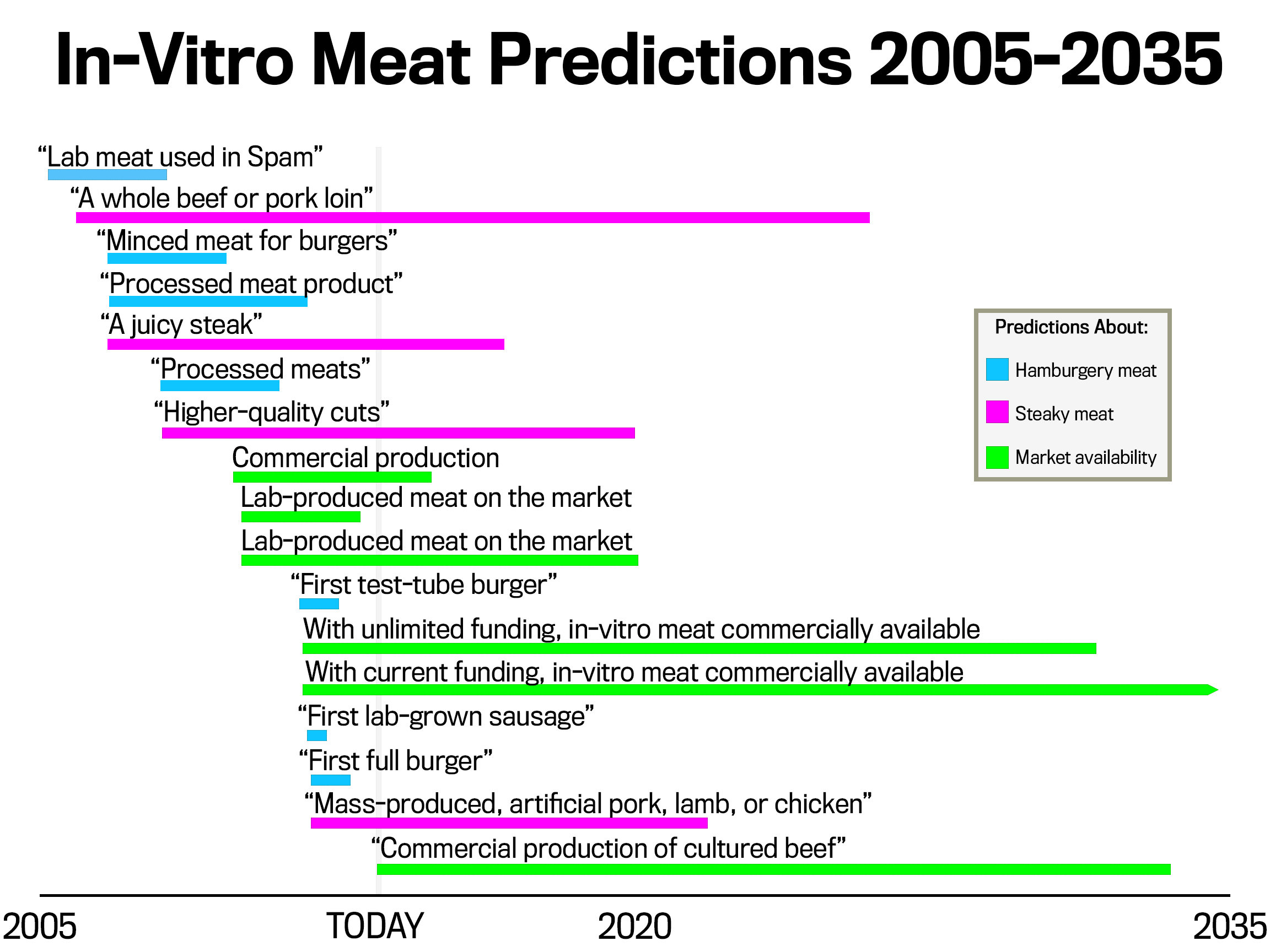
Alexis rounds up predictions about the availability of lab-grown meat:

Ever since I started following in-vitro meat at Wired six years ago, I’ve noticed a trend. Each time there’s a media moment about test tube burgers, dozens of writers discover the existence of this corner of science and get an expert make a prediction about “when we’ll see this kind of meat on supermarket shelves,” or whatever.

This time around, Reuters got Post to predict commercialization in 20 years, but there have been many other types of forecasts. My intuition was that the predictions were always just far enough into the future to make them checking them unlikely. So I made this chart with some help from my memory, Google News, and Lexis Nexis, so that we can all keep track going forward; the data’s embedded below and linked here.

Brad Plumer bets that we won’t see commercially available test-tube burgers any time soon:

At the moment, as Tom Philpott highlights, the artificial meat cells need to be nurtured with ”fetal bovine serum,” or blood derived from cow fetuses. That’s not exactly ideal from an environmental or animal rights perspective — and it’s massively expensive, with the serum selling for around $250 per liter.

So, as an alternative, some scientists hope that future meat cells could be fed with algae. That’s an enticing idea. Algae are exceedingly efficient at photosynthesis, which is why researchers have often looked to the organisms as a way of minimizing the environmental footprint of food production. But it’s never quite worked in the past

Should these hurdles be overcome, Ezra considers the market for lab-grown meat:

Taco Bell, for instance, has been sued for serving beef that’s only 35 percent beef. They countered by insisting their beef is at least 88 percent beef. No one is suggesting their beef is 100 percent beef. Meat grown in a lab wouldn’t be much of a jump. And it’s megachains like Taco Bell and McDonald’s where environmentally friendly, completely humane lab meat would make the biggest difference, anyway.

Earlier Dish on the world’s first lab-grown hamburger here.

Ominous In Egypt

Today the country’s interim president cut short a series of meetings between his government and Western envoys – including a tag team of McCain and Butters – meant to mediate Egypt’s factions:

In the statement Wednesday, interim President Adly Mansour said the international efforts had “ended today.” Additionally, the statement said the Brotherhood and its allies bear “full responsibility for the failure and what will follow.” After meetings Tuesday, U.S. Senators John McCain and Lindsey Graham expressed concerns that mediation efforts might fail. McCain said, “These folks are just days or weeks away from all-out bloodshed.”

Bassem Sabry elaborates on why Egyptians continue to sour on America’s role post-coup:

Some Islamists retain anger over the US being too accommodating of Hosni Mubarak and his repressive tactics. Now, almost all Islamists think America has abandoned Morsi and “electoral legitimacy” after his July 3 overthrow. Of course, many also still retain the belief that the US is against any form of Islamism by nature. They see the recent policy on events in Egypt as proof.

Many in the anti-revolution camp, in turn, think Obama and the US gave up on Mubarak too easily, were too friendly and non-critical of the Brotherhood, if not in strong direct support or even outright control of them. Then, with some irony, many in the liberal, nationalist and leftist pro-revolution camps also share the same view of the relationship between the US and the Brotherhood, while also believing that recent US policy and rhetoric on June 30 and Morsi’s overthrow to be unfair and hypocritical, not sufficiently recognizing the “evils” that the Brotherhood has committed. A large percentage of them also even see the US as trying to protect former allies (or, in that view, proxies) rather than conducting fair policy.

Fouad Ajami observes that the “national mood is foul”:

In their eagerness to overlook their defeat at the polls, the secularists are fierce in their conviction that it was a “revolution” that swept Mohamed Morsi aside.  One figure of the Old Regime, Amr Moussa, a former foreign minister and Secretary General of the Arab League, insists that Morsi had been brought down by “popular impeachment.”  Thus has June 30, the time of the big street protests that led to the coup d’état, been enshrined as a seminal event in Egypt’s political calendar – on par with July 23, 1952, and with January 25, 2011, which marks the agitation that overthrew Hosni Mubarak.  For now, there is infatuation with the army and its commander; there is even revisionism about the police, once the stuff of nightmares for the secularists.

Egypt needs no more revolutionary dates.  What its condition calls for is a recognition of the schism that has brought its political life, once again, into a historical stalemate, and the rule of the army.

Alexander Brock and Amr T. Leheta see an opening for the Salafists:

Their pragmatism has even resulted in the most unlikely of alliances: [leading Salafist party] al-Nour ultimately sided with liberal forces in support of the military intervention against Morsi, perhaps yet again seeing an opportunity to implement its own vision. … [N]ow popularity, not purity of doctrine, that is the compass for al-Nour’s leadership in its decision-making, made clear by al-Nour party spokesman Nader Bakkar’s statement that although twenty percent of its followers is disappointed in its position regarding the military intervention against Morsi, eighty percent remains faithfully aligned.

A New Coat Of Paint For Housing Policy

Lydia DePillis provides a primer on the housing speech Obama gave yesterday. Yglesias analyzes the speech:

[T]he administration isn’t pushing for any major rethink of housing policy in the wake of the crisis. The idea that the government should encourage people to make leveraged investments in owner-occupied housing and that these investments should be the cornerstone of middle-class savings is alive and well with us. Concurrently with that conceptual framework came a policy framework for the future of Fannie Mae and Freddie Mac that hews closely to a bill that’s been introduced in the Senate by Bob Corker and Mark Warner. As befits a bipartisan bill this is a very moderate piece of legislation. It’s a small-c conservative bill that tries to address some of the problems with the old Fannie/Freddie system but tries to achieve essentially the same goal—have the government intervene in housing finance to promote 30-year fixed rate mortgages for owner occupied housing as the normative paradigm in American life, while gesturing at a handful of ancillary social goals.

Yglesias later asks why the government should encourage 30-year fixed rate mortgages, which are unheard of in many other countries:

If you cross the border into Canada it’s not like people are living in yurts. It works fine. But since homebuyers have to carry a bit more interest rate risk, they seem to purchase slightly smaller houses. … [I]t’s not a coincidence that Americans live in the biggest houses in the world. But is getting people to live in marginally larger houses than they otherwise would an important policy goal? I don’t really see why.

A Bloomberg editorial urges Obama to “avoid the siren song of homeownership for everyone”:

The best way to prevent mortgage borrowers from defaulting is to make them put a large amount of equity — at least 20 percent — into their homes upfront. It’s roughly analogous to the sensible requirement that banks use less leverage.

Minimum down payments and strict debt-service ratios have the added benefit of mitigating destabilizing swings in house prices. Economists have shown that, during the recent housing bubble, prices rose as down payments fell. This empowered buyers who had been shut out of the market, which pushed up prices and temporarily increased the homeownership rate — until it came crashing down.

Barro likewise wishes that Obama would stop lauding homeownership:

Americans want to be middle class, and if we keep telling them that homeownership is the “most tangible cornerstone” of middle classness, and the best available evidence of whether you’ve worked hard and been responsible, they’re going to keep wanting to buy houses.

Why not instead emphasize that renting—that is, not taking all the money you have in the world and putting it into a highly leveraged real estate investment—is a perfectly valid life choice, even for people leading prosperous, middle-class lives?

Along the same lines, Douglas Rice points out that more “than a third of American households are renters, but only less than a fourth of federal spending on housing assistance goes to renter households.”