Rapprochement With Rouhani?

On Sunday, Hassan Rouhani was sworn in the new Iranian president. Abbas Milani thinks his proposed cabinet shows promise:

[I]n spite of dire warnings from websites close to Khamenei and the Revolutionary Guards (IRGC), Rouhani did include in his 18 cabinet nominees (who must be approved by Parliament) some key figures close to the reformists and to Rafsanjani. …

His nominee for foreign minister, Mohammad Javad Zarif, is easily his most important olive branch to the U.S. and the rest of the international community. The American-educated Zarif was the country’s one-time representative to the United Nations, and has extensive ties to American political and financial leaders. Zarif has a well-earned reputation as a consummate diplomat, and is firm in his belief that rapprochement with the U.S. and the West is a key to the regime’s long-term survival and interest. He is, like Rouhani, of the opinion that Iran should safeguard its legal rights under the Non-Proliferation Treaty—including the right of enrichment—but must do so while affording the international community the requisite guarantees that the country’s nuclear program will not be diverted to military use.

Ishan Tharoor also focuses on the potential foreign minister:

Zarif’s appointment won’t thaw relations between Washington and Tehran overnight. “People who are celebrating should be a little more cautious,” says Edward Luck, a former high-ranking U.N. official who is now dean of the Joan B. Kroc School of Peace Studies at the University of San Diego. “We’ll get a better face, better music, but the basic fundamentals of the relationship with the U.S. will be the last thing to change, not the first.”

As Foreign Minister, Zarif of course will have a global agenda, not just an American one, and will enter office at a delicate moment at home.

“He will have to be a little careful, he’ll have to look over his right flank,” says Luck. The Rouhani administration has to wade through an economic mess inherited from Ahmadinejad’s tenure and do damage control in the neighborhood. Relations with key regional players like Saudi Arabia are at the lowest of ebbs. “There’s also the situation with the Arab Spring, conflicts in Syria, tensions in Egypt. The U.S. is not the central part of the conversation,” says Trita Parsi, president of the National Iranian American Council, which seeks to build bridges between Washington and Tehran.

Ben Cohen isn’t convinced of any moderation:

Since his election, Rouhani has repeated the mantra that Iran’s nuclear program is entirely peaceful, declaring, “The nation will only be happy when we neutralize the plots of the U.S. We will protect the nuclear technology alongside any other technology.” Essentially, Rouhani wants us to believe that Iran’s nuclear program is benign simply because he says so. Yet he has given no indication that he will permit the IAEA to thoroughly inspect the nuclear facilities, nor has he even hinted whether Iran will reveal additional secret nuclear installations, such as the underground uranium enrichment plant at Fordow that was exposed by the U.S., British, and French intelligence agencies in 2009.

On the domestic front, Ahmad Alehossein suspects Rouhani faces serious obstacles:

[T]he new government may not even be able to pursue such moderate reforms for some very obvious reasons: (1) further economic liberalization in the context of the existing harsh economic sanctions, falling foreign investment, and international isolation is practically impossible unless Iran’s deep state radically changes its nuclear programme; (2) Iran’s economy is structured around a rentier capitalist system mostly dominated by the military and religious-financial institutions only responsible to the supreme leader. Therefore, further economic liberalization in this context means further monopolization (as has already been the case) which in turn strengthens the deep state; (3) Dealing with a double-digit unemployment, a relentlessly growing inflation rate, and a historically unprecedented inequality requires measures such as substantial investments in infrastructures and participatory planning which are in contradiction with the very basics of Rouhani’s economic doctrine.

Max Fisher watches Rouhani’s first press conference, featured in the above video:

The bad news: Wants the U.S. to make the first big move by lifting sanctions

The dilemma in any peace process is that, often, one side has to make the first concession. But in a conflict like this one, where both sides have felt previously burned by the other, that can be a major sticking point. So it’s unsurprising but not encouraging to see Rouhani set a pretty high bar for “first steps”: he said he wants the U.S. to demonstrate its good faith by raising sanctions. From Rouhani’s perspective, this makes sense because the U.S. can always turn sanctions back on, whereas any cuts that Rouhani makes to the nuclear program will be much tougher to reverse if the peace process falls though. Still, this seems unlikely to happen, in part because Obama is probably not going to want to take the enormous foreign policy and domestic political risk of lifting sanctions, given that he can’t guarantee that Rouhani will both want and be able to reciprocate.

Will Marriage Equality Come To New Jersey?

Will Baude reviews a current court case:

Last week, I had a post that was skeptical of the claim that current law requires the federal government to recognize state civil unions as marriages. Reading through this brief recently filed by the state of New Jersey, I am no longer so sure. (The brief is a defense of New Jersey’s civil union law — which allows same-sex couples to have civil unions with the same legal status as marriage, but not technically marriage itself — but the brief also argues that the federal government is required to recognize the civil unions.)

For one thing, state civil union laws sometimes contain language that defines the word “spouse” to include unioned couples in addition to married couples. (See, e.g., the Illinois civil union law I discussed here.) And some federal provisions use the word “spouse” rather than the word “marriage,” although it is not clear they intended for “spouses” to include people who are not in a “marriage.”

For another thing, it almost looks like New Jersey law already defines civil unions as a form of marriage, by stating that marriage includes civil unions.

Nathaniel Frank points out a contradiction in the state’s brief supporting the status quo:

“To reserve the name of marriage for heterosexual couples,” says the brief, makes sense because “altering the meaning of marriage” would, in the words of the 2006 ruling, “render a profound change in the public consciousness of a social institution of ancient origin.” The definition of marriage has “far-reaching social implications.”

Oops, except then it doesn’t. The brief then does an about-face, insisting that the nomenclature distinctions have no meaning at all—an effort to show that the law is not rooted in anti-gay prejudice.

A “long-standing precedent,” the brief explains, dictates “that courts look to essence, not label.” It cites a 1915 court case finding that a law’s import “lies in the essential nature of the work done rather than the names applied to those engaged in it.” The brief goes to great lengths to drive home this point, even dragging in the Bard: “Shakespeare wondered what’s in a name?; for purposes of federal criminal law, the answer is ‘nothing.’ Substance rather than nomenclature matters.” And: “A rose by any other name is still a rose.” And: “Calling a dog’s tail a leg will not give the dog five legs.”

Let’s imagine for a moment that it’s true that nomenclature doesn’t matter a whit. If that’s right, then it’s the strongest case yet for the other side. If there is nothing in the name “marriage,” then New Jersey’s Civil Union Act has no rational relationship to an important state interest. The label is the single distinction the law makes. How can that both serve a compelling governmental interest and mean absolutely nothing, at the same time?

The brief also “contends that it’s actually the feds who are now blocking gay equality by withholding benefits to civil union partners.” Timothy Kincaid suspects that Christie plans to lose the case:

Christie and his legal team have crafted an argument that, while complete legal nonsense, allows him to position himself as a champion of gay couples. He’s declared that the federal government is obligated to recognize civil unions as marriages. And, if it does not do so, plaintiffs should sue the Obama Administration instead of him.

Despite its chutzpah, it’s astoundingly smart. Christie can shift his presented stance from oppressor to advocate, merely by asserting an absurdity. It is he who wants his state’s gay couples to have federal rights, you see, and it’s the Obama Administration that is refusing equality. And it has the added benefit of positioning him to (as I suspect he will) champion the idea of federal civil unions recognition when he makes his presidential run.

Coping With Confinement

In a courtyard at Lurigancho, one of the most dangerous prisons in South America, convicted kidnapper Alejandro Nuñez del Arco leads more than a thousand of his fellow inmates in Full Body aerobics sessions:

An excerpt from Daniel Alarcón’s 2012 profile of the prison offers a glimpse of daily life there:

Because there are about a hundred inmates for every guard (the average in the United States is six inmates per guard), the authorities tend to look the other way when it comes to contraband like drugs, alcohol, cable television, and cell phones — the sorts of comforts that can make prison life tolerable. Drugs in particular help take the edge off the overcrowding and keep an otherwise restive population in an acquiescent haze. As one trafficker told me, “It’s the only way to control these beasts.” He found it frightening to contemplate Lurigancho without its daily fix. Overdoses are common, but there are only sixty-three doctors for the 49,000 inmates in Peru’s prison system, and just a handful of those are assigned to Lurigancho. Enough food for two scant meals a day is delivered to the prison gates, but everything else — from maintenance to discipline to recreation — is the responsibility of the men inside. Each block is run by a boss, a ranking figure in the Lima underworld, whose authority within the block is unquestioned.

Developing Dirty Air

Charles Kenny assesses China’s air pollution:

In part, the pollution problem is connected to a rapidly expanding vehicle fleet—including large diesel trucks burning dirty fuel. Also to blame is China’s coal industry: The country now burns about as much coal as the rest of the world combined. One reason for that is a discontinued policy that gave free coal for fuel boilers to everyone living in the north of China, much of which was consumed in inefficient indoor home heating systems. A paper co-authored by Yuyu Chen of Beijing University estimates that the 500 million residents of northern China lost more than 2.5 billion life years thanks to the free coal policy in the 1990s, and the policy’s impact lingers to this day, with higher levels of air pollution in the north.

Similar challenges afflict much of the developing world—and make air pollution by far the most serious, immediate atmospheric threat to health and welfare in poor countries. Forecasts (PDF) by the think tank DARA suggest that for the next 15 years, 80 percent of carbon-related deaths in the developing world will result not from CO2-related climate change but from local and indoor air pollution.

Relatedly, Fallows passes along a DIY air filter for those struggling to breathe in Beijing.

The Illogic Of Lawn Care

dish_lawn

Ferris Jabr suggests that the typical American grass lawn is out of harmony with nature:

A conventional lawn is … a complete perversion of grass’s typical life cycle. Lawn grasses fall into two general categories: cool-season species, such as fescue and bluegrass, and warm-season species, such as Bermuda and zoysia. During the summer, wild cool-season grasses stop photosynthesizing, turn brown and grow far more slowly if at all in order to conserve energy; in the fall, they rebound. Conversely, wild warm-season grasses become dormant in cooler months and flourish in the summer. To keep our grass lawns green year-round, we continuously douse them with water and fertilizer, forcing the plants to grow nonstop.

But we don’t want them to grow too tall, of course. By mowing down grass before it has the chance to produce flowers and seeds, we effectively trap the plants in perpetual sexual immaturity—although many are still able to reproduce asexually, cloning themselves and spreading laterally with creeping roots. Mowing also requires grass to devote a lot of energy and resources to healing itself by sealing off all wounds. The smell of freshly cut grass—so often comforting and nostalgic—is a chemical alarm call: a bouquet of fragrant volatile organic compounds that plants release when under attack.

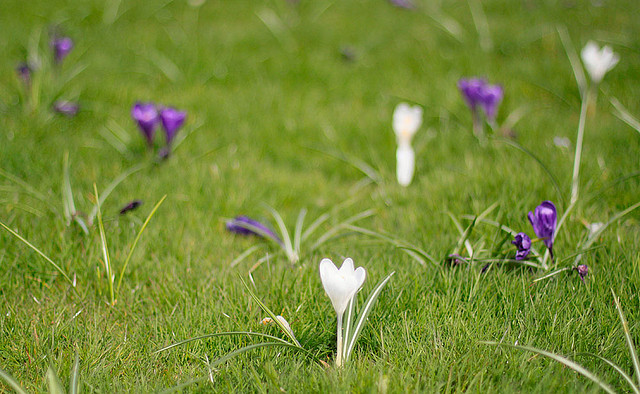
(Photo by Flickr user waferboard)

How Journalism Should Cover Science

Some of Andrew Gelman’s recommendations:

Just as a careful journalist runs the veracity of a scoop by as many reliable sources as possible, he or she should interview as many experts as possible before reporting on a scientific claim. The point is not necessarily to interview an opponent of the study, or to present “both sides” of the story, but rather to talk to independent scholars get their views and troubleshoot as much as possible. The experts might very well endorse the study, but even then they are likely to add more nuance and caveats. …

Just as is the case with so many other beats, science journalism has to adhere to the rules of solid reporting and respect the need for skepticism. And this skepticism should not be exercised for the sake of manufacturing controversy—two sides clashing for the sake of getting attention—but for the sake of conveying to readers a sense of uncertainty, which is central to the scientific process. The point is not that all articles are fatally flawed, but that many newsworthy studies are coupled with press releases that, quite naturally, downplay uncertainty.

Surprised By Grief

dustymontage3It’s not as if I have any excuse (you warned me plenty of times) but I’m shocked by how wrecked I am right now. Patrick, Chris and Jessie, thank God, have been holding down the fort on the Dish, because otherwise I’m not sure I could think about much else right now. How can the emotions be this strong? She was a dog, after all, not a spouse or a parent.

And yet, today, as I found myself coming undone again and again, I realized that living with another being in the same room for 15 and a half years – even if she was just a mischievous, noisy, disobedient, charming, food-obsessed beagle – adds up to a lot of life together. I will never have a child, and she was the closest I’ll likely get. And she was well into her teens when she died.

She was with me before the Dish; before my last boyfriend, Andy; before I met Aaron. She came from the same breeder as the beagle my friend Patrick got as he faced down AIDS at the end of his life. I guess she was one way to keep him in my life, so it was fitting that his ex-boyfriend drove me to the farm in Maryland to get her. I was going to get a boy and call him Orwell (poseur alert) but there were only girls left by the time we got there. I didn’t know what I was doing but this tiny little brown-faced creature ambled over to me and licked the bottom of my pants. She chose me. On the ride home, I realized I hadn’t thought for a second what to call a girl dog, and then Dusty Springfield came on the radio.

My friends couldn’t believe I’d get a dog or, frankly, be able to look after one. I was such a bachelor, a loner, a workaholic writer and gay-marriage activist with relationships that ended almost as quickly as they had begun. I thought getting a dog would help me become less self-centered. And of course it did. It has to. Suddenly you are responsible for another being that needs feeding and medicine and walking twice a day. That had to budge even me out of my narcissism and work-mania.

But I also got her as the first positive step in my life after the depression I sank into after my viral load went to zero in 1997. I know it sounds completely strange, but the knowledge of my likely survival sent me into the pit of despair. I understand now it was some kind of survivor guilt, and, after so much loss, I had to go through it. I wrote my way out of the bleakness in the end – as usual. But this irrepressible little dog also pulled me feistily out.

She was entirely herself – and gleefully untrainable. I spent a large part of our first years together chasing her around bushes and trees and under wharfs, trying to grab something out of her mouth. She’d find a disgusting rotten fish way underneath a rotting pier, wedge herself in there, eat as much as she felt like and then roll around in ecstasy as I, red-faced, bellowed from the closest vantage point I could get. There was the year that giant tuna carcass washed up on the sand and I lost her for a split second and nearly lost my mind looking for her until I realized she was inside the carcass, rendering herself so stinky it was worse than when she got skunked. But the smile on her face as she trotted right out was unforgettable. It was the same, proud, beaming face that appeared from under a bush in Meridian Hill Park covered in human diarrhea, left by a homeless person. Score!

Good times: the countless occasions she peed in the apartment, always under my blogging chair, driving me to distraction; her one giant chocolate orgasm, when she devoured two boxes of Godiva chocolates left on the floor by a visiting friend, ate every one while we were out at dinner, and then forced me to chase her around the apartment when I got home, as she puked viscous chocolate goo over everything, until I slipped in it too. Yes, she survived. The rug? Not so much.

She was also, it has to be said, always emitting noise. She had a classic howl, and when the two of us lived in a tiny box at the end of a wharf, she would bay instinctively at every person and every dog she saw come near. It’s cute at first. But after a while, she drove most of my neighbors completely potty. I tried the citronella collar, but she found a way to howl that stayed just below the volume that triggered the spray. Howling was what she did. There was no way on earth I was going to stop it.

But there was one exception to this rule. In my bachelor days, I’d stay out late in Ptown, trying to get laid, and often getting to sleep only in the early hours. I installed some floor-to-ceiling window blinds to block out the blinding sun over the water – so I could sleep late (this was before the blog). Dusty – usually so loud and restless – would wait patiently for me to wake up, and wedge herself between the bottom of the fabric of the blind and the glass in the window. That way, she kept an eye on all the various threats, while basking in the heat and light of the morning. And until the minute I stirred, despite all the coming and going around her, she uttered not a peep. In her entire life, she never woke me up. This is the deal, she seemed to tell me. You feed and walk me and house me on a beach all summer long, and I’ll let you sleep in.

It was a deal. She never broke her part of it; and I just finished mine.

(Photo montage by Aaron Tone.)

Soaring Through Our Imagination

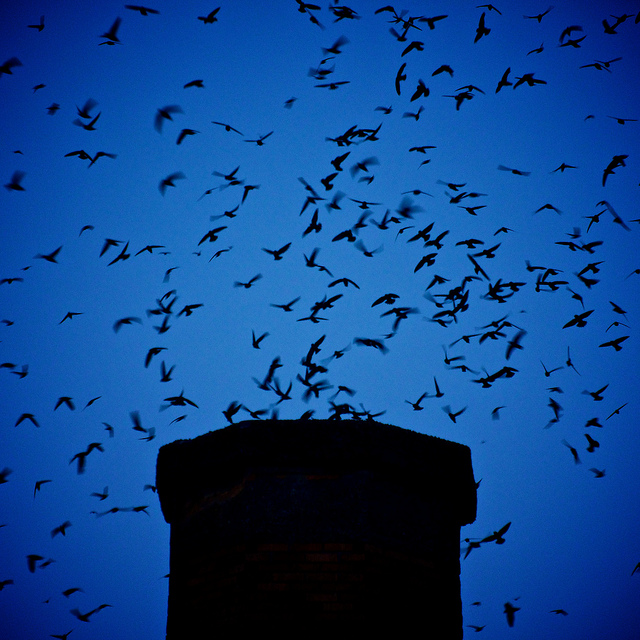
dish_swifts

Mark Cocker contemplates the cultural cachet of birds:

The central symbolic value that birds play in language, literature, art, thought and religion is that of transformation from one state to another. The idea is ancient, visceral and undeniable. Mesolithic infants have been found buried with their heads resting on swans’ wings. The symbol for the Holy Spirit in the Christian faith is a dove. In south-east Asia cranes carried the souls of the dead to heaven. At weddings throughout the western world people release white doves as a symbol of the couple’s love. In Europe white storks bring the spring. Muslims built hospitals to house injured storks and made it an offence to harm them. Traditionally the symbol of homecoming for sailors was the swallow tattooed on their arms.

The examples are innumerable. Central to them all is the idea that birds often express our most cherished ideas and our most exalted values. Look at the spectrum of national flags and other state insignia. Birds, particularly birds of prey, are everywhere – few other creatures feature. It is surely this association with transcendence, or some tiny fragment of it, that is at work in all our encounters with birds. And it is for this reason that they are so crucial to our relationship with all nature.

Jim Crace shares his experience of swifts, “a bird neither friendly nor unfriendly”:

Here, this evening, in Grasse in the Alpes Maritimes of southern France, the noise trapped in the dilapidated, medieval, traffic-free alleyways and courtyards is deafening and eerie. At least a thousand screaming swifts have condescended to spend an hour close to me. I could almost catch one with a butterfly net if I stretched high enough and if they weren’t such whizz-kids of the wing, celebrating every duck and dive and every taken bug with their falsetto palaver. In the final shadows of the evening, these alpine swifts are closer to my head than either starlings or bats would ever dare to come. They are as close as gnats. I’m standing in the eye of the swarm. But still I cannot claim any intimacy with them. Despite this tumultuous proximity, they are not sharing any of their world with me. There is no interface, no common ground. They’re still aloof. My love for them is vain. All they know about is bugs and air, feeding, flying, moving on. They leave me gaping at an empty sky.

Previous Dish on our feathered friends here and here.

(Photo of flying swifts by Robert T. Britt)