Since When Was Free-Loading A Conservative Value?

There are several ways to see the campaign of FreedomWorks and others to persuade young adults to forswear getting health insurance through Obamacare. Perhaps it’s a publicity stunt, a way to vent against what the protestors see as the creeping leftist collectivism of our time. Or it can be seen as sabotage – a spiteful bid to undermine the effectiveness of a law, duly voted on by Congress and backed by a twice-elected president. But what it cannot be seen as, it seems to me, is a principled conservative defense of individual freedom.

For conservatives, freedom is always coupled with personal responsibility. Your right to be free from government interference is also an implicit statement that you can take care of yourself – and won’t at some point suddenly change your mind. This is the core of conservative Road_to_Serfdomlibertarianism: an assertion of radical independence, responsibility and self-sufficiency.

In many areas, this makes perfect sense – but healthcare isn’t one of them. Disease and accident make no distinctions among us. And since 1986, hospitals have been legally required to treat anyone seriously ill who presents himself at an emergency room, with clear medical needs. In the most fundamental way, that was the moment the US socialized medicine – and Ronald Reagan signed the bill. Alas, like so many Reagan domestic initiatives, there was no federal money provided to pay for this. And we all know what happened next: all those extra costs for the uninsured drove up premiums for everyone else, drove up hospital costs, giving them a reason to raise prices even further, and played a role in rendering healthcare unaffordable for many others.

What Obamacare does, like Romneycare before it, is end this free-loading.

The law is telling these young adults that if you want to go without insurance, you are not going to make everyone else pay for it if your risk-analysis ends up faulty. You have to exercise a minimum of personal responsibility to pay for your own potential healthcare. In other words, rights come with responsibilities in a liberal democracy. At least that is what I always understood the conservative position to be.

So why is an allegedly conservative organization actively encouraging personal irresponsibility? Why are they encouraging one sector of society – the young and the fearless – to rely on everyone else’s sacrifice to get bailed out if they have an accident, or contract cancer, or need a hospital to deliver a baby? This is not freedom as the Founders understood it; it’s recklessness, irresponsibility and short-sighted selfishness. Now, if the twentysomethings cannot afford it, it’s one thing – and part of our healthcare cost crisis. But now that Obamacare has removed that excuse and demands that every citizen actually contribute to the insurance pool, that completely defensible excuse is over. No more free-loading, in other words.

So I ask again: why is free-loading now a conservative value?

It is not being independent; it’s being potentially dependent on others while giving nothing in return. And insurance is an inherently collective endeavor. That’s how it works. It’s one area where going it alone makes very little sense. And, of course, the bigger the insurance pool, the lower the premiums. This is not socialism. It’s a simple insurance principle, used by free countries for centuries. It certainly passed muster with Friedrich Hayek, a man you would think would be an influence on the Tea Party’s political program. I’ve cited this before but it’s worth citing again:

Nor is there any reason why the state should not assist the individuals in providing for those common hazards of life against which, because of their uncertainty, few individuals can make adequate provision. Where, as in the case of sickness and accident, neither the desire to avoid such calamities nor the efforts to overcome their consequences are as a rule weakened by the provision of assistance – where, in short, we deal with genuinely insurable risks – the case for the state’s helping to organize a comprehensive system of social insurance is very strong … Wherever communal action can mitigate disasters against which the individual can neither attempt to guard himself nor make the provision for the consequences, such communal action should undoubtedly be taken.

That’s from The Road To Serfdom, one book of the libertarian and conservative Bible. And it’s common sense. It’s leveraging a simple principle – pooling risk – and extending it as far as possible to guard against the “common hazards of life.” There is nothing leftist or socialist about it. And it demands that each of us be personally responsible for the costs our own encounters with illness or accident impose upon our neighbors, rich and poor, young and old. If FreedomWorks were consistent, it would encourage twentysomethings to “burn their Obamacare card” while simultaneously pledging never to seek medical care under any circumstances. That would be coherent, if bonkers. What’s incoherent is claiming that refusing to contribute to a system you nonetheless intend to use is anything but a scam.

In fact, what FreedomWorks is encouraging is the real socialism. It’s using the 1986 law to force hard-working Americans to pay for free-loaders’ care. Since when did conservatives believe in that forced redistribution of wealth from the hard-working to the reckless? Since when did conservatives prefer socialism to personal responsibility?

Since Barack Obama proposed it, that’s when.
The Privilege Of Speaking English

Ta-Nehisi encounters it while learning French in Paris. Other students are from “Italy, Spain, Japan, Korea, Kazakhstan, Portugal, Brazil, Venezuela, Germany, China, Australia and everywhere else”:

I am the only person in the class who speaks only one language. I tell my friends there that I wish more people in America spoke two or three languages. They can’t understand. They tell me English is the international language. Why would an American need to know anything else? Their pursuit of language is not abstract intellectualism. A command of English opens job opportunities.

I am getting some small notion of what it feels like to be white in America. What my classmates are telling me is that the Anglophone world is the international power. It dominates. Thus knowledge is tangibly necessary for them in a way that it is not for me.

Of course the flip-side of this calculus is that power enables ignorance. Black people know this well. We live in a white world. We know the ways of white folks because a failure to master them is akin to the failure of my classmates to learn English. Your future dims a little. The good slave will always know the master in ways that the good master can never know the slave.

Corrections Don’t Get Coverage

IRS Scandal

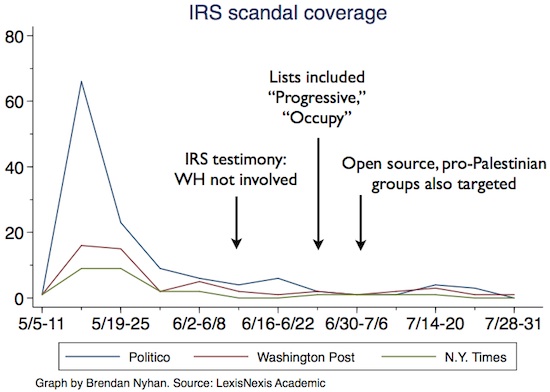
Despite the deflating of the IRS scandal, Brendan Nyhan believes that it could “have serious consequences for the IRS”:

As The New Republic’s Alec MacGillis argued [last] week, Peggy Noonan’s comparisons to Watergate may be hyperbolic but the reputational damage to the agency that she describes could be real.

The problem is what we might call the “scandal attention cycle.” George Washington University political scientist Danny Hayes has described how the “issue attention cycle” results in a surge in news coverage of a new issue like gun control followed by a fairly rapid decline, which received increased attention after the Sandy Hook massacre but ultimately trailed off, following a similar trajectory to previous high-profile shootings. A similar pattern often occurs for scandal—there’s a surge in initial interest as reporters rush to embrace the scandal narrative, but the press quickly loses interest after the most sensational charges are not substantiated. The problem is that it often takes time for the full set of facts to come out. By that time, the story is old news and the more complex or ambiguous details that often emerge are buried or ignored.

Waldman adds:

[I]t’s likely that the idea that “the IRS targeted conservative groups” is going to live pretty much forever, even though it isn’t true. And of course, the people who care—conservatives who believe the Obama administration is guilty of pretty much every crime one could imagine—will do their best to keep it alive, facts or no facts.

The Right’s Brand Of Populism, Ctd

Chait dismisses the idea of Republican populism:

[Y]ou could eliminate every business subsidy in Washington, and you’d still have in place a massive income gulf and a wealthy elite able to pass its advantages on to the next generation (through proximity to jobs, social connections, acculturation, spending money on education) that have nothing to do with government. The egalitarian laissez-faire economy is a fantasy.

Wilkinson pushes back:

I agree that egalitarian laissez-faire is a fantasy, but I deny that rooting out all corporate welfare would do so little and that progressive transfers would do so much.

Mr Chait has set up a false alternative. To say that the “main driver of inequality today is the marketplace” is a fairly empty observation. The marketplace is a complex system of institutions itself created by legal rules, and these rules are mostly established by government. The law constitutes and codifies the corporate form. The law defines the scope of property rights, including intellectual property rights. These political artefacts specify the contours of the marketplace and have vast, systemic distributive consequences. These facts are usually trotted out to correct free-market enthusiasts in the grip of the fallacious idea that “the market” somehow exists outside politics, and that the pattern of income and wealth emerging from the operation of market exchange is therefore “natural” and not already thoroughly political. I’m sure Mr Chait has made these points himself, so it should be be easy for him to see that to say that the marketplace drives inequality is just to say that government does, because the marketplace is a creature of politics.

In Search Of The Male Pill

dish_sperm

Jalees Rehman investigates research into hormonal contraceptives for men:

One of the largest male contraceptive efficacy trials ever conducted was sponsored by the World Health Organisation (WHO) and CONRAD, the US-based reproductive health research organisation. Called Phase II TU/NET-EN, this landmark multicentre study was designed to answer key questions about the long-term safety and efficacy of male hormonal contraception, and enrolled more than 200 couples between 2008 and 2010. The contraceptive used was a long-acting formulation of testosterone (testosterone undecanoate, or TU) combined with a long-acting progestin (norethisterone enanthate or NET-EN), administered via injections every two months. The trial included an initial treatment phase to suppress sperm production, and a subsequent ‘efficacy phase’ that required couples to rely exclusively on this form of birth control for one year. However, in April 2011, the trial was terminated prematurely when the advisory board noticed a higher than expected rate of depression, mood changes and increased sexual desire in the study volunteers. By the trial’s end, only 110 couples had completed the one-year efficacy phase; their efficacy results should be released in the near future. …

The discontinuation of the WHO/CONRAD trial was a major setback in bringing male contraceptives to the market. It also raised difficult ethical questions about how to evaluate side effects in male contraceptive trials.

Since all medications are bound to exhibit some side effects, what side effects should be sufficient to halt a trial? Female contraceptives have been associated with breakthrough bleeding, mood changes, increased risk of blood-clot formation, as well as other side effects. Why should we set a different bar for male contraceptives?

The twist here is that female contraceptives prevent unintended pregnancies in the person actually taking the contraceptive. Since a pregnancy can cause some women significant health problems, the risk of contraceptive side effects can be offset by the benefit of avoiding an unintended pregnancy. However, men do not directly experience any of the health risks of pregnancy — their female partners do. Thus it becomes more difficult, ethically, to justify the side effects of hormonal contraceptives in men.

Previous Dish on the male pill here.

(Photo by Flickr user AndreaLaurel)

Manipulating Memory

Neuroscientists have demonstrated that mice can be manipulated to “recall” memories of experiences that were only implanted – false memories. Jason Castro considers the implications for humans:

Perhaps it would be possible to rebuild particularly cherished and important memories that have deteriorated with age or disease? Or perhaps, more provocatively, some might even embrace the idea of falsified memory – artificially adding in happiness where there is only remembered pain, or subtracting out enduring despair that’s long outlived its usefulness. These are some ethically tricky situations, to be sure. At the same time, though, it’s hard to not sympathize with someone, say a war veteran or a rape victim, who might want the emotional content of a specific, life-destroying memory modified.

Barbara J. King zooms out:

It’s clear to me that memories, though, don’t live on only in our brains. Just as our story telling and the making of new worlds emerge in a rich social dynamic, so does the process of altering our memories by revisiting them. It is as we talk, laugh, revisit the past, argue and tell jokes with others that our memories alter. And as they alter, might not the ongoing interactions and relationships sometimes alter too?

A World Of Sand

photo-27

Rebecca Willis considers the tiny particles:

“Sand”, [geologist Michael Welland] says, “sculpts the landscapes of our planet and reveals the history of the Earth.” Without it, there would be “no concrete, no glass, no silicon chips and a lot less jewellery”. It is hard to conceive of modern life without sand—and therein lies a problem: we are using sand faster than the planet can replenish it.

“We think of sand as something that’s just there,” he says, “but it is not a sustainable resource.” Whole islands are being wiped off the map as man develops the planet, especially by making concrete and extracting valuable minerals. Fracking—the great energy hope of the moment—devours vast quantities of sand. And most of the world’s beaches are undergoing erosion—partly from natural causes and partly because civilisation in coastal areas is “completely perturbing the natural balance of a highly complex system, by removing dunes, building breakwaters, and replacing sand that is removed … with the wrong kind of sand”.

Welland hoped his book would surprise the reader—and it does—but some of his findings surprised him, too. “The microscopic life in between the grains on the beach is truly astonishing.” Tiny invertebrates called meiofauna live there. “If you pick up a handful of wet sand at the beach, you are holding a miniature zoo. And these little critters keep the bad bacteria on the beach under control and relatively odourless for us. The diversity of life in the spaces between the grains of sand is greater than the diversity in the rainforest.” Beach sand is, literally, full of surprises.

(Photo: The dunes outside Provincetown, MA)

The Ethics Of Scientific Studies

Virginia Hughes describes a study that focused on Romanian orphans:

In 1999, [neuroscientist Charles Nelson] and several other American scientists launched the Bucharest Early Intervention Project, a now-famous study of Romanian children who were mostly ‘social orphans’, meaning that their biological parents had given them over to the state’s care. At the time, despite an international outcry over Romania’s orphan problem, many Romanian officials staunchly believed that the behavioural problems of institutionalised children were innate — the reason their parents had left them there, rather than the result of institutional life. And because of these inherent deficiencies, the children would fare better in orphanages than families.

The scientists pitched their study as a way to find out for sure. They enrolled 136 institutionalised children, placed half of them in foster care, and tracked the physical, psychological, and neurological development of both groups for many years. They found, predictably, that kids are much better off in foster care than in orphanages.

She elaborates on the logic underlying the inquiry:

Perhaps the strangest part of this project was that the fundamental scientific question it posed — Are orphanages bad for kids? — had already been answered. Definitively. Studies going back many decades had shown that orphanages are awful. Research with human subjects is normally considered unethical if it doesn’t tackle novel questions. In this case, though, Nelson’s project was ethically justified because Romanian officials had not paid any attention to those previous studies. Quite the opposite: They had a strong cultural belief that state-run orphanages would protect orphans far better than unstable and untrustworthy foster parents.

This cultural belief persists in various forms, as Hughes explores further here.

Happy And Unhealthy?

A new study suggests that a meaningful life is healthier than a simply happy one:

[Researchers Steve] Cole and [Barbara] Fredrickson found that people who are happy but have little to no sense of meaning in their lives — proverbially, simply here for the party — have the same gene expression patterns as people who are responding to and enduring chronic adversity. That is, the bodies of these happy people are preparing them for bacterial threats by activating the pro-inflammatory response. Chronic inflammation is, of course, associated with major illnesses like heart disease and various cancers.

“Empty positive emotions” — like the kind people experience during manic episodes or artificially induced euphoria from alcohol and drugs — ”are about as good for you for as adversity,” says Fredrickson.

It’s important to understand that for many people, a sense of meaning and happiness in life overlap; many people score jointly high (or jointly low) on the happiness and meaning measures in the study. But for many others, there is a dissonance — they feel that they are low on happiness and high on meaning or that their lives are very high in happiness, but low in meaning. This last group, which has the gene expression pattern associated with adversity, formed a whopping 75 percent of study participants. Only one quarter of the study participants had what the researchers call “eudaimonic predominance” — that is, their sense of meaning outpaced their feelings of happiness.

This is too bad given the more beneficial gene expression pattern associated with meaningfulness. People whose levels of happiness and meaning line up, and people who have a strong sense of meaning but are not necessarily happy, showed a deactivation of the adversity stress response. Their bodies were not preparing them for the bacterial infections that we get when we are alone or in trouble, but for the viral infections we get when surrounded by a lot of other people.