Rosemary Hill welcomes back “the essence of summer in London,” the BBC’s annual summer season of orchestral music known as the Proms:
At 16 I was happy with the Proms as self-improvement, indeed I am still. The first one I remember was Paul Tortelier playing Elgar’s Cello Concerto. I went with a school friend having hardly ever heard a live orchestra before. The sheer scale of the thing as well as its beauty was overwhelming. Promming downstairs in the Arena was better for sound and vision, but the Gallery just under the roof, so deep there is room to lie down, struck me as absurdly luxurious. I reclined at my ease while Georg Solti and the Berlin Philharmonic knocked themselves out for my enjoyment.
The cheapness makes it feasible to experiment. Through the Proms I have learned to love Sibelius and discovered that, for me at least, Elliott Carter’s Organ Concerto is one of those pieces best heard from the bar. I listen to the music sometimes more and sometimes less intently but always at the back of my mind there is a mood, an overtone, a kind of mental screensaver playing over.
David Graeber explains the origin of “please” and “thank you”:
The English “please” is short for “if you please,” “if it pleases you to do this” — it is the same in most European languages (French si il vous plait, Spanish por favor). Its literal meaning is “you are under no obligation to do this.” “Hand me the salt. Not that I am saying that you have to!” This is not true; there is a social obligation, and it would be almost impossible not to comply. But etiquette largely consists of the exchange of polite fictions (to use less polite language, lies). When you ask someone to pass the salt, you are also giving them an order; by attaching the word “please,” you are saying that it is not an order. But, in fact, it is.
In English, “thank you” derives from “think” …
[I]t originally meant, “I will remember what you did for me” — which is usually not true either — but in other languages (the Portuguese obrigado is a good example) the standard term follows the form of the English “much obliged” — it actually does means “I am in your debt.” The French merci is even more graphic: it derives from “mercy,” as in begging for mercy; by saying it you are symbolically placing yourself in your benefactor”s power — since a debtor is, after all, a criminal. Saying “you’re welcome,” or “it’s nothing” (French de rien, Spanish de nada) — the latter has at least the advantage of often being literally true — is a way of reassuring the one to whom one has passed the salt that you are not actually inscribing a debit in your imaginary moral account book. So is saying “my pleasure” — you are saying, “No, actually, it’s a credit, not a debit — you did me a favor because in asking me to pass the salt, you gave me the opportunity to do something I found rewarding in itself!”
Truckers are the latest group of blue-collar workers threatened with obsolescence (WSJ):
Some 5.7 million Americans are licensed as professional drivers, steering the country’s vast fleets of delivery vans, UPS trucks and tractor-trailers. Over the next two decades, the driving will slowly be taken on by the machines themselves. Drones. Robots. Autonomous trucks. It’s already happening in a barren stretch in Australia, where Caterpillar Inc. will have 45 self-directed, 240-ton mining trucks maneuvering at an iron-ore mine.
Most of the hubbub around autonomous technology has focused on passenger vehicles, notably Google’s promotional wonder, the Google Car. Ford Motor Co. Chairman Bill Ford Jr. says self-driving cars will hit roads by 2025. But commercial uses are where the real money and action lie: rewiring a massive part of the U.S. economy while removing tens of billions in costs from a commercial fleet that today numbers 253 million trucks.
A fleet of “smart trucks” can reduce staffing needs at a typical iron mine by 30 to 40 percent, according to a recent study from the University of Queensland. Lots of previous Dish on self-driving vehicles here.
In classic fashion, the Clintons let it be known through various toadies and surrogates that they wanted Anthony Weiner to pull out of the race. Friends also vented that comparisons between Huma Abedin and Hillary Rodham were completely outrageous. It was too easy a volley back over the net, but I did it for Hitch. Just when you’ve forgotten what self-loving narcissists the Clintons are, they come back to remind you.
Pope Francis gave a press conference after a triumphant visit to Rio and changed the entire atmosphere in the Vatican toward gay people. K-Lo stuck to the Ratzinger script, but that’s finito. A majority of Americans now favor marriage equality in all fifty states, according to Gallup, but the GOP won’t budge an inch. The global hegemonists in the GOP took aim at Rand Paul. Well, they would, wouldn’t they?
“Pope Francis made clear that being gay is not an impediment for ordination. For him, the issue is not orientation but whether a person is a good priest. Even if a priest fails in celibacy, one can “then convert, and the Lord both forgives and forgets. We don’t have the right to refuse to forget.” The pope made it clear that there is no room for homophobia either in the church or society. But if I had said what he said 24 hours before Francis, I would have been reported to the archbishop,” – Father Thomas Reese, National Catholic Reporter.
“I never thought I’d live to see the day when a Pope would tell me that he doesn’t judge me for being gay, but has a problem with me driving a Lexus,” – a gay priest friend of a gay priest friend.
I’ve just watched the actual video of Pope Francis’ airplane press conference, and it’s even more remarkable than the quotes we gleaned earlier from reporters like John Allen. What’s so striking to me is not what he said, but how he said it: the gentleness, the humor, the transparency. I find myself with tears in my eyes as I watch him. I’ve lived a long time to hear a Pope speak like that – with gentleness and openness, reasserting established dogma with sudden, sweeping exceptions that aren’t quite exceptions – except they sure sound like them.
In the written text, I was disappointed, for example, by his absurd statement that Pope John Paul II had definitively shut down the question of women priests. Firstly, no Pope has the authority to shut down a debate like that, especially one that is purely managerial and pragmatic, and not a matter of doctrine. The statement is so absurd part of me wondered whether Francis wasn’t deploying a little irony … and then I listened to him actually speak the words. And it was far sweeter than irony.
He asserts orthodoxy and then swerves dramatically to one side, his voice lilting and becoming more intense, as if to say, “Yes, I know this is what the Church teaches, and I am not challenging that. But look at the wider picture. Remember that in the Church, the honor accorded to Jesus’ mother is higher than that of any of the apostles, and that women, simply by virtue of being women, are above priests in importance to the Body of Christ.” That’s both a repetition of orthodoxy and yet also a whole-sale re-imagination of it.
Think of this Pope’s refusal to revisit the issue of women in the priesthood and then note that he washed the feet of a woman in Holy Week – the first time any Pope had washed the feet of a woman, let alone, as was the case, a Muslim woman in juvenile detention. Remember also the remarks of one of the most powerful religious figures on earth about atheists:
The Lord has redeemed all of us, all of us, with the Blood of Christ: all of us, not just Catholics. Everyone! ‘Father, the atheists?’ Even the atheists. Everyone! … ‘But I don’t believe, Father, I am an atheist!’ But do good: we will meet one another there.
And this is surely part of the point. What Francis is telling us, it seems to me, is that we should stop squabbling about these esoteric doctrines – while he assents to orthodoxy almost reflexively – and simply do good to others, which is the only thing that really matters. Stop obsessing in your mind and act in the world: help someone, love someone, forgive someone, meet someone.
One of the most telling things about Jesus is that he did not elucidate a theology. It had to be inferred by Paul. Jesus merely told stories of great charm and mystery. But he also clearly transformed the lives of those he encountered by the way in which he lived and died. It was that that convinced so many that this human being wasn’t just any other human being, that the divine had somehow transformed him, and he could transform others. I heard in the voice of Francis today the voice of Jesus confronted with the woman about to be stoned for adultery. No, he does not condone adultery. But the entire dynamic of the story is about something else: it’s about how Jesus defused an impending, brutal execution by bobbing and weaving and drawing in the sand and then speaking intimately with the woman herself with what can only be called revolutionary empathy.
“They are our brothers.” That’s the tone of Jesus. That is, for the Papacy, revolutionary empathy.
Perhaps this is a better way of seeing the difference between Francis and what came before him.
It is impossible to think of Jesus seeing the marginalized of his time, like lepers or Samaritans, and teaching them that they are “somehow distorted, off center, and … not within the direction of creation” because of something they simply are and cannot change. Jesus – as represented by the Gospels – clearly sees that kind of rigid, callous thinking as the mark of Pharisees, the sign of a religion that has forgotten love in its obsession with law, and therefore cannot be connected with the Father of all Creation which is Love. Francis, mind you, does not rebuke Benedict XVI; he pours out affection for him. But everything he is saying and doing is an obvious, implicit rejection of what came before.
What Francis is doing is not suddenly changing orthodoxy; he is instead pointing us in another direction entirely. He is following Saint Francis’ injunction: “Preach the Gospel everywhere; if necessary with words.” He is a walking instantiation of the way Jesus asked us to live: with affection and openness, charity and forgiveness; and a reluctance to seize on issues of theology instead of simply living a life of faith, which is above all a life of action in the service of others:
We all have a duty to do good. And this commandment for everyone to do good, I think, is a beautiful path towards peace. If we, each doing our own part, if we do good to others, if we meet there, doing good, and we go slowly, gently, little by little, we will make that culture of encounter: we need that so much.
Following the second murder of an Tunisian opposition figure in six months, Fadil Aliriza spotlights mounting tension in the original “Arab Spring” nation:
In the background of Tunisia’s political scene, there is a steady hum of anger and frustration. Any big event risks tapping into that well of anger. Tunisians are angry that there has been little progress since the revolution. The economy has not improved and has, in some sectors, weakened. Unemployment refuses to decrease. Corruption is still integral to every facet of Tunisian life. Government and municipal services remain inaccessible and unresponsive to most of the population. Police brutality continues. Stark economic inequalities between people of different economic classes, and between developed coastal regions and underdeveloped interior regions, persist. Political divisions tend to fall along sharp ideological lines, and, despite Tunisia’s woes, assembly members take regular breaks from their task of drafting the constitution.
In this tinderbox, the second political assassination in six months has acted like a spark, and people are looking for someone to blame.
Meanwhile, Juan Cole surveys the chaos in Libya, where “over the weekend, all hell broke loose”:
The assassination of a militant secularist nationalist in Benghazi just after the assassination of of a militant leftist secularist in Tunis raised the question of whether the extremist Libyan and Tunisian devotees of political Islam coorinated the attacks so as to foment turmoil that might form a path whereby they could take over the country.
It seems obvious that the Libyan government needs to swallow its pride and get outside help in accelerating the training of new security forces. What were probably extremist fundamentalist terror cells bombed the courthouse in Benghazi, in front of which crowds gathered on Feb. 17, 2011, to kick off the revolution, was bombed and partially destroyed. Another bomb was set off Sunday evening in Benghazi, as well. …
And no, these problems of transition would not justify having kept the totalitarian and murderous dictatorship of Muammar Gaddafi in place. In fact, many of the extremist fundamentalists were provoked to a life of violence by his oppression. I have a bad feeling about this.
Previous Dish on the recent upheavals in the Arab world here.
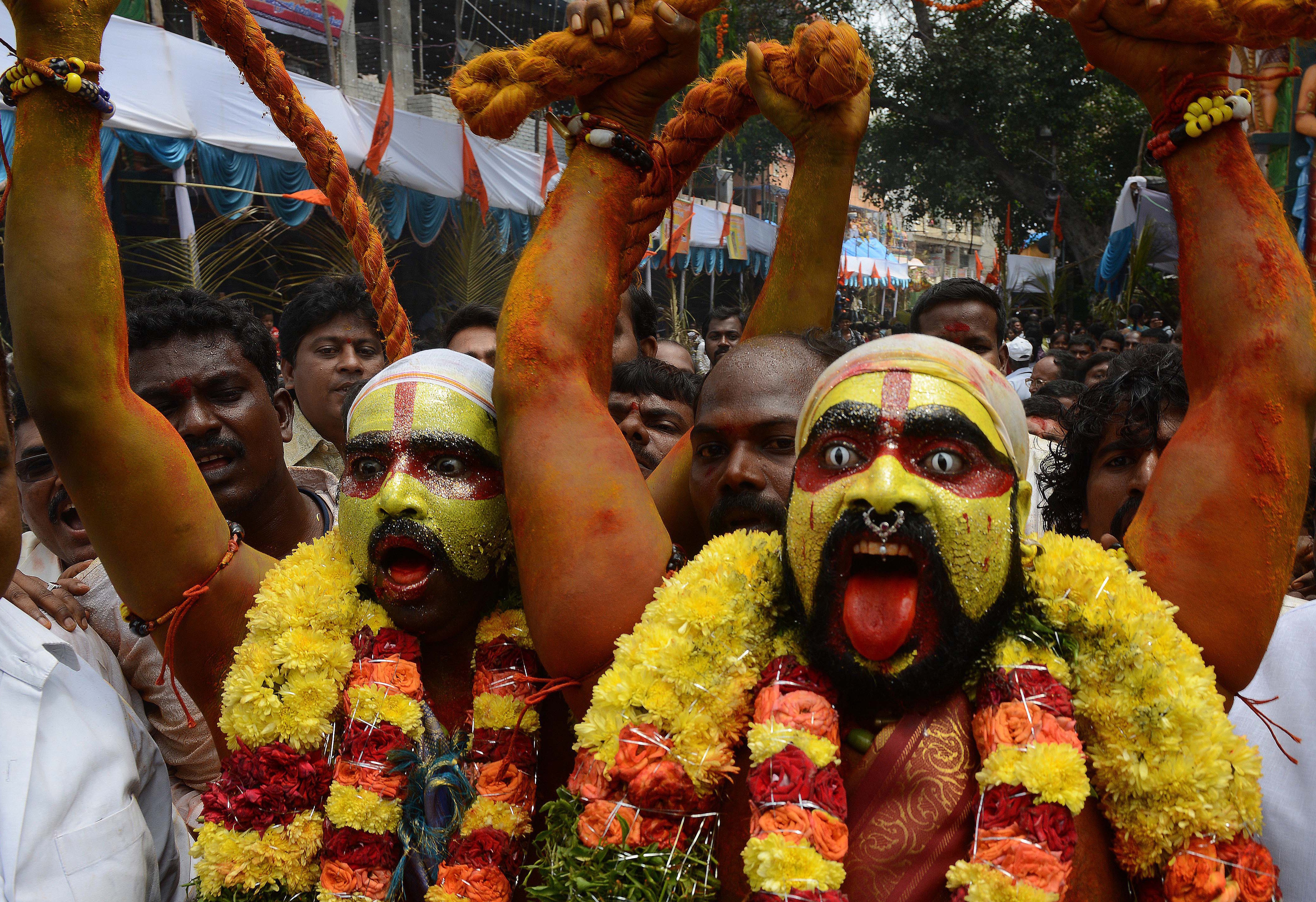
Indian Hindu devotees representing Potharaju, brother of the goddess Mahankali, dance in the streets during the Bonalu festival at the Sri Ujjaini Mahakali Temple in Secunderabad, the twin city of Hyderabad, on July 29, 2013. The Goddess Kali is honoured mostly by women during Bonalu festival by offerings of food and dancing. By Noah Seelam/AFP/Getty Images.