What To Make Of Ferguson?

This embed is invalid


I was on break when the killing of Michael Brown – and the subsequent uproar – took place. And so I’m both unqualified and qualified to offer my two cents on the case. I’m unqualified because I didn’t go through the collective experience of others as this unfolded; I’m qualified because perhaps for the same reason: I can look at the case with a little more distance and a little less emotion. And the best piece I have read on this remains Radley Balko’s report from Saint Louis, where he describes in great and persuasive detail how racial dynamics and a police force financing itself from petty fines from the poor make any idea of equal justice in that area a pipe dream:

Locals say the cops and court officers often come not only from different zip codes, but from completely different cultures and lifestyles than the people whose fines and court fees fund their paychecks. “It was always apparent that police don’t usually have a lot in common with the towns where they work,” says Javad Khazaeli, whose firm Khazaeli Wyrsch represents municipal court clients pro bono. (Disclosure: Khazaeli is also a personal friend.) “But I think Ferguson really showed just how much that can be a problem.”

A recent St. Louis Post-Dispatch survey of the 31 St. Louis County municipalities where blacks made up 10 percent or more of the population found just one town where black representation on the police force was equal or greater than the black presence in the town itself. Some towns were shockingly disparate. In Velda City, for example, blacks make up 95 percent of the town, but just 20 percent of the police. In Flordell Hills, it’s 91 percent and 25 percent respectively. In Normandy, 71 and 14. In Bellefontaine Neighbors, 73 and 3. In Riverview, 70 and 0.

Residents of these towns feel as if their governments see them as little more than sources of revenue. To many residents, the cops and court officers are just outsiders who are paid to come to their towns and make their lives miserable. There’s also a widely held sentiment that the police spend far more time looking for petty offenses that produce fines than they do keeping these communities safe.

Another critical piece of context:

Young black males in recent years were at a far greater risk of being shot dead by police than their white counterparts – 21 times greater, according to a ProPublica analysis of federally collected data on fatal police shootings.

The 1,217 deadly police shootings from 2010 to 2012 captured in the federal data show that blacks, age 15 to 19, were killed at a rate of 31.17 per million, while just 1.47 per million white males in that age range died at the hands of police.

Not a great deal makes sense until you have absorbed that context – and know that Michael Brown was unarmed when he was shot multiple times and killed. He became a symbol of something real – even though the exact details of the altercation between him and a cop were as yet unknown. As to the case itself, I found the prosecutor’s press conference almost laughably tone-deaf, as the man seemed to be more concerned with impugning social media than indicting an accused murderer. It was a small sign of a vast cultural and social disconnect.

But do I believe the Grand Jury was out to lunch? I don’t fully know without having attended the trial and absorbed every piece of evidence now released. But the autopsy confirms at least part of the cop’s testimony – that there was a scuffle inside the car, in which the cop’s gun was fired. And when a person attempts to grab a cop’s gun away from him, or reach into a cop car in order to physically intimidate the cop, we’re not talking about an innocent bystander. We’re talking about an assault on a police officer by someone who had recently stolen from a convenience store. This is not a 12-year-old shot dead for waving a BB gun around. He’s a person who – as the video from the convenience store reveals – can use his weight and size to intimidate and physically threaten those trying to stop him from stealing.

The proximate question, of course, is why Brown was shot multiple times after the altercation in the car.

Brown could have pulled a gun during the original altercation – but didn’t, because he didn’t have one. Couldn’t the cop have surmised that? Wilson, for his part, had several other options available to him:

I considered using my mace, however, I wasn’t willing to sacrifice my left hand, which is blocking my face to go for it. I couldn’t reach around on my right to get it and if I would have gotten it out, the chances of it being effective were slim to none. His hands were in front of his face, it would have blocked the mace from hitting him in the face and if any of that got on me, I know what it does to me and I would have been out of the game. I wear contacts, if that touches any part of my eyes, then I can’t see at all.

Like I said, I don’t carry a taser, I considered my asp, but to get that out since I kind of sit on it, I usually have to lean forward and pull myself forward to the steering wheel to get it out. Again, I wasn’t willing to let go of the one defense I had against being hit.

That might explain the sudden resort to lethal force in the car – but doesn’t explain why a gun was the only weapon he chose to subdue Brown outside the car. He claims Brown charged at him with his hands up, but also reached down inside his waistband. He could have used mace at any point in ways that would not backfire as they might have in the car. And the cop cannot explain the multiple bullets he fired into Brown’s body. But he does revealingly describe him as a “demon”: “when I grabbed him, the only way I can describe it is I felt like a five-year-old holding onto Hulk Hogan.” And the entire episode lasted only 90 seconds.

I suspect it was overkill brought on by any number of factors racing through Wilson’s mind in those frenzied, panicked seconds. And yes, primordial racial feelings may well have been part of the mix. But I can also see why a Grand Jury would have trouble indicting him. A wanted criminal who picked a fight with a cop, struggled with his gun in the cop car, and then turned to face down a man he allegedly called a “pussy” for not shooting at him, is not easily turned into a victim of excessive police violence. The rarety of failures of Grand Jury’s to indict people for murder becomes a lot less rare when you’re talking about a cop confronting a known criminal, especially when the criminal has just tussled with a cop in his car and grabbed his gun.

Which makes this a tragedy. There was no need for Wilson to shoot Brown multiple times; but there was absolutely no justification for Brown assaulting a cop and trying to grab his gun. Once you do that, a jury will not second-guess a member of law enforcement defending himself.

Which leaves us with the endemic problems of trust in the police force that Balko examined.

Which have just gotten immeasurably worse.

Finding The System Guilty

Grand Jury Decision Reached In Ferguson Shooting Case

Freddie declares “this outcome, and so many like it, are the result of a system functioning the way it is intended to function. Racism is baked right into the foundation”:

Every one of those grand jurors might have hearts of purest gold. The outcome was predetermined precisely because the outcome did not rely on the individual character of the jurors. We have police aggression against black people because the white moneyed classes of this country have demanded aggressive policing and the moneyed control our policy. We have police aggression because the War on Drugs provokes it and we still have a War on Drugs because the War on Drugs puts vast amounts of tax dollars in the hands of police departments and a voracious prison industrial complex. We have police aggression against black people because centuries of gerrymandering and political manipulation have been undertaken with the explicit purpose of empowering some people and disenfranchising others.

None of that can be solved through having pure hearts and pure minds. Racism is not a problem of mind. Racism cannot be combated by individuals not being racist. A pure heart makes no difference. In response to systemic injustice, you’ve got to change the systems themselves. It’s the only thing that will ever work.

Jamelle Bouie argues along the same lines:

It would have been powerful to see charges filed against Darren Wilson. At the same time, actual justice for Michael Brown—a world in which young men like Michael Brown can’t be gunned down without consequences—won’t come from the criminal justice system. Our courts and juries aren’t impartial arbiters—they exist inside society, not outside of it—and they can only provide as much justice as society is willing to give.

(Photo: Police confront protestors after rioting broke out following the grand jury announcement in the Michael Brown case on November 24, 2014 in Ferguson, Missouri. By Scott Olson/Getty Images)

The Legal Options Left In Ferguson

Rashad Robinson wants the DOJ to charge Wilson:

Now, justice for Brown lies in the hands of president Barack Obama and US attorney general Eric Holder. The Department of Justice is investigating the death and has the power and responsibility to arrest and prosecute officer Wilson under federal criminal charges. It’s up to our national leaders to step in where Missouri’s politicians have failed, and secure justice for Brown immediately.

Jacob Sullum highly doubts the DOJ will take action:

The relevant statute is Title 18, Section 242, which makes it a federal crime to “willfully” deprive someone of his constitutional rights “under color of any law.” If death results, this crime can be punished by a life sentence or even by execution. But it requires a specific intent to violate someone’s rights, and there is little evidence that Wilson had such an intent.

Jonathan Cohn agrees that the DOJ charging Wilson is unlikely:

But the Ferguson police department is also under investigation, from the Justice Department, and that investigation could very well end in some kind of “consent decree” under which the police changed policies under close federal supervision. It’s happened that way in other jurisdictions where police have come under attack for mistreating racial minoritiesand, as Rebecca Leber has noted, many experts think such arrangements have produced better policing and improved community relations.

The Ferguson Police Department also still has its own internal investigation into Wilson’s conduct, and Missouri’s Department of Public Safety has the right to revoke Wilson’s certification to be a police officer. The most likely remaining legal action against Wilson, though, is a possible civil suit filed by Brown’s family. The burden of proof in wrongful death or civil rights cases is considerably lower than in criminal cases, and the most Brown’s family could hope for is financial penalties and, perhaps, some sense of judicial vindication.

Darren Wilson’s Side Of The Story

Wilson Injury

From a writeup of last night’s grand jury decision:

Wilson testified that Brown punched him in the head after the door-slam, causing him to fear for his life. The teen took off after the first two shots but then stopped, the officer said. “His right (hand) goes under his shirt in his waistband and he starts running at me,” Wilson told the jury. “I tell, keep telling him to go to the ground. He doesn’t. I shoot a series of shots. I don’t know how many I shot.” Ten shots were fired from outside of the police car. McCulloch added that Wilson suffered “some swelling and redness to his face” — potential evidence that he was punched. Hospital photos shown to the grand jury depicted a minimally injured Wilson with some discoloration on his right cheek and the back of his neck.

Josh Marshall highlights another part of Wilson’s testimony:

Fraught and loaded with meaning, Darren Wilson told the St. Louis County grand jury that during his scuffle with Michael Brown, the 18 year old Brown looked “angry”, like a “demon.” This is a classic case of a statement that people on both sides will see through profoundly different lights. For Wilson’s supporters, it’s Wilson’s confirmation that Brown was a thug, an out of control violent malefactor. For Brown supporters, there’s little more graphic evidence of the dehumanization that lead to Brown’s killing.

Friedersdorf reads through testimony by Wilson and witnesses. His takeaway:

I haven’t yet had time to go through all the documents released by St. Louis County, but based on these witness statements, I can see why the grand jury would have reason to doubt whether Officer Wilson committed a crime. At least some witnesses corroborate his story. Some that don’t contradict one another. If the witnesses above all testified in a criminal trial, it’s hard to imagine that a jury would fail to have reasonable doubts about what really happened. There are hundreds of pages to sift through that the grand jury saw. In coming days, we’ll probably discover at least some eyewitness testimony contradicted by physical evidence. But it seems all but certain that we’ll never know exactly what happened that day.

Paul Campos adds:

Cases like this bring to mind Akira Kurosawa’s Rashomon, the film that famously features the depiction of a violent incident from the perspectives of four witness-participants. The witnesses all contradict each other on various key points, and the audience is left to ponder how difficult it is to discern what really happened in a world full of biased, confused, and, otherwise unreliable storytellers.

Jonathan Ellis provides more highlights from Wilson’s testimony. All the released evidence can be found here.

Illiberalism In The Art World

Large Scale Sugar-Coated Sculpture Displayed In Brooklyn's Former Domino Sugar Refinery

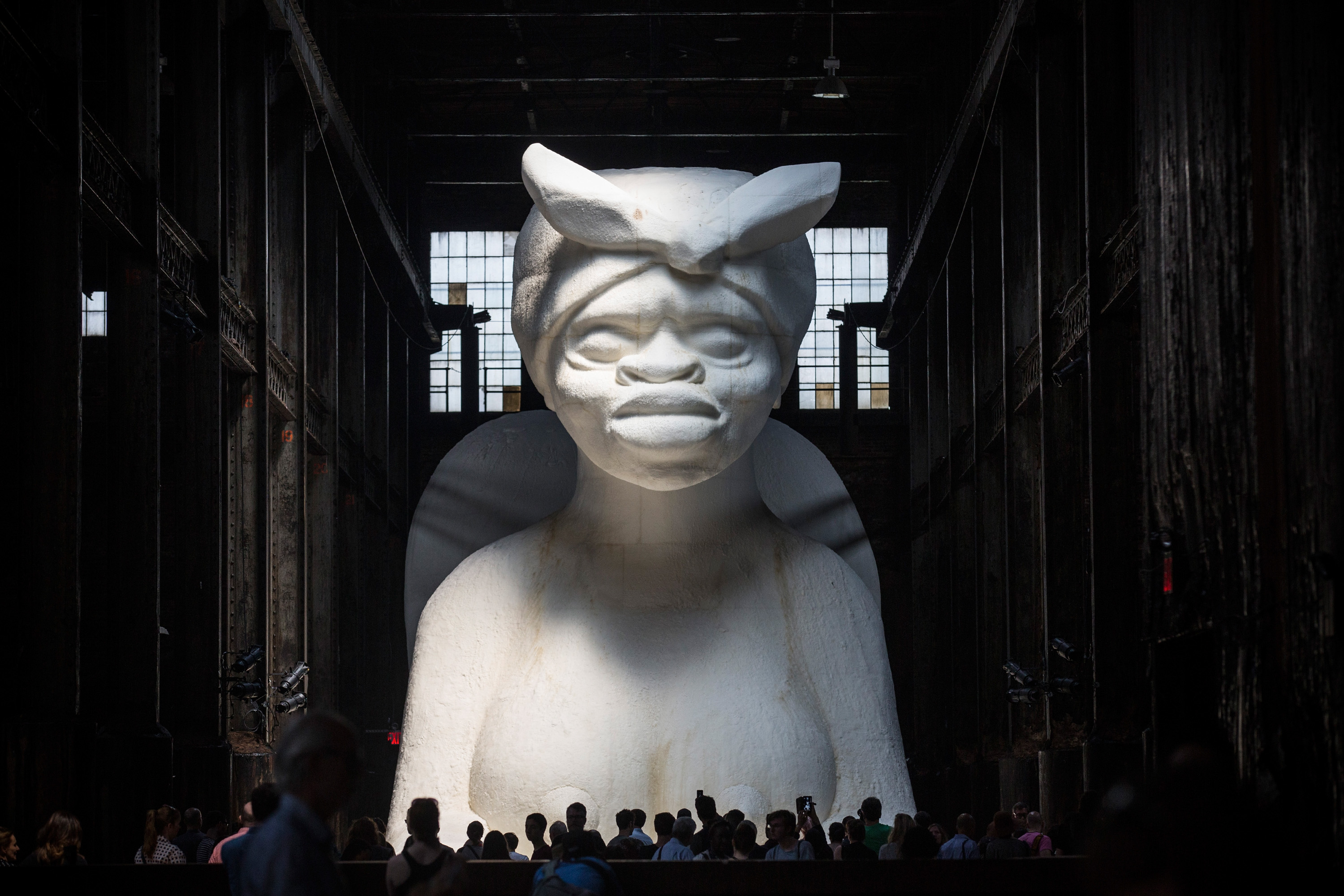
Art critic Jerry Saltz worries that “the decency police” have taken over his field. He ponders why “there’s enormous controversy going on around anyone deemed not to have one’s sexual and racial political papers totally in order, using the ‘proper’ words and designations”:

When I wrote that I didn’t like phenom Oscar Murillo’s gallery-filling David Zwirner chocolate factory, it was said on Twitter that I had “a brown problem”; others threw the word racist around. When I loved Kara Walker’s large sugar sphinx in Brooklyn and wrote that I thought the sculpture should be made into a great float and pulled across the country as a reminder of America’s original sin of slavery, I was said to be “disrespecting” Walker. Amazingly, these comments didn’t stop after Walker herself wrote on Facebook, “I like what Jerry Saltz wrote.” No matter. I was now a “certified racist.”

Since then, I’ve become “sexist,” an “abuser of women,” and a “pervert” for posting on Facebook a graphic picture of a woman’s thrashed behind. The photo was a self-portrait from one of my Twitter friends’ feeds. It’d been posted proudly by her. No matter.

I got scores of Facebook messages from horrified “friends,” and tweets like, “What was Jerry Saltz thinking!” People stormed off the internet in disgust; letters were written to my editor demanding that I step down and asking me to “explain myself.” The strange thing was that I’d already posted dozens of similar and in fact far more graphic images on Facebook, Twitter, and Instagram — images from medieval illuminated manuscripts featuring men being castrated, tortured, and set upon by demons, each posted with some idiotic caption like, “This is what art critics do to bad artists.” These images delighted everybody (or seemed to). But when I switched the gender of the “victim” (now female) and the medium (now photography), all hell broke loose, and the decency police descended.

I’ve never said I have good judgment or that my id is pure. But I’d hate to think what these people would say about Humbert Humbert or Raskolnikov. Still, I couldn’t help notice that the next week, when I posted a more explicit image of a rape, hundreds of people on my Facebook “liked” the picture (and over 2,500 on Instagram). It was a detail of a Bernini sculpture. Medium counts. And so does Facebook, apparently (of Facebook, Twitter, and Instagram, Facebook is by far the most conservative).

He concludes:

If there are only a handful of acceptable ways to express yourself, no one is really expressing themselves at all.

(Photo: People view Kara Walker’s “A Subtlety”, a sphinx made partially of bleached sugar on display at the former Domino Sugar Refinery in the Williamsburg neighborhood of the Brooklyn on May 10, 2014. By Andrew Burton/Getty Images. Dish coverage of the sculpture here.)

It’s Not Easy Seeing Green, Ctd

This embed is invalid


A reader sees a missed opportunity:

“We tend to focus far too much on outward symbols (like Prius driving) in judging whether people are energy conscious.” How could you post that quote from Chris Mooney without referencing the Prius scene from South Park?

Seen above. Another reader:

There are differences between being energy conscious, conserving energy, and energy consumption.  In the scenario presented, what is missing are reasons for driving the number of kilometers.  If the Prius driver has a profession where he/she must drive 28,700 km per year, then one could argue that he/she was being both energy conscious and energy conserving, even though the energy consumption is greater. On the other hand, if the SUV driver were truly energy conscious, he/she would drive a more efficient vehicle to conserve more energy even if the limited distance was for energy conservation.

Another provides a longer critique:

It’s not clear what the actual amount of gas/emissions are used by the Prius (at 48mpg – I’m not converting to kpg right now!), and the SUV at something like 15mpg.

At first blush, the Prius is more than likely getting at least double the mileage so the Prius driver is using less fuel, right? Not that I disagree with the premise of the study. Or, the conclusion.

The hybrids and Priuses are certainly getting more credit than they may deserve. Here in northern Virginia we have a section of US Interstate (I-66) that is HOV only for all lanes in both the morning (into DC), and the afternoon (outbound), in order to cut back on massive traffic; primarily not allowing cars with single drivers. They somehow decided years ago to allow hybrids the luxury of driving the HOV lanes with just single occupants for some unknown reason not at all related to actual traffic on the road. I’d say you see at least 30% of the cars on that road during HOV hours with one occupant. Of course, when you ponder the process what you see is a fuel-saving/carbon-reducing vehicle getting a benefit on a capacity road issue. Strange, isn’t it? I guess the planners just assume that since you get better mileage, you don’t congest roads?

Lastly, the mileage of a car isn’t the most important factor when taking into account fuel usage and carbon emissions – it’s people miles per gallon burned. A single driver of a Prius getting 49mpg is less efficient than my wife and I commuting into DC together in my 32mpg Nissan Versa: we are getting 62 people miles per gallon, they are getting 49 people miles per gallon. And, we are two people in one car – not a bunch of singles.

Carpooling, or multiple riders per vehicle, is far more important than just mpg, but I don’t think people consider that when buying and driving.

Update from a reader:

Something that doesn’t come up much in discussion like this is the following. Folks talk about electric and hybrid cars (anything that uses a charger to fill up the batteries) as if the power source stops at the battery. But that electricity doesn’t just magically appear at the wall socket. It’s generated somewhere by some process that uses some other energy source to provide it.  Depending on where you are, that could be, yes, solar, wind, or hydroelectric or even nuclear generation.  More likely it’s from plants burning fossil fuels: natural gas, fuel oil, or – dirtiest of all – coal.

So. Whatever bright future shines ahead of us, that electric car which does not have a local fossil fuel source – gas or coal in the tank burned locally in the car, but it is still, for the foreseeable future, a fossil fueled machine.  It may be displaced several steps away from its energy source, but it’s energy source remains the same.

Another responds to that reader:

True as far as it goes, but it’s far easier to control emissions at a power plant than at millions of vehicles. Also, as a dirty power source gets replaced, it has an immediate effect on all the vehicles that derive power from it.

Chart Of The Day

162000

Update from a reader:

I’m a lawyer and I studied Epidemiology at Harvard, so I know bad and misleading statistics when I see them. Yes, failures to indict are rare, because under normal circumstances prosecutors only seek indictments when they have strong cases!

This is what we call “selection bias.” If Michael Brown had been white, there would have been no media outcry, and no protests (google “Dillon Taylor,” a white guy shot by police in Utah at the same time Ferguson was going down). Under normal circumstances, a prosecutor would have determined very quickly that Darren Wilson hadn’t done anything wrong, and the case would never have been presented to a grand jury.

In this case, because of outcry (stoked largely by early reporting that seemed to suggest that Wilson had gunned down Brown in cold blood for no reason,) the prosecutor had to take the case to a grand jury to appease the crowd. But the facts never supported an indictment.

We saw this before with Trayvon Martin; a prosecutor tries a fatally weak case under political pressure and inevitably fails. Paradoxically, this makes people more angry, because they don’t understand that these cases would never have been brought in the first place absent outcry.

Even Nate Silver has been passing around the rarity of failures to indict as if that tells us something about the current case. He should know better.

Another reader:

As the website admits, it is a chart of federal indictments, not state indictments. State and county grand juries fail to bring indictments in Missouri at a far higher rate, a quick perusal of Nexis shows.

More feedback “from a former criminal defense attorney”:

I think a lot of folks are missing the multitude of ways this grand jury was handled abnormally. Remember, it isn’t an adversarial proceeding; it is entirely under the control of the prosecutors. In a typical grand jury, the prosecutors do not present evidence that is obviously incorrect, such as the witnesses who said Wilson fired at a running Brown from inside the car. That’s obvious mistaken and therefore not evidence of anything.

Why did they bring out all that garbage before the grand jury? For the same reason that Fox News goes on a tirade over everything Obama, in the hopes that a cumulative impression will be formed that the witnesses were making things up, even as the individual elements of that narrative don’t hold up. And there’s no one in the grand jury room to say “well if you know this guy is wrong, why is he here?” But it was even worse than that. In the transcript, when witnesses testified that rather than running toward Wilson, Brown was actually staggering to the ground, the prosecutor said – in front of the grand jury! – “But that physical evidence contradicts your testimony.” (Which isn’t true – the physical evidence in this case is neutral on this critical point.) In other words, this was not, as McCulloch claimed, a presenting of all evidence, neutrally, to the grand jury. This was out and out advocacy for no indictment.

This is how its supposed to work: If the prosecutor does not believe he can win a conviction, the case ends there and doesn’t go to a grand jury. He exercises prosecutorial discretion. This happens ALL the time. If the prosecutor thinks he has a case, he goes to the grand jury and presents his case. He doesn’t present both sides because this isn’t an adversarial trial that can probe conflicting evidence. The sole question is whether the prosecutor can make his case. If there are witnesses who see a crime contradicted by witnesses who don’t, the trial jury decides after both sides question the witnesses. In the grand jury, the decision is merely whether the prosecutor can proceed. Then the indictment (or, more rarely, no indictment) is released during business hours, even in high profile cases. There are rarely press conferences, but when they occur the prosecutors lay out the charges. They do not advocate their case. They do not whine about social media. They do not speculate farther than the question at hand (In other words, all McCulloch had to say was that the grand jury found no basis for an indictment, yet he went farther and claimed the shooting was justified, an entirely different question.) They do not parade out discredited evidence.

I am open to the possibility that this was not a case that could end in conviction. But we cannot draw any conclusions about the facts from this travesty of a proceeding. It has no credibility. And I’m not even getting to the timing of the announcement – waiting hours and then 20 minutes more as the tension built and built, as if they wanted a riot.

(Chart via Philip Bump)

Obamacare’s Auto-Renewal Mess, Ctd

A reader sighs:

What is wrong with this administration when it comes to their healthcare overhaul? They cannot be this dumb:

Under current rules, consumers who do not take action during the open enrollment window are re-enrolled in the same plan they were in the previous year, even if that plan experienced significant premium increases. We are considering alternative options for re-enrollment, under which consumers who take no action might be defaulted into a lower cost plan rather than their current plan.

So the administration that spent an unconscionable amount of time fighting claims that the ACA was a government take-over of healthcare are considering allowing HHS to take over certain people’s choices for their health insurance. There are no words for how stupid of an idea that is and whoever thought of it should be forced to watch Fox News for a week non-stop until they get the picture.

Another is far more optimistic:

The autorenewal mess … isn’t going to be a mess.  Do you think the people who signed up last year are stupid? They are on the ball, and they are used to shopping. Thirty years of deregulation has taught all of us to check around when a CD comes due, when auto insurance renews, and during open enrollment at  work, and most importantly, when your mobile phone is out of contract.

If you can do your taxes, you can handle this.

And if you can’t, there are people (insurance brokers) who will do it for you – just like there are accountants who will do your taxes for you.  I work in the health insurance industry, for one of the Blue Cross/Blue Shield affiliates, and we are already seeing signs that insurance brokers are all over this. Not all of them, but the smart ones certainly are.  They will be reaching out to their clients, I guarantee it.  There is an incentive; a new policy pays a higher commission than a renewal. So there is a significant financial incentive for the broker to put their customer in a new plan every year.

The reason Obamacare is so rickety and so complicated is that it uses the existing system.  Rather than providing single pay, it depends on a patchwork of state-level insurers; there is no federal market for insurance.   Even the biggest companies have to file their plans at a state level, which is fiendishly complicated because what is OK with one insurance commissioner can be sent back for amendment by the state next door.  If you are a red state living next to a blue state, well … it can be frustrating.

But the genius in the plan is that it greases all the right palms.  The providers are guaranteed payment after decades of writing off uninsured medical – there is now in effect a stop-loss of the amount of the insured’s out of pocket, so rather than eat $50,000 in costs for a hospitalization, the provider will eat the first $12,000 worst case, with the insurance company covering all above that. The insurance companies are given a captive market, and the brokers make money too.  It’s a win all around for private enterprise.

I will be very interested to see what happens if the Supreme Court rules against the federal exchange.  I am guessing the pressure will be on Congress to amend the statute or cede the powerful health care industrial complex to the Democrats for all eternity.

Certainly there will be a few people who fall through the cracks and will be paraded around on Fox News.  Those people deserve the same amount of sympathy as somebody who claims they thought they could just file their taxes once and then the government would take care of it for them – after all, their taxes are coming out of their paychecks.

The Ferguson Decision: Tweet Reax

https://twitter.com/michaelhayes/status/537070409720795137

https://twitter.com/juliebosman/status/537069535413563393

https://twitter.com/tanehisicoates/status/537073199985729536

https://twitter.com/sepinwall/status/537069780122238976

https://twitter.com/msjwilly/status/537073781807022080

https://twitter.com/DannyVinik/status/537076177614434305

https://twitter.com/jetpack/status/537082474187485185

https://twitter.com/PaulLewis/status/537088874418540544

https://twitter.com/JonathanBlakely/status/537091695746482177

The Best Of The Dish Today

Much more Dish coverage soon. Meanwhile, Elizabeth Nolan Brown offers a truce in the gender debate:

Perhaps rape is something best looked at as a phenomenon driven by a small number of serial predators that are enabled by the culture. Callous attitudes toward rape don’t “cause” rape, but they could—in aggregate—create conditions where it’s easier for rapists to do so. Do Valenti and company overstate the extent to which socialization influences rapists? Sometimes. But there’s also a tendency among conservatives and many libertarians to dismiss feminist talk of “rape culture” as patently absurd. And I like to think (or hope, at least) that this is partly a function of parties talking past one another.

It’s a piece, like many of Elizabeth’s, that’s well worth your time. My core principle in all this is about protecting free expression, even at the expense of social justice. Because without free expression, we cannot know what social justice can actually mean. There is an epistemological certainty on the cultural left that troubles me as much as the doctrinal certainty on the Christianist right. It is because we need always to doubt such certainties that free expression comes first. At root, I guess, I just don’t believe that some things must never be said and some debates must never be held. One side may go a long way toward winning … but we should never believe that a debate has ended. It can always be revived. I’ve battled both the conservative cultural police as well as the liberal version on this question. And while I’m more than happy to air as many dissents as there are, I’m not giving up on that basic principle. It’s called liberalism.

Today, I marveled at Merkel, took stock of Obama’s energy and climate legacy, and backed Rand Paul’s call for a formal declaration of war before the US ever goes into combat again. We aired the contours of the latest extension of the talks to restrain Iran’s nuclear weapon potential; and debated whether the executive branch was more of a Republican office than a Democratic one. Plus: the latest round in the fight to insist upon the facts over the myth of Matthew Shepard.

The most popular post of the day was This Is The Way Benghazi Ends …, followed by An Evangelical Changes His Mind On Gays.

Many of today’s posts were updated with your emails – read them all here.  You can always leave your unfiltered comments at our Facebook page and @sullydish. 22 more readers became subscribers today. You can join them here – and get access to all the readons and Deep Dish – for a little as $1.99 month. One long-time holdout writes:

I’ve been enjoying the blog since 2008.  I am sorry I haven’t subscribed until now.  What won me over was the View From Your Window contest.  I am completely hooked on it and was so excited to send in my (correct, I think) guess that I realized I really need to subscribe, if for the contest alone. How about more contests, like one from Tuesday to Saturday, to keep us occupied when we are impatiently itching for the next VFYW?

The contest already takes Chris but primarily Chas these days a ton of time to compile and edit each week, so having another one would be a bit too much to handle. But keep the feedback coming. A final email for the day:

What would happen if Sen. Rockefeller just released the torture report? If it is so important that the American people see it – and I agree that it is – maybe it is time for this child of privilege to take a stand for the sake of the republic. Would he be arrested? Tried? It just seems ridiculous to say “we will read it into the Congressional Record but they will probably stop us. Hmm, if only there was some way to get this report into the hands of the American people.” The Internet. Wikileaks. It’s not that hard.

The Dish is also available. Just sayin’.

See you in the morning.