The Shrinking Of Big Law

Noam Scheiber covers it:

There are currently between 150 and 250 firms in the United States that can claim membership in the club known as Big Law, the group of historically profitable firms that cater to the country’s largest corporations. The overwhelming majority of these still operate according to a business model that assumes, at least implicitly, that clients will insist upon the best legal talent instead of the best bargain for legal talent. That assumption has become rickety. Within the next decade or so, according to one common hypothesis, there will be at most 20 to 25 firms that can operate this way—the firms whose clients have so many billions of dollars riding on their legal work that they can truly spend without limit. The other 200 firms will have to reinvent themselves or disappear.

Yglesias adds that, “while the pace of change obviously seems furious to the people at the center of the storm, the genuinely remarkable thing is how long the Big Law model has lasted—not the fact that it’s fading away.”

The South vs Social Mobility, Ctd

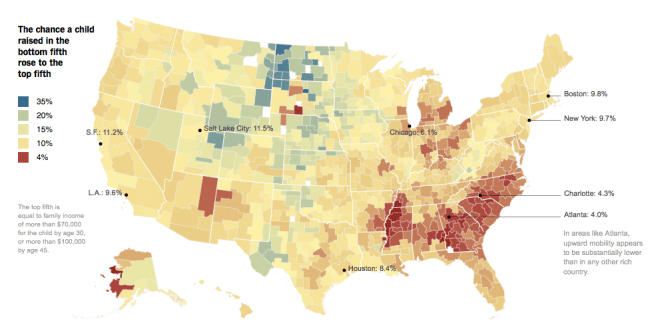
Screen Shot 2013-07-22 at 11.20.59 AM

A reader writes:

Your reader’s reaction (comparing the “black belt” and the NYT map [seen above]) was my first reaction, too. But the article focuses a lot on the issues of social mobility between different cities. Most of the “black belt” is quite rural (these counties may vote deep blue, but their states are GOP strongholds because not that many people live there). Not only are there fewer opportunities in these areas, but the data may be somewhat skewed by smaller response rates. The question is: why do several of the largest and most successful cities in the south (Atlanta, Memphis, Charlotte) have such low rates compared to cities in other parts of the country?

Another sharpens the points of the previous reader:

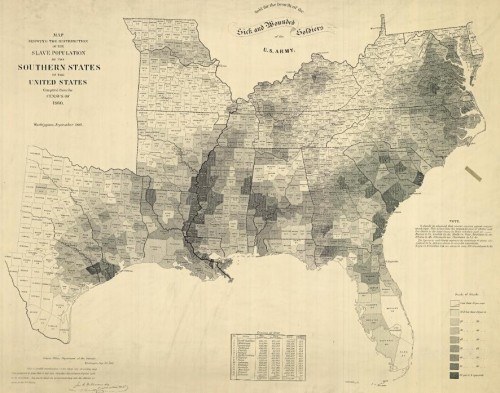
That’s a fascinating map!  But sadly it speaks to racial division more than simple geography (despite what the NYT article seems to suggest).  That low-mobility corner of Arizona?  The slaves-500x393Navajo reservation. West coast of Alaska? Native Alaskan villages.

Also, low mobility is not just in “the South”, or even “the deep South”, but in the specific parts that have a high percentage of African-American population: the Mississippi Delta, the black belt of Alabama (so-called originally because of its soil, but it also applies demographically).  Compare the South in the mobility map to this map of county-by-county presidential election results from 2008, which in the South reflects where African-American voters are concentrated.  (Or, for that matter, this map [seen right] of the last slave census, in 1860.)

Oh, that high-mobility patch on the North Dakota / Montana border?  Beats me.

Another has the answer:

I wanted to make a few observations on the mobility map you posted:

1) Manifest destiny is alive and well. The West still provides opportunities for new settlers after all these years. The map demonstrates the West’s promise for a fresh start has not dried up yet.

2) Extractive resources are the best bets for mobility.

The map’s blue tinge in the Bakken in North Dakota and Montana, the gas and coal fields of Wyoming, and West Virginia and eastern Kentucky’s coal country highlight how important that mining, oil and gas, and coal are for large scale mobility. Pennsylvania’s pale interior of Marcellus fracking production also demonstrates this trend. Where can someone right out of high school rise to a six figure income right away without working on an oil rig? Also, these are the industries that will be hurt the most by efforts to mitigate carbon emissions in the face of global warming. More immediately, these trends show how efforts to slow or halt horizontal drilling and hydraulic fracturing act to shut the door on many people’s best chance at mobility.

3) The Ogallala Aquifer is one of our key national resources. The blue strip down the center of the country largely overlays the Ogallala Aquifer, supporting significant corn and agricultural production. This rich source of groundwater has recently gotten a little press in the Keystone XL debate, but this map shows how important the natural resource really is. As of late, concerns have arisen that the aquifer is being mined, depleting the water traveling beneath the nation’s center.

These observations avoid discussion of the Black Belt, the Rust Belt, and Indian reservations, as enough ink is spilled on those topics. However, in our move to a service-based economy, recognition of the natural resource-driven reasons European nations first set forth in conquest still apply today. Gold, cod, and timber (suitable for mast building, at least) have fallen away to oil, gas, and corn, but these resources provide the most opportunity for achieving the “American dream.”

Globalized Gangsterism

Organized crime is on the rise internationally:

Gangsters are cropping up in all sorts of odd places. Criminal syndicates are implicated in everything from the poaching of rare wildlife to the counterfeiting of drugs and manufactured goods. That growing range of activities attests to the criminals’ skill at exploiting the possibilities offered by deepening global interconnectedness. Consider the opening of this story about a recent global raid by Interpol: “More than 6,000 people around the world were arrested in a two-month anti-counterfeiting sweep that netted tens of millions of dollars worth of fake shampoo in China, phony cigarettes in Turkey and bogus booze in Chile.” The investigators discovered everything from a subterranean factory in Ukraine manufacturing counterfeit cigarettes to a workshop in Peru that puts false labels on motors from China.

A Burj-Eyed View

Jacob Rubin contemplates the perspective afforded by the tallest building in the world:

It is a 360-degree view from the Burj Khalifa’s observation deck, and I would say about forty-five degrees of that semicircle looked out at the plots of ordinary skyscrapers. The dish_burj rest of the view—approximately 330 degrees—was of flat, low urban developments shading into the varied browns of the desert. To the west, a hazy view of the Persian Gulf. All of which would have been mostly unchanged at a much lower height. The irony—a simple one, perhaps, but one I could not get over—was that this building was the city’s most meaningful sight and we were now inside it, looking out at the very little that surrounds it.

This was not the intended view from the Burj. When construction began in 2004, Dubai was still in the grip of fiendish development. By 2009, with the Burj partially completed, Dubai had plummeted into apocalyptic debt, requiring a $10 billion loan from oil-rich Abu Dhabi to complete the project. (Originally titled the Burj Dubai, it is now named after the Sheikh of Abu Dhabi, presumably part of the deal.) No doubt more architectural wonders would have enlivened its view, if not for this financial catastrophe, caused in no small part by the erection of the Burj itself. Less a phoenix rising from the ashes, it is a phoenix whose rising helped cause a financial wildfire. The homage to Frank Lloyd Wright, in this sense, has come full circle: the Burj is impossible, no less fictional for having been made.

And yet this strange panorama makes a trip to the Burj inadvertently sublime. Every monument, at its inception, gives rise to its future ruin, and yet few face the prospect as directly as the Burj. From its state-of-the-art observation deck, one beholds the ageless, ungoverned desert. Futility is never more futilely refuted than with a monument. The Burj seems to have been erected to elucidate this fact.

Previous Dish on the Burj here and here. Another skyscraper will soon be close behind:

Just as the weekend took off, so did the world’s next tallest skyscraper. In China’s 25th biggest city, Changsha, Hunan, ground has ambitiously been broken. In just the next seven months, Broad Sustainable Construction plans to erect its Sky City, a 220-story, 838 meter (2,749 feet) megatower.

(Photo by Flickr user nelson ebelt)

More Luck Than Sense

Chris Dillow reviews the results of an experiment that suggests people confuse luck and skill:

Jordi Brandts and colleagues got a group of [fourth-year finance] students to predict a sequence of five coin tosses, and then selected the best and the worst predictor. They then asked other subjects to bet on whether the best and worst predictor could predict another five coin tosses. The subjects were told that they would bet on the worst predictor from the first round, unless they paid to switch to the best predictor.

82% of subjects paid to make the switch.

But of course, there is no such thing as an ability to predict the toss of a coin. Most subjects, then, saw skill where there was only luck. And, what’s more, they were willing to spend good money to back this daft opinion.

Where Is The Midwest? Ctd

Screen Shot 2013-07-22 at 3.20.13 PM

A reader writes:

This is an eternal argument, man.  Is Oklahoma in the Midwest, or is it a Southern state, or maybe Southwestern? The answer is: it depends on what part of Oklahoma you’re talking about.  Oklahoma is at a crossroads in this country, in a number of ways.  If you’re from Ponca City, not far from Wichita, that’s pretty heavily Midwest.  If you’re from Idabel, down in the southwestern corner, you probably have more in common with Louisianans than you do with Iowans.  If you’re from Gage, out in the panhandle, you’re within spitting distance of New Mexico and Colorado.  And folks down by Lake Texoma … well.

And it’s not just cultural; it’s geographic, as well.  I was just the other day messing around with a map of North American biomes.  To illustrate a point to a friend, I overlaid a US map with state outlines over this map [see above]. Sorry, my bastardized version is on my home computer, but I figure you can tell pretty clearly that the big crossroads right in the middle is, in fact, right in the middle of Oklahoma. There are, like, ten colors on the map that fall within the Oklahoma state line. So, yeah, we’re a little bit of everything; we can provide you with just about anything except for tundra and oceanfront property (to my everlasting sorrow).

Another reader:

My favorite definition of the Midwesterner:

If you call a carbonated beverage pop or soda pop, you are from the Midwest. Hence, Pittsburgh is in the Midwest. Being about a 7+ hour drive from the Atlantic Ocean, Pittsburgh should not be called an East Coast city. A related definition: If you call all carbonated beverages Coke, you are from the South.

Another:

I’ll proffer the great Pop vs Soda map (the one by county is almost older than the Internet, but I think still the best). According to these maps, the dividing line between pop and soda country runs between Syracuse and Rochester. So Syracuse is in the east and Rochester in the Midwest. Of course, while it seems to get the outside boundaries pretty well (other than the western boundary), Saint Louis and eastern Wisconsin call fizzy drinks “sodas” unlike the rest of their midwestern brethren. Tulsa, which is in pretty-southern Oklahoma, must be midwestern (pop) while Indianapolis, in very-Midwestern Indiana, calls it Coke. So it must be in the South.

Freedom On The Farm

Academic Anne Buchanan relates the daily routine of her sister Jennifer, a dairy farmer in Vermont:

Farmers have an old saying: ‘I’ll keep farming until the money runs out.’ Working a small farm makes for a hardscrabble life — no time off and always something more to do, usually for very little pay. But, after the animals are hayed, grained, watered, milked and midwifed, sick ones taken care of, hooves trimmed, bales of hay stacked in the haymow or the driveway ploughed — and more often than not, the neighbour’s too — broken pipes fixed, the neighbour’s errant cows shooed back into their fields, milk processed and yogurt made, the broken hay tedder repaired midfield, lunch served and dinner prepared; if there’s any time left in the day, and amazingly there often is, Jennifer and Melvin are free to do whatever they want to with it. They answer to no one. They can make jam, build retaining walls, throw together a loaf of bread, make soap, sew scrub suits for the daughter who’s a nurse, install an outdoor wood-burning furnace. Melvin has even been known to come in from milking at 2am and pick up whatever history book he’s currently reading and not get to bed until dawn.

It’s a demanding way to live, but Jennifer and Melvin love it. Small farmers have to love what they do, because they’re not in it for the money.

The Best Of The Dish Today

The Duchess Of Cambridge Goes Into Labour

We asked where the MidWest was. And I wondered why the South is so lacking in social mobility. (Hint: race).  We gave you bad art and great editing. And marijuana is slimming!

My two favorite quotes from the day:

You had to have someone with you when you listened to Billie Holiday, for instance. Otherwise, you might kill yourself.

and:

Duckling Snoring: This video is no longer available due to a copyright claim by Snoring Dormouse.

The most popular post of the day was my take on the president’s Trayvon presser; the second hottest was The South vs Social Mobility.

Oh and a future king was born. One day he could grow up and marry a prince!

See you in the morning.

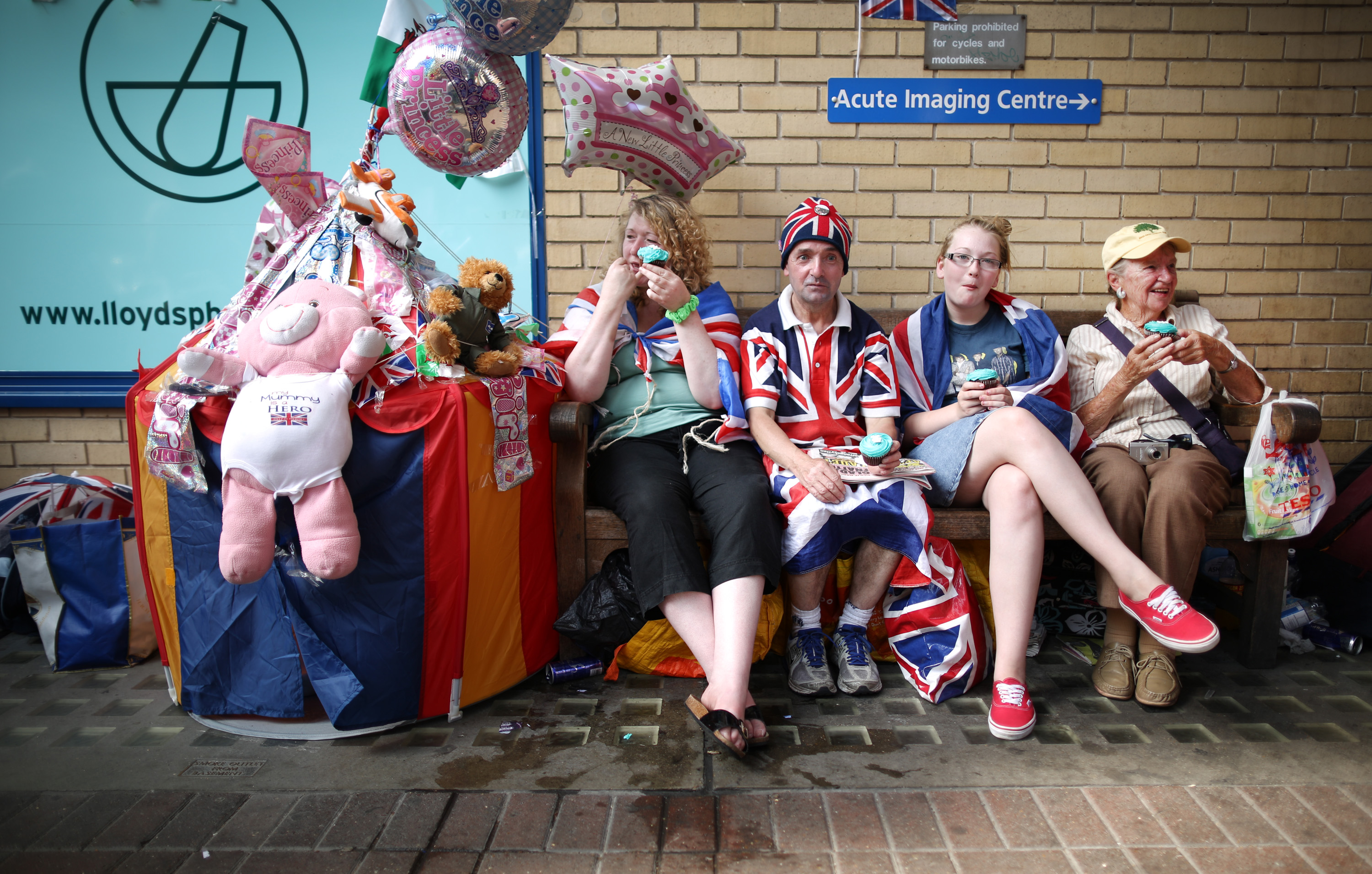
(Photo: Royal fans wait outside St Mary’s Hospital on July 22, 2013 in London, England. By Peter Mcdiarmid/Getty.)

An Epic Close To Home

Ashley Clark explains why Do the Right Thing is a cultural triumph:

On paper, Spike Lee’s Do the Right Thing (1989)—a modestly budgeted comedy-drama that took place entirely on a single Brooklyn block on the hottest day of the year—might seem a curious fit for the label of “American Epic.” Traditionally, when we think of what constitutes “epic” cinema, we might imagine inflated running times, mega budgets, sweeping vistas, and the leap-frogging of decades. And, if we’re talking specifically about Lee’s oeuvre, isn’t Malcolm X (1992), his 201-minute, $33 million, continent-hopping biopic of the life and times of the eponymous activist and orator, a safer bet for the label in such a retrospective?

If we cast away such generic preconceptions, it soon becomes apparent that the earlier film is the bolder choice. Within the strict temporal and location confines of Do the Right Thing lies a work concerned with tackling the biggest of American themes—race relations, ambition, urban survival, economics, violence, and liberty—on a microcosmic scale. With its thrillingly unorthodox blend of Aristotelian unity and Brechtian artificiality, it locates the big in the small, and the national in the local.

Over 120 swift minutes, it assails the viewer with a mixture of character drama, comedy, poetry, music, and then, in its riot finale precipitated by the cops’ murder of young Radio Raheem (Bill Nunn), dares to echo SNCC member H. Rap Brown’s darkly diagnostic pronouncement in the 1960s that “violence is as American as cherry pie.” (He meant “apple,” but he made his point.) Intended by Lee as an artistic response to the racial tensions in a New York City then under the Mayorship of Ed Koch, the film sparked huge controversy, prompting a host of misguided cultural critics to speculate that it would cause riots. It didn’t, of course, but it struck a nerve because it said more about the state of contemporary race relations, and with more complexity and brazen confidence, than any other film in the American cinema to date.

(Hat tip: 3QD)

Don’t Think Of A Scrotum

Inspired by Dostoevsky’s observation, “Try not to think of a polar bear, and you will see that the cursed thing will come to mind every minute,” psychologist Daniel Wegner designed experiments to test how well people can suppress their own thoughts. The answer: poorly. Subjects forbidden to think about a subject not only thought of it more often; they continued to think about it for days on end. In tribute to Wegner, who died earlier this month, Maria Konnikova reprints a 2012 essay on his findings:

The more effort we expend on keeping something from our mind, the more likely we are to be reminded of it—because at some level, we have to keep reminding ourselves not to think about it. As long as not thinking is in the back of our minds, we will be prompted to think of precisely the thing we shouldn’t be thinking about. Wegner calls this an ironic monitoring process: each time we think about a distracter topic to put off the topic we’d like to avoid (something we do consciously), our minds unconsciously search for the unwanted thought so that they can pounce on it if it makes so much as a peep. And if we are tired or stressed or distracted—or even if our mind goes silent for a moment—the unwanted thought will take the opportunity to assert itself.

It’s especially bad in social situations, when we try to avoid making mistakes that would carry some sort of social cost, such as trying not to swear or make sexual references or touch on an otherwise sensitive area of conversation. People who are asked to keep something private are more likely to mention it or allude to it in some way in a conversation. People who are asked not to think of anything sexual are more likely to slip up—and even show greater levels of physical arousal. People with eating disorders are more likely to mention food. People who have some sort of social prejudice—racism, sexism, homophobia—are more likely to say something biased when they are trying to be on their best behavior—especially if they are stressed or otherwise mentally engaged at the time.

Update from a reader:

When I was a child, a friend of my dad’s told me, “If you see a white horse, make a wish – and it’ll come true … unless you think of a red fox.”