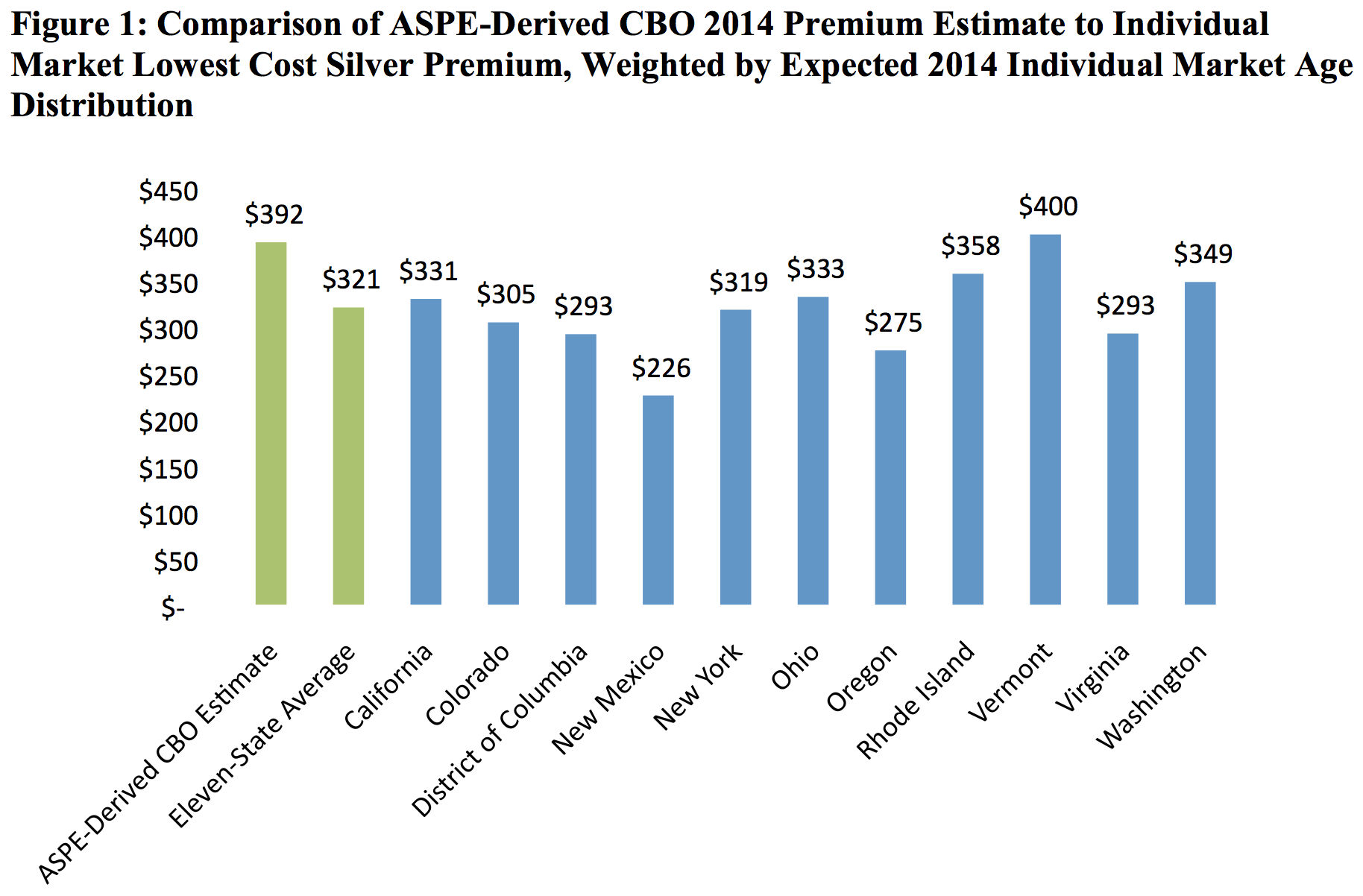
Chart Of The Day

Obamacare Costs

The above chart comes from an Assistant Secretary for Planning and Evaluation (ASPE) report (pdf) on Obamacare’s exchanges. The big finding:

In the eleven states for which data are available, the lowest cost silver plan in the individual market in 2014 is, on average, 18% less expensive than ASPE’s estimate of 2014 individual market premiums derived from CBO publications.

Sarah Kliff explains the chart:

What you’re looking at here shows what insurance plans will charge for coverage that will cover 70 percent of a typical subscriber’s health-care costs. These are averages of the second-lowest cost plans that provide this level of coverage (silver plans, as they’re known under the health-care law)

Jonathan Cohn considers why the premiums are coming in lower than expected:

The law’s critics and, by the way, quite a few insurance industry officials warned that premiums were going to exceed official expectations. The reason: Insurers couldn’t assume that young and healthy people would sign up for coverage. Without those customers, insurers would be left covering people who were predominantly older and sicker—and, as a result, more likely to run up big medical bills. In response, Obamacare’s defenders—or, more accurately, its believers—argued that the combination of subsidies and the individual mandate would be sufficient to entice enough young, healthy people. They also predicted that insurers, facing the prospect of losing customers to rivals, would opt to keep premiums relativley low.

For the moment, at least, the believers’ case looks pretty strong. A brand-new paper from the Robert Wood Johnson Foundation paper, prepared by Linda Blumberg and John Holahan the Urban Institute, may offer a clue why. The paper suggests that most people buying coverage on their own next year will be as healthy, if not healthier, than the typical person who today gets insurance though a job. Maybe the insurance industry’s own actuaries have, after looking carefully at the figures, come to the same conclusion.

Dustjacket Dating, Ctd

A reader writes:

I employed exactly this strategy when I decided, at age 26, that it was time to find a mate. My (Catholic) biological clock was ticking ever louder, and I figured with a few years of dating, I’d be able to be a mom by my early 30s.

Even though I don’t fish, I used a fishing analogy: the sort of fish I wanted would determine my bait and my pond. I wanted a man interested in the intellectual life, but also the physical one; I wanted a man who loved history; I wanted a man who loved women with brains and the means to use them. My chosen fishing pond was, fortunately enough, my work; I was a park ranger, and the many volunteers we got were fun and interesting people. Why look any further?

So I picked Barbara Tuchman’s The Guns of August, a highly readable history of the run-up to and early months of World War I – female, check; history/intellect, check. I carried it with me, and after heading to a bar after a sail with volunteers after work, he struck up a conversation about it. I baited my hook, tossed it in the water, and 18 years later I am still married to the first fish to come along. (I haven’t finished the book yet.)

Don’t Take Your Vitamins?

Professor of pediatrics Paul Offit reviews studies that cast doubt on the benefits of various dietary supplements. For example, individuals who take antioxidant supplements have been found to be less healthy:

How could this be? Given that free radicals [harmful atoms] clearly damage cells–and given that people who eat diets rich in substances that neutralize free radicals are healthier–why did studies of supplemental antioxidants show they were harmful? The most likely explanation is that free radicals aren’t as evil as advertised. Although it’s clear that free radicals can damage DNA and disrupt cell membranes, that’s not always a bad thing. People need free radicals to kill bacteria and eliminate new cancer cells. But when people take large doses of antioxidants, the balance between free radical production and destruction might tip too much in one direction, causing an unnatural state in which the immune system is less able to kill harmful invaders. Researchers have called this “the antioxidant paradox.”

Whatever the reason, the data are clear: high doses of vitamins and supplements increase the risk of heart disease and cancer; for this reason, not a single national or international organization responsible for the public’s health recommends them.

More Dish on the case against vitamins here and here.

Why Is China Missing So Many Women?

The one-child policy (OCP) alone doesn’t account for the shortage of females in the country’s population:

[A]n NBER working paper by economists Douglas Almond, Hongbin Li, and Shuang Zhang makes the case that the roots of the gender imbalance go back farther than the OCP. Specifically, they argue that it was the pro-market land reform policies and breakup of collective farms following the death of Mao Zedong that drove the trend in rural areas — 86 percent of the country’s population at the time. For rural couples, who were allowed to have two children and generally preferred at least one of them to be a boy, the second child was 5.5 percent more likely to be a boy after land reform was introduced in a given area. The introduction of the OCP, which happened around the same time, had an effect as well, but the authors find that it’s almost entirely eliminated when you control for the effect of land reform.

Why exactly land reform had this effect is less clear. The authors consider a number of possibilities including gender bias in land distribution, increase in the demand for male labor, increase in demand for old age support, and the collapse of the rural medical system, but don’t find empirical support for any of them.

More Dish on the state of the one-child policy here.

Christianism Watch

“When you worship God, you are not just doing the right thing in terms of your relationship with God, you are doing your patriotic duty. It is your patriotic duty to worship God in order that we may have a prosperous and flourishing economy” – Bryan Fischer.

A brief reminder of what Christianity actually is (from Luke):

And he lifted up his eyes on his disciples, and said, Blessed be ye poor: for yours is the kingdom of God … But woe unto you that are rich! for ye have received your consolation.

The religious right is one of the major forces against Christianity right now in this country.

Gold, Silver, Bronze, Green

Phelps

The International Olympic Committee has changed its drug-testing policies to disqualify marijuana smokers for “in-competition” use only. The new threshold for testing positive, 150 nanograms per milliliter of blood, is 10 times higher than the previous version, leading NORML’s executive director to remark that only a “pretty dedicated cannabis consumer” would reach that level on game day. Jess Remington comments:

The goal of the new rules is to catch marijuana users who are competing under the influence, rather than those who smoked days or weeks earlier. In other words, the [World Anti-Doping Agency (WADA), which regulates the Olympics] is now treating marijuana like alcohol.

Following suit, the UFC changed their marijuana rules to match the WADA’s just three weeks later. In response to these changes, state athletic commissions have met to discuss raising the marijuana threshold for combat sports. “My personal feeling is that I would much rather focus on obvious performance-enhancing drug use like steroids and blood doping,” Nick Lembo of the Association of Boxing Commissions said. “If I was a trainer, I would much rather have my fighter fighting someone who took marijuana than someone who’s blood doping.”

More Dish on pot and the Olympics here and here.