The Egalitarianism Of Getting Laid, Ctd

A reader sends the above video, which is too perfect:

I just wanted to chime in on this post, since it reminded me of one of my favorite bits from The Chris Rock Show.

Another reader:

Oh. Em. Gee! Andrew, I think I was at the Clubhouse that same night in 1988! Being a young Arab student I probably got mistaken for a Latino but who really cared?! I was there to dance and enjoy myself. And while it was my first time in a mainly black nightclub, the atmosphere was sensual and erotic like nothing I had ever experienced. Good times.

Indeed.

Abraham Lincoln On “Stand Your Ground”

A word from the great president:

Abraham Lincoln discussed this romanticization of violence in 1838, in one of his earliest public speeches, “Address Before the Young Men’s Lyceum of Springfield, Illinois.” What, Lincoln asked, threatened the well-being of American democracy? Only one thing: vigilante violence, “the increasing disregard for law which pervades the country; the growing disposition to substitute the wild and furious passions in lieu of the sober judgment of Courts.” He detailed the epidemic of violence and then located its cause in the need for what we would now call identity politics. Constitutional institutions might be equitable, but they were not lacking in (and it’s striking that Lincoln used exactly this word) “authenticity”—the dry, rational legal system that the revolution had insured could never satisfy Americans’ need for an emotional connection with the past and with each other.

Lincoln’s own call, in response, was for an ever more radical rationalism: “Reason, cold calculating unimpassioned reason, must furnish all the materials for our future support and defense.”

As Adam Gopnik notes, Lincoln even cast the Civil War as the defense of the arid, legal principle that the Union was indissoluble – not a matter of honor or pride or culture. And that, of course, was his key difference with the dueling, honor-driven culture of the South (and Wild West). Adam Cohen also helpfully contrasts English and American self-defense laws:

Nearly 250 years ago, William Blackstone included in his classic Commentaries on the Laws of England a well-established rule: “[T]o excuse homicide by the plea of self defense, it must appear that the slayer had no other possible means of escaping from his assailant.” Sir Blackstone understood why people should be required to retreat before using deadly force: “the right to defend,” he warned, “may be mistaken as the right to kill.” …

[In contrast,] [i]n 1921, in Brown v. United States, the Supreme Court rejected the obligation to retreat. Justice Oliver Wendell Holmes, the author of the decision, later explained: “a man is not born to run away.”

Holmes, our most epigrammatic Supreme Court Justice, got at something profound about the “stand your ground” doctrine. It is not the product of elaborate empirical research or deep philosophical debate. It is, fundamentally, based on a notion of honor: that a man (and presumably a woman, though they seem to invoke it a lot less) should not be required to run away. That honor-based rationale is particularly American. Maybe because of our Wild West origins — the no-duty-to-retreat doctrine is sometimes called the “Texas rule” — or maybe because we are the world’s only superpower, we are a nation that is uncomfortable with retreat. We live in a culture in which avoiding conflict is considered cowardly, or, at best, humorous.

A Win For Russia’s Protestors

Navalny was released on bail today, while his appeal is pending:

Alexei Navalny’s lawyer called the decision to release him on bail, just a day after he was sentenced to five years in prison, as “unprecedented”. The judge in the northern city of Kirov ruled that keeping President Vladimir Putin’s opponent in custody would deprive him of his right to stand in mayoral elections in Moscow on September 8.

Tim Sampson looks ahead:

If Navalny is jailed during the campaign, there will likely be unrest similar to what was witnessed after his conviction. If he loses, many will question the legitimacy of the results. This is especially true, given the public scrutiny this ongoing trial has generated. And if Navalny somehow wins and assumes office, the continuing appeal means that the elected mayor of Moscow could find himself removed from office and jailed on dubious charges.

Benjamin Bidder notes that the Russian government has boosted Navalny’s profile:

Hardly any of Putin’s friends can be happy about seeing Navalny behind bars. “I never saw any potential in Navalny, but now he has some,” confessed Tina Kandelaki, a journalist and television host close to the Putin government. Behind such comments are the misgiving that, by trying to defeat their sharpest critic, those in power might really only be strengthening him.

Will Englund checks the timeline:

An appeal of a court decision in Russia typically takes about six weeks — which would bring Navalny right up to Moscow’s election day.

What Americans Think Of Abortion

Abortion Opinion

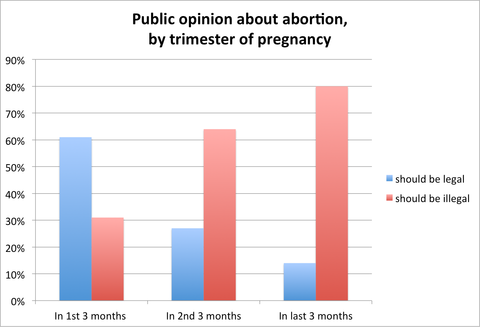
Leonardt examines public opinion:

[A]bortion is one [issue] in which selective readings of the polls can seem to prove opposite conclusions. After writing about abortion and public opinion in Sunday’s Times – arguing that the issue does not benefit Democrats as much as other high-profile subjects, like immigration, guns, taxes and same-sex marriage – I wanted to dig more deeply into the polls and their trend lines. For all the assertions that advocates make about public opinion, I think that a few consistent messages emerge.

The main one is that most Americans support abortion access with some significant restrictions.

If you were going to craft a law based strictly on public opinion, it would permit abortion in the first trimester (first 12 weeks) of pregnancy and in cases involving rape, incest or threats to the mother’s health. The law, however, would substantially restrict abortion after the first trimester in many other cases.

Intriguingly, such a policy would be similar to the laws in several European countries, like France, where abortions are widely available in the first trimester and restricted afterward. It would also be consistent with much of Roe v Wade.

And it would almost certainly have become the law in most states has the Supreme Court not fucked it up. On the brighter side, Razib Khan notes that we are learning to detect fetal abnormalities earlier and earlier:

Whole genome sequencing of 2nd trimester fetuses is now possible, and it seems very likely that in the next few years they’ll move all the way to the 1st trimester. At that point the genetic analysis of 1st trimester fetuses will be routinized and be a simple consumption good. The ultimate question is what are we going to do with all that information? This is not hypothetical, speculative, or blue sky. It’s almost a reality.

Anything that might avoid the excruciating decisions faced by many Dish readers is a good thing. For the best thing I’ve ever read on late-term abortion, check out the Dish’s “It’s So Personal” series. You won’t think about this entirely in the same way again.

Peggy Noonan Loses It, Ctd

In a tiny glimpse of the distant planet she is now on, compare this sentence from her latest conspiracy-theory IRS column:

This is the moment things go forward or stall.

with this missive from something called reality:

The Internal Revenue Service’s inspector general said Thursday that he was expanding his investigation of I.R.S. treatment of political groups that applied for tax-exempt status to see if liberal groups were treated the same way as conservative ones. Under attack from Democrats over his earlier inquiries, the inspector general, Russell George, said there was new evidence to study in the controversy about the handling of tax-exempt applications from Tea Party and other groups. The new evidence suggests that the I.R.S. used not only conservative-sounding keywords to select certain applications for extra scrutiny, but also liberal-sounding words like “progressive.”

Yes it’s time to move forward – to expose what a huge non-scandal this always was.

Yes, Bibi Wants Us To Go To War For Him, Ctd

Contra the prime minister, John Judis parses a new report by former State officials who recommend we ratchet down the pressure on Iran:

Instead of increasing the threat of war, the authors suggest that the Obama administration imitate a series of steps that would persuade Iran that in exchange for pledging not to build a nuclear weapon (and agreeing to inspections to confirm the pledge is being carried out), the U.S. and the other negotiating partners would progressively lift sanctions and would also agree to Iran’s development of a peaceful nuclear program. They urge a meeting in the next months between Obama and Rouhani—perhaps during the fall United Nations session.

The authors point out that the United States stands much to gain from an improved relationship with Iran—not just in ending the threat of a nuclear arms race in the Middle East, but also in gaining Iran’s cooperation in neighboring Iraq and Afghanistan (where Iran initially worked closely with the United States against the Taliban and al Qaeda) and in Iraq and Syria, where a regional Sunni-Shia war looms on the horizon.

Is Rouhani someone “we can do business with” as Maggie once described Gorbachev? That would drive the neocons insane. Gary Sick thinks Bibi needs “a new set of talking points”:

Almost every year since the early 1990s, senior political figures, intelligence specialists and respected commentators have assured us that Iran would surely have a nuclear weapon in three to five years, sometimes less, unless Iran were forced to stop its mad dash for the bomb. It is not hard to understand the logic of this assertion. Israel itself managed to develop a nuclear weapons capability in absolute secrecy in only a few years. It was not alone. South Africa, India, even poor Pakistan with virtually no heavy industrial base, managed to develop nuclear weapons in secret within a decade or so of the decision to launch a determined program. By most accounts, Iran decided to restart its nuclear program — started under the shah and interrupted by the Iranian revolution — in the mid-1980s, nearly 30 years ago.