The Riots That Weren’t

Jelani Cobb responds to dashed expectations that riots would follow the Zimmerman verdict:

The prediction of violence was not simply wrong. It was wrong for all the wrong reasons, in an echo of the way responsibility in the case was shifted onto Martin’s shoulders. There’s a sly inversion at work in the references to lynch mobs and riots, one that takes Zimmerman’s acquittal and expands it to all of American history. This country has a long history of lynchings, but not one in which non-black defendants needed to fear the fury of black mobs. Amplifying the irony is the fact that the verdict was announced on July 13, 2013—the hundred-and-fiftieth anniversary of the Civil War draft riots in New York City, in which white mobs pursued and killed blacks on the streets and burned a black orphanage to the ground.

Weigel sounds off:

Did police scramble in the wake of the verdict to prevent anything from going sour in the cities? Yes. It just seems noteworthy that very little went sour. “Urban blacks may riot when X goes wrong for them” is a perennial story, one that got written in the run-ups to elections in 2008 (“Police fear riots if Barack Obama loses US election”) and 2012 (“New threats to riot if Obama loses the election”). An act of civil disobedience that blocks traffic—on a Sunday, not even rush hour!—isn’t an act of fury that tears a country apart. Honestly, don’t the panic-mongers remember what it felt like when peaceful Tea Partiers were accused of incipient anti-government violence?

Isaac Chotiner feels that Cobb “should recognize the lack of violence for what it is: a real sign of progress”:

A foreign example would be the absence of large-scale rioting after the attacks on Bombay in 2008, where there was the (not unfounded) fear that the country’s Muslim minority would face the wrath of its Hindu majority. Something similar had, after all, happened several times in the previous 15 years. … Anyway, India’s calm was a sign of progress, however tenuous (the country may elect an essentially fascist Hindu extremist as its next prime minister).

In the Zimmerman trial, too, the concern about violence was not just of the Gingrich variety. It was also a fear among people who actually care about racism that the country hasn’t come as far as it has. On a week when it is abundantly clear that America has a long, long, long way to go towards equality, this bit of non-news is the one reason for optimism.

Faces Of The Day

tumblr_mpz9xoYIvJ1qz4e1ro1_1280

Zimmerman and Martin with the races changed, from the Tumblr “While Seated” by Michael David Murphy.

The effect of race on acquittals in self-defense cases and with Stand Your Ground laws can be seen here. Update from a reader:

That FOTD  just blew my mind.  So powerful.  Just sitting with it and being mindful of my own feelings and emotions, it’s amazing how deep-seated and unconscious some cultural and societal prejudices can be.  Images like that bring them into consciousness though, which is the first step toward eradicating them.  I’m emotionally shaken in a way I haven’t since this whole Zimmerman trial began, just imagining how different that hypothetical case would have played out.  Could you imagine O’Reilly/Rush/Hannity’s rage in the unlikely event that an acquittal took place?  Or their smug satisfaction when (far more likely) the black Zimmerman got the death penalty, and “justice” was done?

Ugh, I need to go take a shower.

Yes, Bibi Wants Us To Go To War For Him

This embed is invalid


Which is unsurprising – except that obviously, he feels a little stymied by the choice just made by the Iranian people. (Neocons like their Iranians to be uncomplicated demons.) Ali Gharib unpacks Netanyahu’s latest push – once again made on national television – for the US to attack Iran:

Netanyahu’s remarks clearly took aim at what many advocates of forging a diplomatic deal—a deal, that is, to ease the nuclear crisis between Iran and the West and avert war—think is an opportunity in the election of Hassan Rowhani, a moderate Iranian cleric, to be president of Iran. After the CBS host’s third question, Netanyahu raised the Iranian election himself, for the purpose of dismissing Rowhani: “Now mind you, there’s a new president in Iran,” Netanyahu said. “He’s criticizing his predecessor for being a wolf in wolf’s clothing. His strategy is be a wolf in sheep’s clothing. Smile and build a bomb.” This will of course sound a little odd to anyone who’s looked at a few photos or videos of the lame-duck Iranian hard-line president Mahmoud Ahmadinejad, who smiled constantly.

But the “smile” line was just a catchphrase. Netayahu’s main point is the same one that’s been made before by Netanyahu himself and a virtual who’s who of American Iran hawks (helpfully catalogued by Marsha Cohen): that Rowhani shouldn’t even be given the chance to make good on campaign promises of accommodation with the West and transparency in Iran’s nuclear program.

Netanyahu knows that without the impunity of being the sole nuclear power in the Middle East, Israel’s capacity to wage conventional war at will in the region would be constrained. Adam Chandler notes the context:

The timing of the interview also seems noteworthy because Netanyahu is changing course on the diplomatic front, following the naming of senior adviser Ron Dermer as Michael Oren’s successor as the Israeli ambassador to the United States. On Oren’s way out, he has sought to emphasize that the United States and Israel have enjoyed a strong relationship, especially with regard to strategy on Iran’s nuclear program.

Juan Cole fumes:

Everyone in the international community agrees that the new president of Iran will have to be given at least a year, and maybe more, to prove he is an earnest negotiator for Iran. You can’t just attack a presidential administration that only recently got into office and before taking the measure of it. The European powers and the countries of the global South would never accept it. …  Netanyahu keeps threatening to attack Iran himself, if the US Pentagon won’t do it for him, but this bluff is transparent. Israel cannot plausibly conduct a successful military operation so far from its borders (Iran is a long way away).

Breaking Out Of The Prison Formula

You can almost hear Michelle Dean sigh with relief as she deems Orange Is the New Black “more than just a privileged-white-lady-goes-to-prison-story”:

[It’s] a tricky sell of a show, sitting as it does at an increasingly raucous intersection of pop culture and identity politics. The show follows Piper Chapman (Taylor Schilling) as she heads to jail for 15 months following a very bad decision in her early 20s. The privileged-white-girl-on-the-wrong-side-of-the-tracks plot can very quickly become a powder keg, as Lena Dunham so recently learned. Plus, comedy is an odd match for this setting; we usually expect more grit and gloom from prison, as in HBO’s Oz. But somehow, creator Jenji Kohan has whipped up a delightful show from that dicey premise.

Alan Sepinwall praises the series for zooming out from the main character:

Through Piper, we get to learn how the prison ecosystem works — the voluntary segregation by race, the legal and extra-legal aspects of the prison economy — but we also find out, through flashbacks and present-day dialogue, how the other inmates put themselves here and how incarceration has and hasn’t changed them from the person they were before they were given a jumpsuit and an ID number.

It’s with those stories — how a shy undocumented teenager from Jamaica grew into one of the prison’s most feared elders (Michelle Hurst), the difficult gender transition a fireman made to wind up as the resident hairstylist (Laverne Cox), the way certain lesbian inmates (like Natasha Lyonne‘s recovering addict) feel when their current lovers prepare to return to men on the outside — that Orange becomes particularly engrossing.

In fact, Emily Nussbaum suggests that white, well-educated Piper serves as a narrative “Trojan horse”:

Orange would likely not have been green-lighted if its central story had involved a poor black drug dealer. Even The Wire, one of the blackest TV crime dramas ever, had a white antihero as its lead. So did Oz, which shared a similar premise. (White person lands in penitentiary hell.) But Orange uses that premise as a lure to get us to listen to other voices.

Meanwhile, Matt Zoller-Seitz lauds the show for its “unusually complex and open-hearted” take on sexuality:

The heroine is bisexual, and at no point does the series suggest that she didn’t really love the woman who got her into this mess, or that she doesn’t really love her fiancé. There’s also a transgender character, Sophia Burset (played by African-American transsexual actress Laverne Cox), who enters the story with the eccentric definition of every other character and is never once presented as inherently comical or strange.

Nussbaum concurs:

[The women of Orange] form quasi-familial tribes and wounded triangles; it’s a matriarchal subculture that, as a Seven Sisters graduate, Piper had some preparation for. There are more lesbians here—butch and femme and of every ethnicity—than in any other series on television. Viewers ravenous for representation often graded the fun, flawed The L Word on a curve. Though Orange bears a resemblance to that show, it’s the more solid of the two, at least so far.

How Can The GOP Detoxify Itself?

Last week, Nate Cohn suggested that Republicans “smooth out the many sharp edges of the GOP’s platform and message.” Some of his suggestions:

Keep supporting tax cuts and less regulation, but add an agenda and message aimed at the middle and working class. Remain pro-life, but don’t appear opposed to Planned Parenthood or contraceptives, and return to supporting exceptions in instances of rape or the health of the mother, as President Bush did. Stay committed to religion, but don’t reflexively doubt the science of evolution and global warming, or the promise of stem cell research or renewable energy. Oppose gun control, but why force yourself to oppose background checks? Oppose gay marriage if Republicans must, but could Republicans at least support civil unions? On all of these issues, the GOP need not compromise on its core policy objectives, but can’t afford to consistently stake out ground so far from the center.

But they won’t because moderation is anathema to them. They have become a doctrinal party in which doctrine is eternally true and cannot be changed – whether that is reflected by the view that tax cuts are the solution to every economic problem, that no accommodation to gays can be made at all, that climate change is a hoax, or that all abortion is cold-blooded murder, etc. Douthat pivots off these suggestions to argue against the Senate’s immigration bill:

Concessions on background checks would be at most a modest setback for the N.R.A., and it’s hard (at least for this pro-lifer) to see support for a rape-and-incest exception as devastating to the anti-abortion cause.

But, Ross. You aren’t, alas, the base. You’re capable of pragmatic adjustment, weighing the pros and cons, seeing the least worst option as a win. Have you ever heard that kind of argument on Fox News or Mark Levin or Rush Limbaugh? And do you really think the NRA – a lobby able to scupper modest changes in the wake of the murder of a score of school children – will decide that concessions for the sake of Republican victory is a sane strategy? What conceivable incentive do they have to do that when they get all they want anyway? Ross continues:

But from the vantage point of National Review or the Heritage Foundation or the Center for Immigration Studies (to cite a few places that take a restrictionist line on immigration), the Rubio-Schumer bill looks less like a modest setback, and more like a once-in-a-decade or even once-in-a-generation defeat.

What’s more, the fact that so many analysts, Cohn included, describe a vote for Rubio-Schumer as a vote to take the immigration issue “off the table” indicates that restrictionists are probably right to see it this way: Issues can go off the table because external circumstances changes (Cohn cites the example of the Cold War’s end), but when they are pushed off the table legislatively it’s usually a sign that one set of activists has basically won most of what they wanted, and their rivals have mostly lost.

Along the same lines, Ramesh recommends that the GOP pass a much more limited immigration bill:

The danger of a more sweeping amnesty is that it would encourage new illegal entrants by signaling that they will eventually be legalized, too. Congress should therefore hold off on that step while making sure that enforcement is up and running — and that the political forces that are supportive of amnesty have an incentive to make enforcement work rather than subvert it. Limited amnesty would be a good-faith gesture to show that the promise of future legalization isn’t merely words.

But Bernstein is unsure that scaled down immigration reform is possible:

Here’s the deal. Most Republicans, at the very least, want to pass something — so that they can deflect at least some of the blame for comprehensive reform failing, and at least to some extent because they really do support some legislation. But they can’t pass a comprehensive bill (at least not without relying on mostly Democratic votes), or even a mostly comprehensive bill. So the plan has been to pass a series of small bills that have wider support.

The problem? They may not have the votes for those, either.

Because they are not what Ross would like them to be. They’re fanatics, much more interested in the ideological posture of purity than the compromises of government. So they will block all compromise. They know not what else to do.

A Unique Stigma

Black Men Bias

Corrine McConnaughy has researched it:

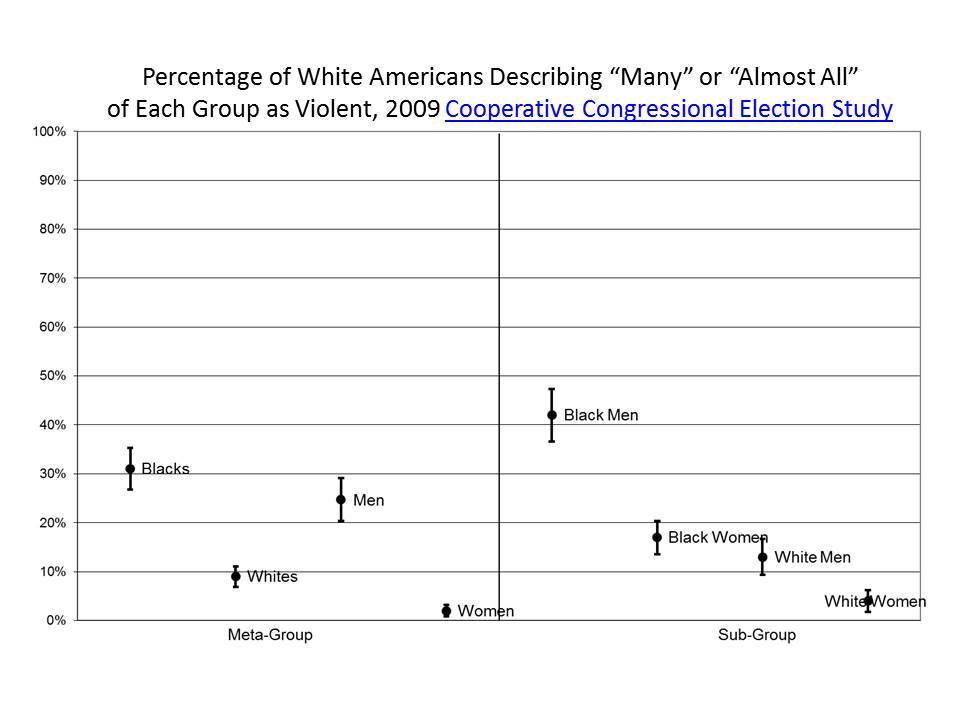
Ismail White and I have been conducting a number of studies on the uniqueness of attitudes toward black men. In a nationally representative sample of white Americans, we find that black men are indeed considered uniquely violent. While a traditional question about racial and gender stereotyping finds that whites perceive “blacks” as more violent than “whites” and “men” as more violent than “women,” a question that asks about combinations of these identities—black men, white women, etc.—shows how black men are uniquely stigmatized.  More than 40 percent said that many or almost all black men were violent, but less than 20 percent said that of black women and white men. The figure [above] displays these results (with the bands indicating 95 percent confidence intervals).

A Motherfucking Snake In A Motherfucking Drain!

And it bit a poor Israeli’s dick. But the comments under the story are priceless:

If only the most sensitive part of the penis had some sort of natural, god-given sheath to provide some measure of protection against such occurrences…

“The man, which paramedics said the snake described as very small…” I can’t be the only one who misread it this one at first glance…

“Richard Gere”‘s is the funniest.

The GOP Folds On The Filibuster

McCain has brokered a filibuster compromise. Chait calls it a “a total victory for the Democrats”:

[T]he threat of the nuclear option has once again succeeded. Republicans threatened to change the Senate’s rules in 2005 to stop Democrats from filibustering their judges, and it succeeded — Democrats agreed to let pretty much any judges through with a majority vote. Once again the majority party forced the minority into a total capitulation. There is a lesson here, and it’s not that the Senate is a wonderfully congenial place whose rules must not be touched.

Ezra adds:

It’s clear now that Reid will change the rules if he believes it necessary. But so too will McConnell.

If Republicans retake the Senate in 2014 and the presidency in 2016, there’s no way Majority Leader McConnell will permit Democrats to routinely filibuster or otherwise obstruct President Christie’s nominees. If they do, he’ll throw Reid’s words back in their face and make the change Reid threatened to make today.

The result is that the minority’s ability to filibuster executive-branch nominees was weakened, even if it wasn’t fully eliminated. The minority can use the filibuster against particularly objectionable nominees that the majority isn’t overly committed to confirming. But they do so with the express indulgence of the majority. If the minority uses it too often, or chooses a nominee the majority really wants to confirm, the privilege of filibustering nominees — and that’s what it is now, a privilege granted by the majority — will be taken away. No majority is going to take that nuke off the table.

How Alec MacGillis understands the actions of Republican senators:

What gives? Why weren’t Republicans more willing to let him go nuclear? Doing so would’ve allowed them to glory in the moral high ground and, once they won back the Senate as seems quite possible in the next few years, seek righteous revenge by breaking the filibuster for purposes far more consequential than confirming nominees to a few second-tier departments.

Others have already noted one reason for Republicans to pull back from this outcome: they could already undo plenty of the Obama legacy with a mere 51 votes—via the budget reconciliation process, which could, for one thing, dograve damage to Obamacare. But I would suggest another theory: that Republicans pulled back, in part, precisely because of the likelihood of how things would play out in the full post-filibuster revenge scenario.

Earlier Dish on the filibuster stand-off here.

Saving A Scent For Later

As Megan Garber considers a new high-tech device for capturing smells – called the Madeleine, demonstrated above – she runs through many predecessors:

The tradition of scent-mapping goes back, it seems, to the 1790s, when the physician and pioneering hygienist Jean-Noël Hallé embarked on an odor-recording expedition of Paris. Hallé had a grand vision that was technologically limited: the equipment he used to document his six-mile expedition along the banks of the Seine started and stopped at his notebook and his nose.

Nearly two centuries later, however, in the 1970s, the Swiss fragrance chemist Roman Kaiser developed the odor-preservation technique he dubbed headspace capture:

a process meant to analyze and manufacturer the fragrances of the natural world. Kaiser used his technique to measure and then recreate the scents of a tropical rainforest; scientists and perfumers have since adapted the process to recreate scents of a more quotidian variety. In the 1980s, the scent scientist Braja Mookherjee, working for the fragrance firm IFF, invented a process that allowed technicians to extract fragrant molecules from living flowers, with the ultimate goal of recreating their smells. In the late 1990s, Japanese scientists began developing an “odor recorder” that promised to capture and replicate the world’s scents.

Today, the odor artist Sissel Tolas uses headspace technology to create Hallé-esque “scratch and sniff” maps of the world. Olivia Alice uses a similar technique to preserve the scents of loved ones that linger on their clothes — by “deconstructing the clothing and extracting its composite and essential elements.” So does Li Jingxuan’s “Aromastagram.”

Previous Dish on historical scents here.

Juror B37 “Thinks The World Is One Big Reasonable Doubt”

An interesting epistemological observation, to be sure, but jury-worthy?

Robert Weisberg teaches criminal law at Stanford Law School, and he immediately wonders what it meant when juror B37 asserted that “You never get all the information. How do you form an opinion if you don’t have all the information?” Weisberg sums up his lawyerly concerns in one sentence: “She thinks the world is one big reasonable doubt.”

Gail Brashers-Krug, a former federal prosecutor and law professor, is currently a criminal defense attorney in Iowa. She also jumped back when B37 said, ”You never get all the information.“ “That’s exactly what a defense attorney loves to hear,” says Brashers-Krug. “That’s reasonable doubt, right there. If I were a prosecutor, that would make me extremely nervous about her.” She adds that B37’s devotion to animals might raise flags for her as well. “The animal thing is weird. She doesn’t know how many animals she has, and she mentions her animals far, far more than her two daughters. She strikes me as eccentric and unpredictable. I never, ever want eccentric, unpredictable people on a jury.”

Apart from her use of newspapers, she seems like a total nutter to me. Alyssa reacts to the fact that B37 was, before thinking better of it, shopping around a book proposal:

[T]he larger issue is when B37 decided she had the material for a book on her hands, and how it might have affected her approach to the trial and her influence on other jurors. As literary world guru Ron Hogan wrote in a series of Tweets “If Zimmerman had been found guilty, Juror B37′s book plans would almost certainly lead his attorneys to ask the verdict be set aide … There is also the question of what Florida prosecutors could do to Juror B37 if she violated sequestration or was taking notes during trial … There is the possibility of juror misconduct, if she planned anything to do with her book during trial … I’d like to know EXACTLY when Juror B37 settled upon the narrative hook that the “system” & the “spirit” of justice came into conflict.”

That misconduct, if it existed, is shameful, but it can’t lead to a retrial of the case. Whatever motivations B37 consciously or unconsciously brought to deliberations and weighing of evidence have done the damage they were going to do, and there’s no way to rectify it.