A Poem For Sunday

Train Tracks

“Rise” by Brenda Shaughnessy:

I can’t believe you’ve come back,
like the train I missed so badly, barely,
which stopped & returned for me. It scared me,
humming backwards along the track.

I rise to make a supper succulent
for the cut of your mouth, your bite of wine
so sharp, you remember you were mine.
You may resist, but you will relent.

At home in desire, desire is bread
whose flour, water, salt, and yeast,
not yet confused, are still, at least,
in the soil, the sea, the mine, the dead.

I have all I longed for, you
in pleasure. You missed me, your body swelling.
Once more, you lie with me, smelling
of almonds, as the poisoned do.

(From Interior with Sudden Joy © 1999 by Brenda Shaughnessy. Used by permission of Farrar, Straus and Giroux, LLC. Photo by Tim Drivas)

Welcome To Your Unemployment

Speaking to graduates of Columbia University’s School of the Arts, David Byrne dumped a big bucket of cold water on their career prospects. Rachel Aron, who was there, summarizes:

In a slide-show presentation on the auditorium’s projection screen, Byrne showed a series of graphs, based on information compiled by the Strategic National Arts Alumni Project (SNAAP), illustrating that if you chose a career in the arts you are, basically, screwed. A pie chart, based on 2011 data, showed that only three per cent of film and theatre grads, and five per cent of writing and visual-arts grads, end up working in their areas of concentration (forty-three percent work in the arts but outside of their specialties; forty-one per cent work outside of the arts altogether). A subsequent bar graph showed that, according to those stats, fourteen writing and fourteen Columbia visual-arts graduates will go on to careers in their fields, and eight theatre and eight film grads will go on to careers in theirs. “That’s the end of the charts,” Byrne said, after sharing another, which showed the median salaries of people working in the arts (between thirty-five and forty-five thousand dollars across all four sectors). “I’m glad you’re laughing.”

Colin Marshall tries to find the silver lining:

[F]irsthand reports from the ceremony don’t describe a too terribly shaken Columbia graduating class, and even Byrne took pains to emphasize, or at least emphatically imply, that truly worthwhile careers — such as, I would say, his own — lay outside, or in between, or at the intersection of, definable fields. And why would you want to work in the same field you studied, anyway? To paraphrase something Byrne’s friend and collaborator Brian Eno said about technology, once a whole major has built up around a pursuit, it’s probably not the most interesting thing to be doing anymore.

Meanwhile, in a commencement address at McGill University, the philosopher Judith Butler offered a more hopeful appraisal for those studying the humanities, focusing on the non-financial aspects of such an education:

The humanities allow us to learn to read carefully, with appreciation and a critical eye; to find ourselves, unexpectedly, in the middle of the ancient texts we read, but also to find ways of living, thinking, acting, and reflecting that belong to times and spaces we have never known. The humanities give us a chance to read across languages and cultural differences in order to understand the vast range of perspectives in and on this world. How else can we imagine living together without this ability to see beyond where we are, to find ourselves linked with others we have never directly known, and to understand that, in some abiding and urgent sense, we share a world?

She continued:

You will need all of those skills to move forward, affirming this earth, our ethical obligations to live among those who are invariably different from ourselves, to demand recognition for our histories and our struggles at the same time that we lend that to others, to live our passions without causing harm to others, and to know the difference between raw prejudice and distortion, and sound critical judgment. The first step towards nonviolence, which is surely an absolute obligation we all bear, is to begin to think critically, and to ask others to do the same.

Related Dish coverage of Joss Whedon’s commencement address here.

Everyone’s Ark

Ark

After reading The Enduring Ark, a children’s book that gives the story of Noah’s ark “a Southeast Asian twist,” Marjorie Ingall considers the tale’s universal appeal:

Is it really surprising that the story works in a Bengali context? Every culture is drawn to flood stories. Judaism, Christianity, Islam, and Baha’i all share the Noah story proper, and epics about floods in general appear in a zillion other traditions, including Indian ones … and don’t get me started on Gilgamesh, Greek mythology, or Mayan and Muisca lore. Adults of all cultures thrill to the evidence of the terrifying power of nature. We want to think we’re in charge, all-powerful beings. Natural disasters are quick to show us we’re not.

Why the myth feels as relevant as ever:

The Noah story seems particularly potent today, since we seem to be entering a new time of environmental destruction. It seems we’ve broken our part of the covenant with God to be caretakers of the earth. Kids hear about hurricanes, tornadoes, and tsunamis so often these days, events that seem to have far more crippling force than they did when we were kids. When I read The Enduring Ark, I couldn’t help thinking of Hurricane Sandy, which caused huge flood damage and suffering in our city and in our own neighborhood. The destruction was an opportunity for tikkun olam—we made sandwiches for homeless shelters, dragged a wagon full of blankets and food to a church, helped Maxie’s school fund-raise for the victims. The way to feel less powerless is to be a helper, and that’s a wonderful message for children.

(“Matsya protecting the Manu and the seven sages at the time of Deluge,” a portrayal of an Indian iteration of the Flood myth, via Wikimedia Commons)

Praise The Lord And Pass The Paycheck

Ted Kluck juxtaposes the public faiths of NFL quarterbacks Tim Tebow and Robert Griffin III:

If “mentioning your faith” had a spectrum, Tebow would be on the high end of that spectrum, and Griffin would be on the moderate-to-low end. While public faith was an integral part of the Tebow brand, Griffin seems low-key by comparison. He said nothing more than “God had a plan” at his Heisman Trophy acceptance speech. He has tweeted periodically—but not excessively—about his faith. His Twitter bio is a play on the popular evangelical mantra of relationship-not-religion, saying “I have no Religion. I have a relationship with God.” Still, Griffin seems to be walking a fine line, appealing to Christians and non-Christians alike.

Despite Griffin’s nuances, Kluck is wary of the trend:

There’s something weird about the Christian celebrity culture. It certainly exists—it’s what enables me to write books about football stars—but I can’t help but wonder if it should exist, if it does us more harm than good. I’m reminded of Paul’s word in 2 Corinthians 2:17, which reads, “Unlike so many, we do not peddle the word of God for profit.” Sometimes it feels like we’re doing exactly that. Our hero-making, at times, ignores the most central truths of our faith. Whether we’re talking about Tebow or RGIII or the next big name, we risk losing the gospel message in the powerful and popularized narrative of the Christian athlete.

Reading Yourself Into The Parables

Michael Peppard advocates a way to shake loose from stale, abstract interpretations of Jesus’s parables:

One method for refreshing the parables is to experiment with where one “reads oneself in” to the story. Many of the parables speak to multiple audiences at the same time, as when the Rich Man and Lazarus (Luke 16) brings comfort to the poor, while also rousing the rich from complacency. Parables about sin and mercy, such as that of the Pharisee and the Tax Collector (Luke 18), invite listeners to read themselves in to both characters at different moments in life. It’s also among the most clever of the parables because once you imagine yourself as the tax collector (“I’m like the tax collector, a humble sinner, and definitely not like that pompous Pharisee”), then you automatically become more like the Pharisee. The oxymoronic pride in one’s own humility springs the rhetorical trap of the story: most of us are both Pharisee and tax collector.

An example of the method in practice:

One of the best interpretations of the Good Samaritan develops by imagining oneself in to the characters of the priest and the Levite. Why didn’t they stop? What was on their minds? Maybe they had perfectly good reasons — the same kinds that we ourselves give when we pass by? I am referring to a middle section of Martin Luther King, Jr.’s “Mountaintop” speech (April 3, 1968). We all know the prophetic ending of that speech, but less known is the eloquent interpretation of this parable in the middle…For King, this is a parable about two things: race and fear.

Greater Than The Sum Of Our Neurons?

Reviewing Curtis White’s new book, The Science Delusion, Mark O’Connell summarizes the non-religious case for a more expansive understanding of truth:

White is a nonbeliever, but like a lot of nonbelievers—me included—he’s frustrated with the so-called New Atheism’s refusal to engage with anything but the narrowest and most reductive understanding of religious experience, and its insistence on the scientific method as the only legitimate approach to truth. He starts out here by taking some well-aimed swipes at the Dawkins-Hitchens-Dennett Axis of Reason, but the book’s interest isn’t so much in the New Atheism per se as in the broader ideology of which it is the militant wing: scientism. Science often looks like the only show in town when it comes to considering things like the nature of consciousness and the meaning of human existence, and White is convinced that the demotion of the humanities—of poetic, philosophical, and spiritual approaches to truth—is a demotion of humanity itself. He’s aggravated, in particular, by the mechanistic model of personhood advanced by neuroscience, whereby consciousness is seen as something that can be “mapped,” explained in terms of “wiring” and “connections,” as though the mind were actually (as opposed to just metaphorically) a kind of computer. And so he’s arguing for a return to the spirit of Romanticism, to an intellectual culture that looks to poets and philosophers and artists, rather than scientists, for insight into what used to be called “the human condition.”

Jerry Coyne unloads on O’Connell:

Aren’t these anti-New Atheism pieces getting tiresome? They have three characteristics: 1. The author is an atheist or agnostic; 2. The author takes New Atheists to task for presenting a caricature of religion and not engaging with religion’s “best” arguments (i.e., academic obscurantism that uses big words), and 3. They call out New Atheists for the horrible crime of scientism.

The response goes on to call out the “nuanced” understandings of religion that New Atheists supposedly fail to engage:

Sometimes I wonder if people like O’Connell have really read the purveyors of obscurantist religious bullpucky: people like Karen Armstrong, Alvin Plantinga, Richard Swinburne, or even Tanya Luhrmann.  Their “nonreductive understanding” is either an attempt to evade spelling out what they really believe, or a wordy justification for garden-variety religion.  And O’Connell also neglects that fact that most religious people aren’t theologians, do not read theology, and have a pretty straightforward (and “reductive,” whatever that means) set of beliefs. Jesus existed, was divine, and was crucified to save us from sin; Mohamed was the prophet and his words are not metaphorical; Joseph Smith revealed the visit of Jesus to North America and you can baptize your ancestors post mortem; you can get “clear” by investing thousands of dollars in analysis with the e-meter, and so on. I venture to say that at least 90% of the world’s religious believers fall into the class that Dawkins criticizes.  Why on earth do critics like O’Connell always equate “religion” with “theology”?

Meanwhile, Pat Finn takes the debate in a different direction, emphasizing White’s re-appropriation of Romanticism as an alternate way forward:

Between the scientific rationalism of the neuroscientists and their allies in the New Atheist camp and the religious dogmatism of, among others, the Christian right, White advocates for a third mode of conceptualizing reality that he traces to Romanticism, which swept through Western Europe in the 19th century. What White sees as central to Romanticism is a commitment to the interminable re-imagining of society, and he considers its legacy to be intimately bound up with the various counterculture movements that sprung up in the second half of the 20th century, when millions of people throughout the Western world expressed dissatisfaction with their culture and tried to change it. To protest requires an act of imagination or will, the type that the scientific worldview tends to de-emphasize or even outright deny with its vision of man as an elaborate piece of machinery. This isn’t a new idea. As White points out, Isaiah Berlin made a similar argument in the 1960s when he said that “[s]cience is submission, science is being guided by the nature of things.” Many other secular thinkers throughout the past two centuries have expressed a similar form of dissatisfaction with the constraints science threatens to impose on human potential, both individually and collectively. To leap beyond the given – to see the world not as a collection of bare facts but as material to be transformed – is, for White, the essence of a progressive political culture. Scientism threatens to extinguish this belief in possibility and freedom that has always been at the heart of progressive cultural and political movements.

Climbing A Ladder To The Heavens

Monestary

George Zarkadakis visited a monastery on Mount Athos, known as the “Christian Tibet,” to experience hesychasm – the “mental prayer” of Eastern Orthodox tradition:

In the early 14th century, a Greek theologian named Gregory Palamas produced a synthesis of Orthodox philosophy that has defined the theology of the Eastern church ever since. He founded the contemporary tradition of hesychasm, which focuses on achieving experiential knowledge of God. Palamas believed that human beings could never understand the essence of God by employing reason alone. But humans could experience God’s actions (or ‘manifestations’ as he called them), through a retreat into inner prayer. While the Catholic tradition of mental prayer allows the faithful to use icons as aids and regards apparitions as signs from God, Orthodox mental prayer focuses on mental stillness and abstraction, deliberately keeping the mind free of images or thoughts.

Palamas claimed that such prayer gradually builds an increasingly close relationship with God. One of the common themes in late Byzantine iconography is a ladder, representing hesychastic prayer, which connects the earth to the heavens.

Though no longer sharing the “central beliefs” of the faith, Zarkadakis found himself moved to wonder:

I climbed the steps to the highest spot on the wall, and looked out towards the sea. The sky was steadily lightening and a cool breeze carried the rejuvenating scent of salt towards me. Thyme, pine, jasmine and laurel emanated from the monastery’s garden. My face was warmed by the first rays of the sun. I knew that the light that kissed my face came from a star — a great ball of fire fuelled by thermonuclear reactions. That the laurels, the thyme, the bees and the chanting monks were the results of millions of years of biological evolution that had probably begun with a humble bacterium. That I smelled, saw and listened because of electrochemical signals that passed between neurons. That my limbic system was on overdrive.

But despite my knowledge, a sense of mystery remained. Why was the sun so magnificent? Why was the sea so dear? Why did I feel a sense of profound meaning in everything? Perhaps my epiphany owed to nothing more than a second night of sleep deprivation. Nevertheless, I had arrived at a state of mind, possibly not dissimilar to that of the praying monks, where logic failed and gazing at beauty was all that mattered. If that was true then perhaps to know God was simply to look at a rising star, and feel inexplicably moved.

(Photo of the Iviron Monastery, where Zarkadakis stayed, by Leon Hart)

Everyday Idols

Elizabeth Scalia, author of Strange Gods: Unmasking the Idols in Everyday Life, finds them – and not just in the places you’d expect:

Perhaps primarily what is strange about our idols — beyond the fact that they are strange gods we were never meant to place before the Creator — is that they are so interior to us. When you mention an idol, the first image most people will conjure up is the golden calf the Hebrews created while Moses was on the mountain. It was an external thing, something outside of the people themselves — and they understood the God of Abraham to be outside of themselves, too. We are more sophisticated in our understanding, now — so comfortable with the notion of “God within” that we barely think what it means.

We may still have idols residing outside of ourselves — if we allow our things, our possessions and creations to stand between us and God, and to essentially own us — but we are very adept at burnishing the godlings of the mind, the ideas and opinions and beliefs formed interiorly. These are petted and loved and fed, and they grow directly in proportion to how much we indulge them, until they become the object of our enthrallment and the entity we serve. If our ideology, for instance, has become an idol, then we nourish it by reading only what suits our point of view; we speak and gather with only those who think as we think; we visit websites that echo our thoughts back to us, until we lose sight of anything beyond it — even the humanity of the one who does not conform to our beliefs. We begin to serve the idol of the idea, alone.

Green To Purple

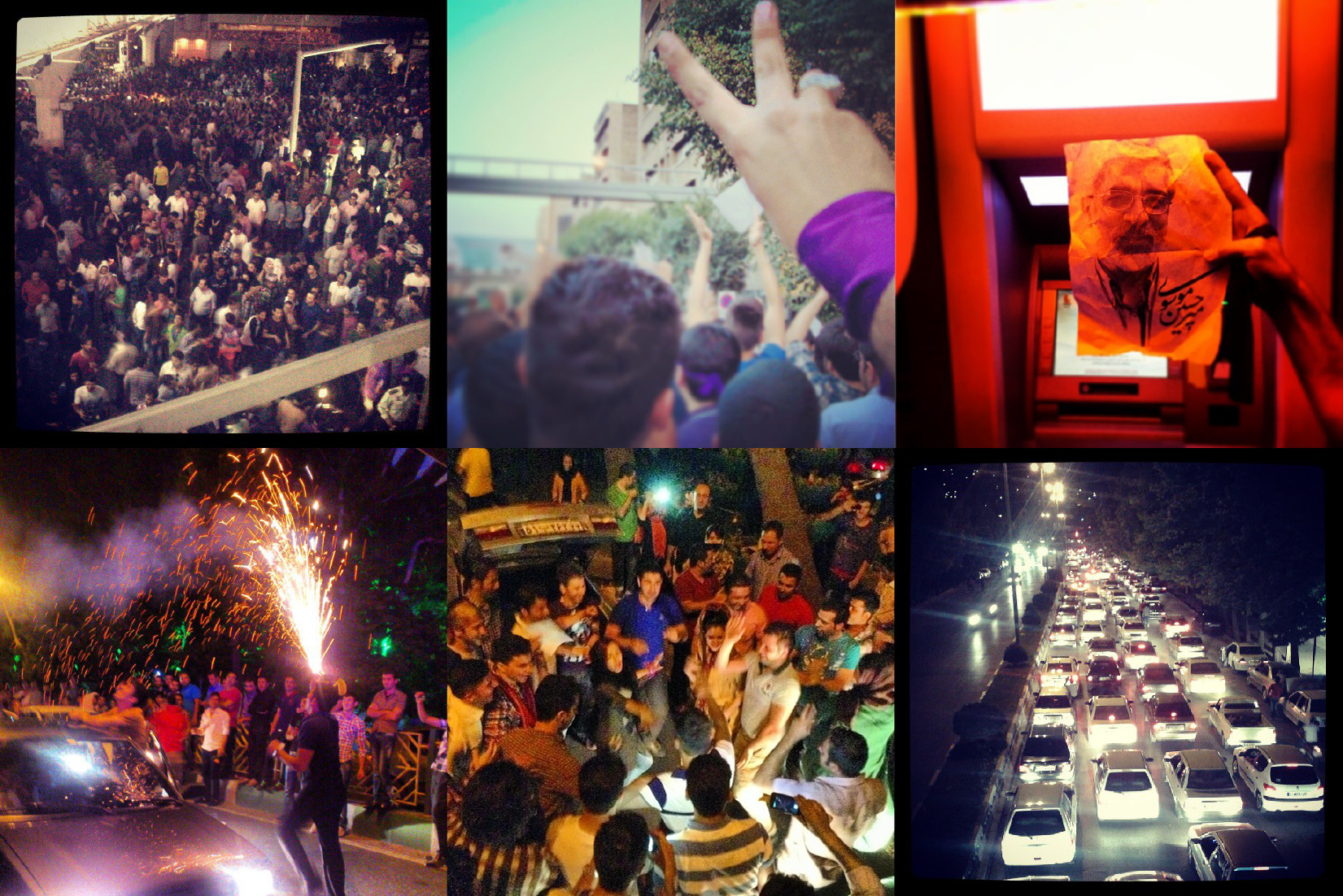
iranelection-instagramed

More tweets from the celebration in Iran, going into the wee hours:

https://twitter.com/PoliticallyAff/status/346041698872336385

https://twitter.com/thekarami/status/346053260014141440

Iran’s semi-official Fars News Agency has a gallery up here. One from BBC Persia here. Mackey has been rounding up videos and tweets as well. Meanwhile, Thomas Erdbrink steps back (NYT):

[I]f the election, which electrified a nation that had lost faith in its electoral process, was a victory for reformers and the middle class, it also served the goals of the supreme leader, restoring at least a patina of legitimacy to the theocratic state, providing a safety valve for a public distressed by years of economic malaise and isolation, and returning a cleric to the presidency. Mr. Ahmadinejad was the first noncleric to hold the presidency, and often clashed with the religious order and its traditionalist allies.

The question for Western capitals is whether a more conciliatory approach can lead to substantive change in the conflict with Iran over its nuclear program. A willingness to talk does not mean a willingness to concede.

But this was no win for Khamenei either:

The election results put the supreme leader under pressure to allow changes to take place, or allow him to make the kind of changes that might be opposed by hard-liners if they controlled all the levers of power. For the supreme leader, a weak loyal president might be less threatening that Mr. Ahmadinejad, who over time alienated the ayatollah as he spread his own power throughout the bureaucracy. The ayatollah had exhorted Iranians to exercise their right to vote. Analysts are predicting at least some change. “There will be moderation in domestic and foreign policy under Mr. Rowhani,” said Saeed Laylaz, an economist and columnist close to the reformist current of thinking. “First we need to form a centrist and moderate government, reconcile domestic disputes, then he can make changes in our foreign policy,” said Mr. Laylaz, who, in a sign of confidence, agreed to be quoted by name.

Omid Memarian thinks the president-elect now has some debts to pay:

Rowhani could have never found much reception within the different layers of the society if two reformist and popular figures, Akbar Hashemi Rafsanjani and Mohammad Khatami, former Iranian presidents, had not supported him.

The popularity of Hashemi Rafsanjani and Khatami themselves has soared over the past few years, particularly after they put distance between themselves and Iran’s supreme leader, Ali Khamenei, following the intense crackdown on the people in the aftermath of the 2009 elections….

That Rowhani’s 18 million votes were followed by a 12 million-vote margin between him and the next candidate showed that Iran’s silent dissidents and suppressed civil society continues to own a very powerful voice. The urban middle-class vote, as well as the blue-collar vote, were cast in favor of Rowhani following the political and social suppression for which the supreme leader is responsible. Not to mention the public realization that the Iranian nuclear program could have continued without sanctions, and that Saeed Jalili, the supreme leader’s representative, has brought economic sanctions to Iran due to his incompetence.

In fact, the Iranian presidential election became a public referendum on the Iranian nuclear program, which for the past several years has been defined as an issue of national security. As such, the Iranian civil society and media have been unable to address and discuss it in their articles and analysis. The election results indicate that the Iranian people have strongly rejected the way the nuclear negotiations, led by Iran’s supreme leader, Ali Khamenei, have been taking shape.

But as Arash Karami reminds us, if Rouhani pursues reform, success won’t come easy:

Rouhani will be facing a litany of domestic and foreign issues, and on many fronts his efforts will be restrained by [the Supreme Leader], who not only controls foreign policy and the nuclear file but has increasingly interfered in the appointment of key cabinet positions under the administration. …

[S]enior policy analyst at Rand Corporation, Alireza Nader, believes that the cards are stacked against Rouhani in implementing meaningful reform. “It remains to be seen how the ultra-conservatives among the Revolutionary Guards and Basij react to Rouhani. There was a lot of hope that Mohammad Khatami could also solve Iran’s problems when he was elected in 1997. But Khamenei and the Guards managed to constrain him again and again. A key question is whether Khamenei will trust Rouhani … Rouhani is very closely associated with Ayatollah Rafsanjani, who was disqualified from the race [by the Guardian Council which is directly and indirectly appointed by the Supreme Leader]. This may not sit well with many of the Iranian hard-liners.”

Our ongoing coverage of the Iranian election, in reverse chronological order, is here.

(Image: Dish mashup of today’s Instagrams from Iran. Clockwise from the upper left – credits to: sh4hrz4d, ardalanka, ashkangiplasi, hommaa, ashkangiplasi, pedramveisi)