Jung On UFOs

In 1957, New Republic editor Gilbert A. Harrison asked pioneering psychologist Carl Jung for his take on the “modern myth” of UFOs. From his reply:

[T]he problem of the Ufos is, as you rightly say, a very fascinating one, but it is as puzzling as it is fascinating; since, in spite of all observations I know of, there is no certainty about their very nature. On the other side, there is an overwhelming material pointing to their legendary or mythological aspect. As a matter of fact the psychological aspect is so impressive, that one almost must regret that the Ufos seem to be real after all. I have followed up the literature as much as possible and it looks to me as if something were seen and even confirmed by radar, but nobody knows exactly what is seen. In consideration of the psychological aspect of the phenomenon I have written a booklet about it, which is soon to appear. It is also in the process of being translated into English. Unfortunately being occupied with other tasks I am unable to meet your proposition. Being rather old, I have to economize my energies.

Colin Marshall comments:

Jung, as you can see, doubled his own interest in the subject by not only considering flying saucers a social phenomenon, but as a real physical phenomenon as well. Serious enthusiasts of both Jung and UFOs might consider bidding on the original letter, now up for auction. Estimated sale price: $2,000 to 3,000.

The State Of Feminism

Louise Mensch considers it mired in identity politics and postmodern etiquette:

We have the unfruitful spectacle of some of the most leftwing commentators in Britain wondering if they are being leftwing enough, or if their background even gives them the right to make an argument. “Check your privilege”, for example, is a profoundly stupid trope that states that only those with personal experience of something should comment, or that if a person is making an argument, they should immediately give way if their view is contradicted by somebody with a different life story. …

At this point, I had drifted off into Monty Python’s Life of Brian, where Stan and Judith are debating whether they should stick up for Stan’s “right to have babies” even though he can’t have babies. And that is what the modern feminist movement has become. Full of intersectionality, debates about middle-class privilege, hand-wringing over a good education (this is again “privilege” and not well-deserved success), and otherwise intelligent women backing out of debates and sitting around frenziedly checking their privilege.

It does nothing. It accomplishes nothing. It changes nothing.

The View From Your Window Contest

Screen Shot 2013-06-01 at 5.07.26 AM

You have until noon on Tuesday to guess it. City and/or state first, then country. Please put the location in the subject heading, along with any description within the email. If no one guesses the exact location, proximity counts.  Be sure to email entries to contest@andrewsullivan.com. Winner gets a free The View From Your Window book. Have at it.

Living Without A Brain

The strange, fascinating story of a man who believed he was brain-dead offers insight into what it feels like to have Cotard’s syndrome:

Nine years ago, Graham woke up and discovered he was dead. He was in the grip of Cotard’s syndrome. People with this rare condition believe that they, or parts of their body, no longer exist. For Graham, it was his brain that was dead, and he believed that he had killed it. Suffering from severe depression, he had tried to commit suicide by taking an electrical appliance with him into the bath.

Eight months later, he told his doctor his brain had died or was, at best, missing. “It’s really hard to explain,” he says. “I just felt like my brain didn’t exist any more. I kept on telling the doctors that the tablets weren’t going to do me any good because I didn’t have a brain. I’d fried it in the bath.”

Doctors found trying to rationalise with Graham was impossible. Even as he sat there talking, breathing – living – he could not accept that his brain was alive. “I just got annoyed. I didn’t know how I could speak or do anything with no brain, but as far as I was concerned I hadn’t got one.”

To read about what his brain scans revealed, go here.

James Brown On Reagan

From a 1984 interview newly animated by PBS Digital:

“I think he’s the most intelligent … I think he’s the most well-coordinated president we’ve ever had in history,” says Brown.

“You think he’s going to win again?” says [journalist Rocci] Fisch.

“I’m not here to endorse. I just know he’s the most well-organized president we’ve ever had in history. His acting ability taught him the whole structure of the country.”

“Communication, you mean?”

“Huh?”

“Communication?”

“He knows what everybody wants. You see, every American, every American man is still a cowboy. See you’ve got to remember that.”

PBS’s animated series, “Blank On Blank,” recently did DFW on ambition.

Whedon’s Words Of Wisdom

Wesleyan University has uploaded a video of showrunner Joss Whedon‘s commencement speech for the class of 2013:

An excerpt:

You have, which is a rare thing, that ability and the responsibility to listen to the dissent in yourself, to at least give it the floor, because it is the key – not only to consciousness, but to real growth. To accept duality is to earn identity. And identity is something that you are constantly earning. It is not just who you are. It is a process that you must be active in. It’s not just parroting your parents or the thoughts of your learned teachers. It is now more than ever about understanding yourself so you can become yourself.

I talk about this contradiction, and this tension, there’s two things I want to say about it. One, it never goes away. And if you think that achieving something, if you think that solving something, if you think a career or a relationship will quiet that voice, it will not. If you think that happiness means total peace, you will never be happy. Peace comes from the acceptance of the part of you that can never be at peace. It will always be in conflict. If you accept that, everything gets a lot better.

The full text of the speech is here.

A Cyborg Heart

You may be able to get one soon:

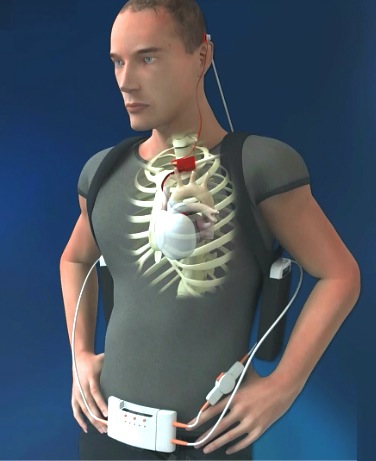
[W]ith demand for heart transplants far exceeding donations, patients can wait for years for a carmat-systeme_01donor heart, while others may be ineligible altogether because of other health issues. An artificial heart can provide a life-saving bridge while a patient waits for a transplant. Surgeons have implanted [the only currently approved artificial heart] in over 1,000 patients. Air is pumped from the external control system (which has recently evolved from a large, 418-pound [air-]driver to a wearable 13.5-pound driver) through tubes that connect through the skin into the device. Puffs of air expand two small balloons inside each chamber of the artificial heart, which pushes blood out of the prosthesis.

[However, in Carmat’s new design,] two chambers are each divided by a membrane that holds hydraulic fluid on one side.

A motorized pump moves hydraulic fluid in and out of the chambers, and that fluid causes the membrane to move; blood flows through the other side of each membrane. The blood-facing side of the membrane is made of tissue obtained from a sac that surrounds a cow’s heart, to make the device more biocompatible. “The idea was to develop an artificial heart in which the moving parts that are in contact with blood are made of tissue that is [better suited] for the biological environment,” says Piet Jansen, chief medical officer of Carmat.

That could make patients less reliant on anti-coagulation medications. The Carmat device also uses valves made from cow heart tissue and has sensors to detect increased pressure within the device. That information is sent to an internal control system that can adjust the flow rate in response to increased demand, such as when a patient is exercising.

(Image: Carmat Wearable Heart System)

“Science Is A Mess And Needs Help”

According to Raymond Tallis, in defense of metaphysics:

In 2010 Stephen Hawking, in The Grand Design, announced that philosophy was “dead” because it had “not kept up with modern developments in science, particularly physics”. He was not referring to ethics, political theory or aesthetics. He meant metaphysics, the branch of philosophy that aspires to the most general understanding of nature – of space and time, the fundamental stuff of the world. If philosophers really wanted to make progress, they should abandon their armchairs and their subtle arguments, wise up to maths and listen to the physicists. …

But there could not be a worse time for philosophers to surrender the baton of metaphysical inquiry to physicists.

Fundamental physics is in a metaphysical mess and needs help. The attempt to reconcile its two big theories, general relativity and quantum mechanics, has stalled for nearly 40 years. Endeavours to unite them, such as string theory, are mathematically ingenious but incomprehensible even to many who work with them. This is well known. A better-kept secret is that at the heart of quantum mechanics is a disturbing paradox – the so-called measurement problem, arising ultimately out of the Uncertainty Principle – which apparently demonstrates that the very measurements that have established and confirmed quantum theory should be impossible. Oxford philosopher of physics David Wallace has argued that this threatens to make quantum mechanics incoherent which can be remedied only by vastly multiplying worlds. …

The dismissive “Just shut up and calculate!” to those who are dissatisfied with the incomprehensibility of the physicists’ picture of the universe is simply inadequate. “It is time” physicist Neil Turok has said, “to connect our science to our humanity, and in doing so to raise the sights of both”. This sounds like a job for a philosophy not yet dead.

Previous Dish on various approaches to metaphysics here, here and here.

The Unequal Valley

The case for realizing the potential of AI:

George Packer recently wrote a piece in the New Yorker on the political culture of Silicon Valley in which he worried about inequality created by technological advances. After getting some pushback, he clarifies his main argument:

My analysis of the Valley’s politics isn’t about left-right in the usual sense. It’s about a particular brand of utopianism that sees solutions for social and political problems in the industry’s products and attitudes. There’s an example of this in what [author Steven] Johnson, in “Future Perfect,” calls “peer progressivism” (also mentioned in the piece). I am skeptical that Kickstarter and Airbnb provide models for solving more than superficial problems. I’m even more skeptical after reading Johnson’s argument that Silicon Valley is fighting back against inequality by creating large numbers of millionaires and distributing profits to its workforce in a relatively equitable way.

This is pretty much my point: life inside Silicon Valley can be a paradise (for its winners) of opportunity and reward. Meanwhile, life outside falls further and further behind. All those highly paid engineers, with their generous stock options and unheard-of buying power, aren’t making the Valley more equal—they’re making it less so. And their success isn’t extending very far into the rest of the economy. Unless everyone becomes a software engineer—a proposal that was floated to me by several tech people, in one form or another—egalitarian stock plans are not an answer to the deepest structural problems in America.

Gregory Ferenstein defends “prosperous inequality”:

Over the long run, technology creates jobs we never even knew existed. The nonprofit Samasource farms out manual data-entry work to refugees in the bleakest war-torn areas on earth. Car-ride sharing service, Lyft, is giving steady income to San Francisco’s unemployed college grads. And Google’s new WiFi-network in sub-Saharan Africa will bring opportunity to the poorest of the poor. Technologists, however, must face the reality that their innovations create financial inequality. Building the technical infrastructure for entire industries or automating jobs inevitably benefits the designers in far greater proportion.

But, in many respects, equality is a lazy measure of social welfare. If certain political interest groups stall innovation, we may be all equally worse off. Instead, judge Silicon Valley by the free time, wellness, and educational value it creates for all of us. By those measures, the Internet economy is a welcome part of society.