Is iTunes On The Way Out?

Purchased Music

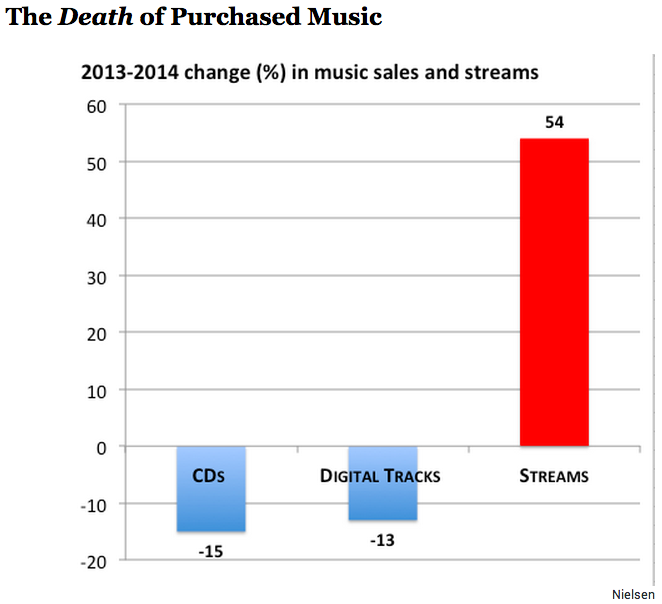
Derek Thompson finds that both CDs and digital music downloads “are down double-digits in the last year, with iTunes sales diving at least 13 percent“:

Digital track sales are falling at nearly the same rate as CD sales, as music fans are turning to streaming—on iTunes, SoundCloud, Spotify, Pandora, iHeartRadio, and music blogs. Now that music is superabundant, the business (beyond selling subscriptions to music sites) thrives only where scarcity can be manufactured—in concert halls, where there are only so many seats, or in advertising, where one song or band can anchor a branding campaign. …

The top 1 percent of bands and solo artists now earn about 80 percent of all revenue from recorded music, as I wrote in “The Shazam Effect.” But the market for streamed music is not so concentrated. The ten most-popular songs accounted for just shy of 2 percent of all streams in 2013 and 2014. That sounds crazy low. But there are 35 million songs on Spotify and many more remixes and covers on SoundCloud and YouTube, and one in every 50 or 60 online plays is going to a top-ten song. With the entire universe of music available on virtual jukeboxes, the typical 3.5-hour listening session still includes at least one song selected from a top-ten playlist that accounts for .00003 percent of that universe. The long tail of digital music is the longest of tails. Still, there is a fat head at the front.

Medicare Wants To Pay For Outcomes

Sarah Kliff puts a favorable spin on the news:

The Obama administration announced Monday a sweeping new plan that will directly affect thousands of hospitals and doctors across the country. The federal government now plans to pay Medicare doctors more if they help patients get healthier — and less if their patients just stay sick. This would be done by tying 85 percent of all Medicare payments to outcomes by the end of 2016 — rising to 90 percent by 2018.

The idea is to move away from the broken and expensive “fee-for-service” system, which pays doctors a flat amount for every surgery and physical they perform — even if they do nothing to actually help a patient.

Orszag is excited:

To be sure, more needs to be done: The targets have to be hit. And that will require action. Today’s announcement provided no details about the specific steps ahead. Will Medicare move more toward bundled payments for specific episodes of care, or toward accountable-care organizations, through which hospitals and other providers receive one payment for all the care a patient needs during a year? Such details are crucial.

The first step in any worthy project, though, is to set clear goals. We desperately needed them for payment reform. With today’s announcement, the administration has raised the odds that the era of slower growth in health costs will continue.

Suderman is skeptical:

This isn’t a plan. It’s a plan to develop a plan (or plans) in hopes of meeting a not-very-well-defined target.

Fine. The administration will eventually try to do something. And whatever that something is, it will likely be a bigger version of a program that has already been tried before. Medicare has tried out lots of experiments in alternative payment systems, attempting to influence provider behavior and health outcomes through bonuses, bundled payments, penalties, and various pay-for-performance measures.

And what we know from these experiments is that even in optimal conditions, it’s very, very hard to make them work.

Jason Millman admits that “it’s still uncertain how well these payment approaches work”:

“We still know very little about how best to design and implement [value-based payment] programs to achieve stated goals and what constitutes a successful program,” concluded a 2014 Rand Corporation study funded by HHS. The report, which reviewed pay-for-performance models implemented over the past decade, said improvements were “typically modest” and often hard to evaluate.

Sam Baker provides more background:

Some of the models HHS wants to expand were part of the Affordable Care Act, including Accountable Care Organizations. Networks of hospitals and doctors pull together into a single ACO, with the goal of tightly coordinating care for each patient. ACOs are billed based on their outcomes, rather than allowing each member to bill Medicare separately. Medicare even penalizes some ACOs if they don’t meet certain quality standards or savings targets.

ACOs have had mixed results: Although they’ve shown an improvement in quality, several providers have dropped out of the program, and Medicare hasn’t saved as much money as many advocates had hoped.

And John O’Shea recommends that, “before blindly pushing Medicare doctors and other medical professionals out of fee for service and over the cliff, the Obama administration should be sure they have a safe place to land”:

[M]edical professionals have found that ACOs are exceedingly difficult to implement. Research by the Medical Group Management Association found implementing and/or optimizing an accountable care organization was one of the top five challenges for members, with 60.2 percent of respondents to one survey saying implementing ACOs was one of the biggest challenges, making it the fifth most challenging issue overall. In fact, of 44 issues facing medical practices, the top challenge for Medical Group Management Association members was preparing for new reimbursement models that include greater financial risk for practices.


It’s High Time For More Marijuana Research

A major doctors’ group supports reclassifying cannabis:

There’s some very early, and largely anecdotal, evidence that marijuana might be an effective treatment for some forms of epilepsy in children who haven’t responded to traditional medications. It’s partly to help bolster these types of clinical studies that the American Academy of Pediatrics today recommended that the government re-classify marijuana as a Schedule II drug, a category that includes other addictive, yet still therapeutic, substances like oxycodone, morphine, and codeine. Currently, marijuana is considered a Schedule I drug, along with things like heroin and acid, which are thought to have no medicinal value.

German Lopez spells out why reclassification has proven so difficult:

When marijuana’s classification comes under review, its schedule 1 status is consistently maintained due to insufficient scientific evidence of its medical value.

Specifically, the scientific evidence available for marijuana doesn’t pass the threshold required by federal agencies to acknowledge a drug’s potential as medicine. HHS’s 2006 review of marijuana’s schedule found several problems: no studies proved the drug’s medical efficacy in controlled, large-scale clinical environments, no studies established adequate safety protocols for marijuana, and marijuana’s full chemical structure has never been characterized and analyzed.

But one reason there isn’t enough scientific evidence to change marijuana’s schedule 1 status might be, in fact, the drug’s schedule 1 status. The DEA restricts how much marijuana can go to research. To obtain legal marijuana supplies for studies, researchers must get their studies approved by HHS, the FDA, and DEA. (This process didn’t even exist until the late 1990s. Before then, it was nearly impossible to obtain marijuana for medical research.

Changing marijuana’s schedule, in other words, is a bit of a Catch-22.

Sullum sounds off:

Reclassifying marijuana would not automatically make it available as a medicine, but it would have several salutary effects, especially if marijuana is placed in Schedule III or lower. Facilitating research is one possible benefit, although if that is the aim rescheduling should be accompanied by the abolition of the federal government’s monopoly on the legal supply of cannabis for research. The AAP does not mention that change, but it makes sense in light of the organization’s position that marijuana derivatives should be treated like any other drug considered by the FDA.

The Hunker Mindset

Drew Harwell never joins the bread and milk frenzy:

Everyone’s shopping list is different — toilet paper, eggs and booze fill many carts — but bread and milk stand out as long-time staples of the panicking pre-storm bustle. A report from Pittsburgh during “The Big Snow” of 1950 said that milk “was the one shortage that has hit all sections,” and that bread was being “doled out” in some grocery stores, a Pittsburgh Magazine writer found last year.

It’s not just that bread and milk work poorly as emergency rations, critics say; they don’t even work well with themselves. Twitter users have even criticized the un-versatility of the combo with a hashtag called #milksandwiches.

A more reasonable alternative?

Bottled water’s not a bad choice. Neither are foods with more nutrients or longer shelf lives: canned goods like tuna, vegetables or soup; peanut butter and crackers; nuts, trail mixes or granola bars. They may break the routine or give less of a feeling of control. But at least you’ll have something to eat.

Daniel Engber tries to diagnose the urge people feel to panic-shop:

[T]his is a different kind of frenzied state than you’d find during a genuine catastrophe—less frightened than nervously excited, not so much survivalist as shopaholic. In fact there’s a name for such behavior, which takes prudence as a beard for gluttony. The word is hunkering, in the specifically American sense of digging in and taking shelter. It’s the anxious form of self-indulgence, where fear is fuel to make us cozy. The end is nigh let’s eat!

Official weather warnings feed this hunker culture. They talk in terms of quantity, not quality—an implicit exhortation to go shopping. Meteorologists say that a crippling and historic storm will dump several feet of snow or more. “More”—that’s what drives the hunkered mind: The weather will be so excessive, with so much snow on top of snow, that we should take excessive action. Politicians gin up excessive numbers, the bigger the better: We’ve got 700 pieces of equipment at the ready, says Boston’s Mayor Marty Walsh, and more than 35,000 tons of salt. On Sunday, New York City’s Mayor Bill de Blasio rallied local hunkerers with a call for immoderation: “Whatever safety precautions you take in advance of a storm,” he said, “take even more.”

Got that? It doesn’t matter what you do, exactly, as long as you do as much of it as possible.

No-pocalypse

2004BL86-640

Becky Ferreira explains how lucky we are to only have to deal with a massive blizzard today:

[Yesterday] morning, an enormous space rock missed Earth by a narrow margin of 745,000 miles, or about three times the distance from the Earth to the Moon. With a diameter of 550 meters and a velocity of about 35,000 miles per hour, the asteroid, known as 2004 BL86, will be so bright in the evening sky that it will be visible through binoculars. Scientists don’t expect another object of this size to pass so closely to Earth until August 7, 2027.

What you’re seeing above:

NASA has released radar observations of the 325 meter-wide asteroid that flew safely past Earth [yesterday] at 8:19 a.m. PST (11:19 a.m. EST), but in those grainy observations, asteroid 2004 BL86 appears to have company — a small moon.


Bob King has more on that exciting find:

Among near-Earth asteroids, about 16% that are about 655 feet (200 meters) or larger are either binary or triple systems. While that’s not what you’d call common, it’s not unusual either. To date, we know of 240 asteroids with a single moon, 10 triple systems and the sextuple system of Pluto (I realize that’s stretching a bit, since Pluto’s a dwarf planet) – 268 companions total. 52 of those are near-Earth asteroids.

With a resolution of 13 feet (4-meters) per pixel we can at least see the roughness of the the main body’s surface and perhaps imagine craters there. No details are visible on the moon though it does appear elongated. I’m surprised how round the main body is given its small size. An object that tiny doesn’t normally have the gravity required to crush itself into a sphere. Yet another fascinating detail needing our attention.

Circling back to Ferreira, she imagines how bad today could have been:

What if [2004 BL86] hurtled towards us just a little earlier, and instead of flying freely through the wake of Earth’s orbit, it collided with us head on? How bad would the damage be?

Fortunately, there is an online tool for calculating the apocalyptic potential of various impact scenarios. Run by Purdue University, Impact Earth allows users to input details about asteroids, comets, and other cosmic death traps, then crunches the numbers on the fallout. I gave the calculator the known details about asteroid 2004 BL86, including its diameter and velocity. I entered a hypothetical mid-range angle of 45 degrees, and specified that the asteroid hit sedimentary land, not water. Then, I asked it to tell me what the damage would be like one kilometer away from the impact site. After a dramatic animation of an asteroid hitting New England, Impact Earth gave me a rundown of the designer catastrophe.

Naturally, it wasn’t pretty. “The projectile begins to breakup at an altitude of 49,800 meters (16,3000 ft),” Impact Earth predicted. It would be fractured by the time it hit the ground, striking the surface at a velocity of about 7.95 miles per second. The energy released would be about 5,120 megatons, which is 100 times more powerful than the strongest nuclear bomb ever detonated. It would leave behind a crater with a diameter of 3.64 miles and a depth of 1.26 miles—similar dimensions to Alabama’s Wetumpka crater. But as the calculator noted under the “Global Damage” category, the impact would not be enough to disrupt the Earth on a global level by altering its orbit or its axial tilt.

Snowpocalypse Now

The historic storm is peaking. So far four governors have declared states of emergency, more than 7,000 flights have been cancelled, and road travel is banned in Massachusetts, New Jersey, Connecticut, and NYC, where the entire public transit system has shut down – a first for a snow-related event in the city. Eric Holthaus checks in on the dire forecasts, which all seem to agree that New England is going to get the worst of it:

In an epic and at times even giddy technical forecast discussion, the NWS office in Boston warned of an “unprecedented” storm. The storm’s central pressure will explosively deepen on Tuesday, at a rate twice that of a “bomb” cyclone. Invoking the technical term for rapid strengthening of these kinds of storms, the NWS forecaster exclaimed, “it’s bombogenesis, baby!” The NWS Boston office also alternately referred to the storm as “historic” and “crippling.” For New England, there may be two separate intense snowfall bands, one in Western Connecticut and one just south of Boston. Exactly where those bands end up will determine which areas receive the most snowfall, but isolated totals exceeding three feet won’t be surprising.

He also notes concerns that the storm could permanently alter the Massachusetts coastline, “boosted by about three feet of storm surge and 20-foot waves.” Whether it ends up a blizzard for the history books or not, don’t let Harry Enten hear you calling it “Winter Storm Juno” – part of The Weather Channel’s storm branding scheme:

A lot of other weather outlets don’t approve of the Weather Channel’s policy. In fact, the National Weather Service and the Weather Channel’s chief private competitor, AccuWeather, appear to hate it. AccuWeather’s founder and president, Joel Myers, has said, “The Weather Channel has confused media spin with science and public safety and is doing a disservice to the field of meteorology and public service.”

Previous Dish on the controversial subject here. But “Juno” doesn’t seem to be sticking:

So over to you, :

https://twitter.com/michelledean/status/559929402134634497 https://twitter.com/dannysullivan/status/559922384719716353

The Best Of The Dish Today

To give you an idea of how far Netanyahu, Boehner and the pro-Israel right have now gone in their campaign to torpedo the critical talks with Iran, I give you two pillars of the US-Israel relationship. It’s one thing for the Clintons’ former ambassador to Israel, Martin Indyk, to say this:

Netanyahu is using the Republican Congress for a photo-op for his election campaign … Unfortunately, the US relationship will take the hit. It would be far wiser for us to stay out of their politics and for them to stay out of ours.

It’s quite another for Michael Oren, Netanyahu‘s former ambassador to the US, to urge the prime minister to reverse course:

The behavior over the last few days created the impression of a cynical political move, and it could hurt our attempts to act against Iran. It’s advisable to cancel the speech to Congress so as not to cause a rift with the American government. Much responsibility and reasoned political behavior are needed to guard interests in the White House.”

Today, the former Israeli intelligence chief, Amos Yadlin, concluded:

I think it’s a political game, I think that makes the prime minister irresponsible.

And I hope you’re sitting down because Abe Foxman of the ADL actually chimed in as well:

This looks like a political challenge to the White House and/or a campaign effort in Israel … I certainly support the sanctions if the deal doesn’t come through but having said that, the invitation and acceptance is ill-advised for either side. It is too important an issue to politicize it.

I wonder if this could actually be part of a more general recognition of how deeply dysfunctional the US-Israel relationship has become or a moment when the pathologically pro-Israel evangelical right and neocons actually over-play their hand. Any sane lobby would wait to see if the talks with Iran can conclude with a deal – still unknowable – and then tear it apart; instead the presumption of the Israeli government that the US is simply required to follow whatever foreign policy Israel wants is driving them all into a ditch.

Remember the way in which Netanyahu lectured – yes, lectured – the president in the Oval Office in a way no other foreign leader would in front of the world press. Remember the dozens of times various neoconservatives or Republican evangelicals have gone to Israel to defend it against pressure from Obama on West Bank settlements. Remember when Republican presidential candidates, like Mike Huckabee, actually celebrate the opening of new settlements, directly against the policy of both this president and the last. This is new and it is toxic.

My hope is that this stunt either actually hurts Netanyahu in the election; or if he wins, and Obama secures an Iran deal, it allows Obama to publicly lay out the US government’s map of what a two-state solution must look like, and to reconsider the UN Security Council veto. No Wile. E. Coyote has tried to bring down Obama as doggedly as Netanyahu has. He even had a cartoon bomb at one point. Which is why a meep meep, if it ever comes, will be one of the very best. And saved till last.

Today, on the Dish, I reviewed where the Republicans are as we face the new political year; we surveyed the unlikely prospects of Chris Christie, the tragic death of Sky Mall in-flight magazine and whether Chandler on Friends was homophobic (lighten up). Plus: an atheist’s view of a week of the Dish; and a classic window view … from Ecuador.

The most popular post of the day was The GOP’s New Year; followed by The Meaning of ’90s Sitcoms, Ctd.

And a reader writes:

We’re now far beyond-the-fact, but we thought you’d enjoy seeing this pic from two devoted readers nonetheless: father surprises son with Dish tee; son surprises father with Dish mug – neither saw it coming. A nice little O. Henry, cross-generational touch to holidays.

FullSizeRender

We only have a handful of mugs left, so get one here before they’re all gone. (Update: All gone.) You can still get your Dish t-shirt here.

See you in the morning.
Can You Teach Funny?

In an essay examining different answers to the question, Saul Austerlitz cracks open one book that says yes:

Mel Helitzer’s Comedy Writing Secrets (1987; updated 2005) suggests a worldwide conspiracy on the part of successful comedians: “Out of fear that discovery of their superficial tricks will be evaluated rather than laughed at, many famous humorists have sponsored an insupportable fiction that comedians must be born funny … Hogwash!” Helitzer lays out a step-by-step program to sharpening and perfecting comedy routines, from the power of POW (plays on words) to the theory of THREES (target, hostility, realism; exaggeration, emotion, surprise).

Comedy Writing Secrets is a workbook, complete with exercises, suggested routines to complete, and wildly dubious statistics. (Are double entendres really 40 percent of all cliché-related humor? How could this possibly be calculated?) Helitzer’s take on comedy occasionally feels fusty and misguided. Referring to Richard Pryor’s audience as “mostly young black militants” is both odd and entirely wrong. Quoting your own jokes alongside the likes of Steve Martin and Steven Wright seems, shall we say, aspirational. But some of the book provides suitable advice for the up-and-coming comic. Helitzer breaks down a haiku-like Mitch Hedberg joke by offering a series of slightly longer, and distinctly less funny, variations on Hedberg’s “I’m against picketing, but I don’t know how to show it” to illustrate his credo that “less is better.”