Pop Plagiarism

Caleb Crain explains how difficult it is to avoid:

Suppose you want to write a brand-new popular tune. A piano has only eighty-eight keys, and the span of the human voice is even narrower. Only a few rhythms and chord progressions reliably please the palate of the masses, and myriad tunes have already been written under these constraints and are protected by copyright. Is it possible to write a new one that doesn’t echo an old one?

Is plagiarism inevitable in pop music? Thanks to combinatorics, the answer is certainly no for a song at full length. And the answer is probably still no if one focuses on just the heart of a song—whatever, legally speaking, that is. But even a genius would probably be unable to write a new pop song that doesn’t resemble some old one for at least a bar or two. When music plagiarism cases go to trial, lawyers and judges must somehow distinguish inevitable echoes from willful theft. “If a song writer is ethical,” A.J. Liebling once quipped, in a book he ghost-wrote for an unscrupulous music publisher, “he will not cop a tune within three years of its publication.” The law aspires to something a bit longer-lasting and maybe even less cynical. But to formulate a rule for distinguishing accidental from larcenous parallels is a fiendish challenge, and in attempting to rise to it, a mind could easily lose its way.

In a follow-up post, Crain features early 20th-century composer Ira B. Arnstein, who “not only ruined his musical career through the chronic litigation of music plagiarism cases; he literally went mad”:

[At the Music Copyright Infringement Resource] you can listen to the songs on both sides and make up your own mind as to whether, say, Shilkret plagiarized Arnstein, as Arnstein alleged he did (the judge’s 1933 verdict: “there was not sufficient originality in the plaintiff’s eight measures to make it worthwhile for anyone to steal them”). In a case decided in 1936, Arnstein claimed that a CBS music director had taken the gypsy-themed tune “Play, Fiddle, Play” from him; you can listen for yourself to that tune, too, as well as to Arnstein’s supposed original. In Unfair to Genius, Rosen points out that judges of the day applied conflicting rules about how to determine plagiarism in music: there was one standard in Allen v. Walt Disney Productions (1941), and a different one in Carew v. RKO Pictures (1942). The songs fought over in both cases are in the Music Copyright Infringement Resource. As are the songs at issue in Arnstein’s lawsuits against Broadcast Music, Inc. and against Cole Porter. The Cole Porter case is the show-stopper of Rosen’s book; it led to a Second Circuit ruling still used by the courts to determine whether there’s been a copyright infringement. Was a pious song of Arnstein’s degraded into, as Arnstein put it, “a song to a cow,” namely, Porter’s “Don’t Fence Me In”?

Discovering Your Neighbor Is A Monster

Details are still emerging about the escape of three young women, including Amanda Berry, kidnapped a decade ago and trapped in a house in Cleveland. Amy Davidson is following the story:

According to a police conference on Tuesday morning, her chance came when she forced a hole in a screen covering the lower part of the door which was big enough for her to push her arm through. Then she started to make noise. (One recalls the way that Natascha Kampusch, an Austrian girl held for eight years, kept looking for a moment to run, and finally found one.) [Neighbor Charles Ramsey, seen in the above interview] came when Berry screamed; and yet she took a risk by trying to get the attention of a stranger. What if he had just told his neighbor, with whom, he told reporters, he’d hung out at local barbecues—“ribs and what not”—that someone in his house was being loud? …

Ramsey’s 911 call is transfixing.

“Yeah hey bro,” it begins, “you check this out.” His intensity, the McDonald’s shout-out, his undoubtedly loose paraphrase of Berry’s account (“This motherfucker done kidnapped me and my daughter”), and also his competence (he does a better job with the essentials like the address than the 911 operator) make him one of those instantly compelling figures who, in the middle of an American tragedy, just start talking—and then we can’t stop listening. (See Ruslan Tsarni, Ashley Smith.) But one phrase in particular, from the interview, is worth dwelling on: “I figured it was a domestic-violence dispute.” In many times and places, a line like that has been offered as an excuse for walking away, not for helping a woman break down your neighbor’s door. How many women have died as a result? They didn’t yesterday.

Dishtern Wanted

The Dish is seeking an editorial intern to help with ransacking the web for smart nuggets, working on larger projects, and guest-blogging when yours truly takes a vacation. The paid internship will be full time, includes benefits and is for a six-month duration. The position is based in New York City. Since the Dish doesn’t have an office, most of the work will be done from home, but the staff meets regularly for lunch and coffee meetings. We’ve decided to cut down to one intern – to keep our budget firmly under control. Which means the one individual really does have to be special.

We are hoping to hire within the next month or so. Start dates are semi-flexible. We’re looking for extremely hardworking self-starters, web-obsessives and Dishheads, who already understand what we do here. We also prefer individuals who can challenge me and my assumptions, find stuff online that we might have missed, and shape the Dish with his or her own personal passions. I want to emphasize that this is an intense job for the intensely motivated. It’s also a pretty unbeatable opportunity to learn what online journalism can be. And a sense of humor is an asset.

To apply, please e-mail a (max 500-word) cover letter explaining why you are a good fit for the Dish and a resumé to apply@andrewsullivan.com. Put “Dishtern” in the subject line. The cut off for applications is Monday, May 20.

The Meh Gatsby

Kathryn Schulz confesses:

I know how I’m supposed to feel about Gatsby: In the words of the critic Jonathan Yardley, “that it is the American masterwork.” Malcolm Cowley admired its “moral permanence.” T. S. Eliot called it “the first step that American fiction has taken since Henry James.” Lionel Trilling thought Fitzgerald had achieved in it “the ideal voice of the novelist.” That’s the received Gatsby: a linguistically elegant, intellectually bold, morally acute parable of our nation.

I am in thoroughgoing disagreement with all of this. I find Gatsby aesthetically overrated, psychologically vacant, and morally complacent; I think we kid ourselves about the lessons it contains. None of this would matter much to me if Gatsby were not also sacrosanct. Books being borderline irrelevant in America, one is generally free to dislike them—but not this book.

Her biggest criticism? The lack of love:

Indeed, The Great Gatsby is less involved with human emotion than any book of comparable fame I can think of. None of its characters are likable. None of them are even dislikable, though nearly all of them are despicable. They function here only as types, walking through the pages of the book like kids in a school play who wear sashes telling the audience what they represent: OLD MONEY, THE AMERICAN DREAM, ORGANIZED CRIME. …  Of the great, redemptive romance on which the entire story is supposed to turn, [Fitzgerald] admitted, “I gave no account (and had no feeling about or knowledge of) the emotional relations between Gatsby and Daisy.”

Lisa Hix takes issue with the book’s portrayal of flappers:

Narrated by a man, the cautionary tale seems to warn against the wiles of The New Woman—the feminist ideal of an educated and sexually liberated woman that emerged in the 1900s.

So instead of intelligent, independent women telling their own stories of rebelling and rejecting their mother’s values, you have male war buddies sharing how vapid, spoiled socialites carelessly wrecked their lives. In “A Feminist Reading of the Great Gatsby,” Soheila Pirhadi Tavandashti points out the pattern:

“The novel abounds in minor female characters whose dress and activities identify them as incarnations of the New Woman, and they are portrayed as clones of a single, negative character type: shallow, exhibitionist, revolting, and deceitful. For example, at Gatsby’s parties we see insincere, ‘enthusiastic meetings between women who never knew each other’s names,’ as well as numerous narcissistic attention-seekers in various stages of drunken hysteria.[“]

Hix emphasizes that what may be remembered as merely a fashion trend was in fact a complicated, “full-blown, grassroots feminist revolution” that we are still feeling the effects of today:

[The flapper] rejected the notion that women should be submissive and keep to their “separate sphere” of the home. She proved that women could work and live independent from men—and party just as hard.

Meanwhile, Zachary M. Seward sighs at how high school teachers commonly interpret the classic:

[They] use the book to teach their students how to strive, filling in the blank, “My green light is _____.” In the novel, Gatsby’s infatuation with social class is represented by the green light on the dock of the Buchanan estate across the bay from his house. And if there’s one line that neatly, almost overbearingly, conveys the novel’s jaundiced view of the American dream, it’s this one: “Gatsby believed in the green light, the orgastic future that year by year recedes before us.”

At Boston Latin School, however, the green light is just good old American ambition. “My green light is Harvard,” a 14-year-old Chinese-American immigrant told a reporter visiting her English class. On the wall of the classroom, students had written their own “green lights” (pdf) on a large piece of green construction paper in the shape of a lightbulb: Pediatric neurosurgeon … Earn a black belt … Make it to junior year… Become incredibly rich.

Previous Dish on Fitzgerald and his novel here, here and here.

Ask Josh Fox Anything: Why Should Republicans Care About Fracking?

The Gasland filmmaker discusses how fracking collides with private property rights:

A reader writes:

Your dissents to Fox’s seemingly biased presentation of the facts around fracking raise a larger issue that I’d be interested in seeing the Dish cover. Specifically, while the preponderance of scientific evidence for global warming tends to be embraced by liberals, issues such as genetically modified organisms (GMOs), nuclear power, environmental issues related to the Keystone Pipeline, and fracking are areas where liberals seem more willing to ignore scientific evidence or embrace questionable science in their opposition.  Why is that?

The fear of “Frankencorn” is a somewhat legitimate concern, but does that slight fear outweigh the far more realistic danger from excessive pesticide, land or water usage, all of which are areas that GMOs offer tremendous environmental benefits?  Similarly, given the danger of global warming and the safety record of the nuclear industry (not to mention that recent studies may show nuclear power has actually saved lives), why are so many liberals hell-bent on opposing nuclear power?  In both cases, the opposition seems to be based on a remotely-plausible worst-case scenario, while the scientific evidence seems to strongly support for the opposite position that supposedly pro-science liberals advocate. I have very good, very well-educated liberal friends who are adamant in their support for reducing global warming, but equally adamant in their opposition to nuclear power or fracking, and I honestly don’t understand this seeming dichotomy.

I don’t either. If your concern is climate change, and you believe that slowing or preventing it is your fundamental priority, then nuclear power should be high up on the list for energy-production. On GMOs, I side with my reader, depending on the specific case. I’m always amused by liberal stoners who oppose genetically modified plants. What on earth do they think they’re smoking? As for fracking, I think it’s worth airing Josh’s case, but I remain unconvinced. If it provides energy while lowering carbon emissions, I’m for it, without some overwhelming argument against. I’ve yet to hear one.

Gasland Part II will air on HBO this summer. Fox’s other Ask Anything answers are here. Full AA archive here.

The Closet Metaphor

Arika Okrent traces its origins:

According to George Chauncey’s comprehensive history of modern gay culture, Gay New York, the closet metaphor was not used by gay people until the 1960s. Before then, it doesn’t appear anywhere “in the records of the gay movement or in the novels, diaries, or letters of gay men and lesbians.”

“Coming out,” however, has long been used in the gay community, but it first meant something different than it does now. “A gay man’s coming out originally referred to his being formally presented to the largest collective manifestation of prewar gay society, the enormous drag balls that were patterned on the debutante and masquerade balls of the dominant culture and were regularly held in New York, Chicago, New Orleans, Baltimore, and other cities.” The phrase “coming out” did not refer to coming out of hiding, but to joining into a society of peers. The phrase was borrowed from the world of debutante balls, where young women “came out” in being officially introduced to society.

The clip above is from a wonderful documentary, The Sons of Tennessee Williams, about the drag balls organized by gay men in New Orleans, when homosexuality was a criminal offense, but dressing like a woman for a pageant wasn’t. And so these balls included the “coming out” of debutantes. It’s a classic case of how the First Amendment protected besieged gay lives for a very long time in America, which is why, in my view, gays should remain in the forefront of its protection – for our opponents as well as ourselves.

A Strange Conservative Indeed

Reviewing my friend Jesse Norman’s Edmund Burke: The First Conservative, Charles Hill spots a paradox in attempting to write such a book:

While recognizing that Burke’s persona, like Walt Whitman’s, contains multitudes, Norman boldly NPG 655,Edmund Burke,studio of Sir Joshua Reynoldssummarizes Burke’s thought for our time. Any such effort, however, is fundamentally un-Burkean. There is no catching Leviathan with a hook. Burke’s writing and speaking—style and substance—are all of a piece, coming together organically. His 1790 masterpiece Reflections on the Revolution in France is clear, but stubbornly resistant to summation. There are no chapters or subheadings, no table of contents, no index.

When the luminous intellectual historian Frank Turner edited a new edition of Burke in 2003, he was determined to produce an index. It was, Turner told me, “the damndest fool’s errand I ever set myself.” When he had finally completed it, he found that the first item he looked up in the index had not been included. To grasp the full force of Burke’s ideas, one must read through his entire oeuvre, without assistance.

About those multitudes:

For Edmund Burke, the eighteenth-century Irish statesman who served in the British House of Commons, the hallmark of a sane society is reconciliation of the present and the future to the past.

We live our lives in the present, with time always progressing forward in a linear direction, so Burke’s respect for the past makes him conservative. Given the modern world’s appetite for change, Burke’s emphasis on continuity and permanence makes him seem like a strange outsider. Furthermore, Burke’s conservatism is expressed in a fierce and fiery, almost reactionary, style.

This puzzled his detractors, who were constantly suspecting Burke of some ulterior motive, of exerting some nefarious influence in the cause of some hidden agenda. The Duke of Newcastle said, “Burke’s real name is O’Bourke, a wild Irishman, a Jacobite, a papist, a concealed Jesuit.” At best, but equally threatening to the state, Burke was an eighteenth-century Socrates, a dangerous gadfly, challenging the settled assumptions of Britain.

The portrayal of Burke in Boswell’s Life of Johnson avoids quoting the statesman directly, and sometimes disguises the identity of the “Burkean” speaker, as if to conceal Burke from the authorities. If this was a conservative, it was a strange conservative indeed. Moreover, Burke took contrarian positions on world issues, positions his critics found difficult to reconcile: religious liberty for Ireland, independence for America, justice and respect for India’s traditions, and to hell with the French Revolution.

Of course, all these positions are entirely easy to reconcile, once you abandon rigid categories of agitprop and actually think. The founder of Anglo-American conservatism was, in reality, a Whig. These nuances would not fare well on, say, the Mark Levin show. But any true appreciation of conservatism as a political disposition would be thoroughly engaged.

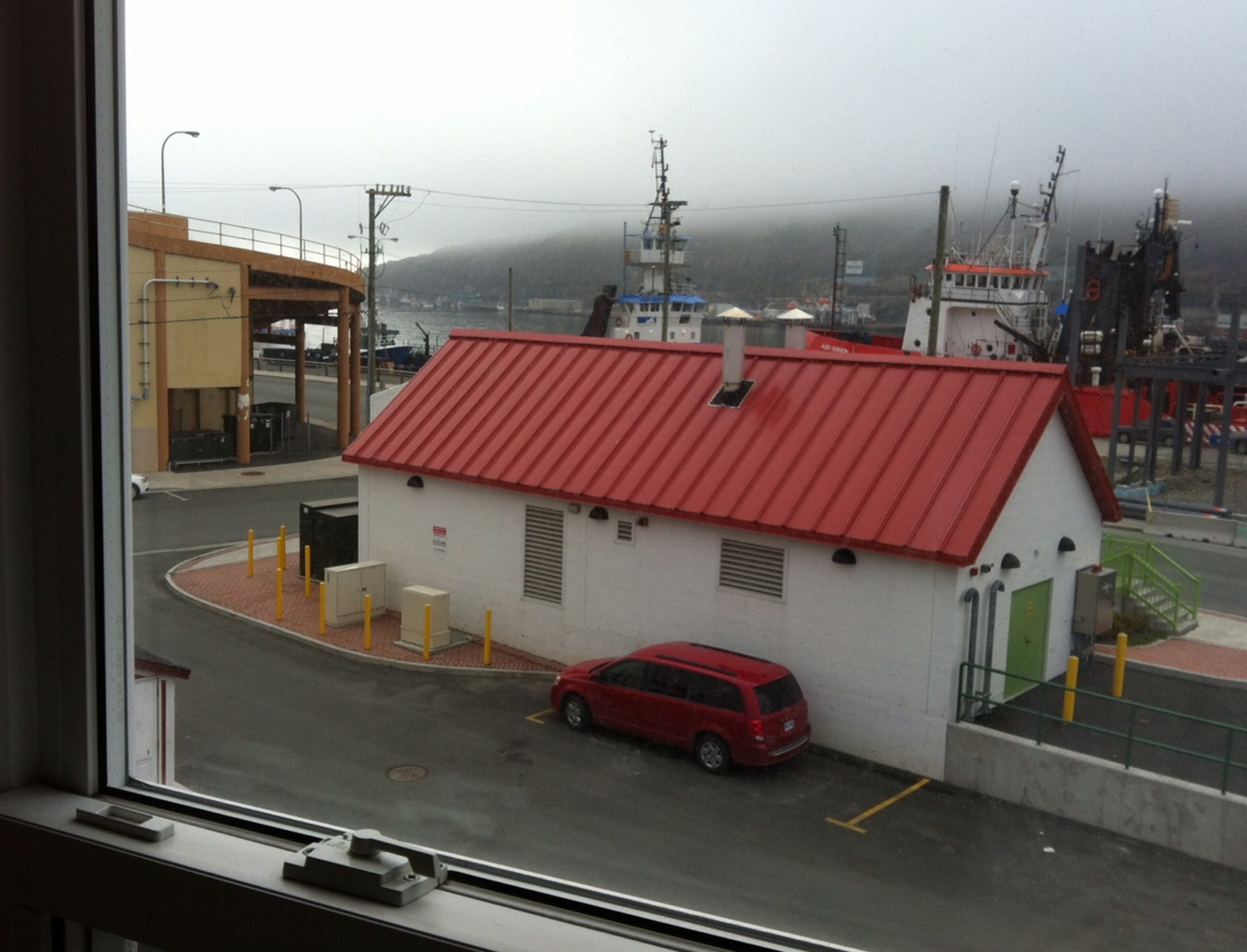
The View From Your Window Contest: Winner #152

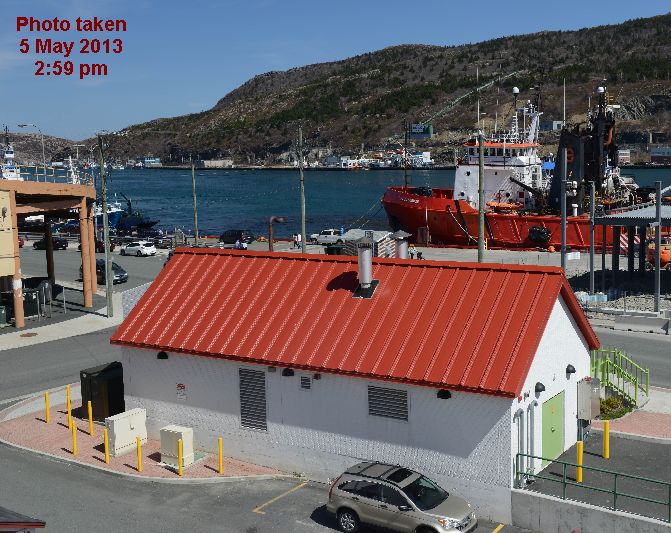
Screen Shot 2013-05-04 at 11.54.44 AM

A reader writes:

The fogged-in, treeless channel with fishing vessels and the red-roofed single building. I see the North Coast of Iceland. (Though as good a guess might be Invercargill, New Zealand, which has the same look at the diametrically opposite side of the world.)

Another:

Reykjavík? Plainly, this is Iceland. No other country in the world has such distinctive window latches.

Another:

Not a lot of time to look around this week, so after what appears to be a left hand drive car, chimneys instead of air-conditioning, I am going to guess Scotland.  Google gave me some obvious fishing villages to start, and Lewwick seems to be a real chance.

Another:

Norway?, Scotland?, Ireland?, Newfoundland?, wait! – that van is a Chrysler product so USA or Canada only – plus the license plate isn’t extra wide like in Europe. Newfoundland?, Victoria?, Puget Sound?, zoom in on the license plate, wait! – isn’t that an Oregon license plate? Sort of looks like a little bit of green in the middle of a white plate so could easily be the Doug Fir tree. Of course, someone from Oregon could easily drive up to the Puget Sound or B.C. but I’ll go with the better odds: Oregon. Columbia River or Pacific Coast? Those boats make me think coast for some reason.

So where on the Oregon coast would there be a harbor like that? First thought to pop into my mind: Astoria, Oregon. Where in Astoria though? I used to live in Oregon but I’ve never been to Astoria and I’m not one of those people who spend hours on Google Earth trying to pinpoint locations for these contests and it’ll probably turn out to be New Guinea or Uruguay or someplace like that anyway. I wonder what the next post is about …

Another:

From the looks of the port city and the building under construction on the right side of the photo, I’m guessing this was an area impacted by the Tohoku earthquake and tsunami in March 2011. I remember seeing a YouTube video of a port being inundated with a shopping center on the shoreline. In looking online, I couldn’t find the name in the particular video, so I will guess Kesnessuma, in the Miyagi Prefecture.

Another:

I’m going to Norway at the end of the month.  This VFYW looks a lot like the pictures I’m seeing in the travel books I’m using to plan my itinerary.  The weather looks about right for this time of year and the scene kind of matches my preconceived idea of what the Norwegian fjords and ports will be like.  There are a lot of places I could choose, but I’m going with Stavanger.

Another:

Well, not much to go on this week, but here is my reasoning: the cars and the license plates look American but the building in the foreground has a Scandinavian feel to it. It also seemed to me like the red and white boat looks a lot like many in the Coast Guard’s fleet. And where would there be cold and damp weather still at this time of year? So I googled where there are Coast Guard stations in Alaska, and it turns out that there is one in Petersburg, Alaska. Plus, the town’s nickname is “Little Norway” because it was founded by a Norwegian, and on Google Earth you can see many of those red-roofed buildings. So maybe the photo is taken from the Morning Mist Bed and Breakfast, second floor?

Another nails the right location:

It’s a bit ironic that while on a business trip in Bangkok, a very exotic location for me, you publish a photo of a place that I consider very familiar, also through work. We’re overlooking the harbor of St John’s, Newfoundland, a beautiful place that is very fishing oriented, which is what draws a Massachusetts-based marine biologist like me to it. The harbor entrance is off to the left, and you can’t see Tower Hill, a very nice place to overlook the city and the Atlantic Ocean. St. John’s is way out into the Atlantic, and nearby Cape Spear is the furthest east one can go on the North American continent. The people are very, very friendly, and they like to drink and play music and sing, and they like you to come along, too.

I know I won’t win – this one is too easy, and I frankly detest the minute detail of winners who determine which hotel room, how high, la la la. That’s just silly. So I’m just happy to know after many years of reading your blog, I finally nailed one, as well as I care to.

A cool view of the hotel:
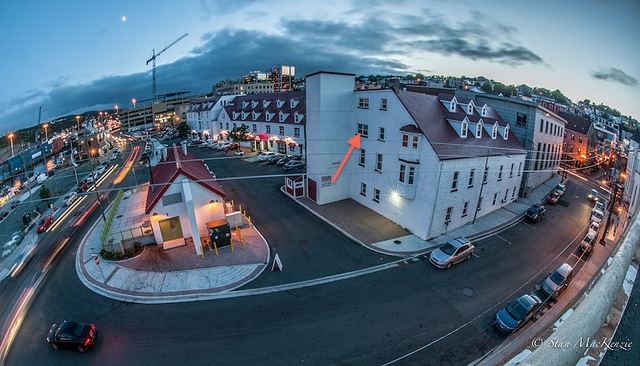
image (3)

Details from another reader:

My spouse lived at the Murray Premises Hotel for a few weeks back in 2010, as part of the Opera on the Avalon Festival, and we visited her there for the last week. Her room was in an annex that faced Water Street, on the other side of this view, near where George Street connects – so if any readers know St. John’s they know that we had to wear earplugs to bed. George Street is perhaps the booziest party street on the planet – and that’s not hyperbole. To quote Wikipedia: “The street has the most bars and pubs per square foot of any street in North America, and is known to have bars that are open later than most others throughout Canada.” There was a 24-hr restaurant directly across the street where revellers would go to eat after the bars closed, then come out and barf into the street.

The photo is taken, I believe from the second floor of the Murray Premises Hotel, facing Harbour Drive. The parkade (as we call them here in Canada) is on the corner of Harbour and Beck’s Cove as part of the Bowring Downtown Centre (Bowring was originally a Newfoundland company est. 1811, a huge company with ships, provisioning, and trade on a worldwide scale in the late 19th and early 20th century – now is a gift store chain). If I’m not mistaken the photo is taken from just outside (or perhaps inside – I can’t quite remember the layout) of the breakfast room.

A local snaps a photo:
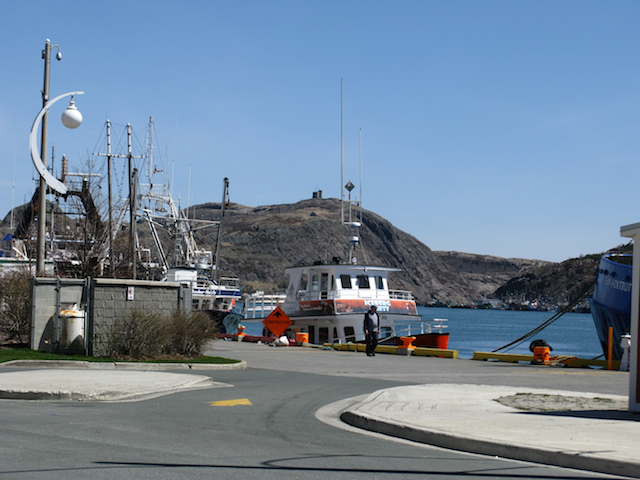
StJohnsHarbour

It happens, it really does happen! One sees the View from your Window Contest and says: I know that place!  Even better: That’s here!   I’ve seen other people have such reactions; I never dreamed that I’d be the same one day.

Another reader:

This is a view from the second floor of the Murray Premises Hotel overlooking St. John’s cove.  I recognize it because my mother did some demographic research on the 1918 flu there and I spent a few weeks with her in the summer.

Another:

Having Lived in Newfoundland for six years while going to school, I recognized this location immediately.  The big Irving oil sign on the opposite hill was a dead give away.  Still my favorite place on earth, would move back in a heartbeat if I could.

Another:

St John’s is a wonderful place with friendly people and appalling weather. After a business trip there years ago, while filling out my expenses back at home, three and a half time zones away, I noticed for the first time that the charming waitress who had served us in a downtown restaurant had left her phone number on the back of the receipt. Nothing like that had ever happened to me before or since. Regrets, I have a few …

Another:
image

I’ve been reading The Dish for yonks, but I’ve never actually sent am email on any topic.  I’ve certainly never been tempted to enter the VFYW contest.  I follow it avidly each week, but mostly to marvel at how people are able to pinpoint such exact locations from such scant clues.  Normally, the best I can do is narrow it down to continent.  But this week, I knew instantly and without a shadow of a doubt.  It was an instant recognition of home. I live on the mainland now, but I was born less than a mile away from where that photo was taken. That is St. John’s harbour.  That is Newfoundland’s characteristic rain, drizzle, and fog.  That is the Bowring building in the corner.  That is a view from the Murray Premises.

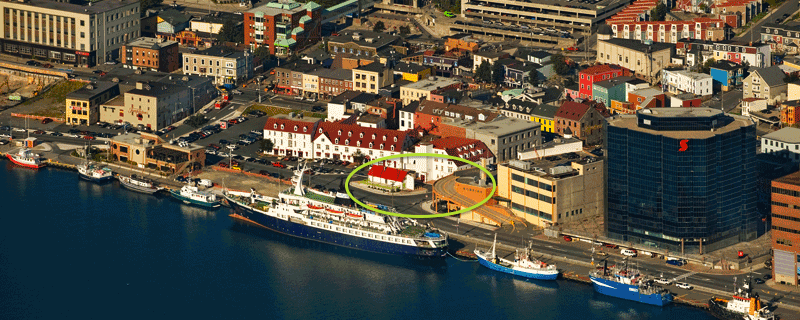
I don’t expect to win.  Having never entered before, I wouldn’t win any kind of tiebreaker, and if the location was obvious to me, it must be obvious to others.  But when I went to verify the location, I saw that Google street view doesn’t actually have data for the corner of Harbour Drive and Becks Cove.  So maybe it will be a tough one for Dishheads without local knowledge?  Probably not. But just in case, I’ve attached from the Murray Premises website that shows the scene from the opposite side of the harbour in much nicer weather. It seems like the picture has been taken from the third floor, and I’m guessing the most easterly window.

So very close. The following reader zeroes in on the correct third-floor room:

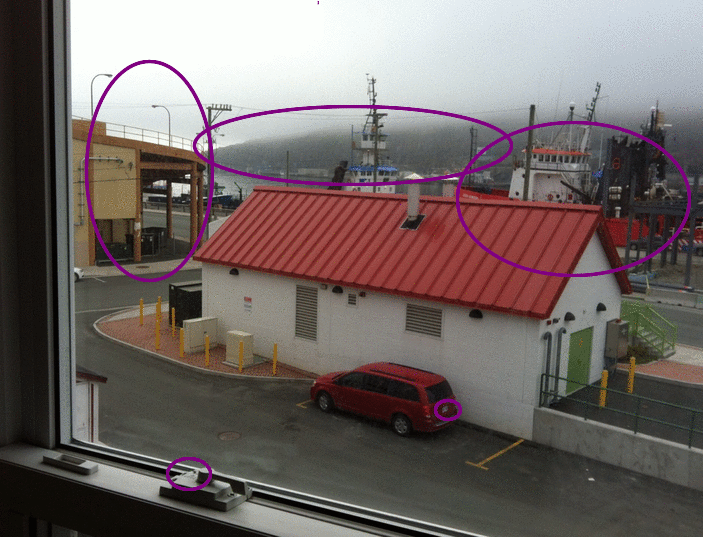
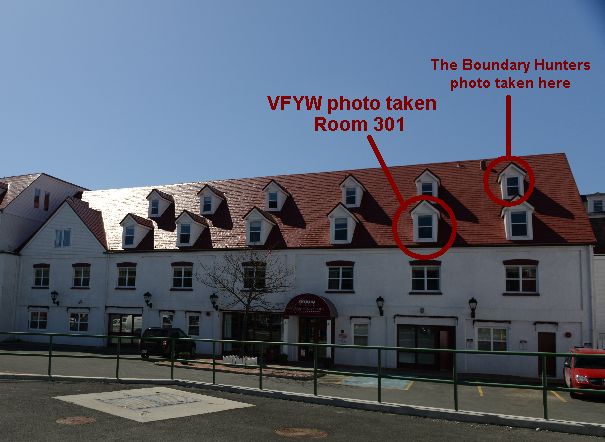
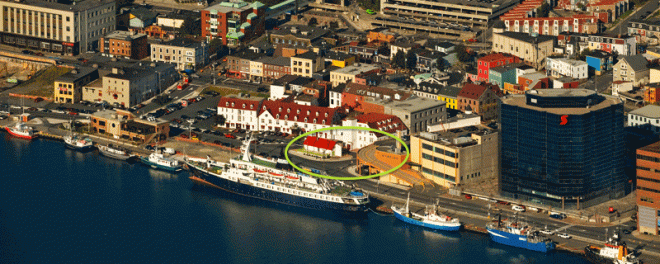
This is the Murray Premises Hotel, located on the town’s harbor in the block created by Harbour Drive, Beck’s Cove, Water Street, and Bishop’s Cove. If my estimation of the sight lines is edited original piccorrect, it’s taken from the bedroom of suite 301, or from this picture, the window furthest to the right and the lower one poking out from the roof. This picture shows the hotel with the the little red-roofed building (a paint shop, apparently) and the little overpass parking exit which are visible from the picture.

The first thing I noticed was that the car in the foreground seemed American-ish with an American-style license plate. I’ve never been to Canada, but I guess they use them there, too? I suspected that this placed the photo in British Columbia, Alaska, Washington, or Eastern Canada. I also saw the word “lock” on the window lock, so that confirmed some suspicion.

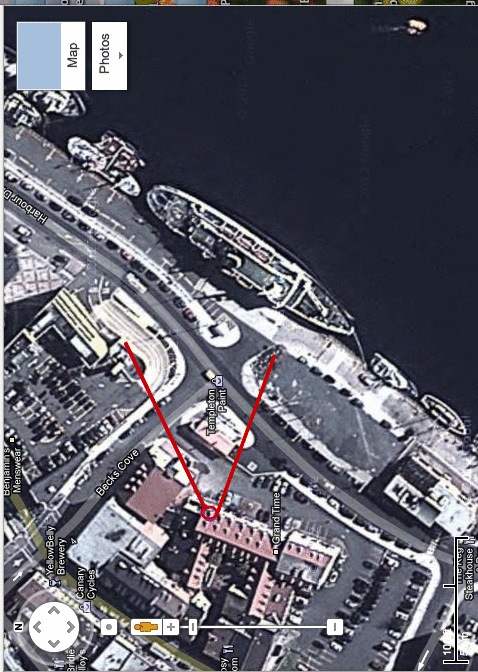
Next, I tried to identify the ships. The red one’s name is visible, but I couldn’t make out anything, really. I tried looking up ship prefixes, but none seemed to match what I was guessing. In doing this, though, I found Canadian Coast Guard ships that were painted in similar patterns. I have no google map w guidelinesreason to think this ship is a coast guard ship, but in looking through the CCG pictures, I found a link to St. John’s. This link provided another to a cool little ship-tracking site, so I looked through and didn’t find anything in St. John’s with a similarly-shaped name or a similar-looking boat. Silly me, I didn’t think about the fact that ships move, so I played on that site looking at other places in Eastern Canada.

At one point, though, I just thought, “No, St. John’s looked right.” So I went back and started looking at Panoramio pictures and street views, and of course, after about five minutes I saw the overpass. The area in front of the hotel seems to be under construction, and there was no street view. But right after the street view jumped past it, I turned it around and there was the overpass, street lights and all. From there, I just found the hotel name on the map, followed it to the website, looked at pictures to confirm, etc. And, you know, e-mailed the hotel to find out the room number. The woman who replied, Kim, was surprisingly nice given the oddity of my request.

An even more ambitious effort – and this week’s winner, given the reader’s long track record without yet clinching the prize:

The key to solving this week’s VFYW contest (in under five minutes) was identifying the red vessel Murray Premisesin the background of the photo.  Turns out there aren’t too many red vessels with ALEX as part of their name.  The ALEX GORDON is an “anchor handling vessel”, built in 1975 and its most recent known port visit, according to this site, was St. John’s,  Newfoundland.  Some quick googling confirmed this was the sight of the photo and the hotel from which the photo was taken is the Murray Premises.

I figured quite a large number of people would also quickly identify the photo location so I thought about what kind of “added value” I could bring to my contest entry.  It suddenly occurred to me, and I’m probably letting the cat out of the bag for future VFYW contests revealing this, that I could utilize a hobbyof mine – geocaching – to help identify the room number and get pictures at the location.  I looked signs_681up the closest geocache to Murray Premises and emailed the owners of the geocache and asked them if they could help me out. And did they ever!  “The Boundary Hunters” went down to hotel and took several photos for me.  They identified the room from which the VFYW photo was taken as room 301.  Unfortunately that room was occupied but they did their best to recreate the photo and were able to access the window one up and one over. The ALEX GORDON is still docked at the same location and the weather has much improved from the time when the contest photo was taken.

Details from the submitter:

This one was taken this morning as the fog was lifting on St John’s Harbour. I took it from our room in the Murray Premises, a small hotel at 5 Beck’s Cove between Water Street and Harbour Drive in what was once a mercantile warehouse built in 1846 and where my husband and I are enjoying a romantic weekend getaway. It’s room 301 … is that specific enough?

(Archive)

Dwight Obama

The parallels between Eisenhower’s and Obama’s foreign policies pile up. Does this Stephen Ambrose quote sound familiar?

Eisenhower’s outstanding achievement was to avoid war. However irresponsible Republican emotional appeals to the anti-Communist vote may have been, and despite the Russian shift to the offensive in the Cold War, Eisenhower refused to engage American troops in armed conflict. He was not immune to intervention, nor to provocative rhetoric, nor to nuclear testing, nor to the arms race (within strict limits), but he did set his face against war. It became the Democrats’ turn to complain that the United States was not “going forward,” that it was not “doing enough,” that America was “losing the Cold War.”

It helps to have a president who actually knows what war is.