“Indeed, the truth that many people never understand, until it is too late, is that the more you try to avoid suffering, the more you suffer, because smaller and more insignificant things begin to torture you, in proportion to your fear of being hurt. The one who does most to avoid suffering is, in the end, the one who suffers the most: and his suffering comes to him from things so little and so trivial that one can say that it is no longer objective at all. It is his own existence, his own being, that is at once the subject and the source of his pain, and his very existence and consciousness is his greatest torture,” – Thomas Merton, The Seven Storey Mountain.
Author: Andrew Sullivan
Priceless Particles

For her project Stardust, Corinne Schulze photographed the “the bits and pieces of archaeological artifacts” she discovered while working with historical treasures at a New York museum:
One day, Schulze looked down at her studio sweep and those tiny pieces of dust and debris left behind struck her differently. Rather than unfortunate casualties of the job, the debris looked to her like celestial formations. She transferred it to a black background—like the vast canvas of space—and snapped a photo.
“It reminded me of the idea that we’re all made of stardust—Carl Sagan and all that stuff,” she said.
Most of the objects she shot were gathered in the early 20th century, when the collection process was far less careful than it is today. Archaeologists shoveled up the objects, dumped them in a box along with whatever dirt and fragments surrounded it, and closed them up with notes about what was found that still left much to the imagination.
See more of Schulze’s work here.
How To Flirt On The Internet
According to Emily Witt, who investigated the live webcam site Chaturbate, it helps if you’re a woman:
At first I avoided the most sexually explicit channels. I preferred to watch women, but not usually at their most pornographic. I watched when they were just doing things, chatting or cutting out paper hearts for Valentine’s Day or listening to the songs of Miley Cyrus. I watched the women because they were more interesting than the men, who invariably positioned themselves in a black computer chair at a desk in ghastly desk-lamp illumination, dick in hand, making the usual motions, unless they reclined in bed and did the same, with little in the way of creativity or gimmicks. It was amazing the diversity of what men wanted performed for them and how little they offered to others, except for a few of the gay guys, who seemed to understand that some form of flirtation might exhilarate the spirit and therefore did yoga routines in bike shorts or lip-synched to pop hits.
Witt goes on to consider whether “internet sexual” qualifies as a new orientation. She talks to Chaturbate performers Max and Harper – whose webcam performances have included a penis-in-ice-water endurance test as well as “puppet shows, and threesomes, and a food fight” – about how their ideas of sex have changed:
As Max and Harper have gone deeper into their online sexual exploration, they have learned that sex is no longer a thing either of them could define. “I know intercourse is definable as a thing but I don’t, like, believe in ‘sex’,” said Max. “I don’t think I could point to it, I couldn’t tell you what it is, because for some people, completely-clothed-just-pulling-at-your-nostrils-at-a-camera is sex, it’s a massive turn-on.”
Some people might look at Max and Harper, or anybody on Chaturbate, and disagree. They might think of clean sheets, a well-made bed, a clearly defined “partner,” and a closed door and think that they know exactly what sex is — loving, maybe; monogamous, probably; dignified by its secrecy; more authentic for not being shared; sacred because it’s not mediated through a cell phone. Spend enough time on Chaturbate and such a view starts to feel both rarified and unambitious. …
Right now I see being sexual on the internet as a bold and risky form of performance. I anticipate that in the future it will just be thought of as sex.
Hathos For Herzog
Werner Herzog narrates one of Klaus Kinski’s outbursts on the set of Fitzcarraldo (language is NSFW, especially for German speakers):
Kinski appears to have experienced the “compulsion of revulsion” for the director. Charlie McCann, who recently saw Herzog speak at the New York Public Library, elaborates:
At one point [event director Paul] Holdengräber read a particularly vivid passage from an autobiography by Klaus Kinski, the mercurial actor who starred in several of Herzog’s films:
“He should be thrown alive to the crocodiles! The sting of a deadly spider should paralyse him! His brain should burst from the bite of the most poisonous of all snakes! Panthers shouldn’t slit his throat open with their claws, that would be too good for him! No. Big red ants should piss in his eyes, eat his balls, penetrate his asshole, and eat his guts! He should get the plague! Syphilis! Malaria! Yellow fever! Leprosy! In vain. The more I wish the most horrible of deaths on him and treat him like the scum of the earth that he is, the less I can get rid of him!”
Herzog’s reply? “It’s good prose.”
He wasn’t just being game. When Kinski was writing this invective, he came to Herzog for assistance. Herzog pulled out his pocket OED and together they looked for choice metaphors and better epithets. It turns out even his sworn enemies come to Herzog for guidance.
Conflict Cuisine
Lionel Beehner considers a correlation:
In my past life as a freelance reporter based in post-conflict countries, I used to think there was a direct relationship between war-torn places and good cuisine. Maybe an inventive menu was a sign of ethnically diverse cultures, which may be synonymous with internecine conflict. Conflict zones, after all, tend to bestride former empires. Or perhaps the horror of war is what lends itself to good food – as a form of culinary escapism.
The tastiest kebabs I’ve tried are in Aleppo (in a former merchant guesthouse since leveled during the war). Which should come as no surprise: Syria sits at a cultural crossroads — its cuisine benefits from Ottoman, Armenian, Jewish, and French influences. That would also explain why the best falafel in Jordan, at least according to aid workers there, is in a Syrian refugee camp. I remember sampling the best cheese and wine I’d ever tried in Tbilisi shortly after Georgia’s 2008 war with Russia. That makes sense – Georgia has been invaded by the Mongols, the Persians, the Turks.
Blander food conversely seems to go hand in hand with peace and stability. Until Rene Redzepi’s Noma lit up the latest New Nordic foodie craze, peace in northern Europe corresponded with a dull and unpredictable diet of meat and potatoes. The Balkans may be a less stable place, but anybody who’s tried a cevapi in Sarajevo can say that Bosnian cuisine is anything but bland. I have fond memories of my trip last year to Tanzania – a country at relative peace since a border scuffle with Burundi in 1996 – but tasting its native cuisine was not one of them. Ethiopia, which has seen no shortage of war and conflict, boasts perhaps the continent’s best food.
The View From Your Window

Phoenix, Arizona, 4.33 pm
On The Sanity Of Artists
Maria Popova digs up a nonfiction gem from Henry Miller, To Paint Is to Love Again, in which he addresses the question:
Certainly the surest way to kill an artist is to supply him with everything he needs. Materially he needs but little. What he never gets enough of is appreciation, encouragement, understanding. I have seen painters give away their most cherished work on the impulse of the moment, sometimes in return for a good meal, sometimes for a bit of love, sometimes for no reason at all — simply because it pleased them to do so. And I have seen these same men refuse to sell a cherished painting no matter what the sum offered. I believe that a true artist always prefers to give his work away rather than sell it. A good artist must also have a streak of insanity in him, if by insanity is meant an exaggerated inability to adapt. The individual who can adapt to this mad world of to-day is either a nobody or a sage. In the one case he is immune to art and in the other he is beyond it.
Mental Health Break
It’s hard to believe all this was 17 years ago:
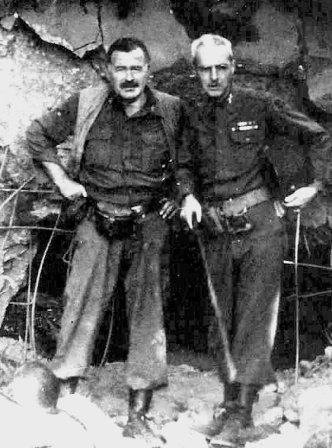
Papa’s Masculinity
Tyler Malone interviews Adam Long, the director of the Hemingway-Pfeiffer House in Arkansas, where Hemingway once lived, about the subject:
Hemingway is sort of the prototypical machismo American writer, but that uber-masculinity aspect of his persona often gets played up. He seems to me a much more complicated man than the mythical bull-fight-loving tough guy allows. Do you agree? And if so, in what ways do you see a different side of Hemingway? And how can highlighting those alternate aspects of his personality help to open up his novels in different ways?
I agree that Ernest is more complex than his one-
dimensional macho performance. Certainly, Ernest was obsessed with masculinity, as were many men in his time and place. Because of this performance, he seems to have worked to ensure that his public persona was quintessentially macho. This probably becomes more and more true as his celebrity grows.
Beneath this, though, I think there is a much more complex person. Looking at his texts, I think that, at times, you see his narrators regret their own chauvinism. It seems to me that many of his narrators are speaking about past events, like one might in a confessional. I think seeing the difference in age in the first-person narrators and the events they narrate is important in seeing growth (or at least regret) in some of the Hemingway heroes.
Previous Dish on the author here, here, and here.
(Image of Hemingway with Col. Charles T. Lanham in Germany 1944 via Wikimedia Commons)
Tweet Of The Day
Judge strikes down same-sex marriage ban in Alabama and conservatives at #IowaFreedomSummit don’t even mention it. Even they know it’s over
— igorvolsky (@igorvolsky) January 24, 2015
 The Dish
