Lincoln’s Media Strategy

Reviewing Harold Holzer’s Lincoln and the Power of the Press: The War for Public Opinion, Garry Wills marvels at how the president deftly handled newspaper editors and reporters, noting that journalism in his day “was a dirty game by later standards, and no one played it better than Abraham Lincoln”:

As soon as Lincoln was elected he set about new dealings with the press. His inaugural Abraham_Lincoln_O-55,_1861-cropaddress was secretly set in type by the editor of the Illinois State Journal, which had the sole firsthand report of his remarks at the train station as he left for Washington. Armed with the presidency, Lincoln famously tried to appoint cabinet members and military officers of as wide political variety as would cooperate with him. Holzer shows us something further—that he used patronage to recruit the loyalties of newspaper owners, editors, and reporters on a grand scale. Newspapering became the preferred path to becoming ambassador, port inspector, revenue collector, postmaster, and White House staffer—dozens and dozens of the ink-stained were brought in to save the Union.

Lincoln even kept wooing the stubbornly negrophobe editor James Gordon Bennett, of the New York Herald, making his son a navy lieutenant (how could the father not support a war his favored son was fighting in?). Lincoln helped a favored editor, John Wein Forney, move from the Philadelphia Press to set up the Sunday Morning Chronicle in Washington by securing for him the remunerative post of secretary of the Senate and giving the new paper government advertising accounts.
Myron Magnet riffs on a different display of Lincoln’s communication skills, his Second Inaugural. He notes the speech is given a close reading in Richard Brookhiser’s new book on Lincoln, Founders’ Son:

Brookhiser properly devotes an entire chapter to Lincoln’s Second Inaugural Address, which he rightly judges the greatest of his speeches—and (in my view) is perhaps the greatest speech ever made. In it, Brookhiser believes, Lincoln completed his lifelong search for a surrogate father, moving from the Founding Fathers to God the Father. To be sure, this speech, delivered on March 4, 1865, like the Gettysburg Address given some 15 months earlier, resounds with the poetry of the King James Bible, which a childhood friend of Lincoln’s sons’ remembered the president would often read after lunch in the White House, while the children played, “sometimes in his stocking feet with one long leg crossed over the other, the unshod foot slowly waving back and forth” as he kept time to the rhythm of the Elizabethan language’s stupendous music.

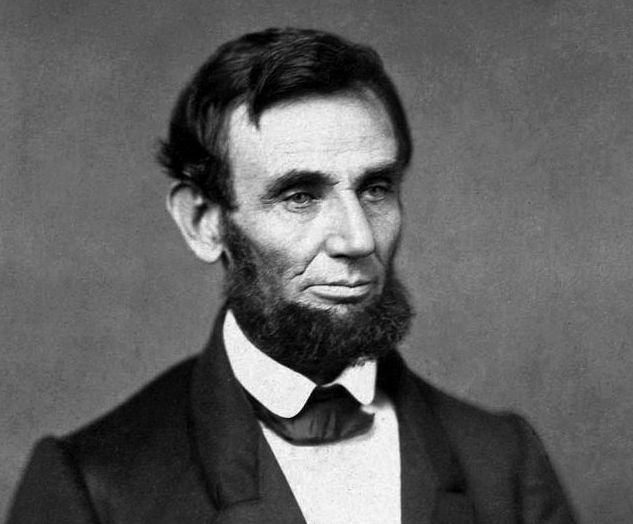
(Image: the first photograph taken of Lincoln after he was elected, 1861, via Wikimedia Commons)
Pot Polling Update

Jacob Sullum checks in on all the states with legalization on the ballot. Oregon could go either way:

know-dope-orA new Oregonian poll puts support for Measure 91, which would legalize commercial production and distribution as well as possession and use, at 44 percent, with 46 percent opposed, 7 percent undecided, and 2 percent declining to say. That two-point difference is within the poll’s margin of error, so the results suggest a dead heat. By comparison, a poll conducted earlier in October, commissioned by Oregon Public Broadcasting and the Fox station in Portland, put support at 52 percent, with 41 percent opposed and 7 percent undecided. The sample in the latter poll was somewhat younger, based on different projections of who will vote. Turnout by younger voters, who are consistently more likely to support legalization, could be crucial to the outcome.

But Jon Walker bets that legalization is still ahead:

[Oregonian pollster Stuart] Elway’s marijuana legalization poll of Washington State at this same time two years ago was off. It found Initiative 502 leading only 48 percent yes to 44 percent no, but it ended up winning 55.5 percent to 44.5 percent. By comparison, SuveryUSA’s final poll of Initiative 502 was very close to the final result.

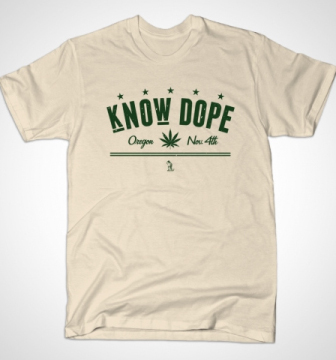
(Image: A “Know Dope” Oregon shirt available here)

The Cost Of Living In A Liberal City

Liberal Home Prices

Jed Kolko connects cities’ housing costs to the politics of their residents:

Looking across all 100 largest metros, the correlation between price-per-square-foot and 2012 vote margin was positive, high (0.63), and statistically significant. In fact, the only expensive red market was Orange County, CA, at $363 per square foot. There was a huge drop-off to the next-most-expensive red market—North Port-Bradenton-Sarasota, FL, at $150 per square foot.

Derek Thompson isn’t surprised:

There is a deep literature trying liberal residents to illiberal housing policies that create affordability crunches for the middle class. In 2010, UCLA economist Matthew Kahn published a study of California cities, which found that liberal metros issued fewer new housing permits. The correlation held over time: As California cities became more liberal, he said, they built fewer homes.

Are Publishers Even Necessary?

In the ongoing feud between the major publishing houses and Amazon, Yglesias has no sympathy for the publishers:

Wisdom on this subject begins with the observation that the book publishing industry is not a cuddly craft affair. It’s dominated by a Big Four of publishers, who are themselves subsidiaries of much larger conglomerates. Simon & Schuster is owned by CBS, HarperCollins is owned by NewsCorp, Penguin and RandomHouse are jointly owned by Pearson and Bertelsmann, and Hachette is part of an enormous French company called Lagadère.

These are not tiny, helpless enterprises. Were their owners interested in the future of books and publishing, they could invest the money necessary to make their own e-reading apps and e-book store and render Amazon entirely superfluous. But the managers of these conglomerates don’t really care. If they can get famous authors to lobby the government to stop Amazon from killing them for free, then they’re happy to take the free labor. But they don’t want to invest actual money and energy in competing with Amazon, they’d rather wring whatever remaining profit there is out of book publishing and dedicate the money to dividends or other industries they’re also involved in.

Matt goes as far as to suggest that publishers’ role as middlemen between authors and consumers has become superfluous in the digital age. Hear hear. But Evan Hughes isn’t having it:

A publisher’s list of books is in essence a risk pool, a term most often associated with health insurance. In the insurance business, the profits from the healthy people outweigh the big losses from the sick ones because the healthy outnumber the sick. In publishing, it’s the opposite, yet the underlying concept is the same. Most books lose money, but the ones that make money earn enough to cover all those novels that didn’t sell.

The publishing scenario that Yglesias is advocating is a world without health insurance. (Ironic, I know.) In a system without the publisher operating as middleman, where the author takes his life’s work and just posts it to Amazon, each book becomes a lonely outpost in the stiff winds of the marketplace, a tiny business that must sell or die. “So what?” Yglesias might say, because that’s the kind of ruthless neoliberal thinker he is. “If people didn’t buy the book, that’s just proof of its worthlessness.”

Yep, especially when the Internet allows anyone with the right voice to find an audience, however niche, to buy their book. And none of the money from those sales will get eaten up by the bloated middlemen of the publishing industry. But Guan Yang runs through some downsides of self-publishing:

A lot of work goes into publishing a book. Someone needs to edit the manuscript. The manuscript must be typeset and copy-edited. A cover has to be designed (most self-published books are terrible in this regard). The book needs to be marketed to readers, which can require producing ads and seeking out publicity. Paper books have to be printed, stored, shipped to distributors and bookstores, and sold; returns need to be managed. E-books have to be converted to various formats, ideally not just using automated tools.

Self-published authors can try to do all of these jobs themselves. Many attempt that, and it shows. Or they can outsource some or all of the tasks. When doing so, it’s best to use professionals who have tried to publish a book before. Maybe a team that’s used to working together. Perhaps the people even sit in the same building, so that they can quickly coordinate.

Congratulations: You have just re-created publishers, but without advances.

And without all the waste and inefficiency of many large publishing houses. Freelance copyeditors or cover designers can be found online for much less, and they are likely to be more receptive and flexible when it comes to the author’s needs. McArdle puzzles over another question Yglesias raises -whether the interests of authors align with those of their publishers:

If Amazon manages to kill most of the other outlets for books, it’s not clear to me that authors end up with more royalties and book sales. The distribution of royalties will certainly be different; some people who would have done well under the current system will end up losing out, while others who couldn’t get a major publisher interested in their product will end up making bank. But as a class, author interests might well be better aligned with those of four mega publishers than one mega retailer. Or might not; I haven’t seen a convincing case made either way.

Even assuming that we establish that Amazonian dominance might be bad for authors, we still have to answer another question: Why should anyone else care? Travelocity was bad for travel agents. Toyota was bad for General Motors. To which most people respond, “Gee, that’s too bad for you, isn’t it?” and happily go about their days. Why should authors be any different?

Views Differ On Meaning Of “Sexual Assault”

After conducting a voluntary survey of its student body, MIT reported this week that 17 percent of female students and 5 percent of male students had experienced sexual assault. But the university’s administration and the students surveyed seem to subscribe to different definitions of that term:

M.I.T. asked about several forms of unwanted sexual contact, from touching to penetration, “involving use of force, physical threat or incapacitation,” that it said clearly constituted sexual assault — the kind that 17 percent of undergraduate women and 5 percent of undergraduate men said they had experienced. In addition, 12 percent of women and 6 percent of men said they had experienced the same kinds of unwanted sexual contact, but without force, threat or incapacity — some of which, depending on the circumstances, can also be sexual assault. Yet when asked if they had been raped or sexually assaulted, only 11 percent of female and 2 percent of male undergraduates said yes.

There was a similar result on sexual harassment. Among undergraduate respondents, large majorities of men and women said they had heard sexist remarks and inappropriate comments about people’s bodies … But the number who described what had happened to them as sexual harassment was relatively small: 15 percent of undergraduate women, and 4 percent of men.

Their consciousness obviously needs to be raised – and pronto. “The university is clearly using a broader definition of sexual assault than its own students,” Batya Ungar-Sargon concludes:

Perhaps the discrepancy lies in the staggering 44 percent of incidents related to being incapacitated by drugs or alcohol, which some students don’t regard as assault.

It seems unlikely that students would underreport sexual assaults caused by force, or a weapon, or threats of physical harm. Eighty-three percent of respondents disagree with the statement that “An incident can only be sexual assault or rape if the person says ‘no.'” In other words, 83 percent of MIT students can distinguish between a nonverbal lack of consent, and sexual assault. If this is the case, why does the survey then disbelieve the female undergrads when only 10 percent say they have been sexually assaulted? To take the 17 percent of “unwanted” sexual behaviors and turn them into sexual assault, despite the 7 percent of female students included therein who do not believe they have been assaulted, is to remove the students’ very canny ability to distinguish the criminal from the unwanted.

After pointing out some problems with the survey’s methodology, Elizabeth Nolan Brown highlights a finding that she finds disturbing:

Contra the affirmative consent crowd, it doesn’t seem that a lack of respect or enthusiasm for obtaining sexual content is a big problem: 98 percent of females and 96 percent of males agreed or strongly agreed that it’s important to get consent before sexual activity. But students are confused about how alcohol and intoxication affect consent, which perhaps speaks to increasing progressive activism around the idea that drunk people can’t give consent. Only about three-quarters of respondents said they feel confident in their own ability to judge whether someone is too intoxicated to consent to sex. And more than half agreed that “rape and sexual assault can happen unintentionally, especially if alcohol is involved.”

I just want to repeat that one more time: Half of the MIT students surveyed think it’s possible to “accidently” rape someone. When you consider undergraduates alone, this rises to 67 percent. This is what we get when people push an idea that rape is really often a matter of consent confusion or a drunken misunderstanding and not something that one person (the rapist) intentionally does to another. This is exactly what those of us opposed to affirmative consent standards mean when we worry about it muddying the waters of consent and confusing the definition of rape.

And the beat goes on.

Decking Out The Midterms In Flannel

Mark Leibovich fixates on the “bumpkinification of the midterm elections”:

Candidates themselves don’t deserve all the blame for their bumpkinizing. Much of that rests with the blizzards of money being blown from wealthy donors and super PACs to a growing oligarchy of media consultants, who typically live on the coasts and work for multiple candidates at once. In a D.C. twist, those bumpkins we see on our screens are often not even real bumpkins so much as some rich guy’s idea of what a bumpkin should be. One telltale signal is how familiar the props are — the livestock, the guns, the motorcycles, the dogs and, of course, the flannel. An ad for Rob Maness, a Louisiana Republican running for the Senate, features a trifecta: a gun, an airboat and an alligator.

In large part, this is what we have to show for the nearly $4 billion that is expected to be spent in this campaign, the most of any midterm election in history. “When you have this much outside spending, way too much of the advertising has no soul,” acknowledged Todd Harris, a partner at Something Else Strategies, who is based in Washington, far from his clients Ernst and McFadden. The people who are creating these spots, in other words, don’t have much connection to the state they’re working in.

Stephen Mihm points out that this has a long history:

Most [of the Founding Fathers] believed the best and the brightest would and should be in charge, and they naively believed that the populace — whom they privately referred to as “the rabble” — would be more than happy to be governed by their social and intellectual betters. It didn’t work out that way. Ordinary people versed in the revolutionary rhetoric of equality didn’t appreciate the condescension, and they pushed back. The novelist Hugh Henry Brackenridge captured the origins of “bumpkinification” in “Modern Chivalry,” a comic tale published between 1792 and 1797. In one scene, an office-seeker accuses his opponent of being seen holding a book. “I am innocent of letters as the child unborn,” the accused says proudly. “I am as ignorant as an ass.”

How Waldman apportions blame:

I wouldn’t want to excuse Washington consultants, but let’s not forget that responsibility is not zero-sum. Everybody who takes part in this is to blame. There are the candidates, who serve up a ten-course meal of drivel. There are the outside groups that swoop in and try desperately to distract and confuse. There are the reporters who decide that it’s really important that they write another ten stories about somebody’s chickens or somebody else’s “gaffe.”

But in the end, ultimate responsibility lies with the voters themselves. It is within their power to say to candidates, “Look, I’m upset about Congress’ inability to solve problems too, but the fact that you put on a flannel shirt and told me a story about the wisdom of your grandpappy does nothing to convince me you’ll actually be able to solve those problems.” They could do that. But they don’t.

Margaret Carlson spotlights an example of what Leibovich is talking about – the ad above from Iowa Republican Senate candidate Joni Ernst:

She’s closing out her campaign the way she began, reminding voters that she’s just a simple farm girl, albeit one who takes a tough line with pigs. In the same plaid shirt, the same dark vest, on the same hog farm, Ernest reminds people she’s not a snooty lawyer looking down her nose at Grassley. Standing in a sty, Ernst calls it a mess.

“It’s dirty, noisy, it stinks.” But she’s not talking about where she is. “I’m talking about the one in Washington.”

In a campaign devoid of policy prescriptions, but with plenty of free-floating rage at Washington, she may be expressing what voters think. This year, it may be the most vivid metaphor that wins elections.

Jazz Shaw pushes back on Leibovich:

There are still people who actually live in farm country and maintain the values he so cheerily derides. There are people working in factories and mills – at least those few who can still find jobs – and get up every day worrying about problems which probably seem quaint, if not fictional, to those who spend their lives living in Manhattan, D.C. or Hollywood.

If Joni Ernst does pull this off and win on Tuesday, the commentariat may have learned a valuable lesson. Advertisements featuring people working on farms, castrating hogs, emptying trash cans or nailing shingles on the roofs of homes actually do work, and not because the viewers are stupid bumpkins. It’s because real people would prefer to be represented in Congress by someone who understands and can relate to their own lives.

Obamacare’s Biggest Winners

Kevin Quealey and Margot Sanger-Katz identify them. The law has most helped “people between the ages of 18 and 34; blacks; Hispanics; and people who live in rural areas”:

Each of these trends is going in the opposite direction of larger economic patterns. Young people have fared substantially worse in the job market than older people in recent years. Blacks and Hispanics have fared worse than whites and Asians. Rural areas have fallen further behind larger metropolitan areas. Women are the one modest exception. They have benefited more from Obamacare than men, and they have received larger raises in recent years. But of course women still make considerably less money than men, so an economic benefit for women still pushes against inequality in many ways.

Meanwhile, Suderman takes issue with the Democrats’ “keep it and fix it” campaign theme:

The problem for Democrats is that, despite their pledges to fix the law, they have offered little in the way of meaningful tweaks. As The Washington Examiner’s Byron York noted last week, when [Democratic Sen. Jeanne] Shaheen was asked in a debate about her ideas, she the only proposal she could name was a committee to study website problems. It was all but an admission that she had no fixes.

Somewhat more substantive is the proposal from Sens. Mark Warner (D-Va.) and Mark Begich (D-Alaska) to add a lower tier of less expensive plans to the system. The basic concept of expanding the range of available products on the exchanges is not without merit, but this version would come with problems. As Ramesh Ponnuru notes, it would create a less expensive insurance product focused on covering routine expenses—exactly the kind of insurance we should want to discourage. That low-cost option, meanwhile, would attract healthy people, and could destabilize existing coverage.

Ezra voxplains the Warner and Begich plan:

The Expanded Consumer Choice Act is a brief bill — less than 2,000 words in all. What it does is open Obamacare’s exchanges to a new kind of insurance product: a “copper plan,” that is both skimpier, and more affordable, than the plans being offered today. Obamacare names its insurance tiers after metals: there are the platinum plans, which cover 90 percent of an enrollee’s expected health costs; the gold plans, which cover 80 percent; the silver plans, which cover 70 percent; and the bronze plans, which cover — you guessed it — 60 percent.

Copper plans cover 50 percent of expected health costs (or, as the health wonks put it, they have an “actuarial value” of 50 percent). That means premiums are cheaper than the platinum, gold, bronze or silver plans — the consulting group Avalere Health estimates that copper plan premiums would be 18 percent lower than bronze plan premiums. But if you get sick, the deductibles and co-pays are much higher. Larry Levitt, a vice president at the Kaiser Family Foundation, says that the deductibles would have to be in the range of $9,000 — which would make them higher than the $6,350 out-of-pocket maximum that the law currently allows.

Catching Catcalls On Camera

This video is making the rounds:

The backstory:

In August 2014, Rob Bliss of Rob Bliss Creative reached out to Hollaback! to partner on a PSA highlighting the impact of street harassment. He was inspired by his girlfriend — who gets street harassed all the time — and Shoshana B. Roberts volunteered to be the subject of his PSA. For 10 hours, Rob walked in front of Shoshana with a camera in his backpack, while Shoshana walked silently with two mics in her hands.

Megan Garber admits “there are approximately 5,000 caveats here”:

Among them: This is an ad (for the Hollaback campaign). It is produced by a “viral advertising” agency. It is not science. It is unclear whether it is even pseudo-science. Could the whole thing have been staged? Yes. Could it have been selectively edited? Certainly.

Still. There’s a reason that the video is currently going viral on YouTube—the way similar videos have gone viral on YouTube—which is that, sourcing questions aside, the experience it records will resonate with pretty much any woman who has ever walked down a street. (Or, for that matter, who has been online.) What is it like to be a woman? Sometimes, sadly, it’s uncannily like this.

Amanda Hess gauged some reactions from guys watching the video:

“I knew this stuff happened—I see and hear it every once in a while—but the frequency of the remarks was astounding,” one colleague told me. “As a (fairly obvious) gay guy, I like to think I know something about being surveilled and self-aware in public, but this style of direct confrontation is pretty rare,” another said. The video is a “great reminder of how even the most ‘innocuous’-seeming comments pile up over the course of an hour, day, and life to feel oppressive and awful,” added a third.

Emily Badger looks though a “a 302-page guide to state laws that may be applied to street harassers”:

New York’s disorderly conduct law bars obscene language or gestures in a public place. Its harassment law bars someone from making alarming or seriously annoying comments to you at least twice (both violations: a $250 fine and/or up to 15 days in jail). Meanwhile, in Arkansas, Arizona, Colorado, Georgia, Kentucky, Minnesota, and Pennsylvania, it’s illegal to follow people (as happens to the woman in the video twice). In the District of Columbia, it’s illegal to engage in abusive language or conduct that disturbs a person’s path through public space.

Though she strongly disapproves of street harassment, Lizzie Crocker rejects criminalizing it:

According to Hollaback’s mission statement, the group is interested in modifying the law to punish offenders (and raising significant First Amendment concerns). Because comments such as those documented in their latest video, they explain, are the “most pervasive forms of gender-based violence and one of the least legislated against.” The group hopes to “inspire legislators, the police, and other authorities to take this issue seriously—to approach it with sensitivity, and to create policies that make everyone feel safe” because catcalling is a “gateway crime” that ultimately “makes gender-based violence OK.”

Hollaback is right to shine a light on these creepy comments from creepy strangers. We should be offended. Such behavior should be considered socially unacceptable. But let’s not get the law involved. Because while calling a passerby “sexy” may be uncouth, it shouldn’t be illegal.