Extending Life By Accepting Death

The Economist reviews Atul Gawande’s forthcoming book on end-of-life care. A fascinating detail:

Many people fear that a doctor who does not try everything possible has abandoned his patients, and they will die earlier as a result. Surprisingly, however, the try-everything approach appears not even to offer a longer life. Multiple studies have shown that patients entering hospice care, which usually means abandoning attempts at a cure, live at least as long as those receiving traditional care. A startling study in 2010 found that patients with advanced lung cancer who saw a specialist in palliative care as well as receiving the usual oncological treatment stopped chemotherapy sooner, entered a hospice earlier, suffered less—and lived 25% longer than comparable patients who received only the standard care. “If end-of-life discussions were an experimental drug, the FDA [an American regulatory body] would approve it,” says Dr Gawande. In life, as in all stories, he writes, “endings matter”.

The Dish recently tackled related issues.

Did Vice “Support” Terrorism?

Andrew March suggests that the gutsy journalist Medyan Dairieh, who embedded with ISIS militants in Syria to get an inside look at the group’s operations and produced this stunning documentary (trailer above), may have violated the law against providing material support to terrorists, given how nebulously that support is defined:

In the test case that came before the Supreme Court in 2010, Holder v. Humanitarian Law Project, the Court held that it was constitutional to prohibit a group of humanitarian legal professionals (including a retired U.S. judge) “from engaging in certain specified activities, including training PKK members to use international law to resolve disputes peacefully; teaching PKK members to petition the United Nations and other representative bodies for relief; and engaging in political advocacy on behalf of Kurds living in Turkey and Tamils living in Sri Lanka.” The Court rejected the claim that the statute “should be interpreted to require proof that a defendant intended to further a foreign terrorist organization’s illegal activities.” Instead it affirmed that the statute prohibits “‘knowingly’ providing material support” and that Congress was within its rights to choose “knowledge about the organization’s connection to terrorism, not specific intent to further its terrorist activities, as the necessary mental state for a violation.” In short, according to the Court: expert advice + coordination with a terrorist group = federal crime.

That decision means, for example, that Jimmy Carter and his Carter Center could be in violation of federal law for giving peacemaking advice to groups on the State Department’s FTO list. Any private individual who coordinates with a group on that list, or a group that the individual ought to know engages in terrorism, with the purposes of providing it advice or assistance—even on how to pursue an end to its campaign of violence—is guilty of a crime by the logic of the Roberts Court.

Giving Up Flying For Good

Eric Holthaus did so about a year ago:

Over the past year, I’ve had to make a few small sacrifices, sure. (My 28-hour bus ride from Wisconsin to Atlanta wasn’t the most relaxing travel experience I’ve ever taken. I’d have much preferred one of these.) But an amazing thing has also happened since I’ve embraced slow travel: My world has shrunk and become richer. (It’s also easier to escape those awkward family reunions.)

My wife and I canceled a frequent-flier trip we had planned to Hawaii and instead spent a weekend at the otherworldly ice caves on Lake Superior in northern Wisconsin. I sent our Civic into a 360-degree spin on an ice road to Madeline Island in a moment of pure joy. It was the coldest I had ever been. What initially felt like one of the biggest sacrifices of our decision to stop flying (enjoying the polar vortex instead of Hawaii in February) turned into a moment I’ll never forget.

A Weak Recovery For Wages

three month moving average

Bill McBride analyzes today’s jobs report:

This was a solid report with 248,000 jobs added and combined upward revisions to July and August of 69,000. As always we shouldn’t read too much into one month of data, but at the current pace (through September), the economy will add 2.72 million jobs this year (2.64 million private sector jobs). Right now 2014 is on pace to be the best year for both total and private sector job growth since 1999.

Vinik recommends looking at the three month moving average (above), which shows that “the economy certainly has strengthened over the past six months and is in better shape.” But he also spotlights the “one glaring sign that there is still slack in the labor market: wages are stagnant”:

In September, wages grew 0.0 percent, below expectations of 0.2 percent. Over the past year, wages have grown just 2.0 percent, barely keeping up with inflation. Wages will rise when employers have to compete for scarce labori.e. when the economy is at or near full employment. That clearly isn’t the case right now, meaning the 5.9 percent unemployment rate doesn’t represent the current state of the labor market. If the Fed were to raise interest rates, it would choke off the recovery and prevent any wage growth.

Annie Lowrey finds that “Jobs Day has become less and less of a tentpole event in the economic data calendar”:

In part, that is because the story of the recovery has become static: It just keeps chugging along at the same decent-enough pace. It is also because the unemployment rate — the headline number in the jobs report — has started telling us less and less about the state of the economy.

She adds that a “broader set of indicators generally gives a dimmer view of the economy — and that remains true this month, good headline number aside”:

So applaud this jobs report. It’s a legitimately good one. But do not let it change your view of the economy too much. Growth might be accelerating, but the underlying story of the recovery is not changing. For tens of millions of families, that unemployment rate is nothing but a number.

Jared Bernstein focuses on the participation rate:

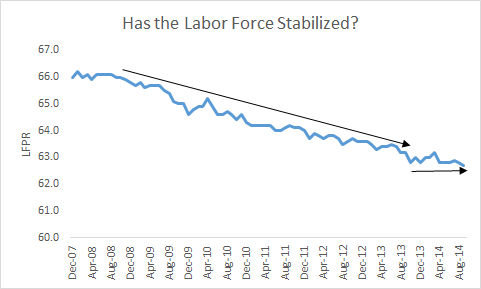
The labor force participation rate (LFPR)—the share of the 16 and up population either working or looking for work—is a key variable to watch these days. It ticked down slight last month, as noted, but as shown in the chart, has generally stabilized over the past year. This has two important implications.

labor force stable

Source: BLS

First, it suggests a strengthening job market as part of the decline in the LFPR over the recession and weak recovery was due to discouraged job seekers giving up hope. Second, as noted above, it means that recent declines in the jobless rate are due to more people getting jobs versus giving up the search.

Ben Leubsdorf plucks out other key numbers from today’s report. One that shouldn’t be overlooked:

The number of workers who have been unemployed for more than six months has declined over the last year by 1.2 million. But 3 million strong in September, they still made up 31.9% of all unemployed Americans.

And Kilgore asks, “will it matter politically?”

It’s unlikely. As Dave Weigel points out, at this point in 2006, just prior to a Democratic midterm landslide, the unemployment rate was under 5% and net job growth was steady if not spectacular.

Truth Be Told

Virginia Hughes looks at the methods for detecting lies:

[T]here’s a huge problem with the polygraph: it’s all-too-frequently wrong. Truth-tellers may show a strong physiological response to being questioned if they’re nervous or fearful, which they often are — particularly if the target of a hostile interrogation. … Because of these considerable flaws, polygraph evidence is almost never allowed in court. But it’s still used routinely by federal law enforcement agencies, not only for screening accused criminals but potential new employees.

It turns out there’s a much more accurate way to root out deception: a 55-year-old method called the ‘concealed information test’. The CIT doesn’t try to compare biological responses to truth versus lies. Instead, it shows whether a person simply recognizes information that only the culprit (or the police) could know.

She considers why the CIT, employed frequently in Japan, hasn’t caught on in the US:

One reason, according to [John] Meixner, is that the CIT only works if it’s given at the very beginning of an interrogation. Otherwise, through the process of questioning, the suspect may gain knowledge about the crime that he or she didn’t have before. Investigators are “not especially keen on that.”

The CIT is also a bit less versatile than the traditional polygraph, because investigators have to know some hard facts about the crime before testing the suspect. In a real-world terrorism plot, for example, investigators wouldn’t necessarily know what city or month or weapon to ask about.

But the biggest reason we don’t use the CIT, according to Meixner and Rosenfeld, is probably cultural. As they wrote in a review paper last year: “The members of the practicing polygraph community simply do not like giving up [that] which they are used to.”

Our Pharmacist Glut

Katie Zavadski covers it:

The pharmacy boom began in 2000. That year, a report from the Department of Health and Human Services suggested that 98 percent of Americans lived in an area adversely affected by a pharmacist shortage. Almost 6,000 pharmacist jobs stood empty, and the shortage was only predicted to grow worse. The following year, a group now known as the Pharmacy Workforce Center predicted a shortfall of 157,000 pharmacists nationally within two decades as demand and responsibilities increased while the number of pharmacists stood still. As Baby Boomers aged, the thought went, pharmacists would be able to fill some roles traditionally held by doctors, and would be able to counsel them on how to take the medications prescribed to them.

Quickly, the free market kicked in.

Over the last 20-odd years, the number of pharmacy schools in the United States has almost doubled. There were just 72 such schools in 1987; today, there are more than 130.

At first, graduates found work easily. No matter where in the country a young pharmacist wanted to settle, the number of jobs available far exceeded the number of people qualified to fill them. Slowly, the numbers began to even out, and 2009 marked a turning point: The number of jobs available was roughly on par with the number of pharmacists searching for work. The days of signing bonuses and vast job choices were over.

How this compares to the quickly deflating law school bubble:

What makes the situation in pharmacy slightly more sinister than a comparable crisis in law is that students commit to many of these six-year programs straight out of high school. (About half of graduating pharmacists each year are aged 25 or under.) Not only do they have little understanding of what such a debt load may mean for them, but they also tend to rely more heavily on the suggestions of parents and friends. And, even if they made the decision to pursue pharmacy through their own research, the rapid growth in the number of pharmacists means many are gambling on a job market six years into the future. Further, while a law degree can be useful in a wide range of professions, including business and consulting, pharmacy degrees have relatively narrow purposes: PharmDs are equipped to oversee the dispensation of medication and counsel patients on how to take it and its effects.

The Dissident We Didn’t Understand

800px-Aleksandr_Solzhenitsyn_1974b

Reviewing Daniel J. Mahoney’s The Other Solzhenitsyn: Telling the Truth about a Misunderstood Writer and Thinker, Lee Congdon appreciates the effort to push back against the famed Soviet dissident’s most vehement Western detractors – but isn’t quite convinced when Mahoney “insists that Solzhenitsyn was a proponent of democracy”:

[Solzhenitsyn] was skeptical of democracy at the higher reaches of power. One need not, he recognized, hold a degree in political science in order to arrive at informed judgments about local matters, but only those qualified by education and experience were competent to guide policy, domestic and foreign, at the national level. It is true, as Mahoney points out, that Solzhenitsyn was more or less resigned to some form of democratic order in post-communist Russia, but like Tocqueville he was far from welcoming it. In Rebuilding Russia, written a year before the collapse of the Soviet Union, Solzhenitsyn observed that “Tocqueville viewed the concepts of democracy and liberty as polar opposites. He was an ardent proponent of liberty but not at all of democracy.”

One of the reasons for Mahoney’s insistence upon his subject’s commitment to democracy is his fear that the Russian might be classed as an authoritarian. In his Letter to the Soviet Leaders, Solzhenitsyn had, after all, written that “it is not authoritarianism itself that is intolerable, but the ideological lies that are daily foisted upon us.” Mahoney insists, however, that “Solzhenitsyn nowhere endorsed authoritarianism as choice-worthy in itself.”

Praising Mahoney’s book, Carl Scott advises those unfamiliar with Solzhenitsyn’s work where to start:

Had I to start over again, I’m not sure the order I’d go in, but certainly the GULAG Archipelago first, in the abridged edition, perhaps some of the key essays and speeches next, available in the Solzhenitysn Reader, edited by Ericson and Mahoney, and then onto either In the First Circle, or the first two first “knots” of the super-novel The Red Wheel, namely, the just reissued–in the superior/complete Willetts translations–August 1914 and November 1916.  The third of these is one of my very favorite novels, despite the criticism it gets for providing too much history and political commentary alongside its main sections.  For In the First Circle and August 1914, make sure you get the newer versions.  And somewhere in there, you need to delve into a number of the short stories and poems.

For more, you can listen to an absorbing podcast Mahoney did about the book here.

(Image: Solzhenitsyn in Cologne, West Germany, in 1974, via Wikimedia Commons)

Is Marriage Equality Losing Support?

Last week, Pew’s polling suggested so. Rover Jones and Daniel Cox don’t buy it:

Even in the few polls that do show a dip in support for same-sex marriage, there is no corresponding bump in opposition. In the 2014 surveys that show a dip in support for same-sex marriage, including the Pew survey and the two PRRI surveys, the dip is not mirrored by an equivalent increase in opposition, but there is a rise in non-response. The Pew survey, for example, showed a five-point drop in support between February 2014 and September 2014, but only a two-point increase in opposition of same-sex marriage. The portion of respondents who offered no opinion, however, increased by three percentage points to 10 percent. …

We don’t have to wait for new polling to say that the few polls showing a dip in support for same-sex marriage are outliers in a larger trend. The incoming tide of support for same-sex marriage may ebb and flow, but it is unlikely to recede as the youngest generation replaces the eldest and as American attitudes across the board continue to shift.

The Best Of The Dish Today

At a speech the other night, I was asked a direct question: “Are you an isolationist?” I’ve never been asked that question before and I found myself wanting to say yes, just to stir shit up. But in a moment of restraint, I did say yes in the current case, but not always. I’m against isolationism if there is something we can do that actually works. But no amount of moral outrage at outright evil makes any sense if there’s nothing we can really do to stop it. Or indeed if our intervention will actually make things worse. As it has in Iraq and Afghanistan.

Readers have asked me what I would do if I were president in this case. My answer is nothing. I would tell the country that this is a consequence of the Iraq War, and that if we could not really quell a Sunni insurgency with a hundred thousands troops on the ground for nearly a decade, then air-strikes are not going to do a thing now. I’d insist that the neighboring Sunni states will have to deal with this themselves – or allow Iran to handle it. If a regional Sunni-Shi’a war is the result, we can always hope that both sides will lose. Invading Iraq was not Obama’s responsibility; his responsibility was to get us out and to stay out. Once Syria’s WMDs had been taken out of the country, it would be a regional conflagration – like the Syrian civil war that has already cost 200,000 lives, or the Iran-Iraq War of the 1980s.

Yes, we should tighten our defenses; yes, we should deal firmly with any Americans who are going to fight there; yes, we should perhaps intervene from a distance if one side seemed to be gaining the upper hand too much. (Our real interest is in bolstering the one stable power in the region, which is Iran.) But basically: leave these insane, foul, sectarian conflagrations to those who fight them. Above all, do not make this a war between Islam and the West. Let it be what it is: a war of Islam against itself.

The alternative was outlined by George W Bush today. His view is that we should be patient and baby-sit “Iraqi” “democracy” for an indefinite period of time with residual troops. We are now doing that in Afghanistan. The alternative, in other words, is an endless pseudo-empire in failed states to achieve “democracy” where such a thing makes absolutely no sense at all. It’s a form of welfare with no cut-off, creating hatred for the US and thereby anti-Western terror for the foreseeable future and beyond.

We elected Obama precisely to be calm and sane enough to be able to resist what he has now done. He betrayed us. His policy, such as it is, is utterly incoherent and as free from any sane fiscal footing as his predecessor’s. He has launched a war against an entity that even the CIA says poses no threat to the US. And his party will be eviscerated in the coming November elections as a result. If you voted twice for Obama to end these unwinnable, bankrupting, open-ended wars, why on earth would you vote Democrat to enable another one? Yes, the polls show support for the new war right now. But just watch. The easy part is over. The civilian casualties will mount, ISIS and al Qaeda are uniting again, the narrative of Islam against the West is back in the foreground, the completely farcical idea of arming “moderate Syrians” will go nowhere, and the terror risk at home will escalate. There will be no victories. Except for the Republicans.

Today, I took note of how Fox News is seizing on the politics of fear that Obama has now legitimized; we reviewed Marilynne Robinson’s latest installment in her stunning Gilead trilogy; we noted how Hobby Lobby is beginning to prove Ruth Bader Ginsburg right; and noted how our only real allies in Syria now hate us. Plus: more on spanking. And a cat that loves being vacuumed.

Many of today’s posts were updated with your emails – read them all here.  You can always leave your unfiltered comments at our Facebook page and @sullydish. Another reader quotes me regarding what’s quickly becoming our email of the month – a first-person account of child abuse:

“What has long struck me about this almost unique aspect of the Dish is not just the fact that readers feel safe to write us, knowing that their identities will be absolutely confidential, but that the quality of the writing is so high.” I have no doubt that your readership is smarter than the average publication’s (and we’re all damned good-looking, too). But my hunch is that your decision not to have an open comments section also drives up the quality of the emails you get. Every smart email you publish sets the bar that much higher for the rest of us. We know there’s no point in emailing you something half-assed, so we write, rewrite, edit, and re-edit our emails.

And then we throw in a line praising (or trashing) the Pet Shop Boys before we hit send.

What have I, what have I, what have I done to deserve this?

If you appreciate the kind of reader-based journalism we do at the Dish, consider subscribing here to get access to all the rich email content – not to mention all the ReadOns and Deep Dish – for a little as $1.99 month. Gift subscriptions are available here if you want to share the Dish with someone or simply want to further fund our endeavor as an existing subscriber. And please drop us an email if you end up doing so; we always love hearing from new and existing subscribers.

See you in the morning.