America’s Newest War Spreads To Syria

US launches air strikes against Isil in Syria

The Guardian is live-blogging the US airstrikes against ISIS in Syria. Juan Cole expects them to do little good:

The some 22 sorties flown on Monday will have killed some ISIL terrorists, blown up some weapons warehouses, and destroyed some checkpoints. But ISIL are guerrillas, and they will just fade away into Raqqah’s back alleys. The US belief in air power is touching, but in fact no conflict has ever been quickly brought to an end where US planes have been involved.

Mark Thompson agrees the airstrikes will have limited impact:

The new attacks, against fixed ISIS targets, undoubtedly did significant damage. But they also will force ISIS fighters to hunker down, now that their sanctuary inside Syria has been breached. This means that the jihadists, who have shown little regard for civilians, will move in among them in the relatively few towns and villages in eastern Syria, betting that the U.S. and its allies will not attack them there and risk killing innocents.

That could lead to a stalemate. While air strikes are likely to keep ISIS from massing its forces, and traveling in easy-to-spot convoys, air power can do little to stop small groups of fighters from billeting with and intimidating the local population.

Jeffrey Goldberg admits that “there exists no strategy for victory, and no definition of victory”:

The advantage of launching strikes against ISIS positions early in this fight is that its commanders now have to spend extraordinary amounts of time, energy and resources merely digging in, and protecting their human and materiel assets, rather than pushing on, toward Baghdad, Jordan and Saudi Arabia. A terrorist preoccupied with his own survival has less bandwidth to threaten yours. But these strikes will not bring about the end of ISIS. Like other terror groups, it can “win” this current round of fighting by surviving, and maximizing civilian casualties on its own side.

The relatively easy task for airpower—of blunting ISIS’s lightning offensives against Iraqi cities—may already be accomplished. ISIS has not captured major population centers in Iraq since the beginning of the air campaign and in some areas, such as Haditha and the Baghdad suburbs, it is contributing to modest counteroffensive gains. Tactically, ISIS’s efforts to offensively employ heavy weapons, mass forces on technicals, and stage large amounts of its infrastructure in the open are highly vulnerable to airstrikes. However, it is important to remember that even in Iraq, where the United States has multiple partners and embedded advisers, these airstrikes have yet to precipitate major counteroffensive gains by Iraqi security forces. ISIS has repelled two major counteroffensives in Tikrit using a variety of guerrilla tactics, suggesting that it remains formidable defensively, a strength airpower has rather more difficulty countering.

ISIS’s tactics and structure suggest that rather than hitting only massed ISIS forces in Iraq and its fixed infrastructure across both Iraq and Syria, an offensive campaign should target its battlefield leadership and the elements of the organization necessary for sustaining and coordinating its operations across the region.

But Julien Barnes-Dacey doubts we can defeat ISIS:

The respective positioning of non-IS rebels and Assad highlights an inconvenient truth: as long as Syria’s civil war rages, international attempts to defeat Islamic State militarily will be significantly hampered, particularly if regional allies are also pulling in different directions. While tactical lines may shift as a result of air strikes, they are unlikely to provoke significant strategic realignments. Given their likely inconclusive nature, they risk drawing the West into deeper intervention. While Obama has clearly stated that US intervention in Syria will remain limited, those calling for wider action may see the proposed initial strikes and arming of rebels as the thin edge of the wedge, with further escalation inevitable.

Significantly, narrow air strikes that inflict collateral damage and leave the regime unscathed also risk further empowering Isis, consolidating its self-declared position as the only legitimate defender of Syria’s Sunni population. Isis’s apparent goading of the US to intervene in Syria and Iraq through the public beheading of a number of hostages may appear misguided given the power that the American military can bring to bear. But blunt military intervention may help entrench local support behind the group.

Larison sighs:

Loose talk of “destroying” ISIS practically demanded expanding the war into Syria. Obama stated he would not hesitate to do this. However, there is even less reason to think that U.S. air power will have the desired effect there than it will have in Iraq. It will not be lost on Sunnis in Syria and Iraq (and elsewhere) that the U.S. didn’t intervene directly in the Syrian civil war until it came time to attack a group opposed to their sectarian enemies. Even if the U.S. is not actively cooperating with the Syrian regime in all of this, it will be perceived as siding with it in the current conflict, and that will be to the detriment of American security now and in the future. For the second time this century, the U.S. is fighting a war that will benefit Iran and its regional allies and proxies, and it is doing so in a way that seems sure to trap the U.S. into open-ended fighting for many years to come.

Greenwald piles on:

Six weeks of bombing hasn’t budged ISIS in Iraq, but it has caused ISIS recruitment to soar. That’s all predictable: the U.S. has known for years that what fuels and strengthens anti-American sentiment (and thus anti-American extremism) is exactly what they keep doing: aggression in that region. If you know that, then they know that. At this point, it’s more rational to say they do all of this not despite triggering those outcomes, butbecause of it. Continuously creating and strengthening enemies is a feature, not a bug, as it is what then justifies the ongoing greasing of the profitable and power-vesting machine of Endless War.

And Hayes Brown wonders what comes next:

So far, Washington is mum on just how long the United States plans to keep up the strikes in Syria, though reports indicate that they will not continue at the tempo seen last night. U.S. Central Command has said only that “the U.S. military will continue to conduct targeted airstrikes against ISIL in Syria and Iraq as local forces go on the offensive against this terrorist group.” As for the people living in the areas that are now the target of these airstrikes, residents are reportedly fleeing Raqqa as quickly as possible. “There is an exodus out of Raqqa as we speak,” one resident told Reuters. “It started in the early hours of the day after the strikes. People are fleeing towards the countryside.” As the civil war in Syria has already caused over half of its population to flee their homes, it can only be assumed that the new campaign against ISIS will only exacerbate the refugee crisis the region has struggled to contain.

(Photo: Syrian children stand on the ruins of a destroyed building during a search and rescue operation among the ruins of it, in a region of Idlib, a northwestern city of Syria, on September 23, 2014. The US launched air strikes against ISIS in Idlib. By AA Video/Anadolu Agency/Getty Images)
Slippery Borders

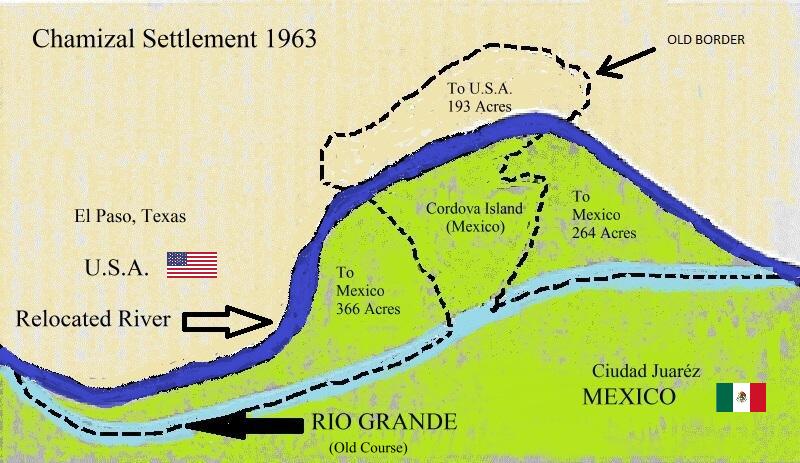
Chazimal_dispute_map_01

In a fascinating history of the Chamizal dispute, Paul Kramer considers what happens when nature refuses to respect national boundaries:

The whole point of setting the border between Mexico and the United States at the deepest channel of the Rio Grande was that the river was not supposed to move.

That was the thinking in 1848, when, following Mexico’s defeat by the United States and surrender of its vast northern lands, boundary surveyors from the two countries were tasked with reinventing the border. The choice of the river for the boundary’s eastern half had been obvious: its use as a territorial marker stretched back into the region’s Spanish colonial past, and it was hard to miss and often difficult to cross. But even as he filed his report on the completed boundary survey, in 1856, Major William Emory cautioned that the river might be an unreliable partner in border making. “The bed of the river sometimes changes,” he wrote, “and transfers considerable portions of land from one side to the other.”

Catastrophic floods in 1860 and 1864 demonstrated how fickle the river could be. The torrents were especially devastating where the river snaked between El Paso and Ciudad Juárez; here the south-moving current veered southeast and slammed into the southern bank, carving out new channels. … By the dawn of the twentieth century, the river’s recurring spring floods had dug a completely new bed for it farther south. About seven hundred acres of land that had once formed part of Mexico – the Chamizal, named for a scrubby plant that grew there – were now connected to the United States. Whether the border had shifted with the river, rounding out the war’s annexationist work, nobody knew.

He concludes:

It was unsurprising that boundary surveyors in the mid-19th century had turned to rivers, in awe and envy, to deliver their borders: the waters were more powerful than the governments that recruited them, and the demands placed on boundaries were light. Over time, the balance of power between states and nature shifted; by the mid-twentieth century, rivers that did not comply with states could be remade in their image.

Is Divesting A Distraction?

Universities are under pressure to divest from fossil fuels. Yglesias spells out the main reason to support this goal:

Fossil fuel companies need to hire staff, they need to lobby politicians, and they need to contract with other companies for services. A world in which it was universally accepted in polite society that fossil fuel companies are problematic and respectable people should avoid dealing with them would be a very different world from the one we live in. Fossil fuel firms would find it challenging to recruit talented staff in a cost-effective way, and would have trouble securing favorable tax and regulatory treatment from the government. This is a real risk, and it’s why no company or sector likes to see high-profile divestment campaigns lobbed against it.

The most famous divestment campaign, waged against the government of apartheid South Africa, is a case in point. It is unlikely that divestment as such had an important impact on South Africa’s corporate sector or financial markets. But it was part and parcel of a larger ongoing campaign that left South Africa socially and economically isolated from the world. That overall isolation did have an impact, and divestment was an important part of that isolation insofar as it gave campaigners concrete asks that were smaller in scale than whole national-level sanctions.

But McArdle dismisses the divestment movement:

In my opinion, activists have selected this issue not because it is useful, but because it is feasible. Unfortunately, it is feasible precisely because it will make no difference in anyone’s consumption of fossil fuel. If it were going to actually be personally costly to members of the community, it would suddenly become very difficult indeed.

Daniel Gross agrees that divestment won’t do much good. What he recommends instead:

Though it resisted divestment, the University of California is pursuing this more difficult path with energy. It’s a giant system, with 10 campuses and five medical centers, 233,000 students, about 190,000 employees, and thousands of buildings. Powering these facilities and people takes about 250 megawatts of electricity generating capacity, roughly that of a “medium size city,” as the university notes.

Right now, the system’s electricity supply is largely free of coal, if not fossil fuels. It gets about 73 percent of its power supply from natural gas sources. But the University of California is seeking to slash its emissions to 1990 levels and wants to become “carbon neutral” by 2025, which, it says, would it make it the first research university to do so. (Here’s the plan.) That’s an ambitious goal—one that the town of Palo Alto has already achieved. And like Palo Alto, which owns a big chunk of a hydroelectric plant, the University of California is becoming more directly involved with energy markets.

Bill McKibben defended divestment last month.

Where Golf Is Driven Out Of Range

In a review of The Forbidden Game: Golf and the Chinese Dream, Maura Elizabeth Cunningham describes the peculiar role of the sport in Chinese society:

[A]s Dan Washburn writes in his compelling new book … golf “offers a unique window into today’s China,” a country of paradoxes perhaps best exemplified by the fact that although construction of dish_kunminggolfnew golf courses has been banned in China since at least 2004, more than 400 were built between 2005 and 2010, making China the only place in the world experiencing a golf boom. Government officials who enjoy hitting the links register at golf courses under false names, afraid of leaving a paper trail connecting them to a game most often associated with capitalism and corruption. And while massive golf course complexes lined with luxury villas populate large tracts of land outside Chinese cities, their owners attempt to hide the courses in plain sight, giving them convoluted names like the “Anji China Ecotourism and Fitness Center.”

Like so much else in contemporary China, golf occupies a gray zone: officially forbidden, yet tolerated — even encouraged — behind the scenes, as local government officials and land developers reap massive profits from the construction of new courses.

Update from a reader:

Perhaps I can contribute a small illustration of the absurdity of golf in China.

My wife and I have lived in China for nearly a year and recently returned from a vacation in Yunnan (very near the course pictured in the thread). One of our stops was Jade Dragon Snow Mountain, which offered wonderful, but in our case, clouded vista at ~4,600m. Coming back down in the cable car and emerging from the fog, we were presented with the last thing we expected at the altitude and surroundings: 18 holes of vibrant green. At 3,100+ meters altitude, Jade Dragon Snow Mountain Golf Club is the longest in the world at 8,500+ yards (par 72). It even boasts villas, but I can’t imagine they would have much conventional luxury at such a remote location.

IMG_20140907_135857_137

(Photo of a golf course in Kunming by Philippe Semanaz)

Confusion Contagion

Jessica Love reviews a study that suggests “we can experience bewilderment on behalf of others”:

Psychologists at the University of York plunked students in front of a computer and presented them with pairs of sentences. The first was always presented aurally, with the students wearing headphones; the second appeared silently as text on the monitor. Crucially, some of the participants were seated next to someone without headphones—someone, that is, who could read the second sentence, but couldn’t listen to the first one.

For some sentence pairs, the second sentence was easy to comprehend on its own: one doesn’t need to hear The fishmonger prepared the fish to make sense of The fish had gills. But in other pairs, the first sentence provided some crucial context: without first hearing In the boy’s dream, he could breath under water, it was tough to interpret The boy had gills.

Yet even the students who’d heard the first sentence experienced an N400 (a pattern of neural activity associated with processing difficulty) in response to the second sentence—but only if seated beside someone without headphones. They knew their neighbors were probably confused, and registered that confusion vicariously. In fact, the N400 pattern was just as strong for students sitting next to people who hadn’t heard the contextualizing sentence as it was when these students themselves read a sentence like The boy had gills without context.

The Best Of The Dish Today

But first, get psyched for Wednesday:

I went to grad school and shared some classes with Zeke Emanuel, who just wrote a great piece for The Atlantic on why he doesn’t want to live much past the age of 75. Money quote:

By the time I reach 75, I will have lived a complete life. I will have loved and been loved. My children will be grown and in the midst of their own rich lives. I will have seen my grandchildren born and beginning their lives. I will have pursued my life’s projects and made whatever contributions, important or not, I am going to make. And hopefully, I will not have too many mental and physical limitations.

Dying at 75 will not be a tragedy. Indeed, I plan to have my memorial service before I die. And I don’t want any crying or wailing, but a warm gathering filled with fun reminiscences, stories of my awkwardness, and celebrations of a good life. After I die, my survivors can have their own memorial service if they want—that is not my business.

I also happened to catch this little piece on Leonard Cohen’s decision to take up smoking again now that he is 80 years old:

At any age, taking up smoking is not sensible. Both the smoker and those who breathe his secondhand smoke can suffer not only long-term but acute health problems, including infections and asthma. And yet, Mr. Cohen’s plan presents a provocative question: When should we set aside a life lived for the future and, instead, embrace the pleasures of the present?

It’s a vital question this one – and not because of the extraordinary costs of maximal healthcare at the end of many of our lives. It’s vital because it challenges our Western denial of death, our cult of life-extension, our refusal to fully absorb the fact that we are finite, mortal, obsolescent. I was horribly lucky to be forced to confront this at a very early age – 29 to be exact. The prognosis back in 1993 was not great for HIV infection, and I watched a close friend die at the age of 31. Is my life somehow worth more than his, I wondered, simply because I’m going to be here longer? Some called this survivor’s guilt. I thought it was merely addressing a core existential question.

One day, a simple thought occurred to me and a huge amount of stress and worry and anxiety lifted. It occurred to me to see life the way we see college. No one gets extra points for staying in college for longer than four years. We understand that it’s finite; and our response is to value the content of that experience rather than its length. I vowed that that was how I was going to treat life from now on. And, although, of course, those feelings waned as my prospects brightened, I haven’t ever fully let go of it.

It lies behind many of the things I did with my life since then – the apparently quixotic fight for marriage equality (the kind of nutty thing you throw yourself into if you only have a few years left); even more quixotic attempts to re-describe conservatism; the crazy idea that I could write directly for readers with no middle man; the equally risky prospect of making an independent business out of a very idiosyncratic blog. I think knowing I was living past my expiration date helped me live more fully and less fearfully. And it makes the idea of trying to live into one’s eighties as a goal a little beside the point.

There’s wisdom in Zeke’s outlook; and, of course, wit in Cohen’s. I think of Hitch. Maybe he could have lived a different, more upright life – which would have been much longer. But would he still have been Hitch? And isn’t it better to have one real Hitch for a short time than a less authentic version that lived into his dotage?

I know this much: I just want to be alive when I die.

Many of today’s posts were updated with your emails – read them all here.  You can always leave your unfiltered comments at our Facebook page and @sullydish. 18 more readers became subscribers today. You can join them here – and get access to all the readons and Deep Dish – for a little as $1.99 month. Gift subs available here. Dish t-shirts and polos are for sale here if you still haven’t gotten one yet. Meanwhile, a subscriber comments on a recent double-round of dissents over my criticism of Obama:

This line right here is why I subscribe: “and it’s made me think hard about it again.” More than any other site, the blog forces me to rethink my own opinions and beliefs which I really appreciate and am more than happy to pay for.

We are incredibly grateful for the support, on behalf of the whole Dish team – Alice, Chas, Chris, Jessie, Jonah, Matt, Patrick, Phoebe, and Tracy. Putting this blog together every day really is a team effort – you included – and we do our best to manage the business side as well, through its ups and downs.

See you in the morning.

“A Clown Made Of Mummified Foreskin And Cotton Candy”

An epic takedown of Trump and, more importantly, the Miss America scholarship sham:

John Oliver and his team are really kicking ass with this new show. Previous Dish on Last Week Tonight segments here, here and here. He’s proof that ad-free long-form journalism can work, and be highly engaging and entertaining, if supported long and steadily enough.

Is Diet Soda Making Us Fat? Ctd

The latest in artificial sweetener scares:

Artificial sweeteners might be triggering higher blood-sugar levels in some people and contributing to the problems they were designed to combat, such as diabetes and obesity, according to new findings published Wednesday in the journal Nature. Although the precise reasons behind the blood-sugar changes remain uncertain, researchers suspect that artificial sweeteners could be disrupting the microbiome, a vast and enigmatic ecosystem of bacteria in our guts.

Svati Kirsten Naruta reminds us that the “news” isn’t really new at all:

There have been a lot of major news stories about the science behind artificially sweetened products. But I didn’t see a single one this week that acknowledged the ones written earlier this year, or in 2008, or 2005. More often than not, each individual story gives the impression that the latest science is either totally new or surprisingly compelling.

“It seems to amplify every time,” Purdue University’s Susan Swithers told Quartz. “Things don’t have to be shocking and new to get this shocking and new treatment.” Swithers herself has been featured in news stories about artificial sweeteners and diabetes, including an NPR one asking “Do diet drinks mess up metabolisms?” in 2013.

Not many news outlets have the space, time or resources to contextualize, at length, each meaningful scientific study. But there’s something wrong with a cycle in which reporters constantly react to press releases from academic institutions or scientific journals by generating uniquely attention-grabbing stories based on each one.

Daniel Engber looks at the historical pattern:

The supposed risks of saccharin, like those of other sweeteners, have a way of glomming on to whatever other fears happen to be in the public mind. In Roosevelt’s day, we worried over fraud in manufacturing – flour cut with sawdust, coffee mixed with powdered acorns—and saccharin was decried as a cheapo surrogate for sugar. By the time Richard Nixon declared a war on cancer, the sweeteners were seen as dangerous carcinogens. These days we’re more concerned with diabetes and obesity, and so the putative effects of drinking diet soda have shifted once again. Now they’re blamed for bringing on the very thing they’re meant to counter: a growing scientific literature hints that artificial sweeteners could make us fat.

And evidently the first sweetener gave the Romans lead poisoning. Previous Dish on sweetener research here. And Aaron Carroll has made the case that however bad artificial sweeteners might be, sugar is worse.

A 19th Century Frenchman Explains the 21st Century Middle East

Drawing on his recent book, Tocqueville in Arabia: Dilemmas in a Democratic Age, Joshua Mitchell applies the French thinker’s insights about the emergence of democracy to today’s Middle East:

Alexis de Tocqueville long ago wrote that the democratic age is upon us. By this he meant that the “links” to family and tribe that held us fast in the aristocratic age were breaking apart before our eyes. dish_Alexis_de_tocqueville_croppedThe political consequence of this social de-linkage, however, was not necessarily benign democratic governance. Indeed, he worried that attempts would be made to refortify the old links, to reaffirm roles at the moment when delinked persons were emerging. What we today often identify as “Islamic Fundamentalism” is just such an attempt to re-fortify the old links, to re-enchant the world. Herein lays the dilemma of the Middle East. Caught in the matrix of the political and social arrangements of the twentieth century that defy credulity, drawn and at the same time repulsed by the fugitive freedom they see on Western shores but only dimly understand, nascent citizens more than occasionally dream of returning to an enchanted world for which an imagined Islam provides a ready guide.

Under these wildly unstable conditions, U.S. foreign policy-makers should take the long view. Democratic governance will not arrive soon in the Middle East. If it does at all, it will emerge only when families and tribes become much less important than they now are. Citizens and entrepreneurs―the building blocks of democratic governance and of market commerce―do not spring up spontaneously out of societies where families and tribes still retain their hold on the imagination. The slow process by which that changes, moreover, cannot easily be accelerated by U.S. foreign policy.

In the meantime, in the interludes of peace, diplomatic and cultural outreach and, above all, higher education initiatives intended to help the younger generation understand and thrive in the disenchanted world it will inherit offer perhaps the most constructive ways to engage the region.

Update from a reader:

Let’s face it. Nothing explains the Middle East.

(Image of Tocqueville by Théodore Chassériau via Wikimedia Commons)