The Length Of The Perfect Coffee Break

It’s 17 minutes, according to Derek Thompson:

DeskTime, a productivity app that tracks employees’ computer use, peeked into its data to study the behavior of its most productive workers. The highest-performing 10 percent tended to work for 52 consecutive minutes followed by a 17-minute break. Those 17 minutes were often spent away from the computer, said Julia Gifford at The Muse, by talking a walk, doing exercises, or talking to coworkers.

Telling people to focus for 52 consecutive minutes and then to immediately abandon their desks for exactly 1,020 seconds might strike you as goofy advice. But this isn’t the first observational study to show that short breaks correlate with higher productivity. In 1999, Cornell University’s Ergonomics Research Laboratory used a computer program to remind workers to take short breaks. The project concluded that “workers receiving the alerts [reminding them to stop working] were 13 percent more accurate on average in their work than coworkers who were not reminded.”

Lisa Evans stresses the importance of stepping away from the computer screen:

What was particularly surprising about the study’s results, however, was what the most productive individuals did during their breaks. “Those 17 minutes were spent completely away from the computer–not checking email, not on YouTube” says Gifford. Taking a walk, chatting with co-workers (not about work), or relaxing reading a book were some common activities the most productive employees did while on break. While many of us often feel the need to look like we’re working hard and putting in long hours at our desks, Gifford says the study shows managers the importance of ensuring employees know it’s okay to step away without fear of appearing lazy or unproductive.

Rouhani Doesn’t Have To Cut A Deal


IRAN-POLITICS-EXPERTS-ROWHANI

As Iran and the P5+1 resume negotiations at the UN in New York over the country’s nuclear program, Trita Parsi flags a new poll of Iranians that “may shed light on the thinking behind Iran’s negotiating position, but also explain why the Rouhani government may think it can live with a no-deal scenario”:

The poll shows that the Iranian public is resistant on two key matters: rolling back the number of operating centrifuges and limiting Iran’s ability to conduct nuclear research. Demands for strict limitations on these issues by the P5+1, the group of six world powers negotiating with Iran, would essentially be deal breakers for the Iranian public: 70 percent oppose dismantling half of Iran’s existing centrifuges and 75 percent oppose limits on Iran’s research activity.

The public’s position on these matters is likely rooted in both a long-standing narrative of the West seeking to keep Iran weak, dependent, and downtrodden by depriving it of access to advanced science, as well as the government’s own rhetoric about nuclear “red lines” on centrifuges and nuclear research. Regardless, the public’s position on these critical variables poses a major challenge for the Rouhani team. It’s not a coincidence that these are the very issues that have caused a deadlock in the talks.

Mitchell Plitnick considers Rouhani’s motivations, noting the political pressures the Iranian president faces from all sides. He also cautions against assuming that Rouhani will agree to a deal for the sake of his political survival:

Rouhani has options and he need not accept a deal that can be easily portrayed by conservatives as surrendering Iran’s independent nuclear program. This issue is particularly fraught in Iran. It has been a point of national pride that Iran has refused to bend to Western diktats on its nuclear program that are widely regarded as biased. That estimate is not an unfair one, given the history of this dispute and the long-standing Western standards for Iran that include a prohibition on Iran enriching uranium itself. That created a dependency on other countries, most notably Russia, which is subject to the whims of international politics. Other countries are not held to such a standard, a point that is deeply held across the Iranian political spectrum.

Rouhani has wisely chosen not to challenge the public on this point, but rather commit himself to finding an agreement that would end sanctions while maintaining Iran’s nuclear independence, albeit under an international inspection regime. This is far from an impossible dream. The Arms Control Association published a policy brief last month with a very reasonable outline for just such a plan which would satisfy the needs of both Iran and the P5+1.

(Photo: By Behrouz Mehri/AFP/Getty Images)

Apple Locks Itself Out Of Your iPhone

Apple has announced a new feature in iOS 8 that prevents the company from complying with search warrants:

In an open letter posted on Apple’s website last night, CEO Tim Cook said that the company’s redesigned its mobile operating system to make it impossible for Apple to unlock a user’s iPhone data. Starting with iOS8, only the user who locked their phone can unlock it. This is huge. What it means is that even if a foreign government or a US police officer with a warrant tries to legally compel Apple to snoop on someone, they won’t. Because they can’t. It’s a digital Ulysses pact.

Law enforcement has a variety of legal tools it can use to compel a tech company to turn over data on its users. In some cases the tech company is even legally prohibited from talking about those requests publicly. If Apple’s correct and it truly has built an encryption system that they themselves can’t break, then they’ve found a pretty ingenious workaround to the problem tech companies face constantly — of being stuck having to choose between their users and the law.

The Bloomberg View editors argue that this is a bad idea on multiple counts:

Apple has now removed itself from this legal drama. If authorities come asking for information stored locally on a customer’s phone, Apple can say it doesn’t have it and has no way to get it. If police want anything on the phone, the user is going to have to let them in — and it’s an open legal question whether the government could force users to give up their passwords, because doing so could violate the Fourth or Fifth Amendments. In other words, Apple’s new privacy policy will make it harder for police to do their jobs.

It could also create new hassles for Apple’s customers. For one thing, the company now can’t help them access what’s on their phones if they’ve forgotten the password. And for all that, this feature would almost certainly do nothing to help them stop the kind of surveillance the NSA conducts. Apple may hope to burnish its reputation with this policy. But it was already something of a corporate exemplar with regard to security and privacy. If it turns out that this new feature is making life more difficult for law enforcement and more confusing for customers — well, it may not be quite the P.R. triumph Apple was hoping for.

Oren Kerr also finds the new design “very troubling”:

If I understand how it works, the only time the new design matters is when the government has a search warrant, signed by a judge, based on a finding of probable cause. Under the old operating system, Apple could execute a lawful warrant and give law enforcement the data on the phone. Under the new operating system, that warrant is a nullity. It’s just a nice piece of paper with a judge’s signature. Because Apple demands a warrant to decrypt a phone when it is capable of doing so, the only time Apple’s inability to do that makes a difference is when the government has a valid warrant. The policy switch doesn’t stop hackers, trespassers, or rogue agents. It only stops lawful investigations with lawful warrants.

But Andy Greenberg points out the cops can still get your data:

[A]s the media and privacy activists congratulated Apple on that new resistance to government snooping, iOS forensics expert Jonathan Zdziarski offered a word of caution for the millions of users clamoring to pre-order the iPhone 6 and upgrade to iOS 8. In many cases, he points out, the cops can still grab and offload sensitive data from your locked iPhone without Apple’s help, even in iOS 8. All they need, he says, is your powered-on phone and access to a computer you’ve previously used to move data onto and off of it.

“I am quite impressed, Mr. Cook! That took courage,” Zdziarski wrote in a blog post. “But it does not mean that your data is beyond law enforcement’s reach.”


The Climate Movement Marches On

Elizabeth Kolbert previews NYC’s climate march this Sunday:

For next year’s meeting in Paris to produce an agreement that’s meaningful, that agreement is going to have to somehow yield truly significant emissions reductions, and do so quickly. After twenty-two years of failed attempts, it’s hard to be optimistic about this prospect.

But for this very reason, you’ve got to give those who are planning to march on Sunday that much more credit for trying. (It seems that the Secretary-General himself will also attend the march.) There’s a lot of inertia in the climate system, and whatever we do to it now, our descendants are going to have to live with the results for a long, long time. Already, the effects of climate change are painfully apparent—in the shrinking Arctic ice cap, in the death of millions of acres of forest in the Western U.S., in more severe downpours and flooding in the Northeast, and, quite possibly, in the current California drought. As Governor Jay Inslee, of Washington, recently summed up the situation, “We are the first generation to feel the sting of climate change, and we are the last generation that can do something about it.”

Bill McKibben defended the march against naysayers during his guest-blogging stint:

I’ve come to believe a few basic things.

One, we have long known much that we need to do to start addressing the issue (job one is to put a serious price on carbon, and stop letting Exxon use the atmosphere as a free sewer). Two, we won’t do these things as long as the power of the fossil fuel companies remains so powerful – we will continue to move in the direction of renewable energy because it makes sense, but we will do so too slowly to make a dent in climate change. Three, the power of the fossil fuel companies is a function of their money, which buys more influence than their arguments deserve; in fact, scientists long ago won the argument on climate change, they’ve just lost the fight. Four, the only thing that can match the power of that money is the power of movements. They’re hard and slow work to build, but when they reach a certain point they can change the zeitgeist, and suddenly segregation is obviously disgusting, gay marriage is obviously common sense, and so on.

I’m not certain we’ll get to that point – movements don’t always work. But I am certainthat we won’t get there without one. And I’m certain too that even if we knew the odds were low we should march. Part of it is simply to bear witness, to say: when scientists issued their warnings, some portion of our species paid attention.

Teaching Inside The Panels

Educator David Cutler advocates using comics in the classroom:

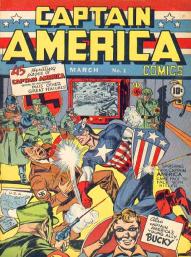
As a journalism and history teacher at an independent school near Boston, I’m not too proud to admit that I use comic books Captainamerica1in my classroom. When we cover World War II, my students analyze the inaugural March 1941 cover of Captain America by Joe Simon and Jack Kirby, which shows super-soldier Steve Rogers deflecting an attack while knocking out Adolf Hitler. When I teach writing, my students analyze Kingdom Come, in which an aging Superman is distraught over a conflict that wipes out much of the Midwest. The pages come alive with lifelike artwork by Alex Ross, while writer Mark Waid exemplifies clarity and concision by making optimal use of each speech bubble. …

“It always strikes me as supremely odd that high culture venerates the written word on the one hand, and the fine visual arts on the other,” says Jonathan Hennessey, the author of The United States Constitution: A Graphic Adaptation. “Yet somehow putting the two together is dismissed as juvenilia. Why is that? Why can’t these forms of art go together like music and dance?” At one Comic-Con panel, where he was a co-presenter, Hennessey projected a page about a Neolithic civilization. “If you look at the image, imagine how much text would be required to establish what you see here,” he pointed out. “The human eye processes images something like 60,000 times faster than it processes text. This isn’t to say that text has no place, but it’s saying that images are very powerful, and if we use them, they could be powerful teaching tools.”

(Image of Captain America Comics #1 via Wikimedia Commons)

Just How Bad Was Nero?

Robert Draper looks into revisionist accounts that suggest history hasn’t been entirely fair to the Roman emperor:

The dead do not write their own history. Nero’s first two biographers, Suetonius and Tacitus, had ties to the elite Senate and would memorialize dish_nerograffiti his reign with lavish contempt. The notion of Nero’s return took on malevolent overtones in Christian literature, with Isaiah’s warning of the coming Antichrist: “He will descend from his firmament in the form of a man, a king of iniquity, a murderer of his mother.” Later would come the melodramatic condemnations: the comic Ettore Petrolini’s Nero as babbling lunatic, Peter Ustinov’s Nero as the cowardly murderer, and the garishly enduring tableau of Nero fiddling while Rome burns. What occurred over time was hardly erasure but instead demonization. A ruler of baffling complexity was now simply a beast.

“Today we condemn his behavior,” says archaeological journalist Marisa Ranieri Panetta. “But look at the great Christian emperor Constantine. He had his first son, his second wife, and his father-in-law all murdered. One can’t be a saint and the other a devil. Look at Augustus, who destroyed a ruling class with his blacklists. Rome ran in rivers of blood, but Augustus was able to launch effective propaganda for everything he did. He understood the media. And so Augustus was great, they say. Not to suggest that Nero was himself a great emperor—but that he was better than they said he was, and no worse than those who came before and after him.”

(Image: Graffiti portrait of Nero, c. 1st century, via Wikimedia Commons)

When Corporations Make Journalism

First, it was sponsored content – advertisements designed to look like articles. Then it was a full-fledged fusion of journalism and advertizing, as sites like Buzzfeed and Upworthy actively worked with corporations to create “brand journalism.” Increasingly, however, the middle-man may be by-passed altogether. And you can easily see how this may come to be: why try cooperating with a website to get their “editors” to come up with ideas and concepts to promote a company’s bottom line, when you can simply hire the journalists yourself, pay them more and make your own publication?

Google is on the case, natch:

While Google has yet to formally introduce its native offering, numerous AdExchanger sources with knowledge of its plans say the company is taking a multi-pronged and deliberate approach to the native trend, stitching together multiple native ad offerings geared to different media sellers. Among those solutions are ad-serving support for sponsored posts on premium publisher websites, and a content recommendation engine of the sort pioneered by Outbrain and Taboola, both of which may launch in 2015.

And new research shows that the most common form of “disclosure” used by websites to demarcate paid posts isn’t working:

Sponsored content using disclosure techniques like the home page buyout (used, for example, by The Wall Street Journal) and the persistent disclosure banner (used by Slate) were only identified as ads by readers 29 percent of the time. In contrast, Nudge found that over half of the 100 people it polled were able to to identify ads that featured disclosures within the content itself. In-content disclosures are rare compared to the other techniques, though … It’s easy to understand publishers’ hesitation toward overly disclosing the brands sponsoring their content. A recent poll by content marketing company Contently found that two-thirds of readers felt tricked when they clicked on sponsored content, and over half of readers said that they don’t trust sponsored content at all.

The FT’s US news editor, Andrew Edgecliffe-Johnson, has a must-read on how all these trends are combining to end independent journalism as we’ve known it:

General Electric’s online news site has evolved from a list of press releases to a virtual magazine using animated gifs, professional photography, videos and infographics (“all the different points of entry we used at Forbes”, Tomas Kellner, [a Columbia Journalism School-trained former Forbes journalist] notes) which features tales of innovation, science and technology from around the giant industrial group. Many are engaging and informative, and some – such as a feature on a Japanese indoor lettuce farm powered by 17,500 GE LED lights – get as many as 500,000 readers …

“There have been corporate newsrooms for ever but they were putting out press releases to try and get you guys to cover it,” notes Richard Edelman, whose family firm is the world’s largest PR agency. “Now it’s self-publishing. That’s the big difference.” Every company is now realizing that it can be a media company, he says.

Notice the pedigree of the dude running the corporate p.r. show: a Columbia J School alum from the mainstream media. The financial incentives for younger journalists to become PR purveyors could not be starker:

For every working journalist in America, there are now 4.6 PR people, according to the US Bureau of Labor Statistics, up from 3.2 a decade ago. And those journalists earn on average 65 per cent of what their PR peers are paid.

Gene Weingarten has the perfect quip:

I am longing for the days when you merely had to sell your soul to appease commercial demands. Now, you have to beg advertisers to take your soul, and then help them pry it out of your body with a claw hammer.

It seems to me that the critical avenue for this denouement is the new media structure.

In the words of Kellner: “People these days don’t care as much about where the story comes from as long as it tells them something.” When the news is consumed as a stream of tweets or Facebook likes coming from everywhere and nowhere, the power of existing independent institutions to enforce ethics, to delineate a space in which paid messaging is nowhere near actual journalism, has attenuated. And the confusion leads inexorably to fusion.

The low barriers to entry into publishing once empowered lone bloggers like yours truly. But of course corporations can play the same game. What troubles me most about “native advertising” is not just that it’s a corruption of journalism, but that, once this principle has been conceded, there’s no stopping the web from becoming a seamless stream of p.r., advertising and journalism, in which it is increasingly impossible to tell any of them apart.

As far as business is concerned, no big deal, I suppose. As far as most readers are concerned, the same seems to apply. But democracy matters – and if the space for an independent and robust press is squeezed even further, the ability of journalists to write the truth for their fellow-citizens, and make a living at it, will slowly disappear. You may think this could never happen. But it appears to happening simultaneously faster and more quietly than anyone might have once predicted.

Biden Trails Clinton By 44 Points

Ezra blames all the gaffes:

[This week], Biden angered Jewish groups by referring to shady lenders as “shylocks.” Then he called Singapore’s Lee Kuan Yew “the wisest man in the Orient.” Biden has history of this kind of thing. In 2006, he said, “you cannot go to a 7-Eleven or a Dunkin’ Donuts unless you have a slight Indian accent.” In 2007, he called Obama “the first mainstream African-American who is articulate and bright and clean and a nice-looking guy.” Biden, New York Magazine snarked, “is your accidentally racist grandma.” …

[T]hese comments keep exposing a cultural gulf between Biden and the party he seeks to lead. Biden is an old-school, white, male politician in a party that’s increasingly young, multicultural, and female. One of the biggest frustration for Team Biden is that their boss has become something of a joke on the internet — and that’s partly because the people driving opinion online are young and very sensitive to the particular kind of gaffes Biden keeps making.

The latest:

In the middle of a Friday morning speech championing women’s issues, Vice President Joe Biden offered warm words for a senator who resigned amid a sexual harassment scandal [Bob Packwood].

Now: England’s Turn?

Reactions To The Scottish Referendum Decision

It’s been a tumultuous day in British politics. Alex Salmond, the charismatic Scottish Nationalist leader who galvanized the independence referendum has resigned as First Minister of Scotland. From his statement:

The real guardians of progress are not the politicians at Westminster, or even at Holyrood, but the energised activism of tens of thousands of people who I predict will refuse meekly to go back into the political shadows. “For me right now , therefore there is a decision as to who is best placed to lead this process forward politically. “I believe that in this new exciting situation, redolent with possibility, Party, Parliament and country would benefit from new leadership.

The promises of devo-max for Scotland – made as a panicked last ditch attempt to preserve the union – are now, however, provoking a backlash in England, especially the Tory parts:

In his speech [after the results], Cameron made clear that the constitutional reforms, including in Scotland, would not be delivered until after the general election, and that Scottish measures would proceed in tandem with changes in England. “We have heard the voice of Scotland and now the millions of voices of England must be heard,” he said.

Cameron threw down a challenge to the Labour opposition to say whether it would agree to the introduction of English votes for English MPs, and announced that William Hague, leader of the House of Commons, would advance the issue in a special cabinet committee.

You can see the point: if Scotland gets to determine its own policies in Holyrood, then why should it also get full representation in Westminster with respect to English laws and English policy? The constitutional complexities are enormous, but figures as disparate as the former prime minister John Major and the Liberal Democratic leader, Nick Clegg, are in favor of devolution to England as well:

“Clearly when you have that degree of devolution [to the Scottish parliament], saying that … a Scottish MP has precisely the same say over matters in English as an English MP, doesn’t make any sense. That’s why you then decide how you divvy votes in the Commons,” Clegg told his regular LBC phone-in audience this week.

Such a change would mean a structural shift rightward for the English parliament, which is why the Labour party is so ambivalent about this. But Cameron may need to get more radical, if only to address the pressures from the UKIP leader, Nigel Farage, who said today:

It’s quite interesting to see Mr Cameron today on the steps of Downing Street relieved that he didn’t manage to lose the union but now panicked by the English question. I think that short-term, as far as English voters are concerned, I’m going to write today to all 59 Scottish MPs and I’m going to say to them in the spirit of finding a fair settlement for the United Kingdom, will you please commit from today not to take part in debates or votes in Westminster on English devolved issues. Short-term that’s what we can do. Longer-term, and I think all the constitutional experts talking on your show say, this stuff is complicated, getting this right matters as it will be for many, many decades to come and I really do think now we absolutely need to have a constitutional convention to talk about how we create a fair, federal United Kingdom.

That process is vital. All I’ve heard from Mr Cameron is that William Hague will head up some committee to discuss the English question and I simply don’t think that’s enough.

I guess we’ll see what’s enough after the next election. But it would not be the first time that Scottish nationalism awakens something just as deep: English patriotism.

(Photo: Leader of the UK Independence Party, UKIP Nigel Farage gives interviews on Abingdon Green on September 19, 2014 in London, England. By Dan Kitwood/Getty Images.)