Who Would Replace Cameron?

Daniel Berman predicts a Yes vote would be bad news not only for David Cameron, but also for other prominent Conservatives:

Cameron’s successor will be chosen for a very specific task; leading the Conservative party into the elections due next spring, not for the next two, three, five, or ten years. As such there are a number of considerations that may well lead the leading factions to settled on someone less prominent.

The first will be the nature of their ascension. Cameron’s fall will be interpreted as a judgement on Cameron’s tenure as leader, and the entire policy of his government. At the very least it will be seen as a repudiation of his handling of Scotland. The Chancellor, George Osborne is associated with both, and his recent entry into the Scottish campaign, the only senior Tory to do so, will reinforce that impression. This does not mean that Osborne or the Cameron faction will be without resources or prospects. Just because they cannot win a leadership contest in 2014, does not mean they would necessarily be unable to in 2015 or 2016. As such they have every interest to delay the issue of a permanent leader as long as possible, while also preserving as many existing MPs as possible in next year’s elections. The current MP intake is far friendlier to Cameron than any of their potential replacements will be. Both goals can be accomplished by backing a lesser-known right-winger as leader.

Is Britain Doomed Regardless?

Gordon Brown’s stirring speech against Scottish independence:

But, even if Scotland votes no tomorrow, Cassidy wonders if the union can survive:

For, although the unionist side seems likely to win this round, in the longer term the impact of the referendum could well be disastrous for those who want to maintain the status quo. About the best they can hope for is a federalized Great Britain that retains the word “United” in its name but is, for most intents and purposes, two separate countries. And even that outcome may prove to be unsustainable. Indeed, the English, who today are lamenting the possible dissolution of their beloved union, may well end up kicking the Scots out of it. …

Imagine what will happen if there’s a “no” vote, and, over the next few years, “devo-max” is enacted. “At that point,” Janan Ganesh, a columnist for the Financial Times, notes, “MPs representing Scottish seats at Westminster, who are overwhelmingly Labour, will be voting on legislation that scarcely affects their constituents. Anybody who thinks this will be allowed to stand does not talk to enough Tory MPs, many of whose private views on Scottish independence already range from insouciance to glee.”

Nora Biette-Timmons suggests that, either way the vote goes, it will strain the union:

Some Conservative Party leaders, for instance, are urging Westminster to revoke the voting rights of Scottish MPs over English-only legislation if Scotland ultimately chooses not to secede on Thursday. Others are calling for more dramatic constitutional overhauls of the United Kingdom. “While the majority of us would like Scotland to stay in the UK, a large majority of us in England now want devolution for our country too,” John Redwood, a Conservative MP from southeast England, wrote in the Financial Times on Wednesday, on the eve of the independence vote. This devolution, he argued, could take the form of an English Parliament as well. “What has emerged from the Scottish referendum is the idea of a federal state, with much greater power being exercised in the constituent nations of the union,” he noted. “What is fair for Scotland now also has to be fair for England.”

And the Tories might even be able to compete with UKIP on that platform. More Dish on Scotland here.

Face Of The Day

INDIA-PAKISTAN-KASHMIR-FLOOD

A Kashmiri flood victim sits at a bonfire outside a tent in Srinagar on September 17, 2014. Army and other emergency officials have battled to rescue tens of thousands of people stranded by the floods, triggered by heavy monsoon rains, that hit the northern Himalayan region and neighbouring Pakistan. By Tauseef Mustafa/AFP/Getty Images.

Did Snowden Tip Off Al-Qaeda’s Cryptographers? Ctd

Contradicting a report issued last month by the intelligence firm Recorded Future (and subsequently dismissed as state-sponsored agitprop by Greenwald), Murtaza Hussain highlights a new report from Flashpoint Global Partners that concludes that Snowden’s leaks about NSA surveillance were not to blame for improvements in jihadist groups’ cyber security:

The report itself goes on to make the point that, “Well prior to Edward Snowden, online jihadists were already aware that law enforcement and intelligence agencies were attempting to monitor them.” This point would seem obvious in light of the fact that terrorist groups have been employing tactics to evade digital surveillance for years. Indeed, such concerns about their use of sophisticated encryption technology predate even 9/11. Contrary to claims that such groups have fundamentally altered their practices due to information gleaned from these revelations, the report concludes. “The underlying public encryption methods employed by online jihadists do not appear to have significantly changed since the emergence of Edward Snowden.”

These findings are notable both for empirical rigor through which they ascertained, as well as their contradiction of apparently baseless statements made by high-ranking U.S. officials regarding the impact of the leaks on U.S. national security. This is particularly important as it pertains to the ongoing public debate over the alleged threat of ISIS.

In Joseph Cox’s reading, the report actually questions whether al Qaeda’s counter-surveillance methods have improved dramatically in the first place:

The history of Islamic terrorists using encryption far predates Snowden, and even Wikileaks. An early milestone was an article in Al-Qaida in the Arabian Peninsula’s (AQAP) English language magazine Inspire in October 2010, which exhorted readers to use encryption. The programme suggested then was Asrar al-Mujahideen, originally launched back in 2007. It runs in a similar vein to popular open source encryption Pretty Good Privacy (PGP), utilising public and private keys to securely send files and messages. A 2.0 version was available in 2008, and after this other programmes came out for popular chat programmes, then Android and Symbian mobile devices.

From Asrar al-Mijahideen in 2007 to developments today, Flashpoint’s findings suggest jihadists haven’t made any major changes to their use of encryption: they’re just taking established models and applying them to different areas, such as instant messaging services or mobile phones.

Passions Running High In Scotland

https://twitter.com/BradenDavy/status/512280185690140672

So what else is new? But Brenda Kutchinsky, a Scottish No voter, argues that the independence referendum has unleashed a “collective madness”:

I am as passionately Scottish as anyone who is planning to vote Yes, but I am being made to feel as if I don’t deserve to belong in my own country. … One of the region’s wealthiest businessmen, Charles Ritchie, has dared to speak out against both independence and the alleged bullying behavior of the Yes campaign. In the past two months, his company has reportedly received two hoax bombs in the post and one live bullet in a box of matches. I have heard that the police are now investigating this terrible matter. Two weeks ago, I summoned up my courage and put a No Thanks poster in my window, against the advice of friends who said it would open me up to abuse and possibly even a brick through my windowHow ridiculous that I should be worried about the consequences of expressing my opinion to people among whom I have lived happily for 15 years, but this is the climate of fear in which I am currently residing.

But Leonid Bershidsky emphasizes that in a global context, “both the secession and anti-secession campaigns have been courteous, nonviolent and affable”:

“Within the set of civil wars, secessionist wars are not only the most common, but are additionally among the longest and bloodiest types of warfare,” Bridget Coggins, now at the University of California at Santa Barbara, wrote in her 2006 doctoral thesis, based on a database of the secession attempts from 1931 to 2002. Of these 275 attempts, 195 were characterized by violence on at least one of the sides.

Although that suggests rather a lot of peaceful disengagements, many derive from Britain’s relatively nonviolent dismantling of its empire after World War II — a policy orchestrated, at least partly, by Prime Minister Harold Macmillan, who was of Scottish descent. Ask Chechens, East Timoreans, Sudanese, Kosovars, Eritreans – or the leaders of the countries from which they fought to split – about playing by the rules; the word “massacre” figures prominently in the histories of these independence bids. … Comparing Scotland with Chechnya or Crimea may seem far-fetched, but Northern Ireland during the so-called Troubles was a hot spot on a similar scale, and its own secession referendum in 1973 was boycotted by the Catholic population. Passions in Scotland, by contrast, run no higher than they would during a local soccer match.

Bershidsky sees the relatively calm campaigns as evidence of the status quo’s soundness, asking “What would a division solve that negotiations within the current scheme of things can’t?” Tom Rogan argues that it’s in the Scots’ economic interest to vote No:

Consider a few statistics. Scottish exports account for only 6.3 percent of the U.K. total, whereas England accounts for 74.1 percent. While Scotland has a slightly higher total employment figure than England does, it has a bloated public sector (22.1 percent of total employment vs. 17.4 percent in England). The Scottish work force is also less productive than its English counterpart. Most disconcerting: Measured per 10,000 adults in the U.K., Scotland has fewer businesses than Northern Ireland and Wales, and a staggering 21 percent fewer than England. The business community has been clear about its view of the referendum. Even the Royal Bank of Scotland has threatened to leave Scotland if independence occurs. In short, the Scottish independence movement has subjugated itself to voodoo economics.

But the prospect of independence sends Suzanne Moore into paroxysms of enthusiasm:

Surely if this “political reformation”, as John Harris described it, happened anywhere else, we would be calling it a velvet revolution and marveling at democracy in action. It may well be fierce, shouty and messy, but these are undeniably voices from below and we should listen. The SNP, once conservative and narrow-mindedly nationalist, has turned itself into something that can harness progressive forces. … All this fretting about neighbors becoming foreigners is a denial about who we already are. Rather than post-national identities, post-sovereignty is the aim. Open borders, mobility and federalism could have been offered through devo max – but they weren’t, so now we have the entire establishment yelling “no, no, no.” So I say yes. Take a leap towards self-rule. One can be on the side of change or against it. The thing is, change is here now, whatever happens. Finally, thankfully, yes.

More Dish on tomorrow’s vote here.

The Senate Is A Coin Flip, Ctd

Senate Control

Aaron Blake ran simulations with the WaPo’s election model. The result:

The battle for control of the Senate is a pure toss-up. Not just like a this-is-very-close toss-up, but like a 50-50-odds toss-up. Our team ran 10,000 simulations using our most recent ratings of the 36 seats up for grabs on Nov. 4. It showed Republicans with a 50.03 percent chance of winning the Senate and Democrats with a 49.97 percent chance of holding the Senate. Again: pure toss-up.

Ben Highton asks, “What explains this over-performance by Democrats, or under-performance by Republicans?”

One possibility is that the “midterm penalty” — the loss in vote share suffered by the president’s party in the midterm — is shaping up to be smaller than in the past. That penalty is estimated by comparing midterm and presidential election years from 1980-2012.  For 2014, we have applied the average penalty, taking into account uncertainty due to variation in past midterm penalties along with the uncertainty that arises simply because 2014 is a new election year.  But it is plausible that the size of the midterm penalty in 2014 may end up being smaller than in the past.  This could be the consequence of voter discontent with the Republican Party, as Nate Cohn has noted.

Another possibility is that there are idiosyncratic features of individual races that the background fundamentals cannot easily capture, and which favor Democrats in certain races. For example, maybe some candidates in the key races are just better or worse in ways that we cannot easily measure — but that the polls are capturing.

Harry Enten presumes that the Democrats’ advertising advantage has played a role:

Democratic Senate candidates and the outside groups supporting them have enjoyed advertising edges in almost all the competitive Senate contests over the past few weeks. Three of their larger advertising leads have been in Colorado, Michigan and North Carolina — the three states where we’ve seen the biggest movements toward Democratic candidates in the FiveThirtyEight forecasts. New Hampshire, one of the few competitive states to move toward the GOP over the last week, is also one of the few states where Republicans have had an advertising advantage. …

The question is whether Republicans and their affiliated groups can catch up. If they can, then we may see a reversion to the mean, and the Republicans’ more robust position might be restored. If Democrats maintain their lead on the air — and if that edge is what’s driving the Democratic run over the past few days — then they might able to overcome a bad national environment.

Andrew Prokop provides more details on the Democrats’ advertising edge:

Some of this advantage is because more Democratic incumbents are at risk, and incumbents usually have an easier time raising money than challengers. But Democrats are getting substantial support from Super PACs and dark money groups as well — the Washington Post’s Matea Gold describes how close allies of Senate Majority Leader Harry Reid are coordinating a major outside spending effort. The top disclosed donors to these pro-Democratic groups include wealthy financiers Tom Steyer and James Simons, as well as media mogul Fred Eychaner and former New York City Mayor Michael Bloomberg, and several unions, according to BOpenSecrets.

Recent Dish on the Senate races here.

Busted With An Eggcorn, Ctd

A flood of emails came in following my bleg for examples of eggcorns. The most commonly cited one:

An eggcorn I am guilty of is “for all intents and purposes”.  I guess I thought it was an extreme statement, therefore I was guilty of stating the phrase as for all INTENSIVE purposes.

Another:

A former employer always said “let’s nip this in the butt” instead of bud, and I always had to stifle a laugh picturing what it would accomplish.

Another:

My favorite example dates back to the early ’90s, when an abstract for a presentation at a computer conference talked about the need to “integrate desperate mail systems”. Why yes, I’ve seen quite a few of those.

That’s actually a malapropism, which many readers are confusing for an eggcorn. Wikipedia helps with the distinction:

The unintentionally incorrect use of similar-sounding words or phrases in speaking is a malapropism. If there is a connection in meaning, it can be called an eggcorn.

But we can’t pass up this malapropism:

My all-time favorite, culled from the annals of Freshman Literature classes everywhere, is Honoré de Ballsac.

Back to the eggcorns:

As a person who sends and receives thousands of so-called professional emails, I can’t tell you how many times I’ve seen a point described as “mute” instead of “moot”.

Another:

For some reason my marketing colleagues are all about “flushing out” concepts these days, rather than fleshing them out. Granted, most of them would be better off flushed …

Another:

People routinely say “breech the subject” when (I’m 98% sure) they mean broach.

And another:

Not too embarrassing, but I long thought that in the Pledge of Allegiance, we were describing the attributes of the Almighty when we said, “one nation, under God, invisible, with liberty and justice for all.”

On that note:

One of my younger brothers when we were little thought the opening verse of the patriotic hymn America the Beautiful went like this: “O, Beautiful for spaceship guys … ”

Another reader:

When I was a kid, my father had an employee in his business who was somewhat developmentally challenged. He used tons of eggcorns, but my favorite was that he called varicose veins “very close veins” – a pretty good description.

One more for now:

Stevie Nicks’ song “Edge of Seventeen” is an eggcorn. Someone told Stevie they had been doing whatever it was they were doing since the age of seventeen. Stevie heard “edge of seventeen” and decided to use that as the title of one of her hit songs.

Many more to come …

Spare The Rod.

enten-datalab-spanking-2

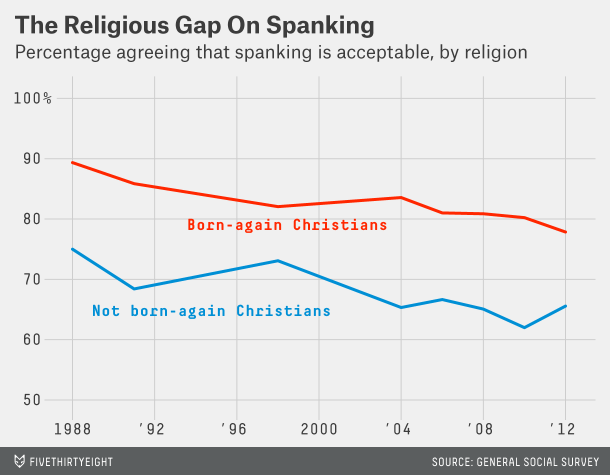
Responding to the Adrian Peterson scandal, Harry Enten provides the above chart:

There is a large gap when it comes to religion. The subsample on religion has been included in the GSS only occasionally, yet there is a clear divergence. Born-again Christians are, on average, 15 percentage points more likely than the rest of the population to agree that spanking is an acceptable form of punishment.

Amanda Marcotte expands on the religious angle:

Christian conservatives defend the practice of spanking children, even with weapons, by saying that parents are not supposed to do so in anger.

“You want to be calm, in control, and focused,” writes Chip Ingram of Focus on the Family and that a parent who embraces corporal punishment “is not an angry, insensitive person with a big club and a vicious agenda.” This echoes a common refrain from parents to justify spanking, that they don’t do it in anger and they reserve it for serious infractions that require a lot of time and processing so the child doesn’t do it again.

Unfortunately, parents are overestimating their own abilities to keep it in check. Researchers at Southern Methodist University strapped audio recorders onto the arms of 33 mothers to see if and when they used spanking, and found that instead of retreating to a quiet space to calmly administer a spanking, mothers who spank are just hitting in anger and frustration. Kids got spanked for finger-sucking, messing with pages of a book, or getting out of a chair when they weren’t supposed to. Parents who spank say they do so around 18 times a year, but the SMU researchers found it was closer to 18 times a week.

In Defense Of Amazon

Clay Shirky believes critics of the company are misguided:

I’d always aspired to be a traitor to my class (though I’d hoped it would be for something a bit more momentous than retail book pricing), but treason is as treason does, so here goes:  The reason my fellow elites hate the people who run Amazon is that they refuse to flatter our pretensions. In my tribe, this is a crime more heinous even than eating one’s salad with one’s dessert fork. The threat Amazon poses to our collective self-regard is the usual American one: The market is optimized for availability rather than respect. The surface argument is about price, but the deep argument is about prestige. If Amazon gets its way, saying, “I published a book” will generate no more cultural capital than saying “I spoke into a microphone.”

Given their deep ambivalence about expanded participation in the making and selling books, it’s worth noting some scenarios Amazon’s critics aren’t afraid of: They aren’t afraid that books will become less accessible. They aren’t afraid that there will be fewer readers. They aren’t afraid that fewer books will be published. Bezos understands that running a great bookstore is more like running a great grocery store than running a great opera company; it enrages my people that he’s unwilling to pretend otherwise.

Meanwhile, Joshua Gans asks, “When Amazon provides the world’s largest bookstore – and it is getting larger and larger – how do authors compete in the market for attention?”

Specifically, while it is nice to believe, as Shirky appears to do, that just “getting it out there” will let the cream rise to the top, Amazon doesn’t provide a platform that quite does that. Instead, Amazon provides a rating platform and, when there are small numbers involved (as they must to have a long tail work out), then we get distortions creeping in. Put simply, people who hate the concept of a particular book, need not have read it to give it one star and distort the picture. [Craig] Mod argues that Amazon can surely do better with its data and I would argue it surely has an interest to do better.

But how to do so is not that obvious. The standard in terms of how to start has been shown to us by researchers at eBay. As I noted a few months ago, Chris Nosko and Steve Tadelis were able to theorise about a better rating system and then also test that it would improve outcomes for consumers. So while we can praise Amazon for putting a competitive wind into an old and rigid industry, we must also be careful to continue to hold them to the fire of accountability for the efficiency of the platform in attention they are creating. It is only if they do so that the old gatekeepers and ‘standard bearers’ will face the challenge Shirky is hoping for.

(Full disclosure: The Dish has an informal business relationship to Amazon through its affiliate revenue program, which virtually anyone can join. The program only generates about 3% of our annual revenue, just about enough to pay and provide health insurance for our interns. And if there’s any doubt that the Dish has long aired criticism of the company, see here, here, here, here, herehere and here. We will continue to do so.)