Free Music Rage

Last week, Apple pissed off quite a few music fans by automatically adding the new U2 album Songs Of Innocence to the libraries of 500 million iTunes users. In the face of a mounting backlash, the tech giant launched a help page Monday with instructions on how to remove the album. Writing this weekend, Peter Cohen spoke for those who didn’t get the outrage:

[T]he inordinate amount of actual anger directed at Apple and U2 over this is so disproportional to the actual event, I’ve started to wonder about the mental state of some of those complaining. It’s really been off the charts. If you fall into that camp, let me speak very plainly: I have no sympathy for you. I have trouble thinking of a more self-indulgent, “first world problem” than saying “I hate this free new album I’ve been given.” For the past few days I’ve seen screeds posted on blogs and remarks on social media attacking Apple and U2 for invading privacy, for their NSA-like invasion of the sanctity of people’s music collections, claims of fascism, and a host of other utterly imagined insults. The resulting outrage has been disproportionate and more than a little sad.

Dan Wineman couldn’t disagree more:

Music collections are deeply personal, and to young people, they can be surprisingly wrapped up in identity. Back when CDs and cassettes were the thing, my friends and I would collect and proudly house them in elaborate alphabetized racks. Every cramped freshman dorm room had several cubic feet devoted to this purpose. You wouldn’t visit a friend for the first time without spending at least a few minutes arms folded, waist bent, scanning tiny lettering on 25 or 50 or a couple hundred plastic spines. It was smalltalk; it was a courtship display. Wait a sec, you’re into Genesis?! Oh, just the early stuff. Cool, cool.

We’ve surrendered the physical trappings, but the connotations remain. And I think Apple didn’t see this because — no matter how deeply they insist music runs in their DNA — from the perspective of the iTunes Store, “library” means licensed content the user is currently authorized to stream or download. But due to various design decisions Apple’s made over the years, that’s not what it means to anyone else. I’d wager that to a majority of iTunes users, “library” means my personally curated collection of stuff that I enjoy and feel comfortable associating with my identity. Messing with that is, to be frank, nothing short of a violation.

Meanwhile, Vijith Assar is struck by the sheer novelty of Apple’s move:

[H]ere’s a very simple reason why this is unprecedented, and that is because it doesn’t make any sense. Never before has such a major technology company also operated as publicist for a creative artist. The whole endeavor yearns desperately to be a landmark new innovation for the music industry, perhaps something along the lines of Radiohead’s legitimately earth-moving In Rainbows, which was self-released with variable pricing in 2007 and remains the gold standard against which music industry innovation is measured.

But this is not In Rainbows, and as such should instead be remembered primarily as a monumental blunder by the tech industry. The delivery mechanism amounts to nothing more than spam with forced downloads, and nothing less than a completely indefensible expansion by Apple beyond its operational purview. This company makes hardware and operating systems – even if it’s one to which I’ve more or less entrusted the management logistics of my personal music collection. It has, demonstrably, no competence in the sort of social and cultural thought that should have gone into a well-orchestrated version of this same gimmick, like, say, a free album as a birthday gift. It also certainly has no business forcing files of any sort onto my computer without my permission.

Marco Arment adds, “The right way for Apple to do a big U2 promotional deal like this would have been to simply make the album free on the iTunes Store for a while and promote the hell out of that”:

Instead, Apple set everyone’s account to have “purchased” this album, which auto-downloaded it to all of their devices, possibly filling up the stingy base-level storage that Apple still hasn’t raised and exacerbates by iOS’ poor and confusing storage-management facilities. And when people see a random album they didn’t buy suddenly showing up in their “purchases” and library, it makes them wonder where it came from, why it’s there, whether they were charged for it, and whether they were hacked or had their credit card stolen.
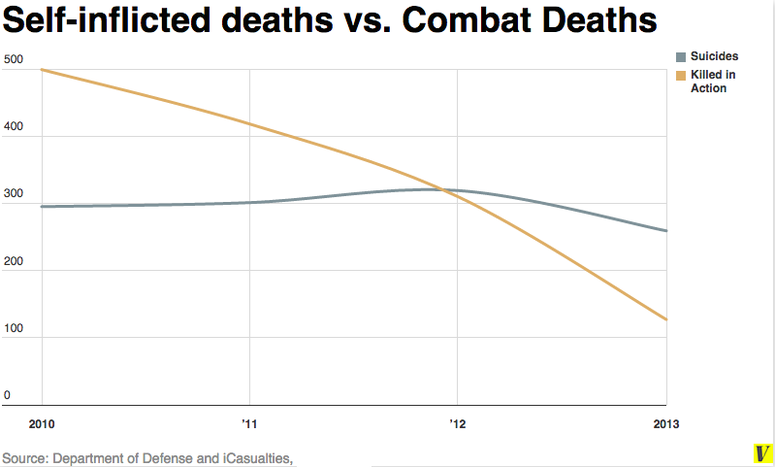
Chart Of The Day

Soldier Deaths

We are losing more soldiers to suicide than to combat:

Last year alone, 475 active service members took their own lives according to a report published last week by the Department of Defense. In the same year, 127 soldiers lost their lives in the line of duty reported icasualties.org — a website that has been documenting war deaths since the Iraq War in 2003. That’s the lowest level since 2008.

The same Department of Defense report said that 120 personnel took their own lives in the first quarter of 2014, a rate of nearly one soldier every day. That compares with 43 soldiers who lost their lives on the front line between January 1 and September 11, 2014.

Good News For The ACA?

The law seems to have effectively boosted insurance rates insurance coverage. Arit John explains:

The number of uninsured Americans fell 8 percent during the first three months of 2014, thanks to 3.8 million uninsured individuals gaining insurance, according to the Center for Disease Control. Put another way, the uninsured rate dropped from 20.4 percent to 18.4 percent among adults ages 18-64. This marks the first government study on health insurance after insurance through the health care law kicked in on January 1 and, as The New York Times notes, the numbers match up with previous independent surveys.

The important thing to note is that this survey is only through the end of March, meaning it doesn’t account for the surge of procrastinators who took advantage of the two week special enrollment period in early April.

Jonathan Cohn is pleased:

Critics will say that the number, though significant, falls short of expectations. And it’s true: The Congressional Budget Office and other experts had predicted the Affordable Care Act would reduce the number of uninsured in 2014 by several million more, in addition to the young people who already got insurance. But, as Sabrina Tavernise explains at the New York Times, the timing means this set of NHIS data didn’t capture most of the late enrollment surge that basically doubled enrollment in the Obamacare exchanges. As Harvard economist Katherine Baicker told Tavernise, the NHIS results sound “reasonably consistent with what had been expected,” given what private surveys like those from Gallup and the Urban Institute have already shown.

Meanwhile, Sarah Kliff argues the CDC data “reflects the importance of a totally different health insurance expansion”:

The Children’s Health Insurance Program was created in 1997 to offer insurance coverage to low income children. By early 1999, nearly all states had opted into the program (and all 50 participate today). That program has, over the past 17 years, cut the uninsured rate of children in half. The uninsured rate for kids has fallen from 13.9 percent in 1997 to 6.6 percent today, a huge decline that pretty much all traces back to the CHIP program expanding coverage.

But as Jason Millman notes, the CDC’s figures are far from the final word:

The new surveys Tuesday also come out a day after the Obama administration announced that 115,000 immigrants who purchased insurance through federal exchanges will lose their coverage by the end of this month for failing to provide documentation of their citizenship or immigration status. Another 360,000 customers risk losing part or all of their premium subsidies after September if they don’t provide updated income information to the federal government. Monday’s news is reminder that the coverage landscape in 2014 is still changing.

Suderman has more along those lines:

It’s possible that many have already lost their subsidies. The CMS memo notes how many cases have been closed, and how many are being resolved. But it doesn’t provide any information at all about how those cases were resolved. That’s a departure from when the discrepancies were first revealed in June. At the time, as CBS News reported, federal health officials stressed that consumers were coming out ahead in the “vast majority” of resolved cases. It seems probable some portion of the resolutions since, and perhaps even a significant fraction, were resolved with the subsidies being taken away.

The Best Of The Dish Today

photo(5)

Check out this review of the Boies-Olson book. It’s by David France, who made the best documentary about the AIDS years, the Oscar-winning How To Survive A Plague. And, yes, I’m persistent.

Speaking of documentaries, “Do I Sound Gay?” was the runner-up in the People’s Choice award at the Toronto Film Festival. Since Dishheads contributed to the Kickstarter, and the whole debate opened up a great thread, I thought I’d let you know.

Oh, and I finally found out what Grover was wearing at the Burn:

I had a French Legionnaire’s hat with the back cover that comes up under. That’s what I wore the whole time, with a couple of different T-shirts. But I brought with me a Soviet officer’s uniform, something I got in Afghanistan years ago, which, when it gets cold at night, if you’ve got to wear something for the cold, that’s a great thing to wear …. And I had Moroccan flowing robes that I got in Morocco, and I thought, ‘Well, if everybody’s looking like Gandalf or something, I’m prepared.’ But they don’t.

Well, some do. Serious beardage all over the place.

Today was the day for taking me to task. Readers told me to take a chill pill on Obama’s decision to go to war. Then they came at me for one more bash. If that weren’t enough, the Guardian busted me for an embarrassing eggcorn (explanation here). I also parsed Pope Francis’ recent mass wedding of several unconventional couples; and defended Sam Harris from the charge of sexism. Dish team analysis of the looming Scottish referendum here and here.

The most popular post of the day was The Offense Industry On The Offense; followed by Freddie’s joyous rant against intolerant social liberals.

Many of today’s posts were updated with your emails – read them all here.  You can always leave your unfiltered comments at our Facebook page and @sullydish. 20 more readers became subscribers today. You can join them here – and get access to all the readons and Deep Dish – for a little as $1.99 month. Gift subscriptions are available here. Dish t-shirts and polos for sale here.

See you in the morning.

The Beneficiaries Of Our Climate Response

David Roberts contrasts preventing climate change with adapting to it. He focuses on the altruism of global warming prevention:

Remember the famous carbon time lag: Carbon emitted today affects temperatures 30 (or so) years from now. So mitigation today doesn’t actually benefit humanity today; it benefits humanity 30 years in the future, when the carbon that would have been emitted would have wrought its effects. It benefits people who are both spatially and temporally distant. That’s almost pure altruism.

Roberts sees climate adaption as “nearly the opposite” of that:

It is action taken to protect oneself, one’s own city, tribe, or nation, from the effects of unchecked climate change. An adaptation dollar does not benefit all of humanity like a mitigation dollar does. It benefits only those proximate to the spender. A New Yorker who spends a dollar on mitigation is disproportionately preventing suffering among future Bangladeshis. A New Yorker who spends a dollar on a sea wallis preventing suffering only among present and future New Yorkers. The benefits of adaptation, as an iterative process that will continue as long as the climate keeps changing, are both spatially and temporally local.

One obvious implication of this difference is that, to the extent spending favors adaptation over mitigation, it will replicate and reinforce existing inequalities of wealth and power. The benefits will accrue to those with the money to pay for them.

Americans Support Strategy They Know Won’t Work, Ctd

Aaron Blake highlights a Pew poll that shows Americans are united in their support for military action against ISIS:

9-15-2014_01But that unity is only a few inches deep. That’s because it’s becoming clear that Republicans are angling for a more active role in combating the Islamic State, while Democrats are very much concerned about so-called “mission creep” — i.e. getting too involved and not being able to go back. Pew asked people whether they were more concerned about going too far in Iraq and Syria or not going far enough. Republicans and conservatives both say overwhelmingly that they worry about not going far enough; Democrats and liberals worry more about doing too much. It’s basically Iraq 2004 — 10 years later.

And who was right then? Waldman entertains the possibility that the public isn’t being hysterical after all:

Only 18 percent of Americans overall — 23 percent of Republicans and 15 percent of Democrats — think the new military campaign will decrease the chances of a terrorist attack here at home. You can slice these data a couple of ways, of course, but around two-thirds to three-quarters of every group believes that the campaign will either increase the odds of a terrorist attack or not make much difference. Yet a majority supports it anyway.

I don’t think there’s necessarily anything confused about that; in fact, it might be a mature, sober judgment. People may believe that ISIS is primarily focused on what it’s doing in the Middle East, and going after them could, in the short run, lead them to try to retaliate against us with a terrorist attack here. But the public might also believe that despite that risk it’s the right thing to do. If that’s so, it would indicate a public reluctantly going along with a limited military action, not one driven by fear and chanting for blood.

So the public wants to launch a war on terrorism that it doesn’t think will decrease terrorism. That leaves those who believe it is “the right thing to do.” Does that mean right as in ISIS is “identical” to the Nazis, as O’Reilly has it? Or as in: it’s so despicable we should attack it even though it won’t work? That does not encourage me about the future of American foreign policy. Drum picks up on the same theme:

Only 18 percent of Americans think that fighting ISIS will reduce the odds of a terrorist attack on US soil. And there’s not a big difference between the parties. Even among Republicans, only 23 percent think a military campaign against ISIS will make us safer at home. That’s a refreshingly realistic appraisal.

But why? Is it because the Republican fear campaign is so transparently unhinged? Or is it because of President Obama’s unusually low-key approach to the ISIS campaign? I’d like to think it’s at least partly the latter. I’m not very excited about any kind of campaign against ISIS at the moment, but as a second-best alternative, it’s at least nice to see it being sold to the public as a case of having to eat our vegetables rather than as yet another exciting bomb-dropping adventure in defense of our national honor. It’s a step in the right direction, anyway.

James Lindsay flags another new poll from the Chicago Council on Global Affairs that illustrates Americans’ contradictory foreign policy tendencies in general:

At first blush the Chicago Council’s poll numbers reaffirm the current conventional wisdom that Americans are more skeptical toward foreign engagements. While a majority of Americans (58 percent) say the United States should take an “active part” in world affairs, the percentage who favor “staying out” (41 percent) is the highest since pollsters first began asking the question back in 1947. (The Chicago Council has been conducting its periodic foreign policy surveys since 1974.) As a result the gap between Americans favoring “active part” over “staying out” has shrunk to its smallest ever, just 17 percentage points.

But the public’s response to other questions in the poll suggest that an increased wariness about foreign policy is not the same as a sharp turn inward. More than eight in ten Americans say that strong U.S. leadership in world affairs is desirable, in line with previous responses to the question. Just as important, even those who want the United States to “stay out” of world affairs think that strong US leadership is either “very desirable” (19 percent) or “somewhat desirable” (50 percent).

But that’s such a vague question it’s had to know what to make of the answer. I mean: who would want the US not to exercise strong leadership? The question is: to what ends? And is it prudent? And can it be controlled?

The New Anti-Semitism In Germany

Leonid Bershidsky reflects on Angela Merkel’s latest response to it:

At Sunday’s rally, people held up signs that said “Jew-hate — Never Again,” but today’s anti-Semitism in Germany has little to do with its previous incarnation: Demonstrators from the euro-skeptic, anti-immigration party Alternative fuer Deutschland carried their own placards at the rally, saying: “Anti-Semitism Is Imported.” For once they were right.

The two men being held by police in connection with the Wuppertal attack are German Muslims, allegedly members of the increasingly active local Salafi community. Although Germany’s Jewish population has rebounded to about 200,000, from the post-World-War-II nadir of about 30,000, Muslims are much more numerous. Berlin, for example, has a Jewish population of about 30,000, and about 200,000 Muslims. …

Merkel’s difficulty in combating this new wave of anti-Semitism is that she cannot speak freely of its nature, because that might be interpreted as xenophobic.

What does any responsible European government do when one minority has an obvious problem with another? No European state has yet found a politically correct answer to that question, not Germany and certainly not France, which saw Europe’s biggest anti-Israel rallies over the summer and is constantly having to deal with challenges such as the incendiary tours by anti-Semitic comedian Dieudonne.

Jonathan S. Tobin responds to the same rally:

Merkel deserves credit for putting herself and her government on the line on this issue at a time when this issue is becoming more of a concern. The atmosphere of hate that she references is the result of a combination of factors in which the influence of immigrants from the Arab and Islamic worlds has combined with traditional Jew hatred as well as the willingness of many European academic and political elites to countenance verbal assaults on Jews and Israel in a way that would have been inconceivable in the first decades after the Holocaust.

But the key phrase in her speech was not so much the much-needed statement that attacks on Jews are attacks on all Germans and German democracy. It was that the people who are being targeted aren’t just those whose clothing indicates Jewish faith but the targeting of anyone who would stand up for Israel.

The ISIS Fearmongers

oreilly3crop

Elias Groll and Simon Engler round up some of the worst offenders, like Oklahoma Senator James Inhofe:

“ISIS, they are really bad terrorists, they’re so bad even al Qaeda is afraid of them,” Inhofe told a local Fox station last month. “They’re crazy out there and they’re rapidly developing a method of blowing up a major U.S. city and people just can’t believe that’s happening.”

Perhaps Inhofe is right, [counterterrorism chief Matthew] Olsen is wrong, and Islamic State militants are indeed plotting an attack right now inside America’s borders. American intelligence officials have certainly been wrong before about the threat posed by terror groups, and the Islamic State has alarmingly large numbers of fighters with American passports who could return to the U.S. to carry out strikes here at home. But the phrase “rapidly developing a method of blowing up a major U.S. city” goes far beyond what experts inside and outside of government say about the group’s capabilities. There is no substance here, only speculation likely designed to inspire fear and drum up support for military action.

Weigel examines the partisan implications of threat inflation:

Here’s the current paradox. The Obama administration—most reliably Chuck Hagel and John Kerry—is describing ISIS in apocalyptic terms. According to Kerry, ISIS is “an ambitious, avowed genocidal, territorial-grabbing, Caliphate-desiring quasi-state.” Their goal is not really to downplay what ISIS can actually achieve, or to reflect the intelligence analysis that ISIS poses little threat to (ugh, this term) “the homeland.” It’s to avoid a Syria-style rebellion in Congress and assemble a coalition of Arab partners in the Levant.

But Democrats do not benefit, domestically, from the hype. Just today, New Hampshire U.S. Senate candidate Scott Brown challenged Democratic Sen. Jeanne Shaheen to secure the border and sign on to legislation that would revoke the citizenship of American ISIS fighters. “If anyone (including ISIS) can cross our borders at any time, with anything in their possession, then Washington has no control over our nation’s security from terrorist attack,” said Brown. That statement sounds like incoherent heebie-jeebie-ism if you listen to intelligence assessments. Current estimates peg the total number of Americans who might have gone to Iraq and Syria for ISIS at fewer than 100. The threat of such an American, if he returned, is not that he’d cross an unprotected border with a knife between his teeth and jihadism on his mind. It’s that he’d use his American passport at a normal TSA checkpoint.

Poseur Alert

“As a friend put it to me: A tattoo isn’t the Word made flesh, but the flesh made word. It may strike old-fashioned types as pedestrian narcissism and adolescent conformity, and sometimes it surely is. But in a deeper and more troubling way, it is canny and subversive artifice, spiced with a moralistic claim to personal liberation. A tattoo is a personal statement but also an anthropological position that accords with the prevailing transvaluations of our time. It’s a wholly successful one, too, judging from the entertainment and sports worlds, and youth culture. With the mainstreaming of tattoos, another factor in the natural order falls away, yet one more inversion of nature and culture, natural law and human desire. That’s not an outcome the rationalizer’s regret. It’s precisely the point,” – Mark Bauerlein.