Was Selma Really Snubbed? Ctd

An insider joins the debate, quoting a reader:

A qualified film not receiving “enough” nominations is no reflection of the quality of the film. Instead, it’s simply a failure of the film’s PR hacks’ effectiveness at marketing directly to the Academy voters. It’s not the film’s fault, nor is it the Academy’s fault; it’s the film’s publicists’ fault. In the case of Selma, I’ve seen more publicity for Paddington.

I’ll call bullshit on that one. To say Paramount’s failure to get a screener to guild members on time is the reason for Selma‘s failure to nominate director Ava Duvernay is condescending to those members that vote on said nomination. As a Producers Guild member, almost every member I know sees it as their responsibility to see all the major potential nominees and they take that responsibility seriously. Aside from screeners, you’ll notice at the bottom of your local paper advertisements for the prestige films a notice that guild members are accepted free at all the major multiplexes. Combine that with the screenings the studios hold before and after a film’s release in not only New York and L.A., but also San Francisco, Atlanta and Chicago, there are plenty of opportunities for guild members to see all of the pictures. Being in the Academy especially is a big honor (besides being an organization that’s very difficult to join) and Academy members treat the nominations period like the High Holidays.

And it may just be that Duvernay’s lack of a nomination has nothing to do with the color of skin but rather the fact that Selma is, frankly, a good but not great movie.

While her approach is refreshingly unsentimental in its portrait of not only King but other heroes of the Civil Rights movement, from a nominating standpoint, historically the Academy likes movies that make the heart ache. Selma‘s exacting and serviceable portrayal of the political minefield Dr. King and his fellow activists had to wade through didn’t strike that nerve – at least among the Academy folks I saw the movie with. Of course, one can say, well then, by that logic Steven Spielberg shouldn’t have gotten a nomination for Lincoln. But the latter film had an artistry that Duvernay lacked.

Of course, that’s just my opinion – but apparently a lot of other guild members agree with me. But Duvernay can take heart that Christopher Nolan was also snubbed as Best Director and I guarantee we’ll still be talking about Interstellar ten years from now. But that’s the Oscars for ya.

Two cents from another reader:

What’s intriguing about this snub is that Selma is exactly the type of movie the academy generally loves. It’s historical, ostensibly a biopic, liberal, and most crucially, “important.” It’s an issue-driven film.

My main take away from the nominations is that four of the films – Boyhood, Birdman, The Grand Budapest Hotel, and Whiplash – are all quirky, independent, character-driven films. Basically, they are movies that don’t usually get a lot of love from the Academy. Think about it: Richard Linklater – Linklater! – is the front runner for best director. For film buffs (er, snobs) like myself, that is a huge thing.

Another:

I am with your reader who wonders why the only “people of color” who seem to matter when people are counting heads (or faces, as it were) are African-Americans, not Hispanic or Asian artists. (I also agree that the first issue is who is writing, directing, and starring in the movies, which necessarily determines the pool of potential nominees.) Last year, people were up in arms that Saturday Night Live didn’t have any black women (but did have two black men), but no one seems to mind that the only Hispanic cast member in recent memory is Horatio Sanz (and I can’t think of another one in its 40-year history).  And I don’t think they’ve ever had an Asian cast member, unlike the Daily Show.  (Asian-Americans have become a significant force in the comedy world – Mindy Kaling, Aziz Ansari, Aasif Mandvi, not to mention Margaret Cho – yet they are nowhere on SNL.)

The show “ER” had a similar track with Hispanic characters.  I watched the show for its entire run and can recall one Hispanic doctor – John Leguizamo, whose character was an irresponsible drug user who crashed and burned.  In contrast, there were many, many African-American doctors, including one of the main characters in the original cast.  (And plenty of Hispanic nurses and patients.)  They also reflected a diverse population in other ways – several gay or lesbian doctors and one with a physical disability.

In short, it’s time for people to realize that we are not just a country of black and white people, that we are a multicultural country with many different nationalities and ethnic groups, and that any discussion of diversity needs to look beyond these two categories.

Update from another reader:

I have to call bullshit on your “insider” calling bullshit. My partner is a member of the Academy and STILL hasn’t received his screener of Selma … and neither have many people he’s talked to. We were invited to a screening for Academy members in LA that took place on the Sunday night before Christmas. Since it was my partner’s first day off in many months and we had relatives coming in town the next day, we declined to attend, assuming a screener would arrive in the mail any day. It’s true that members can watch the films at most theaters for free, but the time between Selma‘s release and the nominations was a very small window during the holidays. If Al Sharpton wants to have an “emergency meeting” in Hollywood about the supposed snub, perhaps he should start with the marketing department at Paramount. They clearly failed to do their job.

Shining Light On The Underground Railroad

dish_darknesstolight

In a review of Eric Foner’s new history of the Underground Railroad, Gateway to Freedom, Jennifer Schuessler reflects on the various ways scholars have understood the way slaves escaped north to freedom:

The first scholarly study of the Underground Railroad, published by Wilbur Siebert in 1898, named some 3,200 “agents,” virtually all of them white men, who presided over an elaborate network of fixed routes, illustrated with maps that looked much like those of an ordinary railroad. That view largely held among scholars until 1961, when the historian Larry Gara published “The Liberty Line,” a slashing revisionist study that dismissed the Underground Railroad as a myth and argued that most fugitive slaves escaped at their own initiative, with little help from organized abolitionists. Scholarship on the topic all but dried up, as historians more generally emphasized the agency of African-Americans in claiming their own freedom.

But over the past 15 years, aided by newly digitized records of obscure abolitionist newspapers and local archives, scholars have constructed a new picture of the Underground Railroad as a collection of loosely interlocking local networks of activists, both black and white, that waxed and waned over time but nevertheless helped a significant number reach freedom.

Wendy Smith notes that Foner “gets his detailed information about the workings of the underground railroad during this fraught period from two invaluable contemporary documents”:

The first is a Record of Fugitives compiled in 1855-56 by Sydney Howard Gay, white editor of the National Anti-Slavery Standard, who recounted the journeys of more than 200 runaways who passed through his Manhattan offices. The second is the journal of William Still, son of a fugitive slave and leader of the Philadelphia Vigilance Committee, which played a vital role because of southern Pennsylvania’s proximity to Delaware, Virginia and Maryland, sources of most fugitive slaves.

Using these documents and others, Foner puts names and faces to activists less famous than Harriet Tubman (who makes a brief appearance) but more important to the functioning of the underground railroad. While Tubman rescued some 70 slaves, Jermain W. Loguen of Syracuse was credited with assisting 1,500 fugitives; Thomas Garrett, one of the many Quakers active in the underground railroad, helped more than 2,200 people cross the Delaware border to freedom.

(Image courtesy of Jeanine Michna-Bales, whose photography project Through Darkness to Light retraces the Underground Railroad)

Dissent By Design

Cassie Packard reviews Disobedient Objects, an exhibition at London’s Victoria and Albert Museum devoted to examining “the powerful role of objects in movements for social change”:

The disobedient objects in the exhibition range from the more tactically frivolous, like the [inflatable] cobblestones [from a 2012 May Day demonstration in Berlin-Kreuzberg], to the blindingly necessary, like DIY tear gas masks. They are largely the products of various left-wing grassroots social movements, though a few objects made in service of paramilitaries — but questionably dressed in the show’s glamorizing rhetoric of left-wing activism — make it into the mix. On the whole, the exhibition is right on trend, combining a growing public interest in design activism with a recent popularization of “object”-centered museum exhibitions and publications. …

In one section of the exhibition is a collection of handmade “book blocs,” a functional riff on the riot shield in which Plexiglas and cardboard are made to resemble oversized book covers. Wielded by groups protesting tuition hikes and budget cuts to education programs, these blocs put police in the bizarre position of physically assaulting oversize books when they attack protestors. It’s a memorable image, and one that certainly drums up attention for its causes as it’s disseminated on the web. Another standout is the Spanish-born “flone” [see above video], an economical marriage of laser-cut plywood and open-source software. “Reinventing airspace as public space” in an age of insidious drone warfare, the flone allows the user to fly his or her smartphone for the purpose of filming police and demonstrations. Of all the items on display, it is the flone whose revolutionary potential feel the most formidable.

In an earlier review, Alice Bell also praised the exhibit:

Entering the gallery, you are greeted with rows of metal poles holding up the displays. An allusion to the bars of prison walls, they also offer the basis for one of the best exhibits: a history of the “lock-on” technique used by activists to attach themselves to each other and/or objects. … [A] history of lock-ons and the Capitalism is Crisis banner [made for the 2009 Blackheath Climate Camp] are as much part of modernity as a gallery of wedding dresses. Their arguments are part of the hard tissue of our world, even if we don’t always recognise it. As are the history of the pink triangle, a collection of anti-apartheid badges and a simple poster-paint-and-cardboard banner that declares “I wish my boyfriend was as dirty as your policies”, all also displayed in the gallery. It’s not complete – there are many protest movements missing – but it’s diverse and engaging.

In another earlier review, Victoria Sadler noted that she “found this a very emotive exhibition, one that drives up a lot of anger and frustration”:

Supporting the exhibits is a number of video clips, including footage from protests such as Tiananmen, the Middle East, Seoul and Japan. The level of violent resistance from the state in almost all instances is incredibly depressing. And the disproportionate use of that violence can be harrowing to watch.

Watching again the tanks of the Chinese Army toppling over the 30ft Goddess of Democracy in Tiananmen Square was quite distressing, as it was to see the footage from Palestine of kids throwing stones with their slingshots, only for their pebbles to be met with gunfire. The V&A has managed to obtain one of these slingshots, a makeshift item created from the tongue of a child’s trainer, and alongside this VT this really had an impact. Included in the video clips is commentary and observation from those that have been active in protest movements, or who have studied them.

It’s eye-opening to listen to how these movements do bring in the egalitarian principles and community consciousness they want to see in the world, but how they also struggle with gender and class structures within their own ranks. But it was easy to agree with these commentators that change has only come about from direct action, from challenges to property and power, rather than negotiation and dialogue.

The exhibition runs through February 1st.

The Second American Revolution?

1024px-Contrabands_at_Headquarters_of_General_Lafayette_by_Mathew_Brady

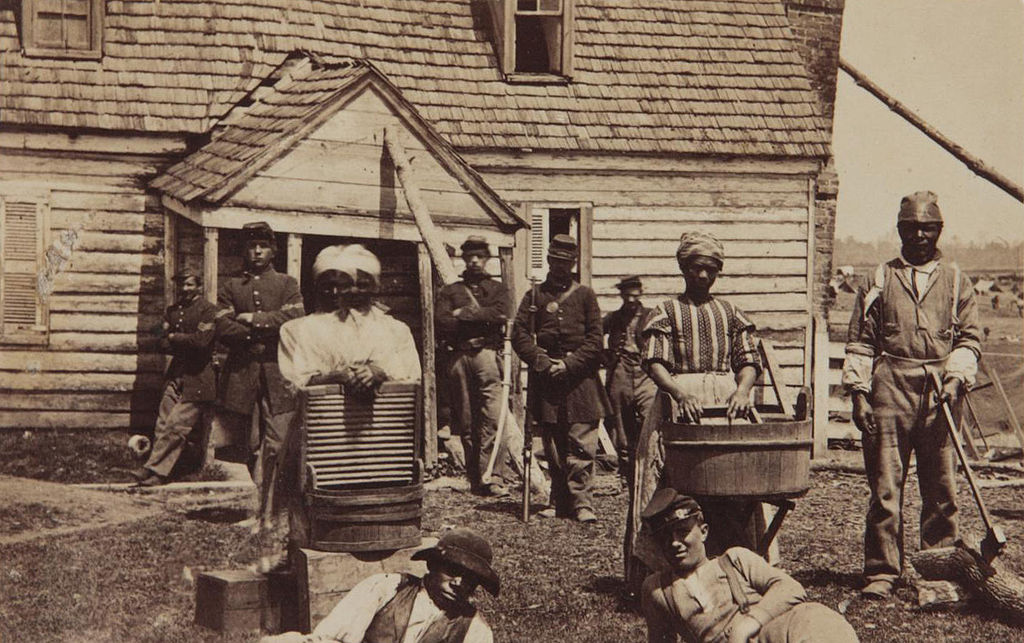
Allen Guelzo walks us through the various ways the Civil War has been thought of as marking a break from the past, from military affairs to law and politics, before asserting that “certainly we should say that the Civil War was revolutionary in one overwhelming respect, and that was the emancipation of 3.9 million black slaves.” But that argument is more complicated than you might think:

Here, we do strike a genuinely discontinuous, revolutionary note, for the Civil War not only violently excised all legal traces of slavery from the Constitution, but practically destroyed all the wealth invested in it, to the tune of nearly $3 billion. But was the overall goal of emancipation actually a revolutionary one? We tend to think of slavery today almost purely in terms of race, as a racial offense and a racial injustice, to be remedied only by full social and political equality. And in that sense, emancipation was a revolution, for in the long history of Western society, it was without precedent for a slave population of such magnitude to be absolutely and immediately emancipated, without compensation to its owners, and then boosted at once into the realm of citizenship.

But in the eyes of the emancipationists, racial redemption was not, in fact, the principal goal.

The fundamental offense posed by slavery in their eyes was that it represented a step away from a democratic political order, and its replacement with the kind of Romantic aristocracy that reestablished itself in Europe after the French Revolution. What Lincoln hated in slavery was not just its racial injustice, but the reemergence in America of the old demon of monarchy, where some people were born with uncalloused hands, booted and spurred and ready to ride on the backs of everyone else, who had to work. Owning slaves, Lincoln complained, “betokened not only the possession of wealth but indicated the gentleman of leisure who was above and scorned labour,” and it appealed to “thoughtless and giddy headed young men who looked upon work as vulgar and ungentlemanly.” Slavery’s tendency to promote aristocratic habits and attitudes made Lincoln regard it as “the one retrograde institution in America”—not because it was racially unenlightened, but because it was “fatally violating the noblest political system the world ever saw.”

(Image: Fugitive slaves who had fled to the Union Army in 1862, just a year before the Emancipation Proclamation, via Wikimedia Commons)

MLK’s “Other America”

King delivers a speech, “The Other America,” before an audience at Stanford University on April 14, 1967:

Eugene Robinson looks back at how King, in the final weeks of his life, increasingly turned his focus to Americans plagued by poverty – “the other America”:

King explained the shift in his focus: “Now our struggle is for genuine equality, which means economic equality. For we know that it isn’t enough to integrate lunch counters. What does it profit a man to be able to eat at an integrated lunch counter if he doesn’t earn enough money to buy a hamburger and a cup of coffee?”

Robinson continues:

[W]hat King saw in 1968 — and what we all should recognize today — is that it is useless to try to address race without also taking on the larger issue of inequality. He was planning a poor people’s march on Washington that would include not only African-Americans but also Latinos, Native Americans and poor Appalachian whites. He envisioned a rainbow of the dispossessed, assembled to demand not just an end to discrimination but a change in the way the economy doles out its spoils.

King did not live to lead that demonstration, which ended up becoming the “Resurrection City” tent encampment on the National Mall. Protesters never won passage of the “economic bill of rights” they had sought.

Today, our society is much more affluent overall — and much more unequal. Since King’s death, the share of total U.S. income earned by the top 1 percent has more than doubled. Studies indicate there is less economic mobility in the United States than in most other developed countries. The American dream is in danger of becoming a distant memory. … Paying homage to King as one of our nation’s greatest leaders means remembering not just his soaring oratory about racial justice but his pointed words about economic justice as well. Inequality, he told us, threatens the well-being of the nation. Extending a hand to those in need makes us stronger.

Max Ehrenfreud, citing Robinson’s article, remarks that “persistent economic inequality has arguably undermined some of the most important achievements of the civil rights movement”:

Legally, our schools are integrated, but in practice, research suggests they’re becoming more segregated. White and black children in kindergarten and younger are much more likely to be separated from each other than whites and blacks in the population at large, which is largely because black families still can’t afford to live in the neighborhoods with the best schools, as Emily Badger has explained. And while segregation between neighborhoods has been steadily decreasing, there are still many places like Ferguson, Mo. where the economic ramifications of decades of racially biased business practices and government policies keep low-income blacks from finding a way out.

It’s often said on Martin Luther King Day that the civil rights movement still has unfinished business, but somehow, the events of the past year seem to have made that fact especially clear.

Read the text of the speech above here.

Why Orwell Still Matters

Charles Paul Freund traces the reputation and influence of George Orwell’s 1984, noting the way it’s been rediscovered by the Left after Communism’s decline:

No Stalin, no USSR, no Cold War. The technology of surveillance, suppression, and control is wholly different from what the book imagines. Even the book’s George-orwell-BBC eponymous year has long since become a matter of literal and figurative nostalgia. Yet the book retains its power, if indeed its power has not grown as its contemporary concerns have faded. The more immediate the state’s threat to readers and their vulnerable technology, perhaps the more compelling Orwell’s message.

In his 2002’s Why Orwell Matters, the late Christopher Hitchens presented a string of examples from leftist British thinkers of “the sheer ill will and bad faith and intellectual confusion that appear to ignite spontaneously when Orwell’s name is mentioned.” But most left-leaning readers have “reclaimed” Orwell—a committed socialist—and long ago learned to love re-imagining Big Brother in terms of Margaret Thatcher, George W. Bush, Dick Cheney, and similar figures. (Of course, it’s not only left-leaning readers who do so.)

Certainly, the reaction from readers within tyrannies has never changed. In the early 1950s, the Polish writer Czeslaw Milosz described how Communist Party members throughout Eastern Europe became fascinated by 1984, which they could only acquire surreptitiously. “Even those who know Orwell only by hearsay,” he wrote in The Captive Mind, “are amazed that a writer who never lived in Russia should have so keen a perception into its life.”

Maajid Nawaz, however, claims a different Orwell novel – Animal Farm – led him away from radical Islam:

It was while in prison, surrounded by several prominent jihadist leaders, that Nawaz realized he wanted to take a different path. He was reading George Orwell’s Animal Farm and came to a new understanding of “what happens when somebody tries to create a utopia.”

“I began to join the dots and think, ‘My god, if these guys that I’m here with ever came to power, they would be the Islamist equivalent of Animal Farm,” Nawaz says. He says he began to see that it’s “impossible to create a utopia.”

“I’m living up close and seeing [the radicals’] everyday habits and lifestyle, I thought, ‘My god, I wouldn’t trust these guys in power,’ because when I called it, back then, and said, ‘If this caliphate, this theocratic caliphate, was ever established, it would be a nightmare on earth,'” Nawaz says.

(Image of Orwell in 1941 via Wikimedia Commons)

What’s In A Black Name? Ctd

Claude S. Fischer reflects on research on racial discrimination and hiring practices, noting a recent study that found “applications with typically white names were notably likelier to get responses [from employers] than those with typically black ones.” He considers a recent study by sociologist S. Michael Gaddis that “explicitly looks at whether racial discrimination is mitigated when job candidates clearly have sterling credentials. The answer is no”:

Gaddis targeted online job listings, analyzing employer responses to about 1800 realistic job applications that he e-mailed. For example, Gaddis used actual home addresses. He systematically varied several candidate attributes. One was race, indicated by first names that tend to be more common among blacks versus whites—e.g., Lamar v. Charlie; Nia v. Aubrey. The key innovation he introduced was the prestige of the college that the applicant had presumably graduated from (with honors)—Harvard v. U. Mass., Amherst; Stanford v. the University of California, Riverside; and Duke v. UNC, Greensboro.

“Applicants” from the elite colleges received an answer 1.7 times more often than those from less elite colleges (15 percent versus 9 percent). White-named “applicants” received an answer 1.5 times as often as black-named ones (15 percent versus 10 percent). The results suggest that having a typically white rather than a typically black name is worth about as much as graduating from an elite rather than a good college. Importantly, the racial factor is probably underestimated, given that employers have to read those names as racially distinctive for them to matter, a reading which is not as obvious as college prestige. Even among the elite-college “applicants,” race made a substantial difference. Looked at another way, black-named “applicants” from elite colleges were about as likely to get a follow-up as white-named “applicants” from non-elite colleges.

Previous Dish on attitudes toward black names here.

Face Of The Day

dish_grandbyakue

For his series Colloses, Fabrice Fouillet photographed some of the world’s most massive statues:

“I was first intrigued by the human need or desire to built gigantic declarations,” said Fouillet. “I was not especially looking for the ‘spectacular’ in the series—even if the dimensions of the statues are—but I wanted to explore how such huge monuments fit in the landscape despite their traditional social, political, or religious functions.”

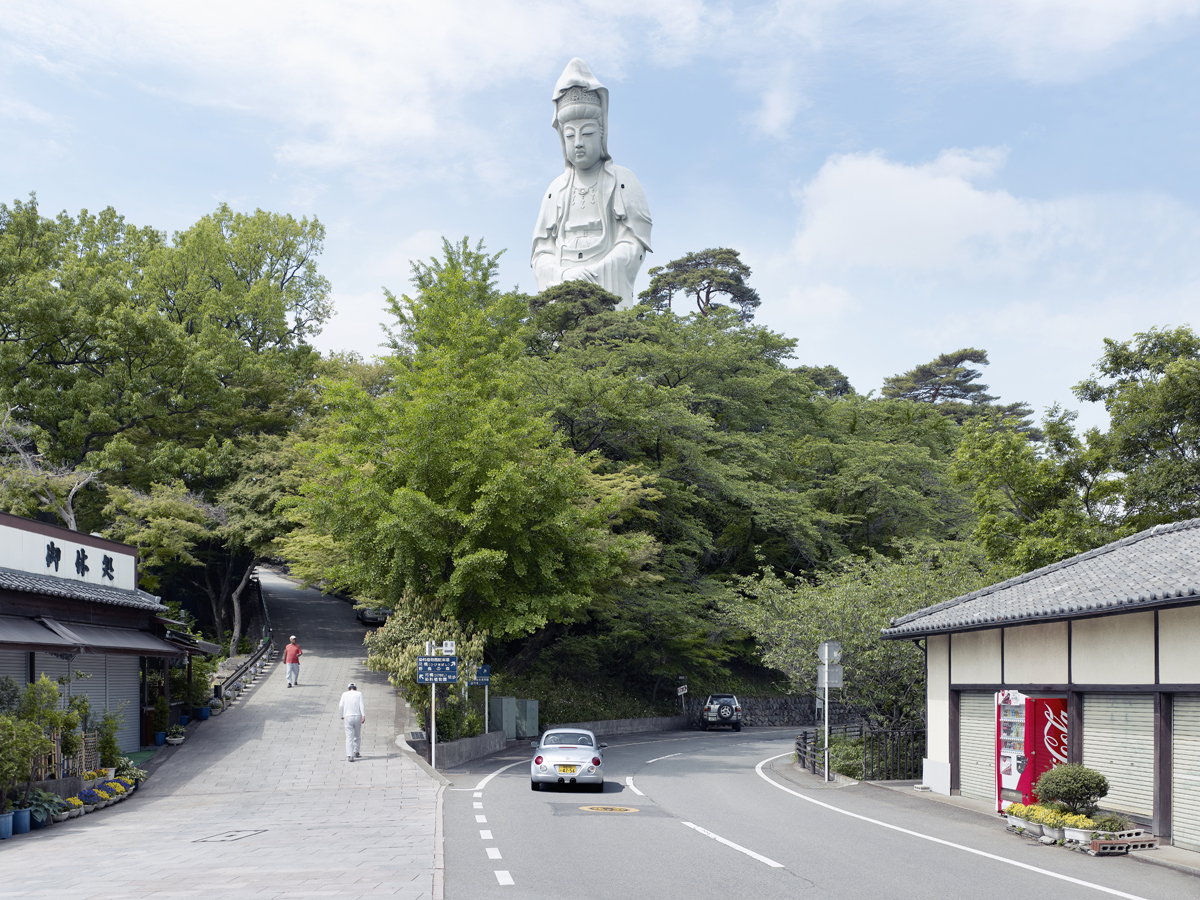
Fouillet frames these sites from the sidelines, capturing the perspective you don’t see in postcards. He frames Dai Kanon in Sendai, Japan, from a few blocks away, for example. Christ the King in Świebodzin, Poland, is framed from behind. In some cases, he shoots wide enough to include mundane details of life and the people living in the shadow of these looming monoliths. Laundry flaps in the breeze beneath the imposing facade of Ataturk Mask in Izmir, Turkey, and a Coca-Cola machine sits just down the hill from Grand Byakue Kannon in Takazaki, Japan. Fouillet appears to be toying with our notions of the sacred and profane.

“It was important to me to extract the monument from its formal touristic and religious surroundings,” said Fouillet. “It is not about a description of monumental symbol but more to observe how and where it takes places.”

See more of Fouillet’s work here.

(Image: Grand Byakue. Takazaki, Japan, 42 m (137 ft). Built in 1936.)