Not So Much At Home On The Range

Jonathon Sturgeon, praising Ben Metcalf’s Against The Country as “one of the more necessary — and most eloquent — expressions of a distinctly American, provincial rage in some years,” names the book the “first good novel of 2015”:

Ben Metcalf’s Against the Country is a strange, essayistic, and autofictional novel that reads like a series of grievances against family, state, soil, dog, snake, chicken, corn, trash heap, school bus, and, well, nearly every thinkable trapping of life in rural America. The book is nothing short of an encyclopedia of American provincial rage in all its irrepressible hideousness. This makes it a thing of beauty.

Metcalf, who was once the literary editor at Harper’s, cultivates an archaic, idiom-damaged style that meshes two regionalisms: the clarity of Midwestern sentences (he was born in Illinois) and the unabashedly cadence-drunk prose of the American South. This makes sense, given that the book’s target is Virginia, and, more specifically, Goochland, the hilarious but honest-to-God actual name for a town where Thomas Jefferson went to school and where the author was raised.

Jason Sheehan also has rapturous praise for the novel, calling it “a book that is like a test-to-failure experiment on modern literature as a whole”:

Against the Country is a supremely challenging book — eschewing plot or, you know, anything in the goddamn world happening, and not made for relaxing with but, rather, for obsession. I read it sometimes out of ecstasy at Metcalf’s virtuoso sprays of words, working his keyboard like Horowitz at the piano (and sometimes, oftentimes, more like Errol Garner playing stride), and sometimes out of rage at its author for being so clever and persnickety and in love with the sound of his own voice and trickeries.

But regardless, it is absolutely and completely worth all investment of time and effort, because it is an undeniably beautiful object, sharp as a new razor, its wandering and deliberate plotlessness, by the end of things, congealing into something better: a story.


Bronwen Dickey also praises the novel, but remarks that “there comes a point when virtuosity, even at its most entertaining, simply isn’t enough”:

Unmoored from larger themes, the once-amusing winks and nudges start to grate, the footnoted asides nested within other asides become exhausting, and you just get tired of being grabbed by the lapels so forcefully and so often. Even the most devout admirer can begin to feel, after too many pages of plotless pétit allegro, stuck in some as-yet-undiscovered circle of hell with Yngwie Malmsteen or Joe Satriani: The good news is that every note in every solo is sounded with exquisite perfection. The bad news is that every note is part of a solo.

In Against the Country, that point of derailment happens in Book 5, almost 200 pages in, when the narrator abandons his social critique and focuses on his abusive father, devoting several incomprehensible chapters to the man’s middling appraisal of Salinger. … That abrupt shift wouldn’t have been so disappointing had the rest of the book not been so promising and so ferociously original, and had it not been written with such obvious, even obsessive, care. It’s possible that the final chapters are, in a nimble-smarty way that is most definitely beyond my patience, part of a prank that only Metcalf and a small clique of eccentric geniuses are in on (“Better to hate at the end of a book, I say, than to love,” Metcalf tells us at novel’s conclusion), or that fans of ultra-trippy metafiction will see these sections as a triumphant rebuke of the reader’s expectations. Oh, you want an ending? I’m sorry. Have some oddball vignettes about family dogs instead.

Adam Rosen offers a mixed review:

Life is different, we learn, in “town,” the narrator’s term for those places with a population density to rival Mayberry. Town is consistently deployed without an article or any identifiable referent, as much a state of mind as a physical location. Its civilizing nature, however, saps its power to haunt. Town may be a refuge from horror, but it is also boring. It was the country that gave us Thomas Jefferson, and corn, and the Carter Family, as the book reminds us.

At least, I think so. Themes are in here, buried beneath the thickets of prose, but Lord if you don’t have to work to find them. Against the Country presents a challenge many may relish. It offers a strange, imaginative take on our national mythology. Still, the story takes so much effort to comprehend that exhaustion sets in long before its merits can be appreciated. What we’re left with is a sense of heavy atmosphere, a vague feeling that all is far from well.

A Poem For Monday

5094938237_a8a40517cd_b

“Old Black Lady Next Door, Walking” by Wanda Coleman (1946-2013):

she walks walking
walked
all thru life
walks
restless like her people
waiting to see
what happens
knowing it will never happen
until after she’s dead

old lady
there are so many things
i want to ask you
but I have no voice

she walks walking
up and down the sidewalk
nylons knotted below her knees

at times my loneliness hers

she is the me
i meet in nightmares

(From Heavy Daughter Blues: Poems and Stories, 1968-1986 by Wanda Coleman © 1987 by Wanda Coleman. Reprinted by kind permission of Black Sparrow Books and David R. Godine, Inc. Photo by Deb Stgo)

Signs Of The (End) Times

5966932327_b4c1a4db38_b

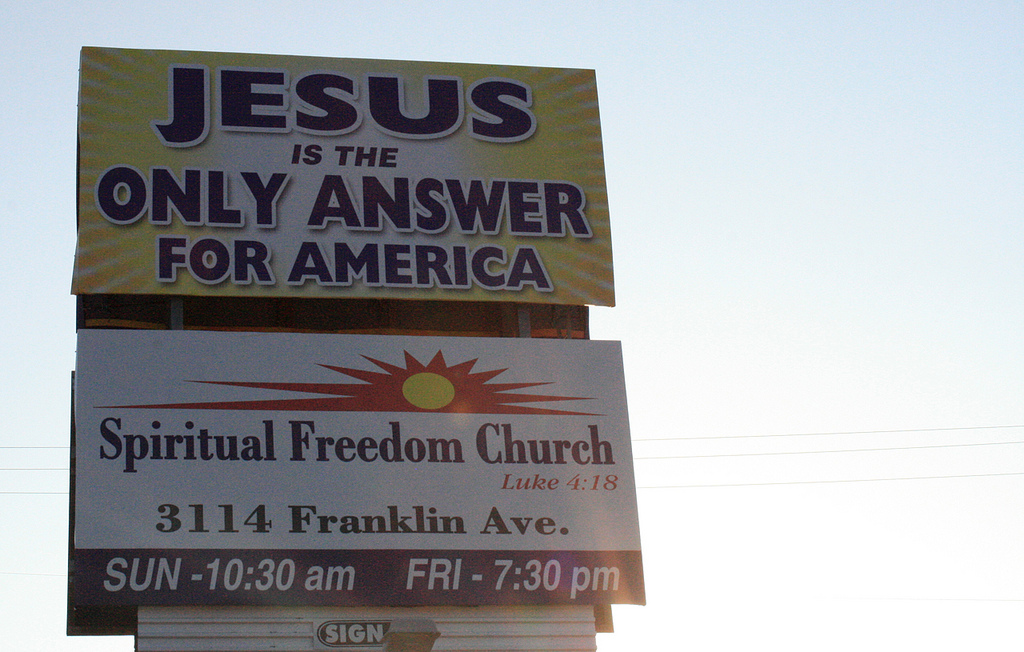
Samantha Allen notices that “in the South, rural billboards have become a bizarre battleground for tired culture wars” and that the region “is where the irrepressible subconscious of white America waves to you from the side of the road”:

But why does it manifest itself in the form of billboards, flags, and crosses? And why is the roadside such prime real estate for incendiary rhetoric in the first place? Billboards remain relatively effective forms of commercial advertising in cities with a large commuter presence but billboards with social messages are not advertising a product, nor are they typically placed in urban areas where ad space would be more expensive. Driving past a loud billboard in the middle of nowhere feels a little bit like watching someone shout impotently into the void. As for flags and crosses, well, they’re just sort of there, aren’t they? What is anyone who rents a cheap billboard or who snatches up land on an access road hoping to accomplish?

The driving factor behind these ads, flags, and attractions seems to be the simple urge to be seen. The Southern Party of Georgia, for example, brags that the Confederate flag outside Tifton is “highly visible to traffic from both directions.” The Sons of Confederate Veterans similarly note that the flag has been “strategically placed” so that it can “be easily seen by the millions who travel Georgia’s main interstate back and forth to Florida.” Cross Ministries, the church affiliated with the Texas cross, claims that “10 million people pass by [the cross] every year” and that it “can be seen from 20 miles away.” The farmer and welder who bought the land for the Confederate flag outside of Tampa was looking for a “high-profile site” that he could still afford. But these roadside sights are nothing more than last-gasp bids for cultural relevance in a world that is, quite literally, passing them by. The people who buy them are playing a no-stakes game of “made you look” with a dogmatic twist.

(Photo by Flickr user me and sysop)

How We Got Modern Political Parties

Lyndon_Johnson_and_Richard_Russell

Reviewing Julian E. Zelizer’s The Fierce Urgency of Now, an account of Lyndon Johnson and the Great Society, Sam Tanenhaus traces our ideologically-sorted political parties to a 1950 report by the American Political Science Association, “Toward a More Responsible Two-Party System”:

This report grew out of a project supervised by E. E. Schattschneider, a professor at Wesleyan and a leading exponent of Wilsonian party government. A political party that “does not capitalize on its successes by mobilizing the whole power of the government is a monstrosity reflecting the stupidity of professional politicians who are more interested in the petty spoils of office than they are in the control of the richest and most powerful government in the world,” Schattschneider had written.

This argument became the overriding theme of the 1950 report. Schattschneider’s team of fifteen scholars and policy experts had talked to congressional leaders, to officials in the Truman Administration, and to state and local politicians. It concluded that the two major parties were “probably the most archaic institutions in the United States”—scarcely more than “loose associations of state and local organizations, with very little national machinery and very little national cohesion.”

The Republican or Democrat sent to Congress was seldom screened by the national party and so felt no obligation to support the party’s program, if he even knew what it was. Once in office, he delivered patronage and pork to his constituents back home. He operated free of a coherent agenda and belonged to no “binding” caucus. The parties, in other words, were failing because they weren’t sufficiently ideological, partisan, and polarizing.

The solution was a “responsible party system”—centralized, idea-driven, serious-minded. Each party needed stronger central “councils” that met regularly, not just in Convention years, to establish principles and programs. Candidates should be expected to campaign on these platforms and then to carry them out, with dissidents punished or expelled. The party in power would enact its program, and the minority party would provide strong criticism and develop alternatives to present at election time.

(Image: President Johnson endeavors to give “The Treatment” to Senator Richard Russell in 1963, via Wikimedia Commons)

Quote For The Day

“The meaning of love is not to be confused with some sentimental outpouring. Love is something much deeper that emotional bosh. Perhaps the Greek language can clear our confusion at this point. In the Greek New Testament are three words for love. The word eros is sort of aesthetic or romantic love. In the Platonic dialogues eros is the yearning of the soul for the realm of the divine. The second word is philia, a reciprocal of love and the intimate affection and friendship between friends. We love those whom we like, and we love because we are loved. The third word is agape, understanding and creative, redemptive goodwill for all men. An overflowing love which seek nothing in return, agape is the love of God operating in the human heart. At this level, we love men not because we like them, nor because they possess some type of divine spark; we love every man because God loves him. At this level, we love the person who does an evil deed, although we hate the deed that he does.

Now we can see what Jesus meant when he said, ‘Love your enemies.’ We should be happy that he did not say, ‘Like your enemies.’ It is almost impossible to like some people. ‘Like’ is a sentimental and affectionate word. How can we be affectionate toward a person whose avowed aim is to crush our very being and place innumerable stumbling blocks in our path? How can we like a person who is threatening our children and bombing our homes? This is impossible. But Jesus recognized that love is greater than like,” – Martin Luther King, Jr., “Loving Your Enemies.”

A Poem For Sunday

5560592965_138d86ff92_b

“Waterbirds” by Michael Longley:

   for Emily

Out of the huge sadness of the Iliad
(I was reading Book Fifteen when you died)
Waterbirds are calling—barnacle geese,
Grey herons and long-necked whooper swans—
Waterbirds in flight over a water-meadow,
Honking, settling in front of one another,
Proud of their feather-power—taking me back
To the camogie pitch where your heart failed.
Waterbirds are calling—barnacle geese,
Grey herons and long-necked whooper swans.

(From The Stairwell © 2014 by Michael Longley. Used by permission of Wake Forest University Press. Photo by Mohamed Malik)

Quote For The Day II

“As long as there is one upright man, as long as there is one compassionate woman, the contagion may spread and the scene is not desolate. Hope is the thing that is left to us, in a bad time. I shall get up Sunday morning and wind the clock, as a contribution to order and steadfastness.

Sailors have an expression about the weather: they say, the weather is a great bluffer. I guess the same is true of our human society — things can look dark, then a break shows in the clouds, and all is changed, sometimes rather suddenly. It is quite obvious that the human race has made a queer mess of life on this planet. But as a people we probably harbor seeds of goodness that have lain for a long time waiting to sprout when the conditions are right. Man’s curiosity, his relentlessness, his inventiveness, his ingenuity have led him into deep trouble. We can only hope that these same traits will enable him to claw his way out.

Hang on to your hat. Hang on to your hope. And wind the clock, for tomorrow is another day,” – E. B. White responding to a letter-writer in 1973, Letters of Note.

(Hat tip: Maria Popova)

The Neuroscience Of Narrative

Exploring the power of stories in our lives, Elizabeth Svoboda explains that “we’ve known intuitively that stories alter our thinking and, in turn, the way we engage with the world,” but that recent research has “begun to shed light on how this transformation takes place from inside”:

Our mental response to story begins, as many learning processes do, with mimicry. In a 2010 Proceedings of the National Academy of Sciences study, the psychologist Uri Hasson and his Princeton University colleagues had a graduate student tell an unrehearsed story while her brain was being scanned in an fMRI machine. Then they scanned the brains of 11 volunteers listening to a recording of the story. As the researchers analysed the data, they found some striking similarities. Just when the speaker’s brain lit up in the area of the insula – a region that governs empathy and moral sensibilities – the listeners’ insulae lit up, too. Listeners and speakers also showed parallel activation of the temporoparietal junction, which helps us imagine other people’s thoughts and emotions. In certain essential ways, then, stories help our brains map that of the storyteller.

What’s more, the stories we absorb seem to shape our thought processes in much the same way lived experience does. When the University of Southern California neuroscientist Mary Immordino-Yang told subjects a series of moving true stories, their brains revealed that they identified with the stories and characters on a visceral level. People reported strong waves of emotion as they listened – one story, for instance, was about a woman who invented a system of Tibetan Braille and taught it to blind children in Tibet. The fMRI data showed that emotion-driven responses to stories like these started in the brain stem, which governs basic physical functions, such as digestion and heartbeat. So when we read about a character facing a heart-wrenching situation, it’s perfectly natural for our own hearts to pound. ‘I can almost feel the physical sensations,’ one of Immordino-Yang’s subjects remarked after hearing one of the stories. ‘This one is like there’s a balloon under my sternum inflating and moving up and out. Which is my sign of something really touching.’

Marching Toward The Promised Land

When he was a child in the 1960s, Simon Yisrael Feuerman’s father told him that Jews and African-Americans, though both minorities, were not oppressed “in the same way.” He reflects on how that ambiguity worked itself out as Jews joined the civil rights movement:

Most notably, our cousin Rabbi Abraham Joshua Heschel famously marched in Selma in 1965. For religious and secular Jews alike, the cause was a moral imperative. Their story, the African-American story, was in some way our story. We knew what it meant to be hated. What’s more, they had their very own Moses, Martin Luther King Jr., a man who quoted and infused life into scripture better than any rabbi I ever knew.

But the fight for civil rights also offered the Jewish community an opportunity. It dovetailed with a deep messianic urge that had been both reborn and transfigured in 20th century America. American Jews had become mesmerized, intoxicated even, by the idea that we no longer had to live life in humiliating passivity waiting for the Messiah. Instead, we, like our black brethren, could become active in ‘forcing the hand of the Messiah’ through overt action and protest. In other words, we could shape our lives with our hands, feet, mouths, and hearts as American blacks did the same. And so we marched with them.

Perhaps the rift between blacks and Jews that began in the late 1960s was rooted in the idea that some African Americans sensed that with all our good intentions we had piggybacked on them. We had used the muscularity of their cause not purely out of a Jewish love of righteousness, but because it gave us a chance to establish our own house in America, cashing in our secularized messianic yearnings on their backs….