The Case For War: Tweet Reax II

The first round of tweets here. Note the date on this tweet:

Live-Blogging The Case For War

9.51 pm. Here’s the best rationale I can think of for what the president has just announced. If we simply left ISIS alone, there’s a real danger that it could begin to organize in such a way as to threaten the US. That in itself reveals the craven dependency that the regional powers still have with respect to this kind of Salafist fanaticism – but it remains a fact. We can do a few things from the air to make ISIS’s life a lot harder, and hope to God that yet more American bombs in Iraq won’t go astray or provoke an even more intense reaction. Maybe the non-Salafist Syrian opposition can get its act together, but maybe it can’t. At best, the strategy is simply to try to contain ISIS with airpower. And that’s basically it. Another Sunni Awakening? That’s the hope. But at this point it’s surely just a hope.

So this is really a police action which does not end crime, cannot apprehend the criminals but can keep the criminals from getting a firmer footing for a while. As long as we are cognizant of that, we can judge its relative success or failure. But it contains no inkling of what the unintended consequences will be, leaves Obama open to even more pressure to send ground troops in if things go South, and allows the Congress to shirk any responsibility to declare war. Apart from all that, it’s brilliant.

9.42 pm. Notice a few salient things: the utter vagueness of the end-game; the refusal to go to Congress for a new war; not even a gesture toward telling us how we actually pay for this amorphous thing (with the Republicans suddenly losing any interest in the debt); no real sense of whether the Iraqi and Syrian forces can really fight ISIS, with or without US air support; and the grand coalition of Sunni Arab states … well, it looks like the Saudis may be rattled enough to help – but you don’t hear a peep from the Gulf states or Jordan.

This is an almost text-book case for not starting a war. I have come to the conclusion that the administration saw a kind of tipping point on the ground with ISIS, has no real solution, and improvised this strategy on the fly. And as far as the model in Yemen and Somalia, well …

And:

And the beat goes on …

9.37 pm. Hard to disagree:

Now, Obama has never denied he is prepared to wage a long war of attrition against Islamist terrorism. So it is not exactly a U-turn to target ISIS the way we targeted al Qaeda in Af-Pak. But if you do not buy the idea that mere force works against Islamist terror – because in a terror war, force can actually embitter and create as much terrorism as it prevents – then this is a grueling conclusion. It means a state of permanent warfare. It sets a precedent that the US can be baited into this kind of action by any two-bit Jihadist with a social media account and a few scary videos.

Do we think American bombs raining down on Iraq again will win us friends? Apparently we do.

9.36 pm. Tweet of the night:

9.30 pm. So here we are. The strategy is not to defeat a direct threat to the United States, because there is no such threat at present. The strategy is to contain ISIS through US airpower, the Kurds, the Iraqi “Army”, and by trying to get the Saudis to work the tribes to turn a critical mass of Iraqi and Syrian Sunnis against the Salafists and toward Baghdad. I presume air-strikes in Syria will be designed to cut off ISIS’ supply lines across the now non-existent border. I don’t doubt there will be special forces on the ground.

There will also be old-school American service-members on the ground in Iraq to help train the Kurds and the central government forces. Somehow, along (one presumes) with massive bribes as during the first “Awakening”, this will turn the tide.

That we have already spent enormous sums training the Iraqi army – and that they fled at the first sign of a black ISIS flag – goes unmentioned. But we should have no illusions about their ability to do anything meaningful to push back the Islamic State. The Kurds have had limited success in regaining territory. But the covert war in support of the non-Salafist Syrian opposition will become much more overt – with the Europeans taking the lead in funneling them arms. Where those arms end up we have no real control over. So in effect we’re pumping a whole bunch of weaponry into Iraq and hoping, once again, that it doesn’t come back at us.

I found the president to be calm and assured. But, to be honest, the final pep-talk about America was unnecessary, even tone-deaf. Who can believe America is a force for good in that part of the world when we have just blown the whole place up – and left a failed state in our wake? And the president still seems to convey an impression that those rescued from ISIS will somehow be grateful to the US for standing up for civilization and its values. They won’t be. They’ll hate us, whatever we do – but especially when we intervene. One obvious factor missing: the Iranians – many of whom apparently believe that ISIS is America’s creation. But the Iranians could scramble the sectarian balance here – but seeming to be a Shiite force of exactly the kind that spawned support for ISIS in the first place.

I don’t buy this as in any way guaranteeing the demise of ISIS; to analogize this war to Yemen and Somalia – where the president’s glib declaration of success doesn’t exactly evoke confidence – is to miss the obvious point that the US created the nightmare in Iraq from 2003 onward. This is a continuation of the same war, with the exact same tactics used by Petraeus to bribe, organize and arm Sunnis repelled by ISIS. But this time, we have no troops on the ground. And the Sunnis are even more pissed off now than they were then. And our credibility is in the toilet. And our levers are weaker. And the multi-sectarian government just barely formed has not even come close to proving its inclusive potential.

I wanted to be reassured. Alas, I’m not.


The Case For War: Tweet Reax

Threat Inflation And The Case For War

Fred Cole tries to apply the Powell Doctrine to the ISIS war, asking whether defending Iraq from the jihadist group is a vital American national security interest:

If we were talking about the fall of Iraq, as ISIS capturing Iraq’s land and resources, then I could see how that could threaten the vital interests of the United States, in time. But, frankly, a few months ago ISIS was an army of technicals, guys in pickups with guns on the back. Now they’ve captured some better gear, they’ve captured some money, but they’re a long way off from being able to threaten the United States. ISIS is far more likely to threaten the vital interests of Iran, Saudi Arabia, and Turkey than the United States. … They’re willing to massacre civilians. They’re willing to massacre prisoners. They’re willing to behead journalists. But hyperventilated claims of ISIS as an existential threat to the United States are nonsense. ISIS is unlikely to touch us here. They can’t capture Baghdad. They’re certainly not an existential threat to the United States.

Doug Mataconis draws the same conclusion:

Notwithstanding the hyperbole of the media, it seems rather apparent that IS is not an immediate threat to the United States despite the threats that they have made to bring the battle to America’s shores.

In no small part, this is because it seems clear that, leaving aside their military success against an Iraqi Army that doesn’t seem to want to fight and “moderate” Syrian rebels that are clearly weaker than IS forces, they don’t have the capability to strike in the same way that al Qaeda did (and even in  that regard it’s worth noting that that 9/11 attacks took several years of planning.) Additionally, though, it seems clear that IS’s ambitions lie elsewhere at the moment. If anyone should be concerned about the immediate threat from IS, it should be nations like Lebanon, Jordan, and Saudi Arabia, which bears at least some responsibility for all of this given their role in providing arms to the Syrian rebels regardless of whether they were “moderates” or jihadists. Given that, it seems fairly clear that describing IS as an immediate and grave threat as much of the current rhetoric has done is extremely hyperbolic to say that least.

But of course, the war cheerleaders are describing it just so. Nick Gillespie calls them out:

As with al Qaeda back in the day, our fears of ISIS suffer from massive threat inflation at every possible level. At the start of the summer, the number of ISIS fighters in Iraq was somewhere in the neighborhood of 7,000 to 10,000; those numbers have doubtless grown but they still face off against more than a quarter of a million Iraqi troops and somewhere between 80,000 and 240,000 peshmerga soldiers. Even the much-maligned Free Syrian Army numbers 70,000 to 90,000. And, it’s worth pointing out, ISIS is facing intense opposition (and some cooperation) from other jihadist groups, including and especially al Qaeda. If the Iraqi armed forces are in fact incapable of fighting successfully against ISIS after years of training and resources given them by the United States, there is in fact little we will be able to do to change things in Iraq[.]

Even among those who don’t overstate ISIS’s capabilities, however, some still favor going to war in order to preempt a future threat:

[I]n a thorough presentation on Sept. 3 at the Brookings Institution, outgoing director of the National Counterterrorism Center, Matthew Olsen, presented a less scary picture. ISIS has no cells in the U.S., Olsen said, “full stop.” Further, Olsen said, “we have no credible information” that the group “is planning to attack the U.S.” ISIS, Olsen said “is not al Qaeda pre-9/11.” …

[But] the potential threat of ISIS targeting the U.S. in the future is real, administration officials say. More conservative observers like Olsen agree that it is better to go on the offensive against ISIS now than to risk them becoming a bigger threat to Americans later. “ISIL poses a multi-faceted threat to the United States,” Olsen said at Brookings, and it “views the U.S. as a strategic enemy.” He says ISIS, “has the potential to use its safe haven to plan and coordinate attacks in Europe and the U.S.” Foreign fighters joining ISIS, “are likely to gain experience and training and eventually to return to their home countries battle-hardened and further radicalized,” Olsen says.

Weigel takes it all in and parts with this wry observation:

Does anybody remember the last time we were told that Iraq had produced an “imminent threat” to American lives? Better to just stain the sheets and hit the panic button, I guess. The long Democratic dream, from Kerry to Obama, of reducing terrorism from an existential threat to a managable nuisance, is just not an election-winner.

Quote For The Day III

“Okay, I recognize Silver but no idea who the other two are. I’ll take a shot at the dude in the middle, though. He developed an app that helps you find the closest lumber yard?” – a commenter at New York magazine, about me, the dude in the middle of the photo-montage, in a new Vanity Fair list of white male “media disrupters“.

(Non-white-male media disrupters can be found here.)

When Fighting Back Means Tweeting Back

Heads up that this video from the State Department contains some really graphic stuff:

Zenon Evans has details:

Playing catchup to ISIL’s spread throughout social media, the U.S. government is also posting daily on the Facebook and Twitter. The campaign is called “Think Again, [Turn] Away” and it’s geared at English-speakers who are tempted to join the terrorist organization. Britain recently raised an alarm because its defense department believe around 600 citizens have taken up arms for ISIL, though some estimate as many as 1,500 have. There are also an estimated 100 American citizens and a sum total of 3,000 Westerners who have joined the fight to establish a Caliphate throughout much of the Middle East. America’s information front focuses a lot on kids: ISIL isn’t letting kids go to school, ISIL is eating meat while children eat bread, ISIL is killing children and using them as suicide bombers. It also features on individuals who became jihadists but are now disillusioned with the fight, as well as Muslims who denounce ISIL as hypocritical and unfaithful to the religion’s teachings.

Alex Altman measures what the US is up against in this battle:

Much of the terrorist group’s work has taken place on Twitter. “2013 was the year of Twitter for Al-Qaeda and ISIS,” [Center for Strategic Counterterrorism Communications coordinator Alberto] Fernandez says. Since May, more than 60,000 Twitter accounts have been set up to herald the group, including 27,000 since the murder of Foley last month, according to an analysis conducted by Recorded Future, a web analytics firm, for the British media outlet Sky News. ISIS has used the platform both to spread grotesque photos of decapitated heads and bloodied bodies—”jihad porn,” as government officials call it—and to recruit potential conscripts. As Twitter cracked down on some of the gory imagery, an ISIS adherent even called for themurder of the site’s employees.

In the meantime, many of the group’s members have fled the site, terrorism analysts say, for more obscure social-media platforms like Friendica, Diaspora and VK (a Russian social-networking site used by the Boston bombers). The U.S. still finds itself outmatched as it tries to suss out and rebut all this activity.

Two Critical Passages

Here are two passages from a released preview of the president’s imminent speech (stay tuned for live coverage):

So tonight, with a new Iraqi government in place, and following consultations with allies abroad and Congress at home, I can announce that America will lead a broad coalition to roll back this terrorist threat. Our objective is clear: we will degrade, and ultimately destroy, ISIL through a comprehensive and sustained counter-terrorism strategy.

Ultimately destroy.” Softened but still clearly putting the US on the hook if ISIS endures, as it surely will. And notice the thin reed of a “new Iraqi government” – with still critical posts to be filled, no real unity among the various sects and factions, and an army that dissolves into sectarianism or total capitulation when ISIS attacks. Then this:

I want the American people to understand how this effort will be different from the wars in Iraq and Afghanistan. It will not involve American combat troops fighting on foreign soil. This counter-terrorism campaign will be waged through a steady, relentless effort to take out ISIL wherever they exist using our air power and our support for partner forces on the ground. This strategy of taking out terrorists who threaten us, while supporting partners on the front lines, is one that we have successfully pursued in Yemen and Somalia for years.

“Partner forces” on the ground? I sure hope he names them – and how many troops they will bring to bear. That’s a pretty important factor right there, isn’t it?

Here’s one thing the American people also need to understand. Anything we do over there will win us no friends and make us infinitely more enemies than we now have. Let’s have no illusions about that. We cannot “win” in Iraq; we cannot destroy sectarian or Salafist militias from the air; we can only lose to a greater or lesser extent. Before we jump into any new war, we should ask: Are we prepared to lose indefinitely – and keep creating as many terrorists as we kill? Are we really ready for a forever war across the world? Because we’re just re-starting one in earnest – in the vortex of what’s left of Iraq and Syria.

Quote For The Day II

“[It is] easy for us to provoke and bait this administration. All that we have to do is to send two mujahidin to the furthest point east to raise a piece of cloth on which is written al-Qaeda, in order to make the generals race there and cause America to suffer human, economic, and political losses. … This is in addition to our having experience in using guerrilla warfare and the war of attrition to fight tyrannical superpowers, as we, alongside the mujahidin, bled Russia for 10 years, until it went bankrupt and was forced to withdraw in defeat,” – Osama bin Laden, 2004.

Teaching Ferguson

Protest over death of black teen Michael Brown in Ferguson

Rebecca Schuman explores the ways colleges have brought “living history” into the classroom:

The desire among professors and students to explore the context of the Brown shooting has resulted in an informal nationwide movement, in fact, loosely gathered under the hashtag #FergusonSyllabus (begun by Georgetown professor Marcia Chatelain). Participants from a variety of disciplines have offered articles, books, blog posts, videos, and more to help teachers help their students understand what is happening here.

This “syllabus” is certainly far removed from the esoteric fare your average freshman encounters—sure, The Epic of Gilgamesh and drosophila flies are important, but their immediate relevance to 18-year-olds is often a bit of a stretch. The events of Ferguson—and, more broadly, the workings of the U.S. criminal justice system, and the racial and economic segregation of our cities—are, on the other hand, palpable around them now. To transform the needless death of a young man to a “teachable moment” may feel heartless, but that doesn’t mean our students shouldn’t learn from it. In fact, they’re eager to.

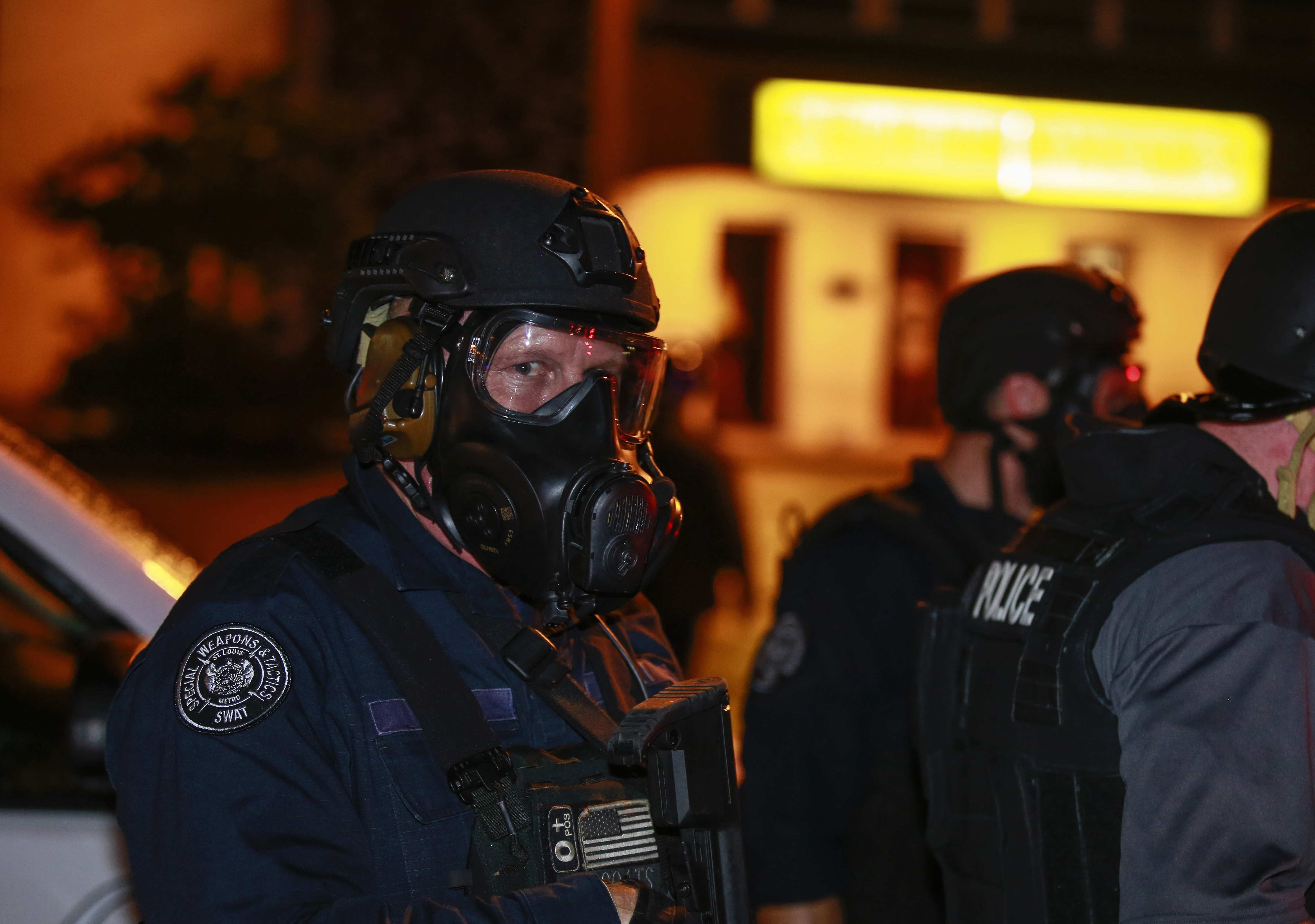
(Photo: Police forces in Ferguson, Missouri, a suburb of St. Louis, on August 17, 2014. By Bilgin Sasmaz/Anadolu Agency/Getty Images)