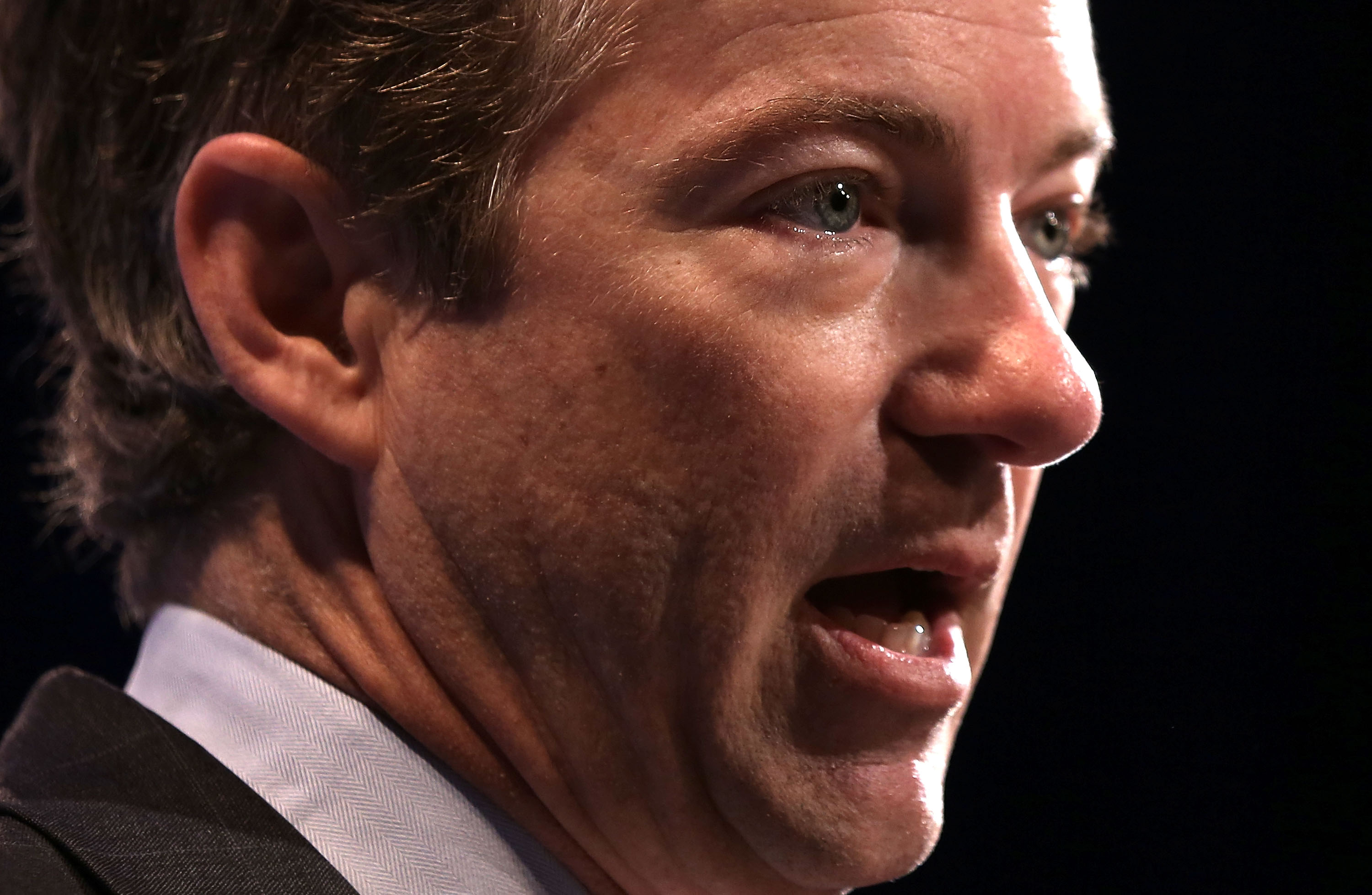
Can Rand Paul Thread The Needle?

Sen. Rand Paul Delivers Immigration Address Hispanic Chamber Of Commerce Conference

Robert Draper profiles the junior Senator from Kentucky:

“The party can’t become the opposite of what it is,” he told me. “If you tell people from Alabama, Mississippi or Georgia, ‘You know what, guys, we’ve been wrong, and we’re gonna be the pro-gay-marriage party,’ they’re either gonna stay home or — I mean, many of these people joined the Republican Party because of these social issues. So I don’t think we can completely flip. But can we become, to use the overused term, a bigger tent? I think we can and can agree to disagree on a lot of these issues. I think the party will evolve. It’ll either continue to lose, or it’ll become a bigger place where there’s a mixture of opinions.”

In effect, Paul was saying that the way for Republicans to win was to become more libertarian — though only up to a point. … Paul added: “Some people are purists, and I get grief all the time — all these libertarian websites hating on me because I’m not as pure as my dad. And I’m putting restrictions on foreign aid instead of eliminating foreign aid altogether. And I’m like: ‘Look, guys, I’m having trouble putting these restrictions on, much less eliminating them! So give me a break!’ ”

Brownstein instead focuses on whether Rand can make inroads with black voters:

Paul has walked his talk by cosponsoring legislation with Democrats, including Senate Judiciary Committee Chairman Patrick Leahy and Senator Cory Booker of New Jersey to reduce mandatory minimum sentences for nonviolent drug offenders; restore voting rights and access to welfare and food-stamp benefits for more former prisoners; and reform the juvenile-justice system. That agenda might not precipitate an immediate GOP electoral breakthrough with African Americans, but it’s serious enough to provide the party its best opportunity since Kemp to engage that community.

By scrambling the usual party alignment, Paul also has the potential to reshape the sentencing debate, much as Bill Clinton did with welfare reform. The question is whether Paul, as Clinton did, can convince his party to join him.

Meanwhile, Kilgore takes Paul to task for completing his 180 on aid to Israel:

I think Paul would be better advised to say he’s changed his mind on aid to Israel than to claim he’s been there all along. He wouldn’t be the first or last pol to have a sudden metamorphosis on an issue or two before launching a presidential bid. But he’s now getting a reputation for being slippery and defensive about his own past associations and statements; he regularly gets angry if anyone suggests he questioned the constitutionality of key elements of the Civil Rights Act of 1964, which of course he did.

(Photo by Alex Wong/Getty Images)

“A Dad And A CEO”

Executive Max Schireson explains how his desire for work-life balance led him to take a step back in his career:

Earlier this summer, Matt Lauer asked Mary Barra, the CEO of GM, whether she could balance the demands of being a mom and being a CEO. The Atlantic asked similar questions of PepsiCo’s female CEO Indra Nooyi. As a male CEO, I have been asked what kind of car I drive and what type of music I like, but never how I balance the demands of being both a dad and a CEO.

While the press haven’t asked me, it is a question that I often ask myself. Here is my situation:

* I have 3 wonderful kids at home, aged 14, 12 and 9, and I love spending time with them: skiing, cooking, playing backgammon, swimming, watching movies or Warriors or Giants games, talking, whatever. …

* I have an amazing wife who also has an important career; she is a doctor and professor at Stanford where, in addition to her clinical duties, she runs their training program for high risk obstetricians and conducts research on on prematurity, surgical techniques, and other topics.

Ester Bloom ties Schireson’s story to the culture of overwork:

The amount of “all in” we require seems kind of insane. Do we want the only people qualified to lead our companies to be people without families, or with families but without interest in spending time with them? Schireson seems like a mensch who has managed to be successful in business. That’s a golden combination. Shouldn’t we as a society figure out how to retain people like that, rather than drive them out?

Kate Dries, meanwhile, focuses on the gender angle:

The responses to his blog post are overwhelmingly positive; even his daughter wrote in to say, “I’m glad you will be able to spend more time with us at home. yayyyyy.”

It’s somewhat fascinating, however, to consider what the response would be if a woman did the same thing as Schireson; she’d probably be at the receiving end of concern from other women that she was giving up her career. (Though as Schireson touches on, women who focus too much on their careers are judged just as much. Women: they can’t win.).

Voter ID Laws Are Worse Than Useless

Voter Impersonation

Justin Levitt brings some facts to lights:

I’ve been tracking allegations of fraud for years now, including the fraud ID laws are designed to stop. In 2008, when the Supreme Court weighed in on voter ID, I looked at every single allegation put before the Court. And since then, I’ve been following reports wherever they crop up.

To be clear, I’m not just talking about prosecutions. I track any specific, credible allegation that someone may have pretended to be someone else at the polls, in any way that an ID law could fix. So far, I’ve found about 31 different incidents (some of which involve multiple ballots) since 2000, anywhere in the country. If you want to check my work, you can read a comprehensive list of the incidents below.

To put this in perspective, the 31 incidents below come in the context of general, primary, special, and municipal elections from 2000 through 2014. In general and primary elections alone, more than 1 billion ballots were cast in that period.

Drum calculates a fraud rate of 0.00002 percent:

Also worth noting: every single one of these cases involves just one or a few people. There’s not a single credible case in the past 15 years of any kind of organized voter impersonation scam of the kind that might actually affect the outcome of an election. There’s just no there there.

Bernstein adds that there “is voter fraud in the U.S., but not of the kind that voter ID is supposed to prevent”:

Most current ID laws — Wisconsin is a rare exception — won’t stop fraud with absentee ballots because measures requiring ID at the polls push more people into the absentee system, where there are plenty of real dangers. Nor will it prevent vote-buying, coercion, fake registration forms, voting from the wrong address or ballot-box stuffing by officials.

These types of voter or election fraud have been documented. But to believe that polling-place voter impersonation is a real problem, you also have to believe that those responsible are super geniuses(because unlike all other election crooks they never get caught), and that these masterminds have chosen the most difficult, inefficient and clunky ways to steal elections.

Alice Ollstein provides the above GIF:

With Republican-controlled states currently fighting the Obama Administration in court over their voting laws, and claiming they need measures to combat voter fraud, the Harvard study is only the latest to find that such fraud is nearly non-existent. … Still, the myth persists, and as minority turnout increases nationwide, the states with the highest rates of participation in communities of color are also the states most likely to pass voter ID laws and other measures proven to suppress minority votes.

Why Bisexuals Need To Come Out


Amanda Marcotte, chiding Larry King for his inability to comprehend how a bisexual can be monogamously married, sees a larger problem of bi visibility:

Part of King’s line of inquiry is just old-fashioned sexism, which has long pushed the belief that women are “naturally” monogamous and only interested in their partners, and that only men have to stifle their interest in others in order to maintain a monogamous commitment.  But part of it really does point to a long-standing challenge when it comes to bisexual visibility: Your sexuality may exist inside your head, but most people are going to judge your orientation by who you’re partnered with. And so monogamous married people tend to “read” as gay or straight, but some may actually be bisexual. … This is a problem because, as the gay rights movement has shown, visibility helps – a lot. There are many myths that proliferate about bisexuals, including the myth that they are oversexed and can’t be monogamous, a myth that King was pushing with this line of questioning whether he intended to or not. These myths exist in no small part because there aren’t a lot of visible bisexuals to act as a counterpoint.

For much more discussion on bisexuality, check out the popular Dish thread, “What’s A Bisexual Anyway?”

Obama’s Imperial Presidency? Ctd

Douthat fears an imminent Obama power grab on immigration. In response, Greg Sargent talks to experts about the limits of executive power. Here’s an important point by attorney David Leopold, “former president of the American Immigration Lawyers Association and immigration reform advocate who has consulted with the White House on immigration law”:

Though many argue that [deferred action for childhood arrivals (DACA)] grants its beneficiaries work status, in fact, the regulation that grants work status to undocumented immigrants who have been granted deferred action predates DACA and applies to many other categories of people granted deferred action. The federal regulations governing employment under immigration law existed well before DACA. Under those regulations, any undocumented immigrant granted deferred action — under programs that preceded DACA or coincide with it — had already been able to apply for employment authorization. It requires them to demonstrate economic necessity. That applied to anyone granted deferred action either individually or categorically.

Therefore, DACA did not create this authorization to work — and nor would its expansion. It simply created a new category extending an already existing work authorization for beneficiaries of deferred action. The president’s authority to grant work status long precedes DACA, and while it does apply to DACA and would apply to its expansion, it is not a direct outgrowth or creation of either.

Beutler goes another round with Ross:

If DACA combines a lawful exercise of prosecutorial discretion with a lawful provision of work permitsand Greg Sargent’s expert sources make a very strong case that it doesthen the question for Douthat is, where along the continuum between a million-or-so potential DACA beneficiaries and the (perhaps) five million beneficiaries of an expanded program would it transform into the “lawless” abomination he decried in his column?

The obvious answer to that question is: We can’t say until we see the details. All we know is that Obama is contemplating a program that’s different in degree, not necessarily in kind, from DACA. Which is why my original response to Douthat’s column posited that he had assumed too much. I still contend that he did.

I remain queasy, but somewhat more sympathetic to the legal case for executive action than before I understood the precise technicalities. I assume that the administration has done due diligence on all of this before it takes a leap in the dark.

Vladimir Putin, Locavore

In retaliation for US and EU sanctions, Putin issued an executive order yesterday banning or restricting food imports from countries that imposed sanctions on Russia. Bershidsky predicts that the counter-sanctions will hurt the Russian economy more than the countries they target:

In all, Europe’s biggest economies plus Poland, Norway, the U.S., Canada and Australia stand to lose some $6 billion in the next year from the Russian food sanctions. That is far from deadly for them. The Russian Micex stock index has lost a third of that amount in capitalization since the food sanctions were announced, because they are expected to hurt retailers such as the discounter Magnit, which has called itself the biggest food importer to Russia. More upscale retailers will need to reconsider their entire sales matrices, shifting to Asian and Latin American imports. That cannot but have an effect on their bottom lines.

Putin appears to care little about the effect of the sanctions. His focus is, as ever, domestic. He is showing his voters in the most tangible way possible that Russia doesn’t need the West to survive. The Kremlin’s propaganda is already playing up this message. “I can survive perfectly well in a world without polish apples, Dutch tomatoes, Latvian sprats, American cola, Australian beef and English tea,” Yegor Kholmogorov wrote on Izvestia.ru before it became clear that tea or cola would not be sanctioned. “Especially if this results in a substituting expansion of Russian agribusiness and food industry.”

Julia Ioffe speculates that the move might backfire:

This is the thing. If the ban really does go through and is as wide-sweeping as the Russian blogosphere fears, it will hurt not America and not the E.U., but the class of people who are well-educated, well-paid, and well-traveled, who know the difference between a Nero d’Avola and a Nebbiolo, and between prosciutto and jamón serrano. That’s a relatively small set of people, and it’s also the people who went out into the streets in the winter of 2011-2012 to protest against Vladimir Putin: the urban middle class, or, as the Kremlin derisively dubbed them, the creacles (from the words for creative class). Still, it will have a wider effect, too. Most restaurants in the country these days serve something from the E.U., things like Czech or German beer (a favorite of Russians of all stripes) and cheap Italian and French wines. Not to mention that much of the beef in Russian restaurants comes from Australia, which has already threatened to ban entry to Vladimir Putin. The ban won’t go unnoticed outside the creative class.

Tyler Cowen still finds it worrying, though:

Commentators are criticizing the economics of such a move, but I think of this more in terms of Bayesian inference.  Long-term elasticities are greater than short.  Under the more pessimistic reading of the action, Putin is signaling to the Russian economy that it needs to get used to some fairly serious conditions of siege, and food is of course the most important of all commodities.  Why initiate such a move now if you are expecting decades of peace and harmony?  Or is Putin instead trying to signal to the outside world that he is signaling “siege” to his own economy?  Then it may all just be part of a larger bluff.  In any case, Eastern Europeans do not take food supply for granted.

Hamas And the Teen Murders, Ctd

Pushing back against the latest Israeli government media offensive, Sheera Frenkel’s sources say that the alleged culprit was tortured into the confession:

“Since the kidnapping of the Israeli teens, the number of cases where torture is being used is unbelievable,” Fadi Qawasami, [a lawyer who is working on the case and is a distant relative of the Qawasmeh family], said in an interview with BuzzFeed in East Jerusalem. “Anyone who has any connection or relationship to the kidnappers has been arrested and tortured.”

Those closest to the investigation continue to doubt the involvement of the Hamas leadership.

Last week, Israeli intelligence officers told BuzzFeed they had not found a direct link to Hamas in their investigation into the kidnapping. “If there was an order, from any of the senior Hamas leadership in Gaza or abroad, this would be an easier case to investigate. We would have that intelligence data. But there is no data, so we have come to conclude that these men were acting on their own,” said one intelligence officer.

When reached for comment Wednesday, after the Israelis had revealed the arrest of Qawasmeh, the same officer told BuzzFeed that from an intelligence standpoint, a connection still did not exist to the senior Hamas leadership.

Obviously I cannot verify any of this but will continue to post any reporting that adds to our understanding. But the alleged use of torture here would be a classic case: not to get intelligence but to create reality to justify more aggression, or exculpate the torturers.

Back Hair Is Beautiful, Ctd

A reader writes:

I’m finally emailing you and it’s because of back hair. Executive branch malfeasance, congressional skullduggery, calamitous events that threaten to shake society to their very core have transpired since I first started reading your wonderful site ages ago. You write ONE missive about back hair and now I feel the urge to reach out.

photo1It cannot be overstated just how much of a hindrance this perfectly natural state of being can be to an individual. Every day one is faced with the perception that they are grossly hideous because of the way God made them. Trips to the beach, a visit to a swimming pool, intramural sports ( I don’t even want to begin with mockery that can come from a shirts versus skins match). All of these moments can just wear ones self-esteem to the point that it’s just easier to avoid them.

It’s easy enough to say that you should be proud of who you are, but it is through the difficulty in getting to this point that I understand in some miniscule way how hard it can be to be different from the norm.  I don’t really expect to there be any sort of reversal, but it would be great if I didn’t hear a “Take your shirt off. Oh you already did.” or “Shouldn’t you be back in the zoo?” joke after removing my top. Maybe one day that will happen, but I’m not expecting it.

Another:

I never realized how maligned back hair is. I’m a straight woman and my boyfriend has a lusciously hairy back.

I call him furry. I love to nestle in it while I’m spooning him. Or nestle his chest hair from the front. It’s one of my favorite things about him, and makes every other man seem peculiarly hairless.

This thought of yours struck me: “Or maybe because when a man allows his body to be what it is, and doesn’t try to micromanage every inch of it, he’s inherently sexier than the manscaped, plucked and trussed twink version.” Man, I wish more straight men had this attitude toward women. Or really, I wish a fraction of straight men held this attitude toward women and hair.

Our reader should check out the Dish thread, “Why Should Women Shave?” Another laments:

As a gay man who is naturally about as smooth as a baby, it is one of my own life’s greatest sadnesses that I am not hairy.  I barely even have pubes.  Hairy chests and thighs, especially, really turn me on (I’m fairly indifferent about back hair, but it doesn’t bother me).  No man in my family is hairy.

But your story about drawing men covered in fur reminded me of an episode from my own childhood.  I must have been about 5 or 6, probably, and I had one Ken doll among my many Barbies.  At some point I decided this plastic replica of man wasn’t to my liking at all, and I found a Sharpie and drew a massive pubic bush on him, and covered his chest in black, inky swirls.  I don’t even know how I knew to do this, but I knew I liked it much better that way.

Unfortunately my two older brothers found it and thought it was the most hilarious thing in the world and told my parents.  My dad took it away from me, though to this day, I still have no idea why.  Especially since he was desperately trying not to laugh when he did it. We never talked about that Ken doll again.  Nor did I ever get it back.

(Photo: the hubby by Ric Ide Photography for Tim-scapes in Provincetown.)

A Reason To Be A Spurs Fan

They just hired Becky Hammon to be the NBA’s first full-time female assistant coach. Yglesias isn’t surprised by the move:

As Slate’s Amanda Hess wrote in a well-timed piece published yesterday, the NBA is generally much more aggressive at promoting women into non-playing roles than the other sports leagues. One reason for that is that unlike football or baseball women do play basketball at very high levels of competition – Division I NCAA, pro leagues in the US and Russia, the Olympics – so women are networked in to the world of big time hoops in a bigger way. The NBA also has a more politically liberal fanbase than the other men’s sports leagues (the WNBA is even more leftwing) and former commissioner David Stern had a personal commitment to the project.

Kavitha Davidson assures fans, “this isn’t some Battle of the Sexes, anything-you-can-do-I-can-do publicity stunt”:

This is a historic move by the Spurs, a progressive organization with a reputation for turning innovation into success – their roster of foreign-born players was also controversial until it started winning rings. As Hammon put it, physical differences will likely always separate men and women on the court, “but when it comes to things of the mind, things like coaching, game-planning, coming up with offensive and defensive schemes, there’s no reason why a woman couldn’t be in the mix.” As women continue to break down barriers in business, politics, and culture, the Spurs have signaled that a basketball team with much at stake has something to gain from a woman on the bench.