The Best Of The Dish This Weekend

dish_kidpics

Nina Arrazello captions a wonderful little art series called Kiddie Arts:

like many children, Dutch artist Telmo Pieper drew imaginative, colorful, creative and not-always-so-anatomically correct creatures and characters when he was 4-years-old. For ‘kiddie arts’, Pieper has reincarnated the drawn works from his childhood as digital paintings, materializing them as realistic figures in intricate detail, vibrant hues and with computerized graphics. The result illustrates the quirky line scribbles as lifelike underwater animals, insects and architecture, each a bit awry in their structural and biological precision.

Love that whale.

I found myself tossing and turning all weekend from the horrible news of the last week. Today, another UN school was shelled in Gaza, killing ten, wounding many more, traumatizing countless others. These civilian deaths even in a place designated as a safe haven simply beggar belief. It is impossible to feel sympathy for either Israel or Hamas at this point. Hamas is daring Israel to kill more innocents; and Israel is eagerly obliging them. How many more children have to die to feed these zero-sum ambitions?

And it is in the wake of last week that I read Michael Oren’s piece on Zionism. As over 200 Arab children lie dead, Oren can’t contain his enthusiasm for the staggering success of the Jewish state. No reflection; no circumspection; just a long celebration until you get to this: “And there is the issue of Judea and Samaria—what most of the world calls the West Bank—an area twice used to launch wars of national destruction against Israel but which, since its capture in 1967, has proved painfully divisive.”

He means painfully divisive for Israelis. The views of the occupied do not merit any attention. And notice the reflexive victimology. This is not an area where the original inhabitants are ghettoized behind barbed wire and checkpoints, where Jim Crow exists alongside new and aggressively anti-Arab settlers, where millions of Israel’s inhabitants have no vote, and where a Russian emigré right off the plane has more rights than someone whose family has lived their for aeons. It is and always will be a existential threat that justifies permanent occupation and settlement, in direct contravention of the Geneva Conventions. This victimology is why when, in a war zone, a soldier is killed, the first word we hear from the Israelis is that he may have been “kidnapped”. Kidnapped? He was killed in battle. But even if Hamas had seized him, he would be captured in battle, not kidnapped. But that would require some sort of understanding that the enemy is also human, some kind of equal. And that seems to happen less and less. What you see in Gaza is Cheneyism fully realized.

Some relief from the Dish’s weekend: a church sign for the ages; Martin Amis’ plea for agnosticism for his friend Christopher Hitchens; why we hate the dentist; the evolution of dick crit; and the collapse of Catholic religious marriages.

The most popular post of the weekend was Why Sam Harris Won’t Criticize Israel; followed by Church Sign Of the Day.

Many of today’s posts were updated with your emails – read them all here.  You can always leave your unfiltered comments at our Facebook page and @sullydish. 23 more readers became subscribers this weekend – bringing us to 29,848. You can join them and get us to 30,000 subscribers here – and get access to all the readons and Deep Dish – for a little as $1.99 month. One writes:

Just upped my monthly to $4.20. Thanks again for all your hard work. The NYT and the Dish have been my go-to news sources for years. If you would only cut back on the Sunday god talk a bit, I would double my contribution. But that would be most un-Dish like, so keep doing what you do. It is appreciated.

See you in the morning.

We Tortured. It Was Wrong. Never Mind.

I’ve wondered for quite a while what Barack Obama thinks about torture. We now know a little more:

Even before I came into office I was very clear that in the immediate aftermath of 9/11 we did some things that were wrong.  We did a whole lot of things that were right, but we tortured some folks.  We did some things that were contrary to our values.

torturefoia_page3_full.gifI understand why it happened.  I think it’s important when we look back to recall how afraid people were after the Twin Towers fell and the Pentagon had been hit and the plane in Pennsylvania had fallen, and people did not know whether more attacks were imminent, and there was enormous pressure on our law enforcement and our national security teams to try to deal with this.  And it’s important for us not to feel too sanctimonious in retrospect about the tough job that those folks had.  And a lot of those folks were working hard under enormous pressure and are real patriots.

But having said all that, we did some things that were wrong.  And that’s what that report reflects.  And that’s the reason why, after I took office, one of the first things I did was to ban some of the extraordinary interrogation techniques that are the subject of that report.

And my hope is, is that this report reminds us once again that the character of our country has to be measured in part not by what we do when things are easy, but what we do when things are hard.  And when we engaged in some of these enhanced interrogation techniques, techniques that I believe and I think any fair-minded person would believe were torture, we crossed a line.  And that needs to be — that needs to be understood and accepted.  And we have to, as a country, take responsibility for that so that, hopefully, we don’t do it again in the future.

What to make of this?

I don’t think it’s that big a deal that he used the English language to describe what was done, in any fair-minded person’s judgment. He’s said that before now. And his general position hasn’t changed. Let me paraphrase: We tortured. It was wrong. Never mind. So he tells the most basic version of the truth – that the US government authorized and conducted war crimes – and hedges it with an important caveat: We must understand the terribly fearful circumstances in which this evil was authorized. But equally, he argues that the caveat does not excuse the crime: “the character of our country has to be measured in part not by what we do when things are easy, but what we do when things are hard.”

This latter point is integral to the laws against torture – but completely guts his first point. As I noted with the UN Convention, the prohibition is absolute:

No exceptional circumstances whatsoever, whether a state of war or a threat of war, internal political instability or any other public emergency, may be invoked as a justification of torture.

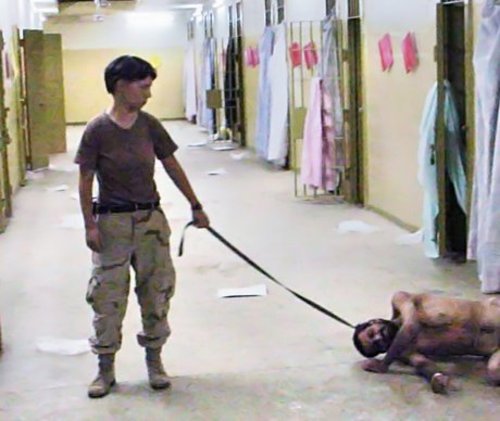
Cheney, Bush, Tenet, and Rumsfeld all knew this from the get-go. That’s why they got their supine OLC to provide specious justifications for the legally prohibited. That’s why they won’t use the word “torture,” instead inventing an Orwellian euphemism. And, of course, the president’s excuse for them – that “in the immediate aftermath of 9/11,” we did wrong things – is deeply misleading. This went on for years abughraibleash.jpgacross every theater of combat. What about what Abu Ghraib revealed about the scope of torture in the battlefield much later on? What about 2005 when they secretly re-booted the torture program? This was a carefully orchestrated criminal conspiracy at the heart of the government by people who knew full well they were breaking the law. It cannot be legally or morally excused by any contingency. It cannot be treated as if all we require is an apology they will never provide.

Yet that’s what the president’s acts – as opposed to his words – imply. And that’s what unsettles me. It is not as if the entire country has come to the conclusion that these war crimes must never happen again. The GOP ran a pro-torture candidate in 2012; they may well run a pro-torture candidate in 2016. This evil – which destroys the truth as surely as it destroys the human soul – is still with us. And all Obama recommends for trying to prevent it happening again is a wistful aspiration: “hopefully, we don’t do it again in the future.” Hopefully?

Then there’s the not-so-small matter of the rule of law.

Call me crazy but I do not believe that the executive branch can simply allow heinous crimes to go unpunished just because they were committed … by the executive branch. It seems to me, to paraphrase the president on agabuse.jpgFriday, that the rule of law “has to be measured in part not by what we do when things are easy, but what we do when things are hard.” How many times does the United States government preach about international law and Western values? On what conceivable grounds can we do so when our own government can commit torture on a grand and brutal scale for years on end – and get away with it completely?

Either the rule of law applies to the CIA or it doesn’t. And it’s now absolutely clear that it doesn’t. The agency can lie to the public; it can spy on the Senate; it can destroy the evidence of its war crimes; it can lie to its superiors about its torture techniques; it can lie about the results of those techniques. No one will ever be held to account. It is inconceivable that the United States would take this permissive position on torture with any other country or regime. Inconceivable. And so the giant and massive hypocrisy of this country on core human rights is now exposed for good and all. The Bush administration set the precedent for the authorization of torture. The Obama administration has set the precedent for its complete impunity.

America has killed the Geneva Conventions just as surely as America made them.

(Photo: a page on enhanced interrogation techniques via a FOIA request.)

Our Number One Ally Update

We discover that Israel was intercepting John Kerry’s phone calls during the Mideast peace negotiations – according to Der Spiegel. We also learn that prime minister Netanyahu’s responded to American pressure for an end to the mass killings of children thus:

In a phone call with US Ambassador to Israel Dan Shapiro about the breakdown of the short-lived UN- and US-brokered ceasefire between Israel and Hamas, Prime Minister Benjamin Netanyahu vented his anger, according to people familiar with the call. Netanyahu told Shapiro the Obama administration was “not to ever second-guess me again” and that Washington should trust his judgment on how to deal with Hamas, according to people familiar with the conversation. Netanyahu added that he now “expected” the US and other countries to fully support Israel’s offensive in Gaza, according to those familiar with the call.

Now give me that annual $3 billion, another $225 million for the Iron Dome, and shut the fuck up.


Faces Of The Day

dish_fotdsun3

Ellyn Ruddick-Sunstein captions:

In a riverside concrete amphitheater in Dhaka, Bangladesh, a community of young street children live with their beloved stray dogs. Separated from their parents or orphaned in the slums of Dhaka, the boys forge a close-knit family with their adopted animals. This is Robindra Shorbod, a park where the kids gather and sell recyclable plastic containers for food, which they unfailingly share with their ten devoted canine companions, Tiger, Romeo, Bullet, Kula, Moti, Michael, Tom, Jax, Lalu, and Bagha.

While visiting Bangladesh, photographer Sam Edmonds met the boys through Obhoyaronno, an NGO committed to changing the wide-spread and horrific killing of street dogs that persists across the region. Dedicated to humane treatment, Obhoyaronno saves lives by spaying, neutering, and vaccinating animals before returning them to the exact location in which they were found. Among these are the the ten dogs living with the boys in Robindra, each bearing a small tear in the ear to signify that they are uninfected with rabies.

See more of Edmonds’ work here and here.

When The Bride And Groom Forgo God

Annalise Fonza, a former United Methodist clergywoman who now identifies as an atheist, reveals the unexpected trouble she encountered after performing a wedding in Atlanta, Georgia, as a licensed humanist chaplain:

A few days after the wedding, the bride called to inform me that they were at the Fulton County Probate Courthouse where a clerk had a question about my credentials. After several minutes of troubling conversations with the clerk and her supervisor, I was told that Judge James Brock had refused to sign the certificate. “Who are you?” the clerk asked me in reference to the title “Humanist Celebrant,” which I was required to provide on the license. Obviously, the clerk and the rest of the Fulton County Probate Court had never heard the term, nor had they heard of the Humanist Society. After a few more phone calls, I was informed that it was Judge Brock’s final decision to deny the certificate and, hence, it was clear that the couple would have to be married again.

The couple decided to get married again that same day, this time in the Fulton County Probate Courthouse, but after a few weeks of wrangling the judge did confirm that Fonza was qualified to officiate weddings in Georgia. What she takes away from the episode:

The truth of the matter is that anyone who openly identifies as I do must expect public scrutiny and possible rejection. People in the United States still discriminate against atheists, even though more and more people are using the word “atheist” to self-identify. In other words, just because one uses the term openly and proudly, doesn’t mean he or she will be accepted without question or won’t face rejection. In addition, the religious bigotry and social entitlement here in the South is so pronounced—by people of every color and background. Many, including African Americans, openly discriminate against or exclude other black people from social and professional circles when they learn that those others are atheists. …

My first time navigating the courts in Atlanta, Georgia, as a humanist celebrant was far from loving, and it taught me the value of being good and godless in a world that is dominated by systems and people who put their faith in gods, but who don’t seem to have the slightest idea of what it means to be loving and accepting of anyone who doesn’t adhere to their religious beliefs.

A Constitution Neither Living Nor Dead

Reviewing Richard Epstein’s The Classical Liberal Constitution : The Uncertain Quest for Limited Government, Stephen Rohde describes how the libertarian-leaning law professor offers an an approach to constitutional interpretation “which ‘starts from the twin pillars of private property and limited government’ and emphasizes federalism, separation of powers, and economic liberties.” Despite such concerns, Epstein is no originalist:

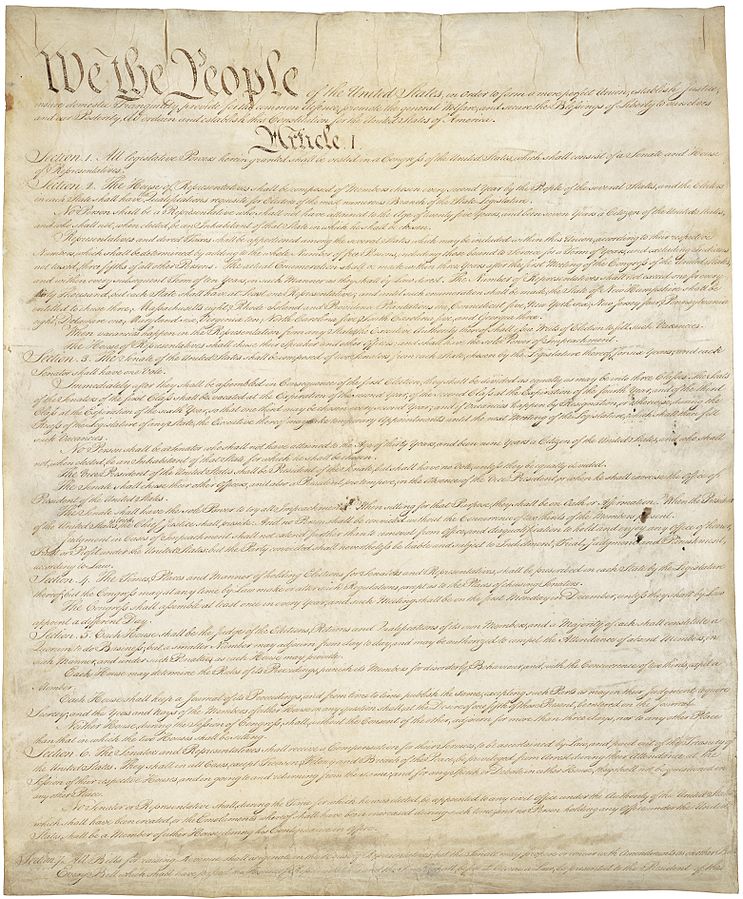
Epstein takes “originalists,” such as Justice Antonin Scalia, to task for their insistence that all constitutional issues must be based on the text of the Constitution as publicly dish_US constitution understood in 1791. Sounding very much like the “living Constitution” proponents he’s about to criticize, Epstein points out that conservative originalists cannot remain faithful to the text because “the Constitution is written in broad bold strokes, which at some points confer vast powers on government and at others impose major limitations on their exercise.”

He rejects the originalists’ “cramped mode of interpretation which, ironically, is not faithful to the dominant interpretive norms of the Founding period,” because “in no legal system at any time could the question of construction be reduced to a search for original public meaning of terms that are found in the constitutional text.” Epstein also observes that the originalist view “offers no basis for the implication of additional constitutional terms that are dependent on either government structure or the nature of individual rights.” Consequently, “a bare text raises more questions than it answers,” which make it imperative “to isolate the general theory that animates the text — usually the protection of personal autonomy, liberty, and property.”

In an earlier review, however, Cass Sunstein reminded us that progressives are the real enemies of Epstein’s vision:

To give content to what he calls (controversially) “the classical liberal vision,” Epstein offers a foil, the villain of the piece, which he calls the “modern progressive” or “social democratic” approach. He identifies that approach with the 1930s, when, he urges, policymakers jettisoned “the traditional safeguards against excessive state power.” As a matter of law, their ill-advised, and constitutionally illegitimate, reforms became possible for two reasons. First, the progressives saw ambiguity in the constitutional text, thus licensing those reforms. Second, the progressives insisted that unelected judges should recede in favor of We the People, acting through elected representatives. Epstein does not deny that the Constitution is sometimes ambiguous. Importantly, he acknowledges that “our basic conception of the proper scope of government action will, and should, influence the resolution of key interpretive disputes.” But he emphasizes that a “detailed textual analysis” has priority over our preferred views about political theory.

Much of his book consists of comprehensive and exceptionally detailed accounts of how constitutional provisions ought to be understood. In many places his discussion is highly technical, but in some important respectsof course not in allyou can take it as a careful and sophisticated guide to Tea Party constitutionalism.

(Image of first page of the US Constitution via Wikimedia Commons)

Learning From Lolita

Grace Boey explores the morality of a number of forms of sexual deviancy, using Vladimir Nabokov’s novel Lolita – in which the thirtysomething professor Humbert Humbert narrates his sexual relationship with a 12 year old girl named Dolores – as a case study of our “unresolved thoughts and feelings” about perversion. She especially notices how many readers of the book simultaneously condemn pedophilia while harboring complicated feelings about Humbert:

[I]t’s easy for readers to experience spurts of sympathy for Humbert. Dolores, after all, was the one who initiated the affair, and she was hardly unacquainted with sex when she did it, having lost her virginity at a summer camp to a young man named Charlie Holmes. Humbert paints a portrait of himself as an unwitting accomplice to the entire affair, seduced by a manipulative nymphet who was all too good at getting what she wanted. He appears, as well, to fit the criteria for pathological pedophilia or hebephilia, having exclusively been attracted to young girls from the start. Humbert, it seems, was set up for depravity from the start. It is completely natural to pity anyone set up for desires that are so strong, yet so utterly wrong and harmful.

Yet make no mistake:

despite his efforts to portray otherwise, Humbert knew exactly what he was doing when he acted upon his desires, and had numerous opportunities to remove himself from the situation long before his temptress made her advances. And the fact that she advanced upon him is of no consequence: she was still a child with a child’s mentality (as he himself observed numerous times). As the party with more experience and more power, Humbert should have known better than to succumb—and it is here that the immorality of Lolita lies.

As the novel progresses, it becomes sadly obvious that young Dolores was not fully cognizant of her best interests when she initiated the affair. Along the way she becomes irreparably damaged by their relationship: she learns to view sex as a transaction, and enters a confusing cycle of resentment and dependence on Humbert that characterizes so many real-life cases of child sexual abuse. Dolores, in the end, escapes to land up broke and pregnant in a clapboard shack, dying at the age of 17 after a stillbirth on Christmas day.

(Video: Scene from Stanley Kubrick’s 1962 film adaptation)

Saving Face

When Richard Norris was 22, he shot himself in the face. In 2012, he received a full facial transplant from a recently-deceased 21-year-old man. In a fascinating profile, Jeanne Marie Laskas describes meeting Norris:

He seems nervous. His hands tremble, bringing constant sips of water to his mouth. His lips can’t quite grip the bottle, so each sip is more a little pour. He fights a constant drool with the help of a towel. His new face is a marvel nonetheless. It’s a new face. Wide and open, the cheekbones of an Irishman and the wrinkle-free complexion of a college kid. It’s difficult to reconcile the youthful face with the body of a man nearly 40. I am trying not to stare. I am trying to stop looking for the seams, where the new connects to the old, the eyelids, the neck, the scar in front of his ears. I am trying to stop thinking about his beard, which isn’t really his beard, except now it is, and it grows. I’m distracted by a thousand little thoughts like these. Coupled with his lack of facial expression—a solid, largely unmoving veneer—in all these ways the barrier to getting to know Richard feels to me immediately and appreciably steep.

Norris now takes medicine “to keep his immune system at 50 percent strength—just enough to ward off common viral and bacteria infections but not so strong that his own antibodies attack his new face”:

“He’s not supposed to smoke,” his mom says. He can’t get sunburn. He can’t get a cold. He can’t drink. He can’t fall and risk injury. He can’t afford to tax his immune system at all. Even a cut could trigger rejection. It starts as a blotchy rash; it means his body is winning the fight to reject the transplant, and Richard has to be flown to the hospital to receive rounds of emergency drugs intravenously. Uncontrollable rejection would mean an almost certain death; the only things left of Richard’s old face are his eyes and the back of his throat. Everything else is now gone for good. “I have to keep watch that his face doesn’t go yellow,” his mom says. “He’s had two rejections so far.”

“I’ll leave you two talking,” Richard says, and he heads outside for a smoke.

In Praise Of The Unknowable

Pivoting off a recent NYT piece on the (un)knowability of the laws of nature, physicist and natural philosopher Marcelo Gleiser revisits the core of his book The Island of Knowledge:

The main point is that it is naïve to believe we can have such a thing as complete knowledge of nature. There are two essential reasons for this belief. The first is simply that to make models of nature we need data. This data comes from tools of all kinds, from microscopes and particle detectors to telescopes and mass spectrometers. Any tool has limits of precision and range. Hence, we are always partially myopic to what goes on. Tools can and will improve. But some shortsightedness will always be unavoidable.

The second reason is that nature itself operates within certain limits: the speed of light and the finite age of the universe delimit how far we can see in space and limit causal relationships; quantum uncertainties delimit what we can say about the position and velocity of submicroscopic objects, and imply in nonlocal correlations through entanglement; math itself has its limits, as Kurt Gödel explores in his incompleteness theorems. The same is true with computers, from Alan Turing‘s undecidability theorem.

His bottom line:

Unanswerable questions invoke a feeling of humility, of how science is, in essence, an ongoing mosaic of ideas, a self-correcting narrative of what we can gather of physical reality. This is far from a defeatist view; in fact, it is liberating. What could be more exciting for us to realize that knowledge is an endless frontier?