Anti-Zionism And Anti-Semitism

Pro Palestinian Demonstrations Are Held Throughout Europe

Some of the protests against the Israeli assault on Gaza have veered definitively into the realm of rank Jew-hatred. The NYT has a decent round-up of the worst today, and it’s especially troubling in France. As the world responds to Israel’s latest incursion in Gaza, Brendan O’Neill remarks on what he sees as the ever-thinning line between anti-Zionism and anti-Semitism:

[I]n the latest rage against Israel, it isn’t only the Israeli state or military that have come in for some loud flak from so-called radicals – so have the Israeli people, and even the Jews. In Paris on Sunday, what started as a protest against Israel ended with violent assaults on two synagogues. In one, worshippers had to barricade themselves inside as anti-Israel activists tried to break their way in using bats and planks of wood, some of them chanting ‘Death to Jews!’. Some have tried to depict such racist behaviour as a one-off, a case of immigrants in France losing control. But on that big demo at the Israeli Embassy in London last week some attendees held placards saying ‘Zionist Media Cover Up Palestinian Holocaust’, a clear reference to the familiar anti-Semitic trope about Jews controlling the media. On an anti-Israel protest in the Netherlands some Muslim participants waved the black ISIS flag and chanted: ‘Jews, the army of Muhammad is returning.’

His theory as to why this happens:

Why does being opposed to Israel so often and so casually tip over into expressions of disgust with the Israeli people and with the Jews more broadly? It’s because, today, rage with Israel is not actually a considered political position.

It is not a thought-through take on a conflict zone in the Middle East and how that conflict zone might relate to realpolitik or global shifts in power. Rather, it has become an outlet for the expression of a general feeling of fury and exhaustion with everything – with Western society, modernity, nationalism, militarism, humanity. Israel has been turned into a conduit for the expression of Western self-loathing, Western colonial guilt, Western self-doubt. It has been elevated into the most explicit expression of what are now considered to be the outdated Western values of militaristic self-preservation and progressive nationhood, and it is railed against and beaten down for embodying those values.

Koplow, meanwhile, flags some nasty Jew-bashing in Turkey:

Ankara’s mayor Melih Gökçek, fresh off the heels of tweeting out pro-Hitler sentiments, urged his government yesterday to shut down the Israeli embassy in Ankara, referring to it as “the despicable murderers’ consulate” and stating that “they are 100 times more murderous than Hitler.” Not to be outdone, Bülent Yıldırım, the odious head of the “humanitarian relief NGO” IHH – the same NGO that organized the Mavi Marmara flotilla – warned Jewish tourists (yes, he said Jewish rather than Israeli, and yes, that was deliberate on his part) not to show their faces in Turkey and threatened Turkish Jews that they would pay dearly for Israel’s actions in Gaza. …

I get the anger and frustration, and I see it personally from Turkish friends on my Facebook feed and my Twitter stream, who are furious with Israel not because they are Jew-hating anti-Semites but because they deplore the mounting civilian death toll in Gaza, which they see as disproportionate and excessive. … But there is a world of difference between criticizing Israel out of a deeply held difference of opinion versus comparing Israelis to Hitler, equating Israel with Nazi Germany, throwing around the term genocide, openly advocating violence against Israeli nationals and property, and threatening Jews over Israel’s behavior. It is completely beyond the pale, and anyone who cares a lick about liberal values should be denouncing it loud and clear without qualification.

Amen.

Update from a reader:

The Dish cites the incident outside the Synagogue de la Roquette, which has been basically debunked/seriously disputed – the President of the synagouge himself confirming the details of this alternative report, on video.

(Photo: A Pro-Palestinian demonstrator holds a placard with the symbols ‘Swastika equal to Star of David’ during a demonstration on July 17, 2014 in Madrid, Spain. By Pablo Blazquez Dominguez/Getty Images.)


Borderline Politics On The Left

Josh Kraushaar casts doubt on the notion that immigration reform is a winning issue for the Democrats:

The conventional wisdom has long held that immigration is the equivalent of Kryptonite for Republicans: If they don’t pass comprehensive reform, their party is writing its own extinction. Indeed, GOP officials have been publicly telegraphing their own vulnerabilities on the subject for years, highlighted by a 2013 RNC-commissioned report where immigration was the only policy area where the authors recommended the party moderate its positioning.

But what if that isn’t the case? A look at the current politics surrounding immigration suggest that Democrats are facing as much conflicting internal pressures from the current border crisis as Republicans face from their own base when it comes to “amnesty,” or legalizing illegal immigrants. President Obama is caught between his base, which has been pushing him to treat the migrants as refugees and settle them in the country, and the majority of voters, who believe that most should be returned to their home countries.

If the House Judiciary Committee’s numbers are correct, the base is winning that particular fight. Byron York relays the new figures, which show that “the ‘vast majority’ of unaccompanied minors seeking asylum are granted it before even appearing before a judge”:

“Information from U.S. Citizenship and Immigration Services (USCIS) that shows 65 percent of unaccompanied alien minors’ asylum applications have been immediately approved by asylum officers in Fiscal Year 2014,” says a Judiciary Committee statement. “And this is just the first bite of the apple. Many more cases can be approved later. Where an asylum officer does not approve the application, it is then referred to an immigration judge where the applicant can try again. If that fails, they can continue to appeal their case.”

The Judiciary Committee says asylum approval rates have “increased dramatically” under the Obama administration. Overall, according to the committee statement, “Approval rates by asylum officers have increased from 28 percent in 2007 to 46 percent in 2013 and approval rates by immigration judges in affirmative cases have increased from 51 percent in 2007 to 74 percent in 2013.” And that does not count appeals.

On the other hand, it’s not as though the GOP is offering any great alternatives. Alex Nowrasteh slams the Asylum Reform and Border Protection Act, introduced in the House last week, which would expedite deportation procedures for undocumented minors:

H.R. 5137 allows children apprehended at the border to be removed without any asylum screening to a “safe third party country” (i.e. Mexico) without an agreement from that country, as is required by current law. If H.R. 5137 becomes law, the U.S. government would immediately start dumping Honduran, El Salvadoran, and Guatemalan children into Mexico.

The crisis along the Southwest border has prompted many Americans to want all unlawful immigrants and children removed. But this bill goes far beyond that desire. H.R. 5137 would remove many foreigners who have legal rights under our current immigration laws. H.R. 5137 would be a disastrous blow to America’s asylum system and send numerous children with legitimate asylum claims back into danger.

Recent Dish on immigration politics and the border crisis here, here, and here. Read our complete coverage of the crisis here.

Your Home Will Be Destroyed In One Minute, Ctd

Martin Longman isn’t buying Israel’s claim that its warning shots are a humane gesture:

What’s clear is that these operations have a different purpose than killing individuals who belong to Hamas. The purpose is to make it clear that belonging to Hamas will cause your family to lose their home and quite possibly their lives. Even living in the same building as a Hamas member or maybe even in the house next door or across the street is a threat to your whole family.

This policy, then, is designed to turn the Palestinian population against Hamas.

It’s designed to make families disown children who fraternize with Hamas. It’s designed to cause apartment dwellers to purge their buildings of tenants who work with Hamas. The Israelis have a term for people who don’t leave their dwellings once they have been warned that a Hamas member is living among them. They are “human shields.” And, as human shields, they have made a decision that denies them any further human rights. …

Perhaps this policy can force Palestinian patriarchs (or matriarchs) to forbid their sons and daughters from associating with Hamas, but if Hamas goes away will their replacements be better? More compliant? Easier to negotiate with? This is a policy of beating people into terrified submission, but similar policies in the recent past have only seemed to bring short stints of calm. The Israelis call this “mowing the lawn.” The grass always grows back, and quicker if it is nourished with rain.

Watch an example of the other terrifying euphemism – a “knock on the roof” – here.

Why Not Have A Two-Tiered Medical System?

Richard Gunderman argues in favor of concierge medicine, a system in which patients pay hefty fees to spend more time with their doctors:

The concierge model of practice is growing, and it is estimated that more than 4,000 U.S. physicians have adopted some variation of it. Most are general internists, with family practitioners second. It is attractive to physicians because they are relieved of much of the pressure to move patients through quickly, and they can devote more time to prevention and wellness….

Of course, there are drawbacks to concierge practice. For one thing, some patients cannot afford it, and others will choose not to pay the fee. Critics also see such models as promoting a two-tiered system of healthcare, in which those with more money get better care.

“But we have always had a two-tiered system,” [internist Frederic] Becker counters, “and it is better to care for 600 patients well than just adequately for three or four times that number. Someday patients, physicians, and healthcare payers will recognize that slower-paced but truly high-quality medical care is a better value than the fast medicine many physicians feel pressured to practice today.”

Meanwhile, Christopher Flavelle fears the rise of specialists who demand cash payments:

The slice of the population that’s willing and able to pay for specialty care in cash is small; the share of physicians in cash-only practices was just 6 percent last year. But that’s double the level from 2011. And if the income gap keeps growing, so will the number of doctors who can find enough cash-only patients to stop taking insurance. …

If the trend accelerates, it may call for new guidelines from the American Medical Association. The AMA now says doctors moving to cash-only practices must “facilitate the transfer of their non-participating patients to other physicians” – for instance, not charging for the transfer of medical records. If no other physicians are available in the community, the doctor “may be ethically obligated to continue caring for such patients.” The AMA also reminds doctors of their “professional obligation to provide care to those in need.” Those guidelines may start to look too vague if the best specialists drop out of the insurance system altogether.

Previous Dish on concierge medicine here.

The Most Egalitarian Of All Possible Worlds?

poverty world

Pointing to a new study showing that income inequality is rapidly declining at the global level, Tyler Cowen argues that the redistribution favored by egalitarian movements in the US would end up hurting international prosperity:

Although significant economic problems remain, we have been living in equalizing times for the world — a change that has been largely for the good. That may not make for convincing sloganeering, but it’s the truth. … Many egalitarians push for policies to redistribute some income within nations, including the United States. That’s worth considering, but with a cautionary note. Such initiatives will prove more beneficial on the global level if there is more wealth to redistribute. In the United States, greater wealth would maintain the nation’s ability to invest abroad, buy foreign products, absorb immigrants and generate innovation, with significant benefit for global income and equality.

Mark Perry backs up Cowen’s thesis with the above chart. But Daniel Little criticizes Cowen’s “Panglossian” picture of global inequality:

Cowen bases his case on what seems on its face paradoxical but is in fact correct: it is possible for a set of 100 countries to each experience increasing income inequality and yet the aggregate of those populations to experience falling inequality. And this is precisely what he thinks is happening.

Incomes in (some of) the poorest countries are rising, and the gap between the top and the bottom has fallen. So the gap between the richest and the poorest citizens of planet Earth has declined. The economic growth in developing countries in the past twenty years, principally China, has led to rapid per capita growth in several of those countries. This helps the distribution of income globally — even as it worsens China’s income distribution.

But this isn’t what most people are concerned about when they express criticisms of rising inequalities, either nationally or internationally. They are concerned about the fact that our economies have very systematically increased the percentage of income and wealth flowing to the top 1, 5, and 10 percent, while allowing the bottom 40% to stagnate. And this concentration of wealth and income is widespread across the globe.

Ryan Avent pushes back as well:

There is an alternative hypothesis, however, which Mr Cowen mostly disregards: that redistribution provides insurance against economic dislocation and therefore softens resistance to globalisation. It’s worth pointing out that the world has experienced two great eras of globalisation. The first combined minimal redistribution with minimal political power for non-elites. The second combined universal suffrage with substantial redistribution. I don’t think it’s unreasonable to conclude that redistribution is the price democracies pay for globalisation.

And that makes perfect sense! Reducing barriers to trade generates net gains, but those gains will occasionally be distributed in highly unequal fashion. If gains are concentrated and no provision is made for redistribution, then a voting majority might well conclude that openness is a losing proposition. Mr Cowen seems to want voters to recognise that whether or not they personally are made better off by globalisation it is a good thing to support, because it enables the enrichment of poor areas of the globe. But few voters are content to have their economies run as charities (and a good thing for economists that they aren’t, as that would make a baseline assumption of rational self-interest look pretty absurd).

Are We Abetting Central American Gangs? Ctd

EL SALVADOR-GANGS-TRUCE

Alec MacGillis shines a light on US gun trafficking to Central America, making the argument that our loose gun regulations are contributing to these countries’ gang violence problem:

According to data collected by the ATF, nearly half of the guns seized from criminals in El Salvador and submitted for tracing in the ATF’s online system last year originated in the U.S., versus 38 and 24 percent in Honduras and Guatemala, respectively. Many of those guns were imported through legal channels, either to government or law enforcement agencies in the three countries or to firearms dealers there.

But a not-insignificant number of the U.S.-sourced gunsmore than 20 percent in both Guatemala and Honduraswere traced to retail sales in the U.S. That is, they were sold by U.S. gun dealers and then transported south, typically hidden in vehicles headed across Mexico, though sometimes also stowed in checked airline luggage, air cargo, or even boat shipments. (Similar ratios were found in traces the ATF conducted in 2009 of 6,000 seized guns stored in a Guatemalan military bunker40 percent of the guns came from the United States, and slightly less than half of those were found to have been legally imported, leaving hundreds that were apparently trafficked.)

“It is a problem,” says Jose Miguel Cruz, an expert in Central American gang violence at Florida International University. “The problem is we don’t have any idea how many [of the trafficked guns] there are. It’s a big, dark area.”

Cynthia Arnson, director of the Latin American Program at the Woodrow Wilson International Center for Scholars, tells Dylan Matthews that an effective US response to the crisis must address its root causes:

Of the $3.7 billion requested by the administration for dealing with the child migrant crisis, a very small percentage of it, about $295 million, goes to addressing root causes of the violence. I think that ever since the United States, starting with the end of the Bush administration, began to pay more attention to Central America as the drug violence was spilling over from Mexico to Central America, there’s been an overemphasis on security and controlling drug trafficking and also just not enough resources overall. …

There’s been a focus in the US and elsewhere in the region on capturing drug kingpins, but I think a lot of people who have looked at this, given the weakness of institutions, including police and law enforcement, including the judiciary, have said that a better approach is to try to reduce the violence connected with local illegal markets, and focus on providing citizen security to the general population. You can’t abandon the attempt to capture major traffickers, but you cannot do that without providing for safer communities and creating greater resilience at the individual and the community level.

Previous Dish on the violence in Central America and the US’s role in it here and here.

(Photo: A member of the “18 street” gang takes part in an event to hand in weapons in Apopa, 14 Km north of San Salvador, El Salvador on March 9, 2013. Gang leaders surrendered about 267 weapons as part of the truce process between gangs in El Salvador. By Jose Cabezas/AFP/Getty Images)

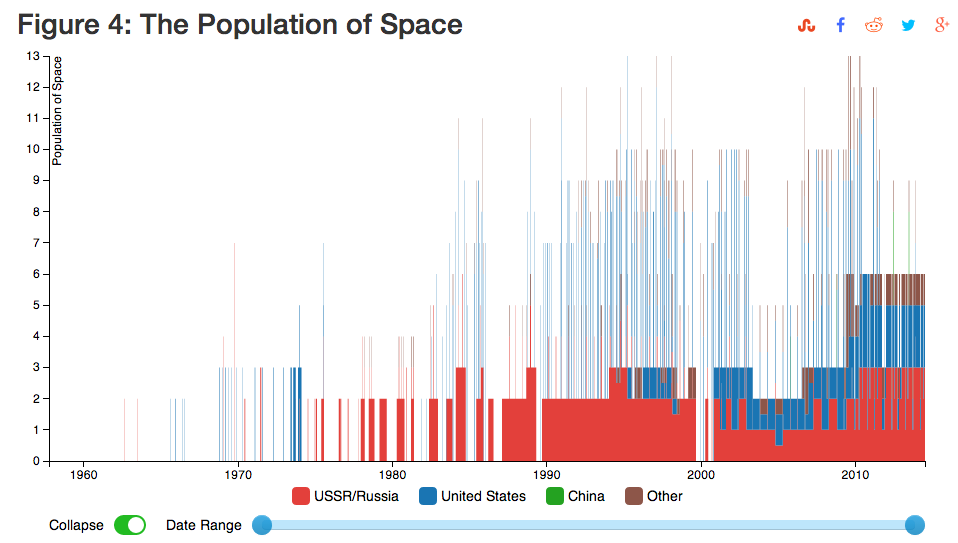
The Final Frontier: Population 6

To mark the 45th anniversary of the Apollo moon landing, Nefarious Plots charted the total number of humans in space over time:

Space Population

Interactive version of the chart here. Susannah Locke captions:

Check out the big, red USSR/Russian blocks versus those skinny American lines in blue. That’s because the American presence in space has often consisted of shorter missions. A lot of this discrepancy has to do with access to space stations, where people can hang out for long periods, sometimes even longer than a year at a time.

All-You-Can-Read

Hayley Tsukayama urges consumers to be honest with themselves about their reading habits before signing up for Amazon’s new literary service:

Kindle Unlimited is $9.99 per month. So you’ll be paying Amazon, whose chief executive Jeffrey Bezos owns The Washington Post, around $120 per year for the unfettered e-book access. If you’re habitually spending money on more than one book per month, then it’s a service to think about. It has its perks for big book buyers – namely that don’t have to worry about spending money on a book you end up hating.

But, chances are, you aren’t reading more than one book per month. In January, the Pew Internet and American Life Project asked how many books the typical American had read in the past year.

The answer? Five.

Maria Bustillos contends that “it shouldn’t cost a thing to borrow a book”:

For a monthly cost of zero dollars, it is possible to read six million e-texts at the Open Library, right now. On a Kindle, or any other tablet or screen thing. You can borrow up to five titles for two weeks at no cost, and read them in-browser or in any of several other formats (not all titles are supported in all formats, but most offer at least a couple): PDF, .mobi, Kindle or ePub (you’ll need to download the Bluefire Reader—for free—in order to read ePub format on Kindle.) I currently have on loan Alan Moore’s WatchmenOriginal Sin by P.D. James, and The Dead Zone by Stephen King.

Alison Griswold concentrates on the business angle:

Kindle Unlimited will add a new layer of complexity to negotiations between Amazon and publishers. So far, it seems that most of the big-name publishers haven’t agreed to let their titles onto the subscription platform. Books published by HarperCollins and Simon & Schuster aren’t offered and those from Penguin Random House are notably absent. Amazon has not said how authors and publishers will be paid for participating in Kindle Unlimited, but it’s unlikely that the models currently used for e-book sales through its store will do the trick.

Brian Heater is concerned that writers like him will get screwed:

We’ve all heard the horror stories of the fractions of cents being doled out by Spotify, with the justification that many musicians make their mint touring anyway. For one thing, that’s hardly a universal and for another, where’s the author’s analog to touring? Unless you’re, say, Hillary Clinton pulling in $200,000 per speaking engagement, no one’s paying big bucks to watch you read. You’re there to sell more books.

The other justification for music-streaming services is the notion that people who really love a record will go out and buy it. Perhaps I’ve just become too immersed in the world of e-books too quickly, but I’m having difficulty imagining a scenario in which I run out and buy a hard copy of a book after reading the electronic version. It certainly hasn’t happened to me yet – I also haven’t found myself going back and re-reading too many e-books to this point.

Joshua Gans fears that Amazon’s new service will discourage the creation of long books:

Amazon’s payment to authors is similar to its payment to them for the Kindle Owner’s Lending Library. There is a fund (amount = F) that is set monthly by Amazon. If there are a certain number of books downloaded that month (N) and your book is downloaded n times, you receive (n/N)*F in payments that month. That’s for lending. For books under the Unlimited plan, they have to be at least 10% ‘read’ (on the assumption that flipping 10% of the pages is the same as reading them). And so your share is based on how often your book is minimally read. Basically, people can try before they buy with their attention.

Now this plan isn’t all rosy because while it rewards books that are readable, it does so asymmetrically. For instance, Piketty’s recent book has 696 pages whereas mine most recent one has 93. Suffice it to say, Piketty will receive the same payment for another book read this month beyond 70 pages as I would get for 10. That strikes me as amiss.

Konnikova, meanwhile, looks at the impact digital devices have on the reading experience:

When Ziming Liu, a professor at San Jose State University whose research centers on digital reading and the use of e-books, conducted a review of studies that compared print and digital reading experiences, supplementing their conclusions with his own research, he found that several things had changed. On screen, people tended to browse and scan, to look for keywords, and to read in a less linear, more selective fashion. On the page, they tended to concentrate more on following the text. Skimming, Liu concluded, had become the new reading: the more we read online, the more likely we were to move quickly, without stopping to ponder any one thought.

The online world, too, tends to exhaust our resources more quickly than the page. We become tired from the constant need to filter out hyperlinks and possible distractions. And our eyes themselves may grow fatigued from the constantly shifting screens, layouts, colors, and contrasts, an effect that holds for e-readers as well as computers.

Not Single-Issue Voters

Reacting to the “Beyoncé voters” meme spawned by that awful Fox segment, Tanya Basu warns against seeing single women as a monolithic voting bloc:

The only thing that unites all single women is their marital status. That’s it.

Simply looking at their marital status doesn’t begin to speak to the complexity of their lives. Some have been married before. Some are in relationships. Some are engaged. Some have children. But at this moment, just about the only thing linking the struggling single mother working a minimum-wage job and the middle-aged businesswoman with a swanky Upper East Side apartment is the lack of jewelry on their left ring finger.

Basu also reminds us that female voters’ concerns do not always center on gender-related issues:

While many women do care a great deal about contraception and equal pay, the biggest concern most women have right now is how the leaders we elect will create a job-friendly environment. Since single women earn less than single men and married women, their jobs are extremely important, especially if they’re trying to get health insurance for themselves and/or their children. They were hit especially hard by unemployment during the Great Recession. And job security isn’t just on the minds of 20-somethings: Senior single women are facing increasing economic insecurity too. In other words, birth control isn’t what will get single women (or for that matter, anyone) to the polls come November. It’s jobs and economic stability.