How Widespread Is Islamophobia?

Brendan O’Neill calls it a “myth”:

Sure, some folks in Europe and elsewhere no doubt dislike Muslims, just as other losers hate the Irish or blacks or women. But the idea that there is a climate of Islamophobia, a culture of hot-headed, violent-minded hatred for Muslims that could be awoken and unleashed by the next terror attack, is an invention. Islamophobia is a code word for mainstream European elites’ fear of their own populations, of their native hordes, whom they imagine to be unenlightened, prejudiced, easily led by the tabloid media, and given to outbursts of spite and violence.

The thing that keeps the Islamophobia panic alive is not actual violence against Muslims but the right-on politicos’ ill-founded yet deeply held view of ordinary Europeans, especially those of a working-class variety, as racist and stupid. This is the terrible irony of the Islamophobia panic: The fearers of anti-Muslim violence claim to be challenging prejudice but actually they reveal their own prejudices, their distrust of and disdain for those who come from the other side of the tracks, read different newspapers, hold different beliefs, live different lives. They accuse stupid white communities of viewing Muslims as an indistinguishable mob who threaten the fabric of European society, which is exactly what they think of stupid white communities.

Dreher is on the same page:

Are there people who hate Muslims simply for being Muslim? Sure. Are there people who respond to Islamic terrorism through acts of bigotry, even violence, against mosques and Islamic institutions? Yes. And shame on them all. Hunt them down, arrest them, throw them in jail.

But there are no anti-Muslim mobs massing in the streets. The mob that massed in the streets of Paris and other European cities on Sunday to protest jihad did not disperse and burn down mosques on their way home (unlike mobs in Muslim countries that torched embassies to protest Muhammad cartoons a few years back).We are not them. We once were, and are capable of becoming them again, as the history of the West shows, but we are not them now.

Friedersdorf counters:

My notion that Islamophobia, or irrational fear of mainstream Muslims, is a recognizable feature of post-9/11 America is informed by the several cities that have attempted to stop the construction of mosques, state attempts to ban sharia law as if we’re on the cusp of being ruled by it, fears that Barack Obama is a secret Muslim, profiling of Muslim college students for no reason other than their religion, the anti-Muslim training materials that the FBI somehow adopted and used after 9/11, and dozens of Muslims I’ve interviewed who say that other Americans are more fearful of them than was the case prior to the September 11 attacks.  …

There has not, of course, been a mass violent uprising against Muslim Americans, or British Muslims, or Australian Muslims, or French Muslims. The implication that it’s therefore irrational to worry about anti-Muslim bigotry or backlash is bizarre. A spike in hate crimes is enough to justify concern and attempts to preempt—surely it’s better to nip the impulse to exact group revenge on Muslims in the bud rather than to act only if a catastrophic backlash has already taken shape!

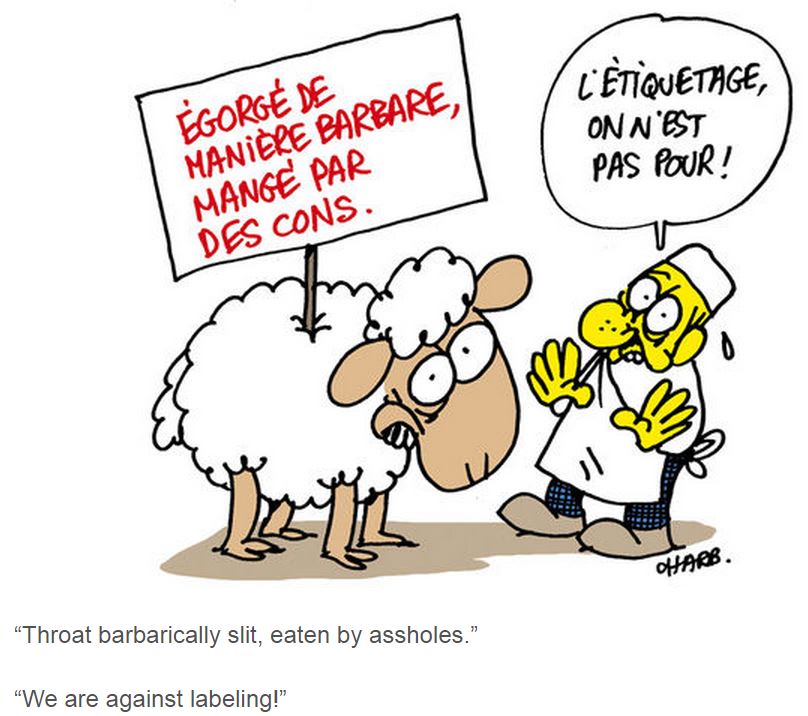
Another Cause Championed By Charlie

charlie-animal-rights

From the in-tray’s most frequent and passionate advocate of animal rights:

I give Charlie Hebdo the benefit of the doubt on allegations of racism and any other accusation of lack of compassion. Why? Because it has shown more compassion than virtually everyone else in the world when it came to the abuse of the most defenseless individuals: “Charlie Hebdo is the only French newspaper that dedicates a weekly column to animal rights, tackling issues such as bullfighting and foie gras.”

One example above. Nine more here.

The Showdown Over Keystone, Ctd

A reader huffs:

Regarding Dave Roberts’ comment that blocking Keystone “will show that there’s life in the climate movement”, I beg to differ.  Keystone is a symbolic victory without any substance; if the moral victory is to “show that people can mobilize around climate with the numbers”, congratulations, you just won a victory that has zero effect on climate change.

I’ve been an environmentalist since I was a kid roaming the mountains of New Hampshire and the backwoods of Maine, but I cringe at supporting any environmental group that is focusing on Keystone.  Today my charitable giving instead goes to groups like the Nature Conservancy that are actually working to protect forests, make coral reefs more resistant to climate change, and otherwise finding practical solutions instead of spending their resources fighting moral victories. If Roberts’ “climate movement” wants me to join them, start picking battles that actually matter – write a bill that sets national renewable standards, or that creates long-lasting incentives for non-carbon energy sources, or something that ACTUALLY MAKES A DIFFERENCE for the climate, and I’ll happily join the cause.

Another counters:

You quote a reader who says “Believing that stopping XL will benefit the environment is just sticking your head in the oil-sands.” Then you allow Dave Roberts to counter, with his claim that such commentators “apply wonk logic to an activist problem.”  Not at all.  If fact, it’s the “wonk logic” of your reader that’s off track.

Max Auffhammer, an environmental economist at UC-Berkeley, did the math last March and estimated that “not building Keystone XL will likely leave a billion barrels worth of bitumen in the ground.” All that bitumen simply cannot get out of Canada fast enough on trains.  If Keystone XL goes down, a lot of CO2 will never enter earth’s atmosphere. McKibben isn’t right on everything, but he’s at least partly right on this.

Another:

To the reader who asked for a dose of reality when it comes to building Keystone; yes, this Liberal will give you that the oil will come out regardless of whether or not Keystone is built.  Since we’re being honest, time for some honesty from the other side as well. First, stop saying this is about jobs.  Why do the oil companies want the pipeline? Because it lowers their cost to get the product to market.  The money they would pay to thousands of truck drivers and train companies they now get to keep.  Yes, there will be some temporary construction jobs created, but once the pipeline is built, it will take very little people to manage, so the net impact will be less jobs.

More honesty?  Whether Keystone is built or not, it will have zero impact on oil prices and therefore no impact on everyday Americans.  Even more?  Yes, the likelihood of a spill is less for the pipeline versus rail/truck, but the pipeline is carrying significantly more oil and a leak can go undetected for some time, so the chance is less but the impact is much, much larger.

So the last reality I’d like to reader to face is this has nothing to do with helping middle/lower class in this country.  This is about people in the oil industry making as much money as they possibly can.

On that note:

As you’re covering the Keystone XL activity today/this week, I hope you’ll include an important factor in these votes and debates that isn’t getting covered: the $721 million the energy industry spent in the 2014 midterms to put industry-friendly politicians in Congress.

It’s no surprise that congressional leaders are so focused on passing Keystone their first weeks back in Washington. Despite this clear connection, most of the Keystone coverage has not highlighted how much the fight for this bill on the House and Senate floors is directly tied to the fundraising dollars that politicians received from big oil. Here are few valuable resources for you if you’re looking into how big oil has influenced the movement on Keystone:

  • How oil and gas lobbying money and election donations have influenced votes in Congress, like promoting offshore drilling or stopping clean energy initiatives, that go directly against the interests of the majority of Americans;
  • How coal, oil, and gas industries have worked behind the scenes to encourage easing restrictions on private money in elections and to strip disenfranchised communities of their voting rights

The New Charlie Issue Sold Out

Charlie Hebdo #1178 January 14, 2015

This embed is invalid


Within minutes:

At a news kiosk across from Paris’ city hall early on Wednesday morning, there was already a line before sunrise at 7:15 a.m. – 45 minutes before the newsstand was supposed to open. The stand opened at about 7:50 a.m., and by around 7:55 a.m., there were as many as 40 people in line. By 8:15 a.m., the newsstand had sold out.

The newsstand’s owner automatically handed people copies of Charlie Hebdo when they got to the front of the line, knowing they weren’t looking to buy any other newspaper. He wouldn’t sell more than one copy to each customer — “I don’t have enough,” he explained.

And good luck trying to buy the magazine in the US:

The short answer: finding a copy outside France on Wednesday will be tough. But that may change in the days that follow, especially if there are additional printings.

However, you can browse the issue using the above PDF, which Prachi Gupta passed along. Tracy McNicoll reads through it:

Under extraordinary circumstances, the surviving staff of Charlie Hebdo has produced an issue that is perfectly true to type: Defiant, uncompromising, funny, sometimes bittersweet, but with nary a hint of the melodramatic. None of the murdered staffers are left out and, just as they would have liked, no target for ridicule is spared.

Ruinous Beauty

State-Hospital-1

In an interview about their work photographing abandoned buildings, Rusty Tagliareni and Christina Matthews respond to a question about the ethics of what they do and why the things they capture are more than just “ruin porn”:

To us this is history. Perhaps at its most raw, but also at its most accessible. We have spoken at school seminars from elementary to high school levels, about the importance of photojournalism. If you can gain someone’s attention, through interesting photos and videos, then you open them up to learning. It’s really that simple. Case in point:

a while back we spoke at a high school, one of the topics was about documenting abandoned asylums. Of course abandoned asylums are of interest to teenagers, they’re mysterious and full of ghost stories. The imagery of decaying buildings is a hook, upon which you attach information. Well, by the end of the 45 minute session the class knew all about the history of mental healthcare, evolution of modern day pharmaceuticals, and the de-institutionalization of the country. We know this because after each session we heard people in the hallway telling others about not only the abandoned buildings, but why they became abandoned, and why there are no longer a need for such large facilities. They all listened to what we spoke about, and they retained the knowledge because it was linked with things that piqued their interest. Our website is just a history lesson wrapped up in some cool aesthetics.

(Photo of Pilgrim State Hospital in Long Island, NY, at one time the largest psychiatric institution in the world. Used with permission of Antiquity Echoes)

Busted With An Eggcorn, Ctd

Just when we thought the thread was over:

I grew up visiting a cabin in the Sierra that my grandfather built after WW2, when my dad was little.  Many of the stories about the cabin involved a Scandinavian journeyman carpenter they hired to help build it.  Because of this, for much longer than I care to admit, I thought a finish carpenter was a carpenter from Finland.

Another:

I fly up and down the East Coast a lot.  For a while I was puzzled about the flight attendants’ announcement about putting “your rollerboards” in the overhead compartments … until I realized that “rollerboards” is a corruption of “roll-aboards” – what small bags with wheels were called when they first came on the market.

Another:

My associate just tried to describe someone as shady and said: “He is all smoky mirrors,” instead of smoke and mirrors.  I told her about your eggcorn thread and warned her that I would be submitting this.

Busted. Many more eggcorns below:

OK, I don’t know if you’ve heard this one already, but …

In the third grade, shortly before Christmas, we were coloring pictures to take home to our parents.  Incidentally, it was Maryland in the 1950s, when each school day began with a prayer, and there certainly was no pressure to avoid religious themes.  A friend of mine drew a nativity scene that included a short, fat man over by the side, among some of the animals.  The teacher was prompting each of us to describe our work, and she asked my friend who the rotund gentleman was.  His reply was that it was Round John Virgin.

Another:

From my French-speaking, Tunisian sister-in-law yesterday: “We should go back there, because it will be a safe heaven.”

Another:

You may be oversaturated with these, but I can’t resist the best one I have seen. I am an appeals prosecutor and read a lot of trial transcripts.  One time an attorney said he wanted to be sure his client’s rights were protected, and the trial judge, known for his loquaciousness, said (according to the transcript), “We try to protects a defendant’s rights deciduously.”  He obviously said “assiduously,” and the court reporter got it wrong.  I couldn’t resist sending a copy of the transcript page to the judge and the defendant’s attorney with the question:  should we be protecting a defendant’s rights deciduously or coniferously?

Another:

Read this today on The Atlantic’s readers’ discussion page:

This administration, beyond being the most polarizing and immature in history, is utterly and completely tone-death.

Tee hee.

Another:

Sorry to be so late with this one, but these eggcorns are hilarious. Many years ago I was at a meeting in a Midwestern city.  One evening a colleague and I went to an English-style restaurant, where the waitresses were referred to as “wenches” (this was in the 1980s).  I ordered roast beef, and the “wench” asked me if I wanted O Juice with it.  I readily said yes.  When we were served, my friend wondered where the orange juice was.  Actually, I was responding to a familiar question that dated to the cafeteria in college, where they often served roast beef “au jus,” but the servers would always ask us if we wanted O Juice with it.

Another:

My sister always wanted to be outside playing with the boys; she resented it when grandmother kept her indoors to learn to knit and sew and do “crewel work.”  I’m sure the frustration contributed to her habit, ever after, of calling it “cruel work.”

Another:

My wife’s grandmother, a sweet lady from the hills of Kentucky, wrote us that she was diagnosed with “high potension.” We were stumped. Hypertension.

One more:

My son’s eggcorn harkens back to the original.  As a preschooler many years ago he understood that acorns came from oak trees.  He then extended the concept to pine trees, calling pinecones pinecorns.  No amount of gentle correction made any difference.  They remained pinecorns for a long time.

Another reader takes a stab at a new subject:

If you’re stopping eggcorns, how about some spoonerisms? JUST THIS SECOND I made up a cool spoonerism from a passing conversation, a habit of mine. I like how it sort of mirrors the original phrase which I think aficionados score extra points for: “Roars to be fecund with.” You’re welcome.

Update from another:

Oh man, I can get on board this spoonerism train. My favorite to date is a take on describing something as highly active/pungent: “kicking like Bruce Lee” turns into “kicking like loose bree.”

And to add to the eggcorns, growing up, my sister didn’t like to make any hard and fast plans, but just “play it by year.” We rib her about that to this day.

Another:

A contribution to your never-ending thread: The head of the local home-school association once wrote, in a newsletter item following a school vacation, that she hoped everyone had had a nice “restbit.” I’ve used that ever since; it sounds even more pleasant than a respite.

Art By Numbers

15682222290_d59dc91240_k

Leann Davis Alspaugh laments the intrusion of smartphones into art museums, not least because of the newfangled “digital beacons” that mine them for data about the viewing habits of those who carry them:

These small wireless transmitters, now at the Los Angeles County Museum of Art and the Guggenheim, for example, can track how fast visitors move through the galleries and which pieces draw the greatest crowds.

The Polish developers of the Estimote digital beacon call their product a “super small computer,” one compatible with all major smart devices and energy efficient. The pastel-colored, irregularly faceted carapace also makes the Estimote uniquely recognizable, a design improbably incorporating the organic and the high tech. The beacons work through a combination of Bluetooth signals and cloud-based data storage. Suddenly made aware of their “innovation deficit,” museums find themselves rushing to hire data analysts and IT departments to crunch numbers and troubleshoot servers.

The pressure to exploit new technology is strong for museums, as one official noted in a recent Wall Street Journal report, to discover not simply “what’s significant art historically but also what’s perhaps on trend.” Big data can be used to point curators toward what people really want to see in exhibitions. “The customer is king” is marketing’s most basic lesson, but in this case only practicable if exhibitions are assembled like products plucked off of a warehouse shelf. Most museum exhibitions are the product of years of planning and negotiation, not to mention navigating logistics, customs, and insurance complications. And let’s not even think about placating private donors or ensuring that artworks are real and have uncontested rights and provenances. To add to these challenges the pursuit and identification of fleeting trends hardly seems a way to enhance the museum experience or to help it fulfill its educative function.

(Photo from the Memorial Student Center at Texas A&M University)

Not Going With The Flow

Reviewing Nicholas Carr’s The Glass Cage: Automation and Us, Alan Jacobs underscores the way often otherwise helpful technologies can rob us of “flow,” the experience of “total absorption in the task at hand, in which body, mind, and environment seem to cohere into a single gestalt.” Examples include Inuits navigating the snow and ice in traditional ways, and pilots who flew without GPS. Jacobs concludes that Carr raises important points that shouldn’t be dismissed as nostalgia:

Carr wants us to ask what value we place on the loss of opportunities to experience flow—the loss even of opportunities to develop and exercise skills that challenge and reward us. Carr readily admits that these are extraordinarily difficult questions. “How do you measure the expense of an erosion of effort and engagement, or a waning of agency and autonomy, or a subtle deterioration of skill? You can’t. Those are the kinds of shadowy, intangible things that we rarely appreciate until after they’re gone, and even then we may have trouble expressing the losses in concrete terms. But the costs are real.” They are real for the Inuit, they are real for pilots, and they are real for us.

Nicholas Carr is asking us to count those costs, as a prelude to figuring out whether we can minimize them. Scanning through the early reviews of The Glass Cage, I can’t help noticing how deeply reluctant people are even to begin addressing the questions he raises. I have seen Carr called a Luddite (of course), a paranoiac, and even a “scaredy-cat.” And among the leading apostles of automation, Carr has discerned an Orwellian tendency to portray costs as benefits. He notes that “Peter Thiel, a successful entrepreneur and investor who has become one of Silicon Valley’s most prominent thinkers, grants that ‘a robotics revolution would basically have the effect of people losing their jobs.’ But, he hastens to add, ‘it would have the benefit of freeing people up to do many other things.'” Ah, that’s better. As Carr wryly notes, “Being freed up sounds a lot more pleasant than being fired.”

Nous Sommes Charlie, But Do We Really Want To Be? Ctd

More reader feedback on this long and comprehensive thread:

Jonah’s Jordanian friend raised the tired and disingenuous claim of freedom of speech never being raised for people convicted of anti-Semitic speech in France, or elsewhere in Europe/the larger West, or hate speech convictions being reserved for Antisemitism. This is such a trope, and is extremely annoying to anyone (I’m a South Asian Muslim) who believes in the absolute right Funeral ceremony held for Ahmed Merabet in Parisof free speech (or at best, the 1st Amendment/Brandenburg Test), because European nations have a long history of criminalizing anti-Islamic speech or anything deemed too hurtful to Muslims.

Denmark, for example, convicted an ex-Muslim Iranian of being racist against Muslims. The UK routinely convicts people of anti-Muslim tweets or Facebook posts and stupidity, such as a year-long jail sentence or having an anti-Islamic poster in your window. Burning of a book (The Koran/Quran) can land you in jail for 70 days. In the UK. Conviction for anti-Muslim posters or speech or burning of a book is routine across Germany or Belgium or anywhere else in sensitive Europe. A racist joke is criminal in Sweden and a Finnish MP can be convicted of hate speech. The French have convicted Brigitte Bardot more than once for anti-Muslim immigrant and anti-Islamic speech and convictions for anti-Muslim speech are common in France.

Jews and Muslims are very well protected by the speech police in Europe. Any attempts to show the supposed “hypocrisy” of free speech campaigners is disingenuous. European-style hate speech laws are misguided but have protected European Muslims.

Another reader:

RE: the Jordanian friend, isn’t the reason obvious? France was complicit and helped in rounding up and sending Jewish people to execution camps. The legacy of Nazism is why anti-semitism is particularly taboo in Europe. I don’t think Dieudonné should have been jailed, but there are obvious historic reasons why anti-antisemitism is treated differently in Europe than other forms of offensive speech.

Regarding the third Abrahamic religion, another notes that “France banned an ad depicting Jesus as a female because of its ‘intrusion on people’s innermost beliefs.'” Meanwhile, like many others, Kenan Malik rejects the notion that Charlie is racist:

What is really racist is the idea that only nice white liberals want to challenge religion or demolish its pretensions or can handle satire and ridicule. Those who claim that it is ‘racist’ or ‘Islamophobic’ to mock the Prophet Mohammad, appear to imagine, with the racists, that all Muslims are reactionaries. It is here that leftwing ‘anti-racism’ joins hands with rightwing anti-Muslim bigotry.

What is called ‘offence to a community’ is more often than not actually a struggle within communities. There are hundreds of thousands, within Muslim communities in the West, and within Muslim-majority countries across the world, challenging religious-based reactionary ideas and policies and institutions; writers, cartoonists, political activists, daily putting their lives on the line in facing down blasphemy laws, standing up for equal rights and fighting for democratic freedoms; people like Pakistani cartoonist Sabir Nazar, the Bangladeshi writer Taslima Nasreen, exiled to India after death threats, or the Iranian blogger Soheil Arabi, sentenced to death last year for ‘insulting the Prophet’. What happened in the Charlie Hebdo offices in Paris was viscerally shocking; but in the non-Western world, those who stand up for their rights face such threats every day.

What nurtures the reactionaries, both within Muslim communities and outside it, is the pusillanimity of many so-called liberals, their unwillingness to stand up for basic liberal principles, their readiness to betray the progressives within minority communities. On the one hand, this allows Muslim extremists the room to operate. The more that society gives licence for people to be offended, the more that people will seize the opportunity to feel offended. And the more deadly they will become in expressing their outrage.

Jörg Heiser also defends Charlie, citing another misconstrued example of their “racism”:

They ridiculed the pope, orthodox Jews and Muslims in equal measure and with the same welfarebiting tone. They took ferocious stances against the bombings of Gaza. … So how can it be that these editors actually campaigning for the sans papier would be so quickly identified as islamophobic racists? Some of the shocking imagery suggested such an allegation. Take one of the most outrageous examples [seen right]. ‘touchez pas nos allocs’ translates as ‘Don’t touch our welfare allocations!’. The case seems clear: an outrageously racist and sexist depiction of girls abducted by Boko Haram and made sex slaves presented, in racial stereotyping, as grotesquely screaming pregnant women of colour, with a future as ‘welfare queens’ in France. But then I did a few minutes of research and came across this online discussion.

What the contributing users – some French, some American – were saying can be roughly distilled into this: mixing two unrelated events that made the news in France last year – the Nigerian school girls kidnapped by Boko Haram; the French government announcing welfare benefit cuts – is a double snipe, in classic Hebdo style, at both Boko Haram and those who hold grotesque fantasies and stereotypes about ‘welfare queens’, i.e. the French Far Right and its followers. Many of the covers of the magazine work in this strategy of mimetic parody mixing two seemingly unrelated things to create crude absurdity in order to respond to the crude absurdity of the Le Pen followers (think of the [Steven] Colbert Report done by Southpark, but ten times amplified by France’s tradition of mean, challenging joking, made to grin and bear it, going back to the 17th century ).

Max Fisher draws a good parallel to that controversial cover:

To get a sense of how Charlie Hebdo’s two-layer humor works, recall this 2008 cover from the 002485946.0New Yorker. It portrayed Barack Obama, then a presidential candidate, as Muslim. And it portrayed his wife, Michelle Obama, as a rifle-toting militant in the style of the black nationalists of the 1960s. It caused some controversy.

If you saw this cover knowing nothing about the New Yorker or very little about American politics, you would read it as a racist and Islamophobic portrayal of the Obamas, an endorsement of the idea that they are secret black nationalist Muslims. In fact, though, most Americans immediately recognized that the New Yorker was in fact satirizing Republican portrayals of the Obamas, and that the cover was lampooning rather than endorsing that portrayal.

To understand Charlie Hebdo covers, you have to look at them the same way that you look at this New Yorker cover. And you also have to know something about the context of French politics and social issues.

(Photo: A Jewish man holding a placard reading “I’m Ahmed” in English attends the funeral ceremony for Ahmed Merabet, the French policeman killed by the Kouachi brothers in Wednesday’s attack on the Charlie Hebdo magazine, at Takva Mosque before he is buried at the Muslim Cemetery of Bobigny in Paris, France on January 13, 2015. By Mehmet Kaman/Anadolu Agency/Getty Images)
Face Of The Day

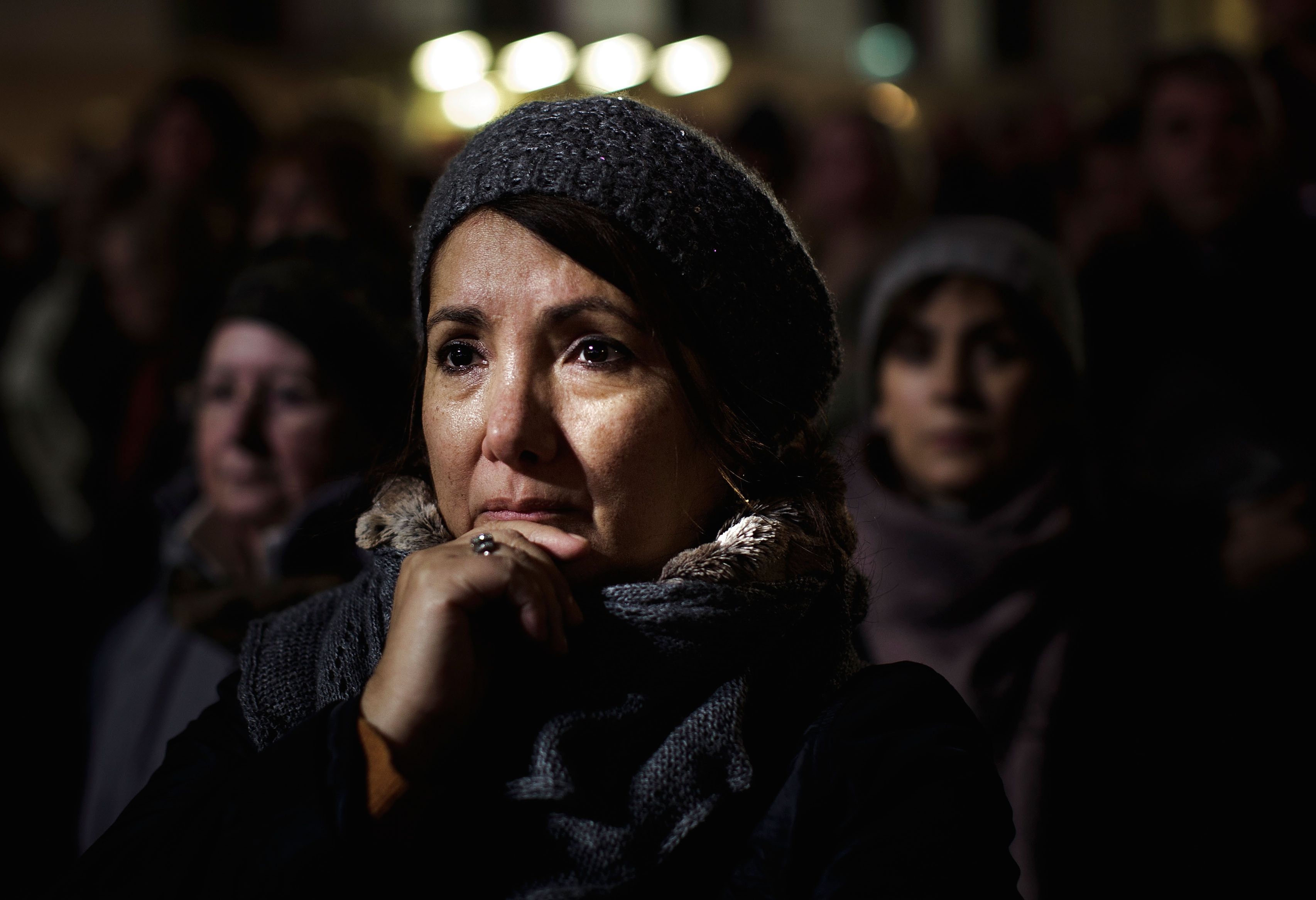
Muslims Hold Berlin Vigil Following Paris Attacks

A woman attends a vigil on January 13, 2015 organized by Muslim groups at Berlin’s Brandenburg Gate to commemorate the victims of the recent terror attacks in Paris. Germany is home to four million Muslims, and many mosques and Muslim associations have been outspoken in condemning the recent terror sprees by Islamic extremists that left 17 people dead, including 10 employees at the satirical Charlie Hebdo magazine. By Carsten Koall/Getty Images.