After receiving a diagnosis of Alzheimer’s five years ago, Sandy Bem decided she would kill herself before the disease completely overtook her life. In May, Sandy and her husband Daryl gathered family to announce that she had set the date:
[Bem’s daughter] Emily says when she showed up at the meeting she was still very angry, convinced that her mother should hold on. Emily, who also lives in Ithaca, has a toddler. She wanted more time with her mother. But over the course of the meeting, this feeling began to ebb. “It was just so obvious that this is about as good as it gets for a human exit,” Emily says. “She was surrounded by everyone who loved her, they were telling her how and why they loved her. This was not a bad way to go.”
Two days later, Sandy’s friends and family gathered again, this time at the home of Sandy’s best friend. They all met for dinner as Sandy, across town, got ready to kill herself.
Sandy, with Daryl at her side, went on a long walk and watched a last movie — Mary Poppins, one of the few films Sandy could still follow. Assisted suicide is not legal in New York, so Sandy went into the bedroom alone to drink the drug overdose she’d ordered online. She followed it with a glass of wine. Finally, Sandy called her husband of 49 years into the room to ask for a last favor. “She asked if I would get into the bed with her,” Daryl says, which he did. “I held her, and I could hear her breathing. Just sort of watching every moment until her breathing just kind of stopped.”
And here is the thing. The relatives and friend I spoke to agree that something in this process made dealing with Sandy’s death much easier. “This is going to sound really funny, but I wouldn’t have had it any other way,” Emily Bem says. “It made it less like a grieving process and less like a sort of horrible thing that had happened, and more like something that made sense and felt right and actually had some joy to it in its own way.”
The Dish thread on different approaches to a loved one’s passing, “A Good Death,” is here.
Those above are our guys, apparently. Pity their machine gun just blew up. But Michael Crowley still manages to argue that the president is “finally getting serious” about Syria in his decision to seek $500 million from Congress to train “moderate” rebel groups there:
Obama … still wants Assad gone. He just doesn’t want him toppled by ISIS. It’s not exactly a simple plan. And it will unfold slowly. If Congress approves Obama’s plan, it will be months longer before a Pentagon training program gets underway—and more time still before it forges enough skilled fighters to shape the Syrian conflict.
What’s clear is that Obama understands the status quo in Syria is a disaster, one that is creating what the recently-departed United Nations special envoy, Lakhdar Brahimi,called a “failed state” prone to “blow up” the wider region. And so Obama may be admitting he’s wrong. After months of arguing that taking serious action in Syria is too risky, Obama is signaling that the consequences of inaction — now unfolding across northern and western Iraq — are too dangerous to tolerate.
Or perhaps too dangerous to avoid appearing to do nothing, while not exactly doing much – for the exact reasons we have not done much before. No one has ever shown how aid could be sent to some rebels and not get purloined by the crazier ones – no one. The premise of Mike’s argument is that somehow this wasn’t and isn’t the case – but it is, as Juan Cole explains:
Training given by the US to “moderates” will be shared with ISIS and other radicals.
It is obvious that the training the US Central Intelligence Agency gave Afghan Mujahidin in northern Pakistan in the 1980s, in how to form covert cells and how to plan and execute tactical operations flowed to the Arab volunteers who were allied with the Mujahidin. In other words, US training helped to produce al-Qaeda when the training was shared by trainees with allied radicals.
There is little doubt that any special training given Syrian Sunnis by the US will be acquired by members of al-Qaeda affiliates for use against the US. It will be acquired because out on the battlefield US-trained moderates will be de facto allies of ISIS, and so will need the latter and will fight alongside them, sharing techniques. It will also be acquired when the moderates defect to the al-Qaeda affiliates.
Keating also questions the logic behind the intervention:
Given the atrocities he has committed, it is an unpalatable notion, but we may be fast approaching—if we haven’t already passed—the point at which the humanitarian and regional stability consequences of continuing to support the fight against Assad outweigh those of accepting that he will remain in power.
I would also hope that before authorizing these funds, Congress presses the administration to explain why the $500 million given to the rebels to fight ISIS will be more effective than the billions spent on training and equipping the Iraqi army that crumbled before them this month. The question becomes even more pressing given the nearly $5 billion that the president wants to fund counterterrorism training in several countries. (Remember when we were pivoting away from the Middle East?)
My faint hope is that all this activity is a ruse for doing very little. But my hope is fading, as the hegemonist impulse remains.
(Photo: Two Free Syrian Army (FSA) members injured after a machine gun exploded while shooting outside the Aleppo prison on May 26, 2014. By Salih Mahmud Leyla/Anadolu Agency/Getty Images.)
The obvious damning answer is that I am a man and no one has taken anything away from me – indeed the all-male majority who upheld Hobby Lobby’s religious rights specifically barred any procedure other than female contraception. If they did that for prescriptions for Truvada, for example, I might react differently. And I take that point. But its flipside is that this was a very narrow ruling, and the limiting of it to closely-held corporations, in which a small group of people with identical religious convictions can dictate the details of health insurance coverage they pay for, is not the great exemption for religious beliefs that some were fearing. It does not apply to publicly traded companies, for example. Here’s the reassuring language from Alito:
This decision concerns only the contraceptive mandate and should not be understood to hold that all insurance-coverage mandates, e.g., for vaccinations or blood transfusions, must necessarily fall if they conflict with an employer’s religious beliefs. Nor does it provide a shield for employers who might cloak illegal discrimination as a religious practice.
Of course, employment discrimination against gay people is legal discrimination in many states, so this may not seem much comfort. But I suspect that if closely-held religious companies start firing people explicitly because they are gay and therefore not kosher, the prospects for both a federal employment non-discrimination law and a heightened scrutiny ruling for gays improve considerably. And the recourse in this case is a pretty simple one: just extend the existing third party arrangements for religious institutions to closely held, religiously based companies. The main worry – Ginsburg’s – that this could create a dangerous and expansive precedent seems a little overblown to me. If anything, the real precedent is the Religious Freedom Restoration Act, and that remains at the Congress’s discretion, not the Court’s.
But none of this is to say I find this development a positive one for religion.
A Christianity that seeks to rid itself of interacting with sinners or infidels is not a Christianity I recognize. A Christianity that can ascribe the core religious nature of a human being to a corporation is theologically perverse. Corporations have no souls. They do not have a relationship with God, as Jonathan Merritt points out here. And a Christianity that seeks to jealously guard its own defenses rather than embrace the world joyfully and indiscriminately is not one that appeals to me.
But in some ways, this can be seen as a libertarian ruling. It reframes the argument of the religious right toward the libertarian one of self-defense, rather than of the imposition of religious standards on others. And as long as women can have easy access to free or subsidized contraception through Obamacare by another method, it can rest sturdily on that foundation.
The worry, it seems to me, is that it further restricts the area of neutral public life. It turns the world of business into something much more like a world of theology. It chips away at the notion of a naked public marketplace, where we can leave our faiths behind and simply buy and sell goods and not worry about anyone else’s religion or lack of it. And that’s a loss. But if it is restrained adequately and imposed narrowly, not that great a one. And if we can lean on the side of religious freedom – even of the defensive and narrow variety – without restricting the actual access to some forms of contraception, why shouldn’t we?
(Photo: Sister Caroline (L) attends a rally in Chicago with other supporters of religious freedom to praise the Supreme Court’s decision in the Hobby Lobby case on June 30, 2014. Oklahoma-based Hobby Lobby, which operates a chain of arts-and-craft stores, challenged the provision and the high court ruled 5-4 that requiring family-owned corporations to pay for insurance coverage for contraception under the Affordable Care Act violated a federal law protecting religious freedom. By Scott Olson/Getty Images)
Scott Anderson traces the origins of the present crisis in Iraq back to World War I:
For nearly 400 years prior to World War I, the lands of Iraq existed as three distinct semi-autonomous provinces, or vilayets, within the Ottoman Empire. In each of these vilayets, one of the three religious or ethnic groups that predominated in the region – Shiite, Sunni and Kurd – held sway, with the veneer of Ottoman rule resting atop a complex network of local clan and tribal alliances. This delicate system was undone by the West, and for an all-too-predictable reason: oil.
In order to raise an Arab revolt against the Ottomans, who had joined with Germany and Austria-Hungary in World War I, Great Britain forged a wartime alliance with Emir Hussein of the Hejaz region of Arabia, now the western edge of Saudi Arabia bordered by the Red Sea. The 1915 pact was a mutually advantageous one. Since Hussein was an extremely prominent Islamic religious figure, the guardian of the holy cities of Mecca and Medina, the alliance inoculated the British against the Ottoman accusation that they were coming into the Middle East as Christian Crusaders. In return, Britain’s promises to Hussein were extravagant: independence for virtually the entire Arab world.
But oil was discovered in all three of these vilayets, and so “the ‘nation’ of Iraq was created by fusing the three Ottoman provinces into one and put under direct British control.” Unrest predictably ensued, setting in motion the dynamics we’re still grappling with today:
In a belated effort to defuse the crises in Iraq and elsewhere in the Middle East – throughout the region, Arabs seethed at having traded their Ottoman overseers for European ones – the British government hastily appointed Winston Churchill as Colonial Secretary in early 1921. One of the first people Churchill turned to for help was Lawrence the war hero and champion of the Arab independence cause. As a result of the Cairo Conference that March, one of Emir Hussein’s sons, Faisal, was made king of Iraq, while another son, Abdullah, was placed on the throne of the newly-created kingdom of Jordan.
But whereas the ‘artificial nation’ of Jordan would eventually achieve some degree of political stability and cohesion, the same could never truly be said of its Iraq counterpart. Instead, its history would be marked by a series of violent coups and rebellions, with its political domination by the Sunni minority simply deepening its sectarian fault lines. After repeatedly intervening to defend their fragile creation, the British were finally cast out of Iraq in the late 1950s, their local allies murdered by vengeful mobs.
If all this sounds vaguely familiar, it’s for very good reason: the disastrous British playbook of 1920 was almost precisely replicated by the United States in 2003.
Recent Dish on the First World War’s impact on Middle Eastern politics here.
(Image: British troops entering Baghdad in 1917, via Wikimedia Commons)
Ilya Somin believes the number of times SCOTUS has ruled unanimously against the Obama administration on an issue of executive power says something about the president’s view of the constitution:
The administration’s unanimous defeats in significant constitutional cases cover a wide range of issues, including freedom of religion, property rights, executive power, and the Fourth Amendment. What these otherwise disparate cases have in common is a strong reluctance to accept even modest limits on federal authority.
Some of the complaints reflect the normal back-and-forth of party politics. Democrats charged that the George W. Bush administration seized too much power as well. Almost all of those complaints, however, centered on longstanding differences of opinion over the scope of a president’s Article II powers as commander-in-chief. The Obama administration has advanced broad readings of its power over a wider range of issues, without much in the way of Article II arguments.
The fact that even liberal Supreme Court justices appointed by Democratic presidents — two appointed by Obama himself — have repeatedly ruled that the administration’s positions ran afoul of the Constitution suggests that more than just party politics is at work.
But the questions involving Article II have much more profound implications. The notion that the executive branch has the right in wartime to seize an American citizen and torture him into incoherence strikes me as a more important question than whether someone can have access to free contraception if her employers disapprove. Orin Kerr finds this criticism unfair for another reason:
Ilya has some fun suggesting that Obama was the uniter, in that he personally brought the Justices together with his positions. But at least in the cell phone cases, the arguments likely were crafted mostly by career lawyers who have been in the government for a long time.
The Bush Administration DOJ took the same position back when it existed, at least to the extent that the arguments of DOJ lawyers can be imputed to “the Administration.” And state prosecutors took the same position in their respective state courts and in Riley. It’s the standard position you would expect any prosecutor to take, not something BHO cooked up one afternoon after reading his daily chapter of Saul Alinsky.
More broadly, I think the internal dynamics of the Justices are too contingent to draw easy conclusions from vote counts. Maybe my experience is quirky. But when I was a law clerk, I was struck by how a case that seemed very easy ex ante could somehow emerge 5-4 ex post. And the opposite was true, too: a very hard and close case ex ante could somehow emerge 9-0. The public would assume that the 5-4 cases were close and the 9-0 cases were simple and easy. But at least in my experience, the reality was sometimes far different.
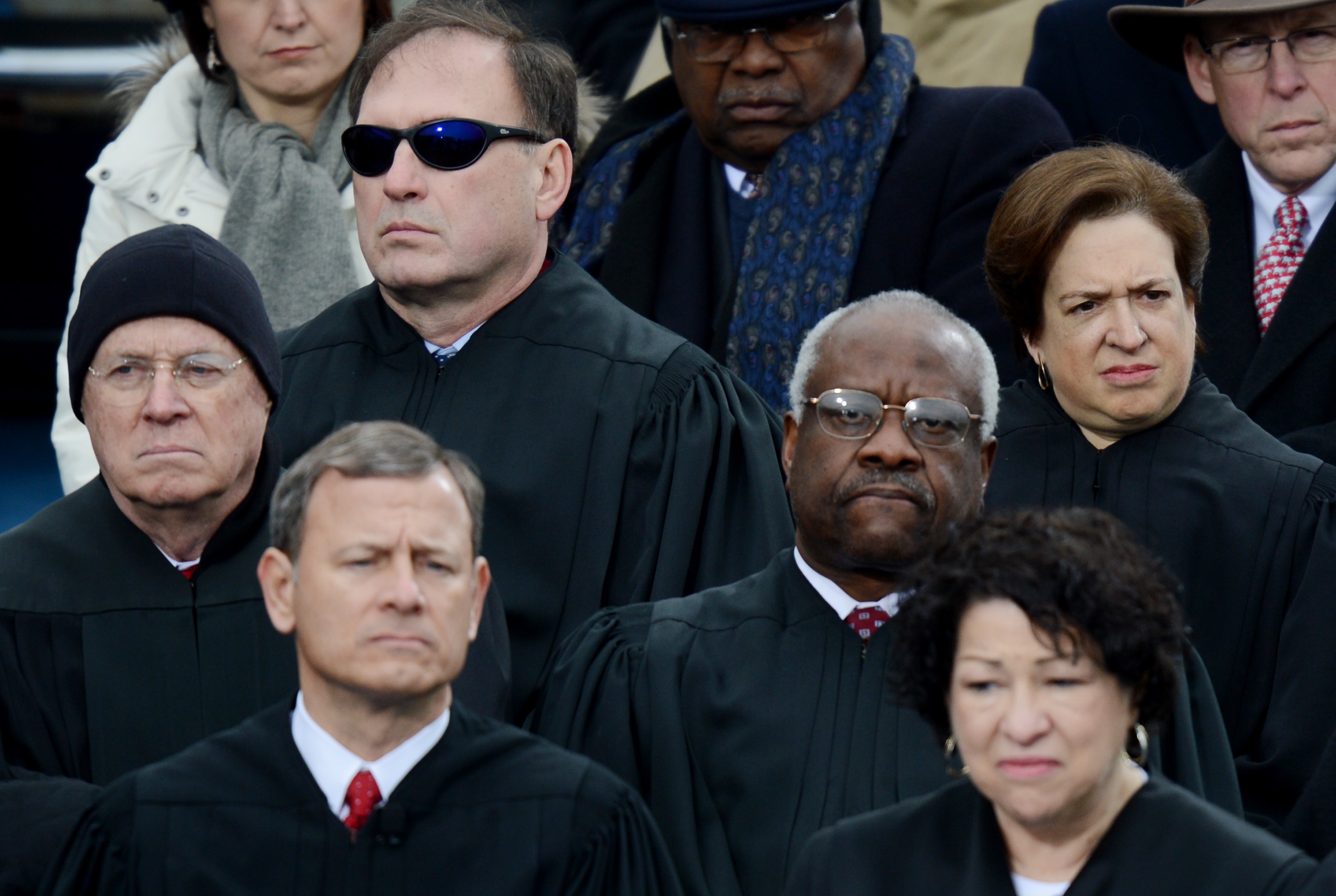
(Photo: Members of the US Supreme Court after US President Barack Obama was sworn-in during the 57th Presidential Inauguration ceremonial swearing-in at the US Capitol on January 21, 2013 in Washington, DC. By Saul Loeb/AFP/Getty Images.)
The Supreme Court ruled Monday that some corporations can hold religious objections that allow them to opt out of the new health law requirement that they cover contraceptives for women. The justices’ 5-4 decision is the first time that the high court has ruled that profit-seeking businesses can hold religious views under federal law. And it means the Obama administration must search for a different way of providing free contraception to women who are covered under objecting companies’ health insurance plans.
[Alito] held that this provision of the health care law, as applied to Hobby Lobby, ran afoul of the terms of the Religious Freedom Restoration Act (RFRA), a 1993 law signed by President Bill Clinton which says the government may not “substantially burden a person’s exercise of religion,” unless it has a “compelling” justification and has used “the least restrictive means” available.
“Under RFRA, a Government action that imposes a substantial burden on religious exercise must serve a compelling government interest, and we assume that the HHS regulations satisfy this requirement. But in order for the HHS mandate to be sustained,” Alito continued, “it must also constitute the least restrictive means of serving that interest, and the mandate plainly fails that test.”
Read the full text here. Noah Feldman frames it thus:
The core of the court’s opinion held that the Obama administration had failed to satisfy its burden under the law to show that it had adopted the least-restrictive means to respect religious liberty rights. To get there, the court first had to decide that closely held corporations are entitled to protection under the law. The court broke this into two questions.
The first was whether corporations are persons under RFRA. The court answered this with a resounding yes that extended to all corporations … This analogy between nonprofit and for-profit, however, had already been adopted by the Supreme Court in the Citizens United decision with respect to free-speech, so it’s not terribly surprising that it was adopted in the context of religious liberty.
The second question, however, was whether corporations could be said to hold religious beliefs. Here the court restricted itself to holding that closely held corporations can be said to possess the religious beliefs of their owners. This is not the same thing as holding that all corporations — and certainly not publicly traded corporations — would necessarily have the capacity to possess religious beliefs under federal law or under the U.S. Constitution.
Emma Green has more on that “closely held” distinction, emphasizing that “the most important question here isn’t actually about contraception—it’s about businesses”:
The Court has held that these businesses qualify as “persons,” meaning that they can have religious beliefs.
It’s worth noting that this ruling only applies to closely held private companies, or businesses that are owned by a small number of people who are mostly involved in the day-to-day operations of that business. Roughly 90 percent of American companies qualify as closely held, so this ruling will apply to a pretty sizable portion of the American business community. But it won’t affect coverage requirements for publicly held companies, which include large companies traded on the stock market—as Kevin Russell over at SCOTUSblog writes, the Court is “leaving for another day whether larger, publicly traded corporations have religious beliefs.”
In the end, a closely held corporation is really nothing more than a partnership with tax advantages. What ever you might call it, it is still a business that is owned by a small amount of people. If Hobby Lobby were a partnership or sole proprietorship, there would be no question that the Greens [the Hobby Lobby owners] would be within their rights to assert a religious objection under the RFRA. Given that, it doesn’t strike me as being all that radical to say that they retain those rights when they enter into a different kind of business form that, ultimately, was chosen so that they could expand the company to the national operation employing thousands of people that it is today. We are still talking ultimately about the individuals who own the company and their rights, which is why this decision would not make any sense if you applied it to a publicly traded corporation owned by tens of thousands of individuals and institutions like Apple, or Exxon Mobil.
Meanwhile, Jason Millman clears up a common misconception:
The administration and supporters of the contraception mandate had warned that a broader recognition of corporations’ individual rights could enable more business owners to claim religious exclusions for other health-care services, such as blood transfusions or vaccinations, and civil-rights protections. The court today said its ruling narrowly applies to just the contraception requirement.
Hobby Lobby doesn’t object to providing contraception; it objects to contraceptives that may act as abortifacients. (Donna Harrison provided some background information on this issue for NRO.) And the mandate isn’t in Obamacare. Even the very liberal Congress of 2009-10 never explicitly decided, or even really debated whether, to force companies to provide contraceptive coverage. HHS used the authority the law gave it to impose the mandate. Several pro-life Democrats who provided the law’s narrow margin of victory in the House have said they would have voted against the law had it included the mandate.
Kate Pickert specifies that line over contraception drawn by Hobby Lobby, whose “individual position is less extreme than many believe”:
The company objects to paying for morning-after pills and inter-uterine devices, but freely provides insurance that covers tubal ligation, birth control pills, condoms, diaphragms and contraception delivered via a patch or ring inserted into the cervix. More than 80% of all contraception users in the U.S. rely on these methods.
There will be a lot of liberal fulmination today about an activist right-wing Supreme Court and impending theocracy. Just remember: 1) If Congress wants to require all employers to cover birth control, it can pass a new law that explicitly exempts itself from the Religious Freedom Restoration Act. This ruling wouldn’t be an obstacle to such a law.
In her dissent, Justice Ginsburg bristles at the majority’s “decision of startling breadth.” Justice Kennedy tries to argue otherwise in his concurring opinion, arguing that the majority opinion “does not have the breadth and sweep ascribed to it by the respectful and powerful dissent.” And yet majority opinion held that corporations are “persons” under the Religious Freedom Restoration Act! That’s huge! While the court limits part of its ruling around the contraception mandate to closely held corporations (defined by the IRS here), the essence of the decision is a profound and radical shift in corporate rights.
Further, the ruling in part eroded the distinction between religious non-profits (which were already exempted from parts of Obamacare) and private corporations. If you think going to the mall is like going to church, that makes sense. To everyone else, it’s nuts.
[She] called the majority opinion “a decision of startling breadth.” Ginsburg read a portion of her decision from the bench on Monday. Addressing the majority of her colleagues — including all but one of the six men sitting on the Supreme Court — Ginsburg wrote:
In the Court’s view, RFRA demands accommodation of a for-profit corporation’s religious beliefs no matter the impact that accommodation may have on third parties who do not share the corporation owners’ religious faith—in these cases, thousands of women employed by Hobby Lobby and Conestoga or dependents of persons those corporations employ. Persuaded that Congress enacted RFRA to serve a far less radical purpose, and mindful of the havoc the Court’s judgment can introduce, I dissent.
The justice goes on to criticize the opinion’s interpretation of the religious freedom law, writing that “until today, religious exemptions had never been extended to any entity operating in ‘the commercial, profit-making world.'”
The reason why is hardly obscure. Religious organizations exist to foster the interests of persons subscribing to the same religious faith. Not so of for-profit corporations. Workers who sustain the operations of those corporations commonly are not drawn from one religious community. Indeed, by law, no religion-based criterion can restrict the work force of for-profit corporations…The distinction between a community made up of believers in the same religion and one embracing persons of diverse beliefs, clear as it is, constantly escapes the Court’s attention. One can only wonder why the Court shuts this key difference from sight.
“In sum,” Ginsburg adds about the free exercise claims at the heart of this case,“‘[y]our right to swing your arms ends just where the other man’s nose begins.’”
What will this mean for women in the immediate future? Probably not much:
It is extremely likely that the Obama administration will by regulation provide for the government to pay for the [contraception] coverage. So it is unlikely that there will be a substantial gap in coverage.
“The New Testament never — not one time — applies the “Christian” label to a business or even a government. The tag is applied only to individuals. If the Bible is your ultimate guide, the only organization one might rightly term “Christian” is a church. And this is only because a church in the New Testament is not a building or a business, but a collection of Christian individuals who have repented, believed on Christ, and are pursuing a life of holiness. Journalists or cultural commentators might use the phrase “Christian business” in colloquial or cultural terms, but conservative evangelicals must admit that the term makes no theological sense for them given their views of salvation, sanctification, and revelation,” – Jonathan Merritt.
By using the inherited clout and expertise of the Greater Israel Lobby to get Congress to torpedo it, after the fact:
The plan, obtained by Foreign Policy, calls on Congress to oppose the lifting of financial sanctions on Iran until it proves that its entire financial sector, including the Central Bank of Iran, has sworn off support for terrorism, money-laundering, and proliferation. Some of those topics haven’t been part of the ongoing U.S.-led talks with Tehran, which means that linking sanctions relief to those conditions after a deal is made would likely drive the Iranians off the wall, say experts. Tehran would likely see any such measures as moving the goalposts and as evidence that the United States wasn’t genuinely interested in backing up its end of the deal.
And that removes the last barrier to the neocons’ next war in the Middle East (if they haven’t managed to launch another one in Iraq before them).
Remember the EU trade agreement that set off the Maidan protests in Ukraine when former president Viktor Yanukovych turned it down six months ago? Well, his successor Petro Poroshenko signed it on Friday, effectively snookering Putin and raising anxieties about how Moscow might respond. Bershidsky considers what effect the deal will have on Russia:
In a document meant to dispel myths about the association agreement, the European Commission stressed that “there is nothing in the Agreement which will affect trade with any other trade partner of Ukraine, including Russia. Therefore no negative economic effects regarding trade with other trade partners of Ukraine can be expected as a result of the Agreement itself. Threats by Russia to raise its tariffs if Ukraine signs the Agreement are not based on economic reasoning”.
That isn’t strictly true. Russia and Ukraine already have a free trade agreement, signed under the auspices of the post-Soviet Commonwealth of Independent States. What scares Russia about Ukraine’s EU deal is the possibility that duty-free EU goods, passed off as Ukrainian ones, will flood the Russian market.
Steven Pifer worries that Putin may react more aggressively than he’s letting on:
Can Moscow now reconcile itself to the association agreement? A Russian deputy foreign minister warned of “serious consequences” but conceded that signing such a document was “a sovereign right of any state.” Mr. Putin’s spokesman said Moscow would take steps to avoid any negative impact on the Russian economy.
To be sure, Russia has legitimate interests at stake. Kyiv appears ready for a dialogue on minimizing the impact of the association agreement on Ukrainian-Russian trade. But will that satisfy Moscow? That is a key question. Russia has significant influence over the armed separatists in Donetsk and Luhansk, many of whom are Russian citizens, and has other leverage over Ukraine. Russia can use that influence and leverage to promote a ceasefire and a settlement, if it wants to. If Moscow instead chooses to continue its efforts to destabilize Ukraine, that will immensely complicate implementation of the Ukraine-EU association agreement.
And on the same day that Poroshenko signed the deal, Russia’s gas conglomerate threatened to reduce natural gas supplies to any European countries that try to re-export it to Ukraine:
In remarks to reporters, Alexei Miller, the CEO of Gazprom, spoke out against European contemplation of a maneuver called “reverse-flow supply”—taking Russian gas exported to Europe and re-delivering it to Ukraine. If successful, the stratagem would reduce Moscow’s ability to pressure Ukraine to pay a disputed $4.5-billion gas debt. “A reverse flow is a semi-fraudulent mechanism whereby gas runs in circles,” Miller said. “This is Russian gas.”
Ukraine already receives gas this way from Germany, which delivers it via Poland. And Slovakia has agreed to reverse-flow a small volume to Ukraine as well, starting in October. On June 25, Gunther Oettinger, the European Union’s energy commissioner, explored the idea of significantly enlarging the plan to effectively take care of all of Ukraine’s gas imports.
Putin is not as smart as he’d like us to think. I like to think of him as Cheney-smart.




 The Dish
