Did Terrorists Just Elect Le Pen? Ctd

Philip Gourevitch scrutinizes how the French right-wing leader has played her cards over the past week:

In the immediate aftermath of the attack on Wednesday, as traffic surged on her Facebook page and she picked up thousands of new followers, she did nothing special to insert herself into the story or to exploit the fears that the Front has long fed on. She reiterated her longstanding call for France to withdraw, unilaterally and at once, from the Schengen Agreement, which allows for open borders within the extended European community, but that was hardly newsworthy. Rather, Le Pen appeared to adopt the time-tested opposition strategy of waiting for the political establishment to make a misstep that would turn attention her way—and she did not have to wait long. Within hours of the Charlie Hebdo massacre, the ruling Socialists and a coalition of allied parties of the left announced plans for a massive solidarity rally on Sunday—a silent march through the heart of Paris in the cause of “national unity”—without extending an invitation to the National Front.

The exclusion of the Front was great news for Le Pen. Nobody believed that she would have wanted to go and be associated with the political mainstream, but, by failing to invite her, the Socialists had given her a cudgel.

Comparing Le Pen to her father, Jean-Marie, and other intellectual forebears of the French right, John Gaffney finds her wanting as a standard bearer:

Marine is good on TV, she’s a reasonable debater, and she seems to have chosen to walk away from lots of the right’s traditions and manners. But the detox also involves – apart from all the other things it involves – losing one’s intellectual tradition. Does this have advantages – for her and/or for those who oppose the FN?

Marine Le Pen is ‘ordinary’, in fact, very and deliberately ordinary. She is, in the true tradition of the far right, a very forceful personality. But she’s a particular forceful, and a particular ordinary. She’s a twice divorced mum who lives with her partner and their respective kids. That is a far cry from far right values, in itself. And the fact that it is a woman leading this movement is fascinating, a movement whose philosophy and populism loves the leader, but never imagined it might be a female leader. But she is not like Joan of Arc, the FN’s female heroine. She has no visions. No grace inhabits her; she is more like a bossy and assertive middle manager at Asda.

She certainly doesn’t look as if – unlike her father – she has read Barrès or Voyage au bout de la nuit…. as have all French politicians and intellectuals. One gets the impression that not only has she not read them, she doesn’t give a toss either.

Meanwhile, Martin Robbins demolishes Le Pen’s call for France to bring back the death penalty in response to the Charlie Hebdo massacre:

What, exactly, are executions supposed to achieve? You can’t execute a suicide bomber. Death isn’t a big problem for the kind of fanatics willing to die for a cause. Even if you just look at ordinary crime, there’s no real reason to think that execution would deter people. As Amnesty put it, “The threat of execution at some future date is unlikely to enter the minds of those acting under the influence of drugs and/or alcohol, those who are in the grip of fear or rage, those who are panicking while committing another crime (such as a robbery), or those who suffer from mental illness or mental retardation and do not fully understand the gravity of their crime.” They note that murder rates are considerably higher in those American states that still have the death penalty.

David Corn piles on:

The goal of martyrdom has motivated numerous jihadists to conduct murderous action. Suicide bombers, the 9/11 plotters, and others seek to die in pursuit of their cause and believe that there will be a reward on the other side. So the best punishment, when such criminals are apprehended, would be to deny them martyrdom and force them to wait decades, maybe half a century, to meet their violence-supporting maker—preferably in a small, isolated cell for all that time. Recruiters of jihadist killers might have a tougher time selling a decades-long stint in prison than a glorious exit in a blaze of gunfire or a high-profile state execution that would receive attention around the world.

Our Deep Divide Over Guns

A couple weeks ago, Adam Gopnik claimed that “the majority of Americans agree that there should be limits and controls on the manufacture and sale and ownership of weapons intended only to kill en masse.” Lisa Miller disagrees:

Americans are perhaps more divided on the issue of guns than they’ve ever been. In 2014, just 47 percent — less than half — of Americans said that gun laws should be “more strict,” according to Gallup, down from 58 percent after the Newtown shootings and 78 percent in 1990, the year James Pough killed ten people, most of them at a General Motors office, with a semi-automatic rifle.

Forty-two percent of Americans have a gun in their home, a percentage that has fluctuated by about 10 percentage points over the past generation but is not so far from the proportion that owned guns in 1960: 49 percent. Yes, according to a year-old Rasmussen poll, 59 percent of Americans favor a ban on semi-automatic weapons, like the one Adam Lanza used in Sandy Hook. At the same time, 70 percent of people say they’d feel safer living in a neighborhood where owning a gun was allowed. “The majority is there,” writes Gopnik, but nearly every shred of evidence points the other way: Despite what would seem to be its obvious benefits, a majority on gun control has thus far been impossible to muster, even in the aftermath of the Newtown shooting. …

To frame the gun debate, as Gopnik does, as sane versus insane, with gun-control advocates, such as himself, as those “who actually want to reduce the number of gun massacres” and pro-gun forces as both (his language) dishonest and unscrupulous “prefer[ring] an attachment to lethal symbols of power” is to misunderstand the issue — or to miscast it to support his fictional notion of a consensus of right-thinking people like himself.

And nowhere are the murky, volatile, and heartbreaking conflicts within the gun debate laid bare more than in Newtown. I spent a good deal of time there in 2013, reporting a story about the aftereffects of the shooting, and was surprised to find so much sensitivity — and so much disagreement — around the subject of guns. There was no consensus. The town priest, ostensibly a strong moral voice in town, shied from articulating a principled allegiance to one side or the other. Even in a place where 20 children had died at the hands of a madman with a gun, the most basic questions of how to prevent a reoccurrence hit the rawest of nerves. No one wanted to say where they stood for fear of offending a neighbor who might feel another way. On the question of assault rifles, “I don’t want to demonize anyone,” said a parent whose child was in the school that day and lived. He had become an activist for stronger gun laws, but he lives in town, and his pro-gun friends were as devastated by the events of December 14, 2012 as he was.

Update from a reader:

The Beltway consensus seems to be that meaningful gun control is no longer possible in the U.S. But there is lots of room for change that can protect lives. Here in WA state, we passed Initiative 594 in Nov., that closes the gun show and online sales loophole. We had hundreds of passionate volunteers working on this initiative, and backing by deep pockets both here and outside the state, people like Bill Gates and Nick Hanauer. Now we are mobilized to pursue additional legislation to keep guns away from the mentally ill, hold parents responsible when their underage kids use guns in crimes, and inform people when confiscated guns are returned to those they had filed restraining orders against. There is pride that we beat the NRA at their own game, and this is now a state-by-state battle.

The Poor Rich Kids Of Instagram

Natasha Vargas-Cooper surveys the Rich Kids of Instagram phenomenon, which spans from Tumblr to a reality show to a new novel. She admits that browsing the kids’ photos inspires a kind of sympathy:

Yes, the rich kids seem determined to remind us that they have stuff the rest dish_rkoi1 of us will never have. The captions they post with their photos are, at times, slyly aware of their part in inequality (cf. a picture of a private jet and a luxury car with the caption “The struggle is real”). But for all that, the kids don’t seem especially power-hungry so much as aimless and languid. Behind these faux-provocative posts lurks a desperate clamor for attention that almost verges on a cry for help—something that makes you feel a certain involuntary (and certainly undeserved) pity for these manically self-documented upper-crusters.

She has a less charitable view of the book:

The book’s main gimmick is identical to the Tumblr’s MO: the outrage is all imputed to you, the reader, in advance, by its ostensible targets or by the medium itself. This means, in turn, that the proceedings float serenely above any semblance of real-world criticism. So, not surprisingly, the book suffers from the same thing the actual rich kids of Instagram kids do, only at far more tedious length: a depressing lack of imagination.

Here, for example, is one of the novel’s rich kids fuming about her maid while also clumsily name-checking her 1,200-thread-count sateen sheet set: “Woven in Italy. For what I paid, I could buy your illegal Guatemalan cousins. That is, if you weren’t from Jersey.”

There’s no pulse-pounding social tension or class resentment on offer here—unless you’re especially aroused by inarticulate dialogue. The novel doesn’t proceed in a mood of detached anthropological inquiry, the way that, say, Louis Auchincloss or John Marquand’s old-money fictions did. There’s no anger, no weight, no insight. All you have in the way of a rich-kid call-to-arms is the empty bravado of the anonymous site creator’s acknowledgements at the front of the book: “To all the RKOI kids, who are unapologetically themselves; in a world where so few people will live out loud, you guys have guts, and for that you deserve admiration.”

In a recent issue of Bookforum, Choire Sicha also reviewed the novel, writing that “you could be convinced, while reading it, that this is a Vile Bodies of our times, or one of the cloddier Henry James morality plays, as told by the children of Heathers.” He singles out a choice internal monologue:

I feel the heat rise to my face and wonder, for the gazillionth time, if crazy runs in the family. Maybe it’s already laser-cut into my DNA, and one day it will bubble up from inside. Just like that, I’ll go from Junior Class Perfect with a 3.87 GPA (fuck that granola art teacher, B-minus? She wears Crocs, for fucksake. What does she know about aesthetics?) and morph into Girl, Interrupted.

Dead-on impersonations like this run throughout; the price tags are all correct and the cultural touchstones are all stomped on nicely. There’s something charming about this Waugh wannabe, as it truly is viciously faithful to each and every archetype. But then the instigators of the book thank darklord David Kuhn, and CAA, and a bunch of richies in the acknowledgments, and you remember it’s just a bit of harmless insider fun. What could a book do to the oligarchy, anyway? Piketty didn’t pike them, so no one will. So we learn that the anonymous proprietors of Rich Kids of Instagram are wholeheartedly on Team Join Them, since they, and we, are certainly not going to beat them. After all, it’s not like they can spell acquiescence in a hashtag.

(Image via Rich Kids of Instagram. Caption: “Don’t hate the player, hate the game! #gamesetmatch”)

The NYPD’s Record On Chokeholds

German Lopez voxplains a new set of findings:

The report, by the NYPD inspector general, looked at 10 cases involving chokeholds between 2009 and 2014. The Civilian Complaint Review Board recommended the most serious penalty in nine of 10 cases, but the NYPD reduced the punishment to lesser penalties — or none at all — in the cases that have been carried out to completion.

The NYPD’s guidelines explicitly ban the use of chokeholds no matter the circumstance. But the inspector general found police officers, in a practice called “particularly alarming” by the report, sometimes used chokeholds “as a first act of physical force in response to verbal resistance.”

Friedersdorf is troubled:

Consider one of those incidents:

In a Nov. 19, 2008, incident, a 15-year-old detained on robbery charges alleged he was choked by a sergeant while handcuffed to a rail inside a Bronx precinct house. CCRB substantiated the allegation based on another teenage witness in the station and the sergeant’s account.

Then-Commissioner Ray Kelly decided to impose the following punishment: no punishment at all.

New York City is policed on the theory that if small transgressions against law-and-order go unpunished, the ensuing disorder will result in a city where more serious crimes like homicide are more common. The NYPD flagrantly failed to police itself as officers engaged in violations of chokehold policy. Predictably, the tactic persisted. Yet later, when a chokehold contributed to Garner’s death, the cops disclaimed responsibility. They don’t want to be policed using the logic of their policing.

More incidents from the IG report highlighted here. The embattled mayor is downplaying the report, which, by the way, doesn’t include Garner’s fatal encounter. De Blasio’s nemesis, union boss Patrick Lynch, was true to form, calling the inspector general’s findings “anti-police bias”. And the police commissioner?

[Bill Bratton] believes better training can give cops better alternatives, and reduce not just the use of chokeholds but the chances of chokehold-related tragedies like the death of Eric Garner. … And Bratton is vehemently opposed to one step, proposed by the City Council — to make chokeholds illegal. “You cannot make it illegal because then it is really putting cops at risk,” Bratton told me in December. “Because there’s going to be times when they’re in one of these street fights, if they feel that they’re at risk of losing and they’re worried about themselves being overcome. Cops are authorized to use force appropriate to the threat.”

And this time cops should have no doubt about whose side Bill de Blasio is on. “Oh yeah, the mayor clearly understands that there are going to be instances where a cop is going to use a chokehold in a life-or-death situation,” Bratton says. “In that case, anything goes.”

Meanwhile, Caroline Bankoff checks in on the stoppage:

At the end of last week, Bill Bratton declared the NYPD work stoppage “over in the sense that the numbers are starting to go back up again.” “I anticipate by early next week that the numbers will return to their normalcy,” he added. The New York Times reports that the numbers do seem to be behaving as Bratton predicted: “In total, officers made 4,690 arrests in the week ending on Sunday, police statistics showed, according to a precinct commander who saw the numbers. The number is below the 7,508 in the same week in 2014, but above the 2,401 made between Dec.

Update from a reader:

The post regarding the recent report by NYC’s Civilian Complaint Review Board is quite misleading. A full report is available in this pdf. A crucial point that is being overlooked by many is as follows:

In its more comprehensive report on chokeholds issued in October 2014, CCRB reported that from 2009 through June 2014, CCRB received and disposed of 1,082 complaints alleging 1,128 chokehold allegations by NYPD officers. Of the 520 chokehold allegations that it investigated fully, CCRB substantiated ten chokehold allegations.

Thus, the CCRB was able to substantiate around 0.9% of the chokehold allegations during a 5-year period. I will grant you that a harder look should have been taken at those cases and perhaps some additional training might be helpful. But we all need to remain mindful of the big picture here and lay off of the sensationalism. Less than 1% is a microscopic number in a city the size of New York with a police force of over 30,000.

Just Like The Real Thing

Reviewing a career-spanning exhibition of the photorealist painter Richard Estes, Amy Henderson puts his distinctive style in its cultural context:

By the early 1960s, America’s marketing phenomenon was setting off cultural earthquakes. Social critics like Daniel J. Boorstin warned about the rise of a culture based on “simulation” and “illusion” rather than on reality. In his landmark The Image: A Guide to Pseudo-Events in America (1962), Boorstin pointed an angry finger at “Madison Avenue, Washington bureaucracy, the eggheads” for turning America into a land dominated by “pseudo-culture.”  

The idea of “simulation” had an impact in the art world as well. Warhol, after establishing himself as a highly successful commercial artist, began making “replications” of consumer products such as Brillo boxes and Campbell’s Soup cans. … By blurring the lines between commercial art and high culture, Warhol took direct aim at high-art snobs and proclaimed: We live in a supermarket world!

When Richard Estes ventured away from commercial art in the mid-to-late-’60s, he, too, carried the Mad Men brand with him. According to the exhibition catalogue, pop art amused Estes, but as “witty commentary more than art.” Instead, his lifelong love of photography led him to anchor himself in photorealism. The sense of simulation and illusion that were instrumental in his earlier career as a commercial artist would reemerge as central tenets of his photorealist art.

No Place Like Rome

Michael Auslin reflects on the enduring relevance of Augustus, the first Roman Emperor:

640px-Bust_of_augustusAfter the Ides of March, the teenaged Octavian figured in no one’s political calculations. Mark Antony was the dominant figure, and Brutus and Cassius retained significant forces. Yet within just a few years, it would be Antony and Octavian fighting for the ultimate supremacy of the Western world. To read of Octavian’s cautious, calculating, and sure moves during the two decades of civil war, leading to his victory at Actium in 31 B.C., is to encounter political genius of the rarest kind. With his indispensable partner, Agrippa, Octavian then did what had escaped even the great Caesar: establish a durable and impregnable political system to capitalize on his military victory. Thus ended both a century of civil war and Rome’s traditional freedoms. To a world desperate for stability, Augustus was accepted as the unquestioned and irreplaceable arbiter of order.

Augustus’s legacy did not stop with politics, for the Rome of our dreams, too, is largely his creation, carried to its ultimate expression by his successors. The world might not still be fascinated with a city of brick had not Augustus left it one of marble, to paraphrase his famous saying. The fora, baths, Colosseum, and palaces of eternal Rome maintained, even enhanced, their spell over men’s imaginations by their ruins, as much as in their pristine prime. Even the anti-monarchical Americans drew legitimacy from Rome’s material forms. Washington, D.C. is modeled more on imperial Rome than Greece, with its Capitol Hill and classic architecture.

(Photo of a bust of Augustus in the Musei Capitolini, Rome, by Xuan Che)

A Fresh Start For Sri Lanka?

SRI LANKA-POLITICS

In a surprise upset on Friday, the country’s strongman president, Mahinda Rajapaksa, was voted out of office, losing to his opponent Maithripala Sirisena, who had promised much-needed reforms and reached out to the country’s marginalized Tamil and Muslim communities:

Sirisena, a one-time ally of Rajapaksa who defected in November and derailed what the president thought would be an easy win, took 51.3 percent of the votes polled in Thursday’s election. Rajapaksa got 47.6 percent, the Election Department said. … Like Rajapaksa, Sirisena is from the majority Sinhala Buddhist community, but he has reached out to ethnic minority Tamils and Muslims and has the support of several small parties.

Kate Cronin-Furman stresses what a mess of things Rajapaksa made during his decade in office:

Over the course of 10 years in power, Rajapaksa had undermined the institutions of South Asia’s oldest democracy, beefing up Sri Lanka’s already robust executive presidency. He also consolidated power in the hands of his family. One brother served as secretary of defense, a second the speaker of Parliament, a third a cabinet minister, and numerous sons and nephews were installed in positions of power. Potential opponents to the dynastic project were bought off or brutally silenced. Election Day fell on the sixth anniversary of the killing of well-known journalist Lasantha Wickrematunge, who accused the Rajapaksas of his killing in a chilling posthumous editorial. Independent media have since learned to self-censor. …

The first few days of Sirisena’s presidency have already brought change.

By Saturday, long-blocked Web sites were suddenly viewable, surveillance of journalists had been officially discontinued, and political exiles had been invited home. Word spread that a reinstatement of impeached Supreme Court Justice Shirani Bandaranayake was in the works.

The editors of the Christian Science Monitor pray Sirisena will move Sri Lanka forward in the healing process after its lengthy and bitter civil war:

While his victory was a rejection of the power grabs and corruption under his predecessor, Mahinda Rajapaksa, just as noteworthy is the fact that he won a majority of votes from the country’s major ethnic and religious groups. This brings some hope that Sri Lanka will finally allow a full accounting of a war that lasted nearly three decades and took an estimated 80,000 to 100,000 lives. Sri Lanka’s government has not come clean on civilian casualties toward the end of the war. It needs that kind of truth-telling for social healing, as other conflict-scarred nations, such as South Africa and Brazil, have discovered.

The editors of Bloomberg View are excited at the prospect of turning the South Asian island nation away from China’s sphere of influence:

Whether the U.S. and India can exploit this opportunity, however, will depend on whether they recognize what’s unique about Sri Lanka. The first thing to appreciate is that voters weren’t necessarily driven by resentment of China. They elected Maithripala Sirisena as president because they had tired of the opacity and perceived cronyism of Rajapaksa’s administration, symbolized in part by multibillion-dollar projects handed out to Chinese companies with little oversight. Elites had begun to fear that Beijing would soon demand more political and military influence as part of its largesse. Yet, unlike Myanmar, which shares a land border with China, such concerns remain somewhat theoretical. Sri Lanka has vast infrastructure needs — and therefore good reason not to reject Chinese money entirely.

Harsh Pant observes that it won’t be easy to disentangle Sri Lanka’s extensive ties to the Middle Kingdom:

China’s support was crucial for Sri Lanka during the last phase of the war against the LTTE [Liberation Tigers of Tamil Eelam]. Chinese support has also been invaluable for Sri Lanka to Screen Shot 2015-01-12 at 10.00.42 PMconfront U.S.-backed resolutions at the UNHRC [United Nations Human Rights Council]. As a result, the two nations now have a declared “strategic cooperation partnership.” For China, its ties with Sri Lanka give it a foothold near crucial sea-lanes in the Indian Ocean, as well as entry into what India considers its sphere of influence. China is financing more than 85 percent of the Hambantota Development Zone, to be completed over the next decade. This will include an international container port, a bunkering system, an oil refinery, an international airport and other facilities.

Indian policymakers will be mistaken if they think that a change of regime in Colombo will lead to a dampening of Sino-Sri Lanka ties. China’s role is now firmly embedded in Sri Lanka – economically as well as geopolitically. India will have to up its game if it wants to retain its leverage in Colombo.

Alyssa Ayres links the China question back to Sri Lanka’s lingering challenges regarding good governance, human rights, and transitional justice:

Sirisena defeated Rajapaksa with a platform focused on ending corruption, restoring Sri Lanka’s image and its relations abroad, and renewing a “compassionate governance” in the country. The perception of the Chinese financing itself became part of the Rajapaksa regime’s weakness—the perception that Sri Lanka’s ruling family had not only mortgaged the country’s economic security but had enriched themselves. Sirisena’s manifesto speaks of a 90 percent pilfering, for example (p.8). (These are all allegations, not proven facts.)

We can expect a Sirisena government to launch inquiries, and likely cancel the more than $1 billion contract with China to build a new port city, as promised by then-opposition leader Ranil Wickramasinghe, now prime minister, in mid-December. While the new Sri Lankan government is not looking to end its relations with China—after all, it is the second priority country listed in the election manifesto—it will be very difficult to mount anti-corruption investigations and unwind these sorts of contracts without introducing tension into Sri Lanka’s relations with China.

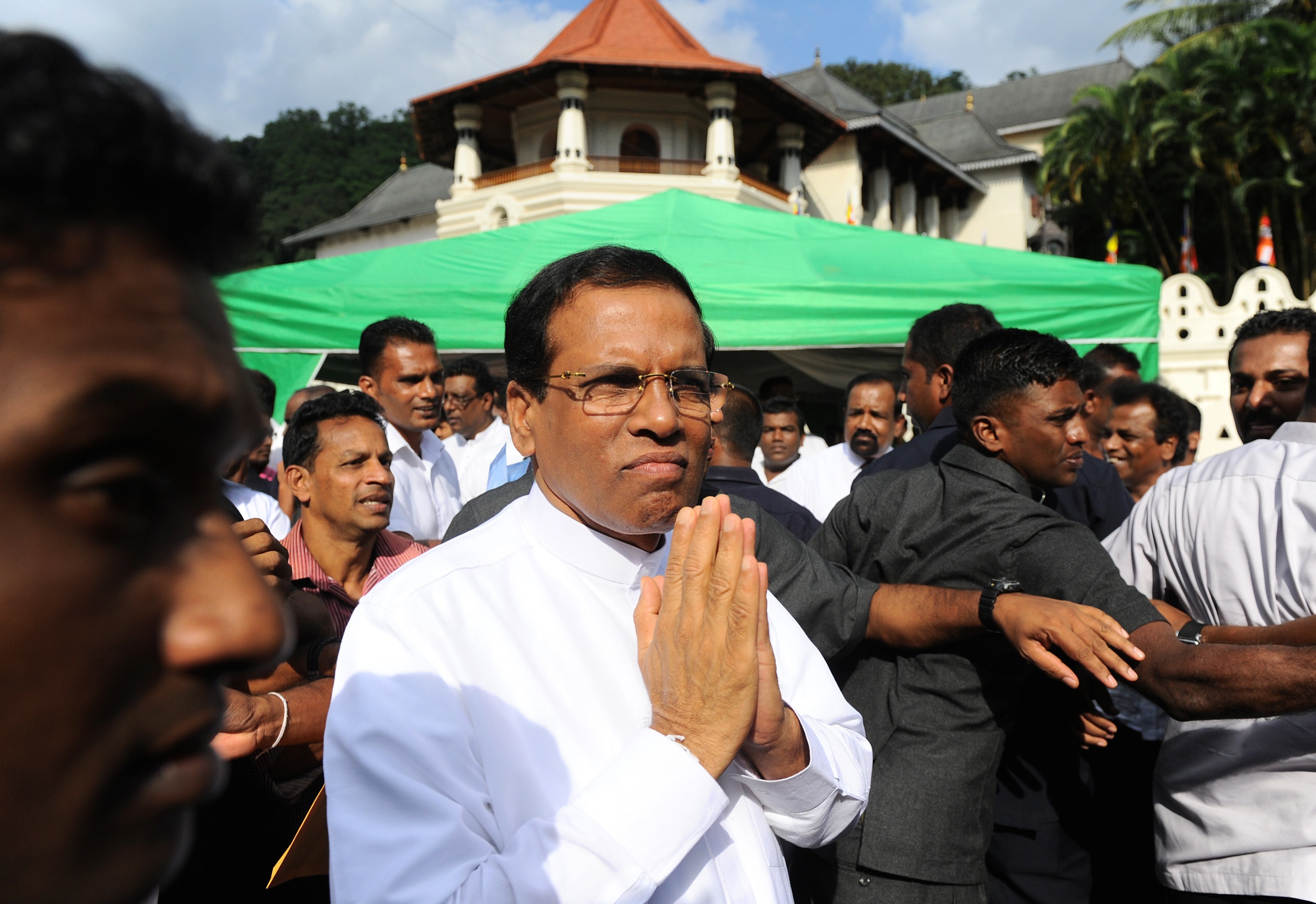
(Photo: The new president of Sri Lanka, Maithripala Sirisena, gestures to supporters after speaking outside of the Buddhist Temple of Tooth in the central town of Kandy on January 11, 2015. Sri Lanka’s new government on January 11 accused toppled strongman Mahinda Rajapakse of having tried to stage a coup to cling to power after losing last week’s presidential election. By Ishara S. Kodikara/AFP/Getty Images)

Face Of The Day

o-CHARLIE-COVER-570

Magnifique:

Charlie Hebdo revealed their cover image for this week’s issue, printed just days after two gunmen opened fire on the newspaper’s Paris office, killing 12 people. Four of the Charlie’s cartoonists were killed in the attack. The cover shows the Prophet Muhammad holding a “Je Suis Charlie” sign with the caption, “All is forgiven.” The newspaper said that it will print over 1 million copies this week, with financial help from Google, Le Monde and other organizations. It usually prints around 60,000.

The Plan To Make Community College Free, Ctd

Danielle Douglas-Gabriel cautions that Obama’s proposal still falls short for many would-be students:

Free tuition, even for two years, is not nearly enough to cover the cost of attending college. Tuition and fees counted for just 21 percent of the budget for students who attend two-year public college and pay for off-campus housing, according to a recent study from College Board. While the average tuition and fees at a community college is $3,347 for the 2014-2015 academic year, housing cost another $7,705, books averaged $1,328 and transportation added up to $1,735. Keep in mind, too, that Obama’s plan also doesn’t cover fees, which schools routinely charge for using labs, campus health centers and computer labs.

Libby Nelson addresses such concerns:

[Obama’s plan] would apply before Pell Grants. That means that poor students would have more Pell Grant money left over to help them pay for books and other life expenses. But Obama’s college plan would also help a constituency largely ignored by federal aid programs: families who earn too much for federal financial aid but aren’t wealthy enough to afford thousands of dollars of college bills.

Douglas-Gabriel acknowledges the Pell Grant factor but finds that “many students could still wind up working full time or taking out loans, albeit smaller amounts, to pay the difference.” Mike Konczal’s take:

Everyone—poor and middle class—would benefit from college cost control. Indeed this addresses one of the main conservatives complaints about student aid.

If the supply of education is hard to move, then subsidizing education through aid will raise the price of education, as colleges capture some of that as a subsidy. Worse, it also increases costs for students who don’t receive the subsidy, resulting in price inflation.

Fair enough. But if that’s true, then it must also be true that lowering the price of tuition directly with a public option will reduce prices across the board. Suddenly state and private colleges will have to consider if they offer enough value to make their price over community colleges a reasonable value. This is what the economist JW Mason refers to as progressive supply-side economics, and it’s part of the reason public options are so valuable. There’s a reason the CBO keeps scoring the public option as a major cost saver in healthcare. It’s not just the lower price of the public option; it’s that a public option “would tend to increase the competitive pressure on [other] insurers” in the exchanges, leading them ”to lower their premiums, which would further reduce federal subsidies.” This won’t break the back of rising higher-education costs, but it will help.

Scott Shackford, on the other hand, is deeply critical of Obama’s plan:

It’s not the students being subsidized, it’s the college. So they’re going to do everything in their power to keep these students attending, even if it results in students leaving college with associate’s degrees they can barely read, which will subsequently devalue the degrees in the eyes of employers.

Even in an era of grade inflation, though, community colleges also have terrible completion rates for students seeking two-year degrees. The Chronicle of Higher Education offers a handy map showing completion rates lower than 10 percent in states like Indiana and Rhode Island after three years of attendance. The best state, South Dakota, has a 52.9 percent completion rate. For-profit colleges [like Bryman College], for all their criticism for taking advantage of students (and federal subsidies), have a higher graduation rate than community colleges. … If a student falls into the extremely high drop-out rate for students, the government (and the taxpayers) don’t get the money back. So the White House is promoting a program funded by taxpayers to subsidize—wait, I mean further subsidize—a system that has baked in an extremely high failure rate.

But again, this program is not a subsidy for students. It’s a subsidy for faculty and college level administrative bloat.

And Andrew Flowers shows how such colleges are in more need now than in recent years:

As my colleague Ben Casselman pointed out in April, college enrollment is declining for recent high school graduates (those 16 to 24 years old). And it’s falling fastest for community colleges. This drop comes after a surge in enrollment during the Great Recession. For those graduating high school between 2007 and 2009, the share enrolled at two-year colleges rose to 27.7 percent from 24.1 percent. After reaching a high with the 2012 graduating class, the share of these young people at two-year colleges dropped sharply in 2013, to 23.8 percent. …

With better employment opportunities available for high school graduates, community colleges might just need the incentive of free tuition to lure more students.

Follow the entire Dish debate on the topic here.