Starting Over

Steve Clemons thinks it's time for Obama to make his own weather in the Israel-Palestine question:

My hunch is that people around the President like Tom Donilon, Denis McDonough, Ben Rhodes, Jon Favreau, and Adam Frankel are collectively the Ted Sorensens of today — though not quite the irreplacable him. They have faith in President Obama, and they need to guide him into what will eventually be a collision with Netanyahu that will both be part unstoppable assertion of America's power combined with sensible restraint. But there is no doubt that the President now must put his imprint on the deal he wants and no longer depend on the illusion that the two primary parties have the maturity or sense of their long term national security interests to do a deal on their own.

The question is whether he can get away with it domestically, even though it's clearly in the national interest. I think he can if he places the argument firmly within the contours of the broader goals of American foreign policy, and of rescuing Israel from a descent into apartheid-style international isolation. He will be opposed of course. AIPAC helped destroy the Obama promise to reset relations with the moderate Muslim world in 2008/2009; Eric Cantor will no doubt do whatever he can to give Israel as many weapons, goodies and cover for war that he can; candidates in 2012 who dare to suggest the US adopt its own foreign policy in the Middle East, rather than the Israeli government's, will be ruthlessly targeted by AIPAC and its donors.

But the end-point of this same old pattern will be the destruction of Israel in the near or distant future. And at some point, surely, even AIPAC will want some kind of two-state solution.

If The Deal Fails

Ed Kilgore asks liberals to think a couple moves ahead:

[P]ersonally, I consider ever-worsening economic inequality the great undiscussed issue of our time, and think the abolition of estate taxes would be morally obscene. But those who urge a course of action that makes these positions non-negotiable have a responsibility to game-plan this out a bit in terms of real-life consequences. "Fighting" is not a strategy; nor is "drawing a line in the sand." No rebellion is going to change the Obama administration's handling of the 2009 stimulus bill or the 2010 health reform bill. And you can't make the tax issue a no-brainer: yes, Obama did promise to oppose extension of tax cuts keyed to the top bracket, but he also promised, much more vocally, to extend the rest of them, so he's going to have to break a promise anyway you look at it.

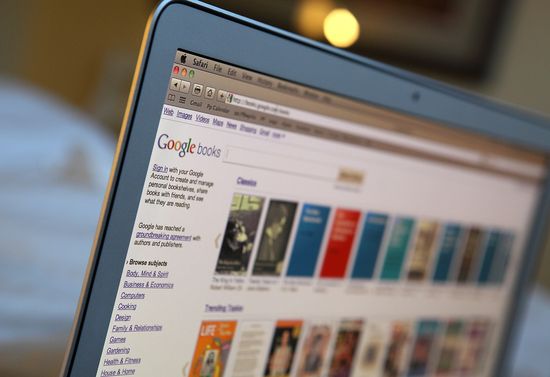
The Digital Books Giants Square Off

GoogleBooksGetty
Laura Miller compares Google's new e-book store to Amazon's Kindle:

Google eBooks is a big improvement on the Kindle (still the most popular dedicated e-reader device) if you anticipate wanting to switch from one dedicated e-reader device to another, but if you're switching to an iPad, then it's a wash. On the other hand, if you're a student at the library one afternoon without your Kindle or iPad and you want to be able to access a Kindle book you bought for a class, you're out of luck. (If that last example strikes you as an exotic scenario, bear in mind that while Kindles are the most popular dedicated e-reader devices, the majority of people who read e-books still read them on a laptop or desktop computer, and many of these readers are students.) Your Google e-books, however, can be read on the library's computer using a Web browser. But hold on a minute! — Amazon just announced that it will be introducing its own Web-browser-based Kindle reader in a month or so.

(Image: Justin Sullivan/Getty Images)

There’s Are No Political Mulligans

Ezra Klein wishes that the Democrats had been better strategists:

The way this should have gone is that Democrats should have proposed turning the Bush tax cuts into a two-year payroll holiday, and adding some other relief measures besides. We should be cutting taxes during a recession — the cuts just shouldn't be focused on the rich. But Democrats didn't run that play. They didn't really run any play. Obama simply opposed the tax cuts for the rich. And so this outcome, in being completely different than the one they said they were going for, is being understood as a loss, and even a capitulation. But they're losing their way into a better deal, and one that looks more like the deal they should've been going for in the first place.

The Limits Of Anonymous

Babbage chats with members of Anonymous, a group currently launching denial-of-service attacks in support of Julian Assange:

Anons do understand their limitations. The ones I talked to know that to take down a Swedish prosecutor's website does not halt the prosecution in Sweden. They described their motivations, variously, as trying “to raise awareness”, “to show the prosecutor that we have the ability to act” and “damage and attention”. This is all that a denial-of-service attack can do: register protest. It is not cyberwar. It is a propaganda coup. And it's limited to a limited set of websites: vulnerable, but important.

R.M. at DiA is unsettled:

One area where I disagree with [Babbage] is in his insistence that all a  denial-of-service attack can do is register protest. When you take down the website of a PostFinance or MasterCard, as Anonymous has done in the past, it does more than simply show disapproval, it affects business. This is the future of activism, and it is both empowering and scary. A group like Anonymous isn't really trying to impose anarchy as much as it's trying to impose the will of its members (or whichever members are active at a certain time). As it fights for freedom on the internet, it constricts the net itself, by taking down websites and halting e-commerce.

Mounting A Primary Challenge Against Obama

Weigel thinks it's a bad strategy:

All of this liberal discussion about challenging Barack Obama (it really is limited so far to Robert Kuttner, Michael Lerner, and a handful of other people) misses the point about how to effectively pressure a political party into doing what you want. The least effective way of pressuring the party is to back a stunt campaign against the president of the United States. Nothing gets more coverage. Nothing is less winnable. 

Seriously: Lerner and Kuttner? I suspect they'd even get Mickey back on the Obama bus.

The Daily Wrap

Today on the Dish, on the tax front, Andrew argued the deal would win back independents and some Republicans. Andrew parsed the two sides to Obama, and cheered that a post-partisan president could pop the bubble of demonization that the GOP had drummed up. Nate Silver previewed the GOP line of attack for 2012, readers responded, and Leonhardt imagined three outcomes for the tax cut game in 2012. Macroeconomic Advisers did the math, Howard Gleckman assessed it from both sides, we realized not even the Tea Party train could stop Bush's tax breaks, and we tracked the rest of opinion on the tax compromise here, here, and here.

Assanged was transforming from punk to hero, and Serwer feared for national security journalism if Assange gets prosecuted. Samuels expected better of journalists, Michael Moynihan tried to resist the conspiracy theories surrounding the rape accusations against Assange, and E.D. Kain asked the pertinent question of whether we'd let China do to Assange what we want to.

The DADT repeal teetered on the brink of getting to the floor. Steve Chapman was hopeful about DADT since he realized familiarity with gays breeds acceptance. Scott Morgan predicted a cannabis-friendly campaign for 2012 hopeful Gary Johnson, and Larison could hardly contain his enthusiasm for Johnson to run. McCain reversed himself on the DREAM Act, abortion politics stayed the same even when everything else changed, and Amanda Marcotte didn't understand what's so grand about marriage. Reza Aslan pleaded for a Palestinian state, and the most conservative part of the country ate like gluttony isn't a sin. The greenest packaging may already exist in banana leaves, Clive Thompson gushed over Instagram, and e-cigarettes celebrated a judicial victory. Tom Friedman baited Matt Taibbi with his bad metaphors, and Marty Beckerman sailed free with crotchless men's underwear.

Creepy ad watch here, chart of the day reax here, VFYW here, MHB here, and FOTD here.

–Z.P.

Where Obama And The Left Agree

Sargent puts the tax fight in perspective:

Obama's argument with the left, at bottom, is more a dispute over what's achievable, and less an argument over what is desirable to achieve. Obama opposes extending the high end tax cuts, just as the left does. His disagreement with the left is over whether there's another way to achieve the goals Obama and the left agree on: Extending the middle class cuts and extending unemployment benefits. The left says a protracted fight would achieve those things. Obama and his advisers say a fight wouldn't achieve those things, or at least that a fight wouldn't achieve them in time to stave off a tax hike for the middle class. Hence his willingness to reach a deal.

Indeed, Obama's outburst yesterday was rooted in genuine frustration with the left for not agreeing with him about what's possible given today's political realities.