Palin And The Caribou

It has become a Sunday night ritual now: we watch “Sarah Palin’s Alaska” followed by “The Walking Dead”. The latter is much more believable as reality – but the former has its zombie charms.

What’s particularly awesome about SPA is that each episode is obviously crafted around a “Sarah’s-Just-So-Darn-Great” arc followed swiftly by the brutal murder of various life-forms. It helps to have some kind of Mormon-style family meme – last week was Track’s becoming a man, this week was Sarah bonding with Dad while shooting deer – combined with at least one scene gutting the innards out of something previously bright and beautiful. Last week, we saw Bristol holding the still-beating heart of a former halibut; this week, poor little Piper got to look at a caribou heart – “it reeks!” – as the Palins allegedly stocked up on protein for the winter.

But as with most Palin fantasies only gingerly related to planet earth, there are some discrepancies that even Palin’s control of the editing cannot quite remove. We are obviously supposed in the latest episode, for example, to imagine Sarah heading out with daddy Chuck every season for some huntin’, bein’ an expert at shootin’ a gun, revealin’ her years of expertise and training in the wild north as an all-round MILFy mama grizzly from the wilderness.

So why did her dad rather touchingly finish the trip by saying, “It’s been great to meet you again”? Why did she not know if the gun her dad gave her would kick back? Why did she then seem unable to shoot even close to the caribou when dutifully set up by her dad and his hunting side-kick? Who can say? Hilariously, she tried to show later in the same episode that her dad’s gun had to be off-kilter or she would have made the shot with no difficulty. And maybe she was right. Again: who can say? After a while, the suspension of disbelief kinda works. Which is why this show is so like her political career: you just have to drop all desire to have it make any sense and it’s relatively painless. If you relax, it hurts less.

A few other things that slip through the propaganda net. Her poor dad – at 72 – probably shouldn’t be striding through the undergrowth above the Arctic Circle in search of prey. He took a nasty fall trying to burnish his daughter’s NRA rep. Piper is as catty as her mom: she noticed that the caribou Sarah eventually shot was a relatively little one. And the woman who mans – yes, mans – the tiny outpost hundreds of miles above the Arctic Circle and lives alone for nine months of the year … well who could blame her for trying to get in one clumsy kiss with her idol before being abandoned to another year in darkness?

As I said, a series that reinvents the zombie genre with surprising freshness and human detail. Good times.
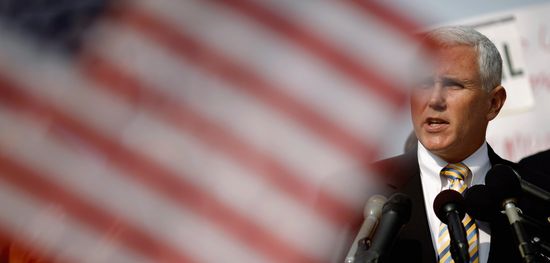

“Palin With Gravitas”?

PENCEChipSomodevilla:Getty

Allahpundit sees the logic of a Mike Pence run at the White House:

The guy who’s usually mentioned as the threat to Palin is Huckabee, of course, because they’d compete for social conservatives. But establishment Republicans dislike Huck almost as much as they do Sarahcuda, as he’s ever eager to remind us. So imagine for a moment that you’re Karl Rove, nervously weighing the possibility that one of those two will be the nominee. You can try to head them off by pushing Romney or Daniels or Thune, but then you run the risk of a pure “centrists vs. the base” primary — and because the base tends to be more motivated to turn out, they’d have the upper hand.

The alternative is to try to coopt part of the base by backing a compromise candidate instead, someone who might be more fiscally and/or socially conservative than the establishment would prefer but who would peel off base voters from Huck and Palin and would stand a better chance of appealing to centrists against Obama. That’s Pence. He’s got 10 years of legislative experience, he’s deeply respected by fiscal cons and social cons, he gives a good speech, and he’s less ostentatious about “values” than Huckabee is so he runs a smaller risk of alienating moderates in the general election.

Pence is considering running. Pence's extremism on almost all subjects does not seem to me to be an advantage over Palin, but it might square a couple of GOP circles. Still: this very white guy stomping on Sarah wouldn't be good optics either. And she'd win.

(Photo: Chip Somodevilla/Getty.)

Debt Or Unemployment?

Several readers have objected to my view that tackling the long-term debt is obviously the biggest issue now on the table. What about unemployment, they understandably ask? Well, I'm not an economist, but it strikes me that the options for more aggressive spending to prop up demand (and thereby reduce unemployment) are limited (for both political and economic reasons). QE2, extension of the Bush tax cuts for a year or two, and continued unemployment benefits, with a little jawboning on the Chinese currency, is about as good as we're gonna get.

What we're missing is the long-term confidence to spend and invest. And showing that there is a light at the end of the Bush-Cheney debt tunnel would definitely help. Here's Christina Romer on this in the NYT:

The more genuine source of tax uncertainty is related to the government’s long-run budget deficits. Congressional Budget Office projections show that the current budget trajectory is grossly unsustainable. The tax changes required to balance the budget in the future could be modest or enormous, depending on what happens to spending.

Simply promising not to raise taxes wouldn’t be helpful. The American people are wise enough to understand that wishing won’t make the problem go away. The only way to resolve this fundamental uncertainty is to enact a credible long-run deficit reduction plan that shows what spending will be cut and what taxes will be raised, once the economy returns to full employment.

You can accept all of Ezra Klein's points on avoiding debt-hysteria, and still see the clear and powerful current economic reasons to address the future now, before it decides to address us.

Prop 8 Update

C-SPAN is covering today's proceedings:

A three-judge panel on the Ninth Circuit Court of Appeals in San Francisco will hear an oral argument today on California’s ban against same-sex marriage. In the November 2008 elections, California voters approved Proposition 8, an amendment to California’s Constitution that limits marriage to a man and a woman. The Court will decide if a lower court rightly struck down the voter-approved ban as unconstitutional. … 

The oral argument will be divided into two hour-long sessions with a brief recess in between. In the first hour, the parties will address each appellant’s standing and any other procedural matters that may properly be raised. In the second hour, the parties will address the constitutionality of Proposition 8. 

C-SPAN's schedule says that the oral arguments will be broadcast live from 1 pm to 3:30 pm  ET. 

A Tweet Echo Chamber?

James Harkin views the world of Twitter diplomacy. On Iran he isn't impressed:

When you look at the figures you realise that only a very small number of Iranians were using [Twitter]. In 2009, according to a firm called Sysomos which analyses social media, there were 19,235 Twitter accounts in Iran – 0.03 per cent of the population. Researchers at al-Jazeera found only 60 Twitter accounts active in Tehran at the time of the demonstrations, which fell to six after the crackdown.There’s certainly a growing internet culture in Iran – in Blogistan, the media academics Annabelle Sreberny and Gholam Khiabany estimate that there are about 70,000 active blogs in the country, including a vibrant gay blogosphere – but it’s far from being the preserve of liberal reformists….

It was more useful for the global media. ‘Twitter functioned mainly as a huge echo chamber of solidarity messages from global voices, that simply slowed the general speed of traffic,’ the authors of Blogistan conclude. On 16 June the authorities forbade journalists from covering the demonstrations without permission. Kicking their heels in their hotel rooms, most foreign correspondents began surfing through the blizzard of tweets and video clips to try and work out what was going on.

But it was all difficult to verify, and a good part was tweeted from outside the country: to add to the chaos, many overseas sympathisers had changed their location to make it look as if they were in Iran. The point – perhaps – was to confuse the Iranian authorities by opening the information gates, but the flood of unverifiable tweets may have confused the protesters too. Some of what was sent around on Twitter – the news, for example, that Mousavi had been arrested – simply wasn’t true, so the movement’s high-profile foreign supporters were often retweeting rumour and disinformation from the comfort of their desktops.

The Death Of Newspapers Has Been Exaggerated

Cory Doctorow explains:

The experiment that we are presently conducting as a society is aimed at discovering what kind of information and transactions are really and truly “newspaper material” and not material that we stuffed into the margins of a newspaper because we needed it and newspapers were the only game in town. It may be that there’s nothing left when we’re done, that there’s a better way of delivering every word and every picture in the newspaper than to print it on broadsheet and fold it in eighths, in which case, newspapers may die, or they may end up being the territory of newspaper re-enactors, the equivalent of hobbyists who knap their own flint or re-enact the Battle of 1066. Or it may be that newspapers do have a small and important and moving clutch of information and stories and images that really, really are better on paper.

Maybe the audience for that will be too small and specialized to support a large business, and maybe the audience will club together and treat newspaper like a charity, the way that opera (another medium that lost a lot of its stories to more popular and hence cheaper successor media) functions today. Or maybe the cost of producing a paper will dip so low that we won’t particularly need a business to support it (Clay Shirky: “Will we still read the New York Times on paper in the future? Sure, if we print it out before reading it”). Or maybe there is a large and substantial and popular insoluble lump of newspaperstuff that no successor medium is better at hosting, a critical mass of popular material that sustains newspapers in a diminished but substantial niche, perhaps like vinyl records.

What Now On The Debt?

Don Taylor watches Obama:

The next big move is that of the President. Will he propose a budget to Congress that contains these hard choices, perhaps forcing continued discussion of these issues? The results of the Commission suggest there could be hope of the White House being able to work with the Senate on these issues. If they build momentum, it may become increasingly hard for the Republican controlled House to ignore things given how much Republicans have traditionally talked about deficits (they have mostly only talked, however).

Where Are America’s Corner Pubs? Wisconsin.

Us_bars_groceries_100122

A reader writes:

Have Avent and Steinglass never been to the Upper Midwest?  St Paul, Duluth, Madison, Milwaukee?  Corner pubs are everywhere. Get out of the boring Beltway and live a little.

Another writes:

Wisconsin has got to be the closest thing to the English utopia these two dudes describe.

Nearly every town in this state has more bars than churches. Breweries are in fact allowed to own pubs in Wisconsin. In Eau Claire, some of our most popular food joints are that bar around the corner.

I also think Steinglass is mistaken in thinking that this is due to national law; alcohol is typically regulated by states, and in some cases counties, in the United States.

Another:

In my home state of Wisconsin, the small town with 400 people, four churches, and four bars is almost a cliché.  I’m sure that the zoning laws in DC and thereabouts play the largest role in the demise of the corner bar there; older cities large and small have grown up with the corner bars as cornerstones.

Another:

I live in Wisconsin, and we take our kids to the bar and grills (what we call pubs) fairly often. Sometimes I take my daughter out to lunch at the local bar and grill and we sit at the bar with the daytime drinkers and eat our burgers. The local school has a fundraiser with bands at a local bar/grill attended by all the kids and parents.

Another:

In fact, in Wisconsin, if you are with your parent, you can have a beer as a ten year old!  It is a completely different culture.  I’m from neighboring Minnesota, which does very well in this category, but it does not hold a candle to Wisconsin. (This link takes you to a map of the U.S. showing cities that have more bars than grocery stores.  Wisconsin and the upper Midwest really stick out.)

Another:

You need to visit Milwaukee. We have corner bars, usually referred to as "taverns", on probably every fifth street corner in the city. This was written up in the Telegraph a decade ago:

The big brewers might have rolled out their barrels for the last time but the barmen haven't. There are a reputed 6,000 watering-holes in Milwaukee, one for every 100 residents. If James Bond style isn't your fancy there are sports bars, games bars, yuppie bars, Bavarian bars, pick-up bars, music bars and grumpy working-men's bars where no one says a word.

There are rules for drinking well in Milwaukee. The place is safe enough: its streets are wide and logically arranged, its atmosphere happy. But smart drinkers remember that it's also a big place with bars widespread on district street corners, each reflecting a micro-community. Be prepared to travel. Cabs are plentiful and five or six dollars will usually get you to the next oasis.

I invite you to come for a visit sometime and see!

Better Than The Elephants?

Kevin Drum makes the case for the left's fiscal responsibility. Yes, compared with the Republicans, the evidence is impressive (which is why I favor an anti-debt crusade by Obama for the next two years):

At the federal level, center-left types fought an entire national election in 2000 based largely on the idea that times were good and the federal government should be accumulating surpluses. It was a pretty big deal, and as you'll recall, we center-lefties lost that election and George Bush proceeded to piss away the surplus and run up more debt than any president in history. On the spending side, center lefties recently passed a big healthcare overhaul that was largely funded by cuts in Medicare spending, and instead of applause for their fiscal sobriety they got hammered for it by Republicans during the 2010 midterms. In other words, on the federal level center-left types have proven over and over that they are willing to be pretty responsible on spending and budgetary issues despite getting clobbered for it. But the opposite isn't true of conservatives and taxes.

One need look no further than the national-level dogfight going on right now over the expiration of the deficit-busting tax cuts that originally got George Bush into the White House. No conservative who wants to win reelection even dares consider taking a responsible position on this.

But how are things at the state level? What happens when center-lefties try to restrain spending and build up surpluses during good times? They very quickly learn a harsh lesson: if you accumulate money in a rainy-day fund, conservatives will promptly demand that it be "returned to the taxpayers." That happened here in California as far back as 1978 and was a big reason for the passage of Proposition 13. And if you allow a temporary tax cut to expire, your career might be over. This happened here in California as recently as 2003, when Gray Davis got tossed out on his ear for allowing the car license fee to automatically revert to its old level when the state budget got out of balance.