Syria Intervenes

On Wednesday, Jassem Al Salami flagged evidence that Syria, and quite possibly Iran as well, were carrying out airstrikes against ISIS in Iraq:

[Tuesday morning,] unidentified jet fighters bombed a market in the Islamist-held city of Al Qa’im in northwestern Iraq. The city, which recently fell to militants from the Islamic State of Iraq and Syria, is near the Syrian border, so we’re assuming the bombers were Syrian—an eastward extension of Damascus’ brutal air war against rebel forces. At approximately the same time as the market exploded, Iraqi social media users reported contrails over Baghdad heading from west to the east. The contrails didn’t match the usual twin pattern of civilian airliners or military cargo aircraft, indicating fighters.

Four separate air arms are now active over Iraq, which is fighting a desperate battle against invading ISIS militants coming from Syria. Iraq, Syria and—possibly—Iran have bombed ISIS. And the U.S. Navy and Air Force are flying reconnaissance missions. We’re pretty sure the contrails over Baghdad weren’t from American planes.

Maliki confirmed this yesterday, saying that Syrian planes were indeed striking the militants and that he was pretty happy about it. The Syrian government is denying it, but “a Syrian source” provides Mohammad Ballout with a detailed account of what areas the air force is targeting and why:

In the past six days, Syrian warplanes conducted air operations to support Iraqi forces in their moves against ISIS and slowed down the advancement of ISIS to the Jordanian borders. ISIS has already taken over the strategic city of Ratba, which opens the way to the Saudi-Jordanian triangle and Terbil crossing and leads to Jordan.

A Syrian source reported that squadrons of Syrian military aircraft in the eastern regions, especially in Deir ez-Zour and Tabaqa, raided six Iraqi regions in coordination with the Iraqi army, two days after the ISIS attack on Mosul. Moreover, the Syrian warplanes targeted the ISIS locations in Ratba, Qaim, Mosul, al-Waleed, Baaj and al-Ramadi.

The Syrian warplanes intensified their efforts in Raqqa to strike the supporting bases of ISIS. They are also trying to destroy the organization’s main gatherings in al-Shadadi, south of Hasakah, which ISIS had transformed into spots to collect weapons and spoils that it had confiscated in Iraq.

Ian Black connects the airstrikes to Assad’s calculation that ISIS has changed from a useful propaganda tool to a security threat:

When Assad freed hundreds of hardened Salafi fighters, in 2011 and 2012, many of whom had previously been allowed, with the help of the Syrian Mukhabarat intelligence service, to cross into Iraq to fight US forces there, his intention was probably to bolster the narrative that Syria was engaged in a fight against violent extremism. Winning the propaganda war would ward off western help for the moderate opposition and cause damaging divisions in rebel ranks. …

The Syrian National Coalition, the main western-backed opposition group, dismissed those raids as “a ridiculous decoy” designed to rebuild trust with the international community after Assad’s clandestine relationship with Isis was exposed. But a plausible explanation could be that recent developments in Iraq have forced the Syrian president to take Isis more seriously than he has done so far. Tacit cooperation with a dangerous enemy may now be over. If war makes for strange bedfellows, neither party should be too surprised if, when the relationship outlives its usefulness, the other one simply kicks them out.

Along the same lines, Keating posits that Assad has been rehabilitated, at least partially, by dint of an enemy even scarier than himself:

For the most part, Assad tolerated the rise of ISIS in recent months in a bid to divide and stigmatize the rebels. He has now begun bombing them at the exact moment that the U.S. and Europe have become increasingly alarmed about the group’s rise.

A bit less than a year ago, it seemed extremely likely that the U.S. would drop bombs on Assad’s military. Today the U.S. is seriously considering dropping bombs on Assad’s enemies. And Assad has succeeded in this turnaround while continuing the wanton slaughter of Syrian civilians and possibly continuing to use chemical weapons. The Syrian leader’s actions may have plunged an entire region into irreparable chaos, but in terms of pure self-preservation, he looks pretty shrewd right now.

But still, Syria remains a humanitarian catastrophe, a fact for which Assad remains primarily responsible:

It is hard to fathom the humanitarian crisis in Syria getting any worse than it already has. But it is, with the number of Syrian civilians residing mostly beyond the reach of United Nations relief workers swelling from 3.5 million to about 4.7 million, according to new U.N. estimates. Those enduring the brunt of the misery are civilians trapped in rebel-controlled terrain, cut off from life-saving assistance by a dizzying array of bureaucratic regulations and subjected to a relentless barrage of indiscriminate barrel bomb attacks by the Syrian Air Force, according to the internal U.N. data as well as a June 20 report to the U.N. Security Council by U.N. Secretary General Ban Ki-moon. …

Over the past three months, humanitarian relief deliveries to opposition areas throughout the country have fallen by 75 percent compared to the quantities of aid delivered in the first three months of the year. According to Ban, the Syrian government has systematically blocked the delivery of medical supplies — particularly syringes and blood supplies — to civilians in rebel-held areas. Ban said that was “in clear violation of international humanitarian law,” Ban wrote. “Tens of thousands of civilians are being arbitrarily denied urgent and life-saving medical care.”
Quote For The Day

“Part of Republicans’ problems—and frankly, to tell you the truth, some in the evangelical Christian movement—I think [they] have appeared too eager for war. When people come to me and they’re lobbying for ratcheting up some sort of bellicose policy towards one country, even if it’s a bad country, I tell them that and when I read the New Testament, that when I read about Jesus, I don’t see him involved, he wasn’t really involved with the wars of his days.  And, in fact, people rebuked him for not being [what] they wanted. They wanted somebody to stand up to the Romans. He stood up in a different sort of way, but he didn’t organize coalitions and guerrilla bands and arm them. Now I’m not saying that you shouldn’t have people who want to defend against evil, bad forces around the world, but I think you need to remember that he was the prince of peace, you know, we’re talking about ‘blessed are the peacemakers,’ not ‘blessed are the war-makers,'” – Rand Paul, a year ago.

“If Windsor Was The Battle of Normandy, This Decision Is The Liberation Of Paris”

US-JUSTICE-GAY-MARRIAGE

One of the long standing debates in the gay civil rights movement – like all civil rights movements – has been a question of priorities. What’s more important: marriage equality or employment non-discrimination? Military service or hate crime laws? And the answers to those questions are usually complex, dependent on circumstances, events, opportunities and political philosophies. My own position was a pretty libertarian (or constitutional conservative) one from the get-go: it was far worse in principle and practice, I argued, for your own government to be discriminating against you than your fellow citizens in private enterprise. Only when the government is brought to heel should other actors even be looked at. In Virtually Normal, I even tried to lay out a strategy that would only target government discrimination – and then see if more general discrimination withered without government action.

I was – am – a lonely voice in the gay community. Back in the 1980s, the consensus was first that we should push for a broad windsor-600-thumb-580x773-269511civil rights act along the lines of African-Americans; and then, as that seemed like a pipe-dream, the strategy was to single out the one provision that commanded the most support – curtailing employment discrimination. Marriage and military service were seen as far too quixotic to be pursued with any vigor for the foreseeable future.

The argument that Evan Wolfson and I marshaled was that the movement was missing something important. My view was that the campaign for marriage and military service would more powerfully redefine the movement on the lines of love and service, as opposed to merely sex and victimhood. I thought the debate itself would reveal who gay people really were beyond the defensive stereotypes and easy dismissals. And I thought this would lead to a shift in collective consciousness, even if we fought these battles and lost, that would help us across the board.

A quarter century later and there is still no federal employment non-discrimination law, but we have openly gay military service and now half the country’s gays living in states with access to civil marriage – including federal recognition. But more to the point, the legal and constitutional arguments about marriage have ineluctably changed core premises about sexual orientation  in our collective consciousness – and made the case for basic legal and human equality for gay people far more robust.

And so it does not surprise me to see, in a fascinating case about jury selection just decided (pdf), that the Windsor case is already elevating the legal status of homosexuals far beyond marriage equality itself. Somehow, this has flown below the radar this week, but it could be the biggest breakthrough of the year.

Alison Frankel has two great columns on the case. Here’s her gist:

A three-judge panel of the 9th Circuit found that Abbott Laboratories improperly excluded a gay man from serving on the jury in a trial of GlaxoSmithKline’s claims that Abbott improperly jacked up the price of certain HIV medications. In an opinion written by Judge Stephen Reinhardt, the appeals court held that under the Supreme Court’s ruling in Batson v. Kentucky, jurors may not be struck for discriminatory reasons – and that under Windsor, claims of discrimination against gays and lesbians must receive the same heightened scrutiny as those against other protected minorities. That might sound technical, but if the panel’s decision is upheld, it will be extremely difficult for any law in the 9th Circuit’s jurisdiction that discriminates against gays and lesbians – including same-sex marriage restrictions – to survive an equal rights challenge.

“We now have a holding in clear terms that any law that treats gay people differently is subject to heightened scrutiny,” said Roberta Kaplan of Paul, Weiss, Rifkind, Wharton & Garrison, who won the Windsor case at the Supreme Court. “That’s Game Over…. If Windsor was the Battle of Normandy, this decision is the liberation of Paris.”

The dissent in the case echoes Robbie’s assessment. Frankel:

If you want to know just how monumental a gay-rights ruling the 9th U.S. Circuit Court of Appeals issued Tuesday, just two days short of Windsor’s one-year anniversary, take a look at the dissent written by Judge Diarmuid O’Scannlain and joined by Judges Jay Bybee and Carlos Bea. O’Scannlain posits that his colleagues’ decision in the case, GlaxoSmithKline v. Abbott Laboratories, “precludes the survival under the federal Constitution of long-standing laws treating marriage as the conjugal union between a man and a woman.” But it’s even more drastic than that, according to the dissent: The appellate decision has changed the standard for evaluating all laws targeting gays and lesbians, the dissent said, “with far-reaching — and mischievous — consequences.”

If the 9th Circuit dissenters turn out to be as good at fortune-telling as Scalia, states in the Western swath of this country — California, Oregon, Washington, Montana, Idaho, Nevada, Arizona, Hawaii and Alaska — won’t be able to curtail equal rights based on sexual orientation, even if the states think they have a rational basis for doing so. That’s a much farther-reaching holding even than the 10th Circuit’s decision Wednesday that Utah’s ban on same-sex marriage is unconstitutional — and for gay rights proponents, it’s quite an anniversary present.

It sure is. Heightened scrutiny for gays as a class is indeed game over for gay equality. And if it sticks, we will have the crazy, quixotic, impossible dream of marriage equality to thank for it.

Happy Pride, y’all!

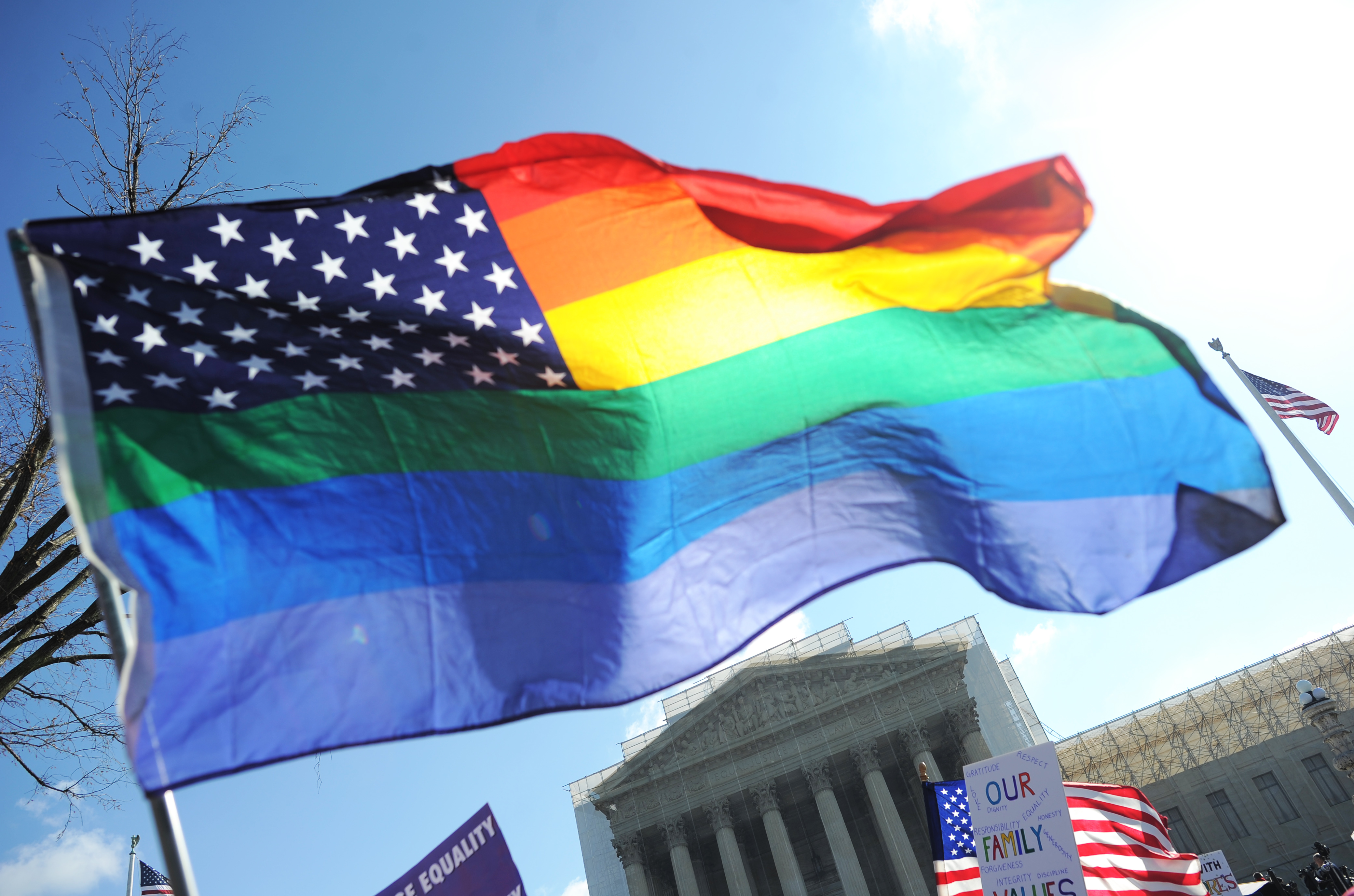
(Photo: Same-sex marriage supporters wave a rainbow flag in front of the US Supreme Court on March 26, 2013 in Washington, DC.  By Jewel Samad/AFP/Getty Images. Edie Windsor and Robbie Kaplan on the day Windsor was decided. By Getty Images.)

Recess Over

Yesterday, in National Labor Relations Board v. Noel Canning, SCOTUS nullified three temporary appointments Obama made to the board last year while the Senate was out of town but holding pro forma sessions to prevent the president from making recess appointments – a tactic devised by Democrats during the Bush administration. The ruling may also nullify the appointment of Richard Cordray to head the Consumer Financial Protection Bureau, which is being challenged in a separate case in federal district court.

However, the court’s first ever opinion on the Recess Appointments Clause largely upheld the president’s powers in this regard. Lyle Denniston outlines the rules it establishes:

First, the president may make a temporary appointment when the Senate is in recess between its annual sessions when it takes a formal break or during interruptions of one of its annual sessions, provided that the Senate actually has made itself unavailable for at least ten days.  The Court turned aside the idea that this power would exist only when the Senate was formally out of town between annual sessions.

Second, the president may make a temporary appointment when the Senate is in recess, even if the vacancy arose before the Senate became unavailable and remained unfilled when it took a recess. The Court refused to embrace the notion that the power applied only to a government post that became vacant during a recess, and had to be filled during that recess. Both of those parts of the decision went in favor of presidential authority to fill vacant posts.

Third, in the only part of the ruling decidedly against presidential prerogative, the Court barred the president from filling a vacancy when the Senate is holding what it, by its own action, treats as a working session even if it does no real work and shuts down fully every three days.  That is too short to be treated as a recess.

The court ruled unanimously but issued two separate opinions: the controlling opinion by Breyer and a concurrence by Scalia that reads more like a dissent. Noah Feldman dives deep into Breyer’s reasoning, which strongly reflects his pragmatic approach to constitutional law:

In essence, Breyer was acknowledging that, as a practical matter, the dispute between the two other coordinate branches of government shouldn’t be resolved by the court simply declaring that it knows the meaning of the Constitution, especially when that meaning is uncertain. … Then, in a still more frankly pragmatic part of the holding, Breyer stated that short breaks of three to 10 days should presumptively be considered not to be recesses at all.

Of course, the numbers three to 10 don’t appear anywhere in the Constitution. It’s a hallmark of pragmatism to add numbers for practicability even where the Constitution is silent. That, for example, is what Justice Sandra Day O’Connor did in her affirmative action opinion in 2003, when she famously said that she expected affirmative action to sunset within 25 years.

Ilya Shapiro, however, prefers Scalia’s originalist argument, which was joined by Roberts, Alito, and Thomas:

The only “rule” that emerges from Justice Breyer’s controlling opinion is that a three-day recess, the longest the Senate can adjourn without the House’s consent, isn’t long enough to enable recess appointments. That’s a very pragmatic decision and seems to confirm executive practice prior to recent years. It also happens to lack any connection to constitutional text (as Justice Scalia points out for four justices in concurrence), whose best reading indicates that only recesses between Senate sessions – not when, e.g., the Senate takes two weeks off around Christmas – count for purposes of activating the recess-appointment power. Moreover, that power is only textually justified to fill vacancies that arise during the recess itself, not for openings that the president didn’t happen to fill while the Senate was sitting.

In other words, Justice Breyer’s unprincipled opinion, while limiting recent presidential practice, cements a much more expansive reading of that power than the Constitution allows.

But Scott Lemieux ridicules Scalia’s “ahistorical” approach:

Scalia’s claim that the text of the recess appointment clause has only one reasonable interpretation simply beggars belief. As Breyer observed, among the people whom Scalia deems incapable of understanding the English language are Thomas Jefferson, who wrote in a letter than the recess appointments clause was “certainly susceptible of [two] constructions”.

Besides which, that a majority of the Supreme Court disagrees with Scalia’s interpretation of the text – even though it agrees with his bottom line on the case – also makes it hard to accept that the alternative, accepted reading of the text is, as Scalia implies, simply irrational. Even worse for Scalia’s assertion is the evidence provided by nearly two centuries of actual government practice.

So what does this ruling mean for now? Not all that much, beyond nullifying these three recess appointments:

[N]othing in the Court’s ruling suggests that it would invalidate other, earlier recess appointments.  To the contrary, the Court made clear that, over two centuries, presidents had made only a very small handful of recess appointments during recesses that were shorter than ten days.  And later on, it contrasted its approach with that of Justice Scalia – whose approach, it contended, “would render illegitimate thousands of recess appointments reaching all the way back to the founding era.”

But what about other recess appointments in the future?  The short answer is that it really will depend on which parties are in power.

Morrissey asks what happens to the decisions the NLRB made when the invalidated appointments provided it with a quorum:

The answer appears to be that they can be successfully challenged and set aside. That was the context of the challenge to the recess appointments in the first place — lawsuits against regulation created in that period that alleged they were illegitimate. This ruling means that the Supreme Court unanimously agrees on that point, a severe rebuke to the “constitutional scholar” President and his abuse of power. More practically, though, the recent appointments to the NLRB can reconstitute that regulation if they wish, so the victory may be short lived for the plaintiffs.

Serwer raises the same question:

It’s unclear where the high court’s ruling leaves decisions made by the NLRB while its members were recess appointed. Richard Cordray, the recess appointed director of the CFPB, was later confirmed by the Senate. He then ratified past decisions made prior to his confirmation.

“It’s possible that the NLRB members could go back and ratify the decisions that were made when they were recess appointed, but it’s unclear if that would hold up in court. So that is something that would be litigated going forward,” said Brianne Gorod, appellate counsel with the Constitutional Accountability Center. ”The CFPB is in a slightly different position. Richard Cordray ratified all of his decisions after he was confirmed, and so I believe there’s no legal problem with those decisions at this point.”

“In the immediate term,” David Graham answers, “it’s not clear that this will make a big difference”:

What precipitated Obama’s NLRB appointments was a standoff in the Senate between Obama and Senate Democrats, who wanted to confirm nominees, and Senate Republicans, who vowed to block them. That crisis came to a head when Majority Leader Harry Reid invoked the “nuclear option,” lowering the threshold on confirmation votes to a simple majority and eliminating the threat of a filibuster. So even though Republicans still control the House, Obama hasn’t had to rely on recess appointments to fill posts.

But Republicans are generally favored to win back the Senate in November. If they do, they’ll have new power to block presidential appointments, and Obama will have a new incentive to find ways to work around them.

Damon Root cheers the court for placing some limits on a form of executive power that he says Obama has abused extensively:

This ruling represents a resounding and well-deserved defeat for the Obama administration, which failed to garner even a single vote for its expansive theory of executive power. Indeed, in terms of recess appointments, President Obama has revealed a tendency towards unilateral action that exceeds even that of his predecessor George W. Bush, who was no slouch in the executive power department. Yet unlike Obama, Bush adhered to the independence of Congress and stopped making purported recess appointments in 2007 when Senate Democrats first introduced the tactic of holding pro forma sessions to thwart his nominees.

But Jeff Shesol argues that it’s the congressional Republicans, not the president, who have abused their constitutional prerogatives:

[Alexander] Hamilton thought it “not very probable” that the Senate would block a Presidential nominee unless there were “special and strong reasons for the refusal.” That improbable event is now routine.

What the founding generation did not (and probably could not) imagine was obstruction as the first and sometimes the only order of business; what they did not foresee was a Senate faction that does not believe, as they believed, that “the true test of a good government is its aptitude and tendency to produce a good administration.” The prevailing idea on the right today is that no government is a good government, and that members of Congress discharge their patriotic duty not by producing, but by precluding, a good administration. Historical practice may point, as the majority opinion affirms, in one clear direction, but it sure isn’t the direction we’re going.

Do Animals Get Depressed? Ctd

The song in this video is fairly insufferable (you can mute it without losing anything), but the story certainly isn’t:

A reader recommended it:

You should link to the recent footage of a goat rescued from an animal hoarder who was inadvertently separated from his companion donkey and went into a depressive decline, refusing to eat or move although otherwise checking out as healthy. The rescuers examined the animal’s history and realized what the problem likely was. A volunteer drove 14 hours round trip to fetch the donkey to reunited it with the goat. There was an immediate improvement in the goat’s attitude toward life.

Another responds to the question at hand:

Oh my goodness yes!  Dogs can TOTALLY gets depressed My Dalmatian, for instance: we moved when he was two, and we thought the poor thing would never recover from the shock!  It got so bad that this normally voracious creature, who once sat stock still begging for someone’s lunch for twenty by-the-stopwatch minutes, actually stopped eating his dogfood altogether.  My brother even walked right by him with a full stack of hot pizzas and he didn’t even look up!  We finally had to give him doggie uppers we were so worried about him.

On that note:

I know you’re not a Michael Moore fan, but his short lived TV Show TV Nation did a “Pets on Prozac” segment. It’s a little sad and a little funny.

Another reader:

Of course animals can get depressed, sometimes severely so. Ask virtually any staffer at a large animal shelter if they have seen cats with Fatty Liver Syndrome. This awful, self-perpetuating disease occurs when a depressed cat will not eat and its body goes into starvation mode, forcing fat from their reserves to move to the liver to be converted to lipoproteins for survival. This overwhelms the liver and causes the body to shut down, yet it also has the effect of making the cat feel full, perpetuating the starvation.

This ironically comes as a direct result of improvements in adoption rates at large shelters.

In decades past, a shelter would typically euthanize dozens of animals in a day or a week. But as acceptance of spay and neuter surgery, keeping pets indoors, and other progressive policies took hold, many shelters were able to go “no-kill,” meaning that they did not euthanize healthy, adoptable animals. But an unintended result is that the average time spent in a shelter for, say a cat, went from a few days to often weeks or months. And for some cats, a shelter can be a very depressing place, with barking dogs, a constant parade of new people, cleaning chemicals, and so forth.

I ran the world’s largest cat-only adoption organization and sanctuary, and to combat this depression we utilized a whole host of techniques, including creating small free-roaming colonies, dramatically increasing the number of volunteers providing one-on-one petting and interactions, and sending cats out to long-term foster care. The consequences of depression, like Fatty Liver Syndrome, can be reversed if caught early. But it’s even more important to not let it happen in the first place.

Update from a reader, who points out that “Monty Python was all over this 40 years ago”:

Another:

You may have already seen this, but no discussion of dog sadness is complete without Allie Brosh’s story about moving with her dogs.

Jihad 2.0, Ctd

ISIS’s online propaganda machine may be sophisticated, but they aren’t the only Iraqis on Twitter. Anti-ISIS voices are also making themselves heard:

While ISIS’s brutality — and its inclination to display it on every social media platform available — has been well covered, the Iraqi counter-campaign has garnered relatively little attention in Western outlets. But the #No2ISIS hashtag has already surged on Instagram and seems to be doing so on Twitter as well. Anti-ISIS protesters in London began using the hashtag earlier today on posters, while the Iraqi ambassador to the U.S., Lukman Faily, has even appeared in photos holding placards with the hashtag.

The idea is simple: For many Iraqis, the quickest way to counter the ISIS propaganda machine is to make one themselves.

Meanwhile, Jillian York wishes Twitter would stop shutting down the jihadis’ propaganda accounts:

Is there any benefit to Twitter allowing these accounts to thrive? Anna Therese Day, an independent journalist who has been working on the ground in Syria since 2012, believes there is. “As a conflict journalist, the Internet, particularly social media, has been an invaluable tool in identifying and reaching out to sources and interview subjects,” says Day. “In the case of ISIS, I’ve personally used various Internet applications to stay in touch with them as well as other sensitive sources, and their public internet presence has informed a significant part of our understanding about the group’s recruitment, worldview, and motivations as well as how they relate to each other.”

It isn’t just journalists who see Twitter as an important channel for communication with these groups. In 2011, amid calls from Sen. Joseph Lieberman for Twitter to block al-Shabaab’s accounts, Kenyan military spokesman Maj. Emmanuel Chirchir tweeted that “Al Shabaab needs to be engaged positively and twitter is the only avenue.”

Working Less Pays More

You don’t have time to watch this right now:

… because you’re working too much:

The 40-hour workweek is mostly a thing of the past. Ninety-four percent of professional workers put in 50 or more hours, and nearly half work 65 or above. All workers have managed to cut down on our time on the job by 112 hours over the last 40 years, but we’re far behind other countries: The French cut down by 491 hours, the Dutch by 425, and Canadians by 215 in the same time period. Workers in Ireland and the Netherlands are also working less. We’re also increasing our productivity, getting more done in the time we spend at work. It went up by nearly 25 percent between 2000 and 2012. …

Taking some time off actually improves a worker’s productivity at work. A study from Ernst & Young found that every ten hours of vacation time taken by an employee boosted her year-end performance rating by 8 percent and lowered turnover. Former NASA scientists found that people who take vacations experience an 82 percent increase in job performance upon their return, with longer vacations making more of an impact than short ones.

Relatedly, Cohn wants the US to have better work-family policies. Here he addresses the main pushback:

Conservatives in particular complain that requiring paid leave would hurt businesses, because employers must scramble to fill vacant posts—and do so temporarily. But if you talk to actual business leaders, you hear a different, much more nuanced story.

The trend among Fortune 500 companies has been towards offering longer leaves, with more compensation. Google, for instance, recently announced that it was extending paid leave for its employees by several weeks. One study found that the market even rewards such behavior; when companies announce they are extending parental leave, share prices rise.

The reason is that offering workers more leave tends to improve retention. Although the evidence is far from definitive, many studies have shown that, overall, new parents (and, in particular, new mothers) are more likely to return to work if they have the opportunity to take an extended leave for newborns. If companies don’t offer such long breaks—if they insist employees come back too soon—the new parents are more likely to abandon the job altogether and never come back. When workers who would rather work leave their jobs anyway, to take care of children, the companies aren’t the only ones who suffer. The economy does, too.

Zachary Goldfarb asks:

Why hasn’t the president been more aggressive on family leave? He’s enacted other major family-related benefits, such as the expansion of health care insurance under the Affordable Care Act, and proposed other child-focused policies, including a plan to offer pre-K to 4-year-olds from low- and moderate-income families. The idea of paid leave, however, hasn’t seriously come up in White House policy discussions, according to a person who has been deeply involved in those talks.

The reason has to do with the substantial cost of such a program, and the difficulty of funding it without raising taxes on the middle class — which would violate a major 2008 campaign promise. Recall that during his first presidential campaign, one of Obama’s big promises was that he would not raise taxes on any household earning less than $250,000 a year. He has tried to hold firm to that pledge, rejecting pressure from liberals who argue that it creates an unnecessary limit on what he can accomplish.

An Orthodontic Hat Trick, Ctd

On the subject of Luis Suárez, a reader writes, “The one thing you might want to mention is that human bites are very, very nasty”:

I’m a clinical pharmacist working in a big-city emergency department, and by far, the worst bite wounds and consequences we get in the emergency room are human bite wounds. The potential for infection with seriously awful bacteria is quite high. Eikenella Corrodens is the worst, and it causes infections almost exclusively from human bite wounds. When it gets into a joint (you see this in “clenched-fist injuries,” virtually always the result of someone hitting someone else in the mouth and lacerating their knuckles), it can especially cause lots of issues, including moving to the heart valves and causing endocarditis.  The infections from those bites are really tough to treat.

If it were me, I’d much rather be bitten by a dog or cat or any type of (non-rabid) animal than a human.

Physician Matt McCarthy elaborates on the many disgusting organisms living in your maw:

The pathogens that live in the mouth include common Staph and Streptococcus species, as well more obscure, yet potentially lethal bacteria like Eikenella, Fusobacterium, Peptostreptococcus, and Prevotella. You might not have heard of Eikenella, but at our hospital we see it quite frequently, typically as the causative agent of endocarditis, a potentially life-threatening infection of the heart. The bacteria can live harmlessly in the mouth, but if enough of it gets into the bloodstream, it can wreak havoc. There’s a good chance Luis Suárez has Eikenella living in his mouth—most of us do.

But wait, there’s more: Syphilis can also be transmitted via biting. The one case I know of occurred when a prostitute bit a 47-year-old man in the right nipple during sex. The nipple bled profusely, eventually became ulcerated, and failed to respond to several rounds of antibiotics. It was more than a month before doctors figured out it was syphilis. Not that anyone involved is known to be carrying around an STI—but would you want to explain how you caught syphilis from Luis Suárez?

Should Parking Spaces Be For Sale?

A reader suggests the topic:

While you’re mulling over paying for restaurant reservations, how about the public variation on this issue? I speak of companies that pay people to occupy public street parking spaces and then sell the use of the space to the highest bidder, or companies that provide apps allowing people to do this on their own.

This has become an issue here in San Francisco, where the city attorney has just sent a cease-and-desist letter to one business. In essence, a driver pulls into a parking space on the public street in a neighborhood where parking is especially scarce. They then advertise the immediate availability of that space online to the highest bidder. When the bidder arrives, they pull out of the space, and the “buyer” pulls in.

The city attorney’s argument is that parking is a public resource that shouldn’t and can’t be privatized. I happen to agree with him, but maybe your readers would like to discuss?

They previously discussed the topic herehere, and here. After almost fifteen years of Dish, there seems to be no subject you readers haven’t tackled.