The Base’s Faves

6a0133f4f7f710970b013489b306ef970c-500wi

If you wonder why thoughtful, constructive conservatism is seemingly nowhere to be seen, check out conservativehome's poll of over a thousand GOP activists as to their favorite pundit stars. Money quote:

Worryingly, columnists often regarded as among the most thoughtful conservatives did not fare well. David Brooks of the New York Times only mustered a mention from 1.3% of the panel (14 people). Ross Douthat, also at the NYT, won just four votes and Mike Gerson, Washington Post writer and former speechwriter to President Bush, gets just three mentions.

Notice that only one, George Will, is not a Fox News employee. And he has adjusted to adopt some of the FNC's top obsessions: that Obama is a socialist and that climate change is a hoax.

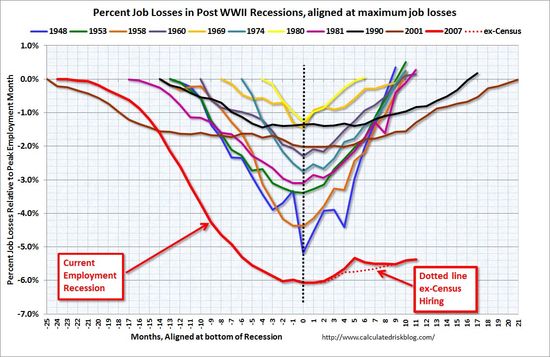
Stuck At The Bottom

Employment_RecessionsAligned_Nov

Ezra Klein's take on the jobs report:

It's not that these numbers are catastrophic: They're worse than October but better than September. They're just evidence that the labor market's recovery hasn't taken hold yet — and that is catastrophic.

Leonhardt is equally gloomy:

What’s causing this? No one knows, to be honest. But the most likely suspect is the same one that has been hurting the economy for much of this year. Financial crises do terrible damage, and the economic aftershocks from them tend to last longer and be worse than people initially expect.

Today’s report is another argument in favor of the Federal Reserve’s attempts to reduce long-term interest rates, through its so-called quantitative easing program. It’s also an argument for making sure that any extension of the Bush tax cuts includes measures that are more likely to create jobs, such as business tax cuts, a payroll tax cut and an extension of unemployment benefits.

Chart from Calculated Risk.

28 Percent

Andrew Koppelman notes how far we've come as a country:

With Illinois’s passage of the civil unions bill, more than a quarter of the population of the United States – to be precise, a bit over 28% – now lives in a jurisdiction that recognizes same-sex marriage or its functional equivalent. It is only a bit over a decade since the Vermont Supreme Court ruled on December 20, 1999 that same-sex couples have the right to all the same rights and benefits as opposite-sex spouses. The same-sex marriage movement continues to be one of the most rapidly successful movements in American history.

The Shamelessness Of John McCain, Ctd


The Daily Show With Jon Stewart Mon – Thurs 11p / 10c
Gaypocalypse Now
www.thedailyshow.com
Daily Show Full Episodes Political Humor The Daily Show on Facebook

Fred Kaplan calls out McCain, and others like him:

The evidence, the polling data of service men and women, the testimony of senior officers, the everyday experiences of living and fighting, the imperatives of national security, as well as the obvious moral standards of contemporary life—all point to, at the very least, a shift in the burden of proof on whether DADT should be repealed. It’s no longer valid, and it’s clearly a pretense, to call for further studies, further surveys, closer questioning. If McCain and the others oppose repeal, they have to come up with some new reason—or fall back on the oldest, most unpalatable reason—why.

Meanwhile, Mark Blumenthal dismembers McCain’s attempt to dispute the survey’s methodology.

Wikileaks Quote Of The Day

From this cable:

[Israeli] General Baidatz argued that it would take Iran one year to obtain a nuclear weapon and two and a half years to build an arsenal of three weapons. By 2012 Iran would be able to build one weapon within weeks and an arsenal within six months. (COMMENT: It is unclear if the Israelis firmly believe this or are using worst-case estimates to raise greater urgency from the United States).

The Dwarves And The Primaries, Ctd

Bernstein adds a fairly obvious but important point to this debate:

[C]andidate weaknesses in the primary season are not necessarily weaknesses in November, and vice versa.  So any pro-choice candidate is incredibly weak in the Republican nomination contest, because pro-life groups will veto such a candidate, even though in the essentially impossible event that such a candidate was nominated, he or she might be strong in November.  At a more plausible level, we can talk about Mitt Romney's weaknesses in the caucuses and primaries, such as his less-than-fully-conservative past and the possibility that some Christian conservatives might be reluctant to vote for him on religious grounds.  But if he's the nominee, no one concerned about abortion on that side would prefer Obama's fully pro-choice position to Romney's perhaps insincere, perhaps surface-deep pro-life position.  And while it's vaguely possible that a handful of voters are so anti-LDS that they would prefer that Obama is reelected, it isn't going to be a large group. 

Where Are America’s Corner Pubs? Ctd

Pints_Getty

A reader writes:

Unfortunately, the pub culture in the UK is changing, and has been for years. 

Pubs have been closing at an alarming rate all over the UK.  Companies that own pubs were expected to be good investments during the recession as people gave up on more expensive forms of entertainment, but in fact pubs did terribly. There are still plenty of pubs and plenty of people going to them, but the old corner-pub-as-social-center model seems to be breaking down.

Another writes:

Americans often fail to realize that many "traditional" pubs in England are owned by larger firms (I'm looking at you, Youngs) and resemble franchise restaurants (Applebees, Chilis) here in the US. They may feel like a corner pub to the unfamiliar, but when you live in England and start to see the same black and white photos of the same "founders", you catch on to the gig.

I spent some time in Oxford and fell in love with the pub culture there. Back in the States, I had difficulty finding good pubs and good pints. You have to leave the major elite metro cities and head to the second tier cities to find the American pub. Atlanta, Boston, and Minneapolis have great pub cultures. Out west, Portland and San Fransisco are good too. I'd imagine Denver, Colorado has many pubs but I don't have any experience there. From there, head to smaller cities. (Ft. Collins, CO.; Athens, GA.) America has corner pubs, but they're not on every corner.

(A good rule of thumb is to look for pubs that specialize in Craft Beer or high gravity Belgian style beers. These are rarely part of the big distribution networks where the distributors demand a certain atmosphere to help sales.)

Another:

Europe is Americanizing, especially in Britain and Ireland as people move into far suburbs, commute further by car, and buy bigger houses. This has deeply hurt their pub culture. I wonder if the economic crisis will end the decline of pub culture. It'd be a small silver lining in a dark time.

(Photo: Carl de SouzaA/AFP/Getty Images)

Healthcare Repeal: Harder Than It Looks

Jonathan Cohn thinks fully repealing the bill is near impossible:

[A]dvocates of repeal have one extra liability that the law's architects did not — a lack of majority support even before the wrangling begins. As late as July 2009, well into the ugly legislative process, more than 50 percent of survey respondents were telling Gallup that they supported comprehensive health care reform. Previous polls frequently showed support to be even higher. By contrast, repeal starts with less public backing. In most polls, only around 40 percent of respondents say they want to get rid of the health law. And the number falls dramatically when pollsters tell respondents that repeal would mean giving up popular features like guaranteeing coverage for people with pre-existing conditions.

None of this means the Affordable Care Act is safe. Partial repeal strategies, like withholding the funds to implement the law, seem quite plausible. But wholesale repeal? It looks like a very difficult task.

The Daily Wrap

Today on the Dish, Andrew protested and mourned the removal of David Wojnarovicz's video "A Fire In My Belly" at the behest of Bill Donohue. We tracked day one the DADT hearings, and awed at McCain's shameless flip-flopping. There were hints of a huge civil rights movement in the gay community (and not to advance marriage-lite) and for Hispanics. Frum countered Wilkinson on the DREAM act, and Scott Brown pleased his state across party lines and may vote to repeal DADT. Andrew insisted anti-Semitism wasn't raging in Adams Morgan, Douthat compared Assange to al Qaeda and Will Wilkinson reassured us leaks will happen with or without Assange. Timothy Garton Ash appreciated the candor of the cables, and American diplomats in Germany didn't care for the privacy of German citizens.

Palin obscured the economic reality for working class supporters, and even her supporters urged her to rise above her celebrity gossip status and actually address some policy arguments. Andrew advised Obama on his next big gambit, we sized up Bloomberg's shot at 2012, sniffed the blood in the water for Pawlenty, and got some historical perspective on past primary dwarves that have risen to the occasion. Stan Collender and Howard Gleckman plumbed the depths of deficit commission's pitch and Bernstein dug away at whether deficits matter more than just politically. The GOP was bipartisan in name only, and the west coast was impenetrable to the Republican tsunami.

The smug not only burned, it also bombed. Readers got wild and crazy on bicycle dates, nerds had similar startup ideas, and the suburbs killed American pubs. We asked the Partridge family to shut up and sing, and the spousal diaspora spread. Iraqi police dressed the part, Scott Morgan caught us up on the cannabis substitute ban, the pill could be affecting fertility, and Michael Agger wanted to mine Facebook's data to improve society, not just to fill the coffers of advertisers.

Chart of the day here, tweet of the day here, Malkin award here, email of the day here, quote for the day here, VFYW here, MHB here, and FOTD here.

–Z.P.

The Shamelessness Of John McCain

Clips of McCain at DADT hearings:

John McCain talks to Howie Kurtz:

His explanation [for supporting DADT]: “The Marine commandant is opposed to [dropping] Don’t Ask Don’t Tell. I know for a fact the other three service chiefs have serious reservations.” As for their superiors, McCain casually mentions the commander in chief and defense secretary, “neither of which I view as a military leader.”

Chait's eyes widen:

Uh, isn't the message that John McCain does not respect civilian control of the military?

McCain said that troops should get "to make a judgment on who they want to serve with…" No wonder Gates bristled. Bernstein asks for clarification:

Does he really believe that?   Does he really believe that troops should get to choose who they want to serve with? Forget about civilian control of the military, and forget about the specific issue of DADT: does John McCain believe in in any notion of basic command structure?

Jeb Golinkin counters McCain's larger point:

 McCain points to the Marine Commandant (currently General James F. Amos) as evidence that the nation’s military leadership does not support repealing DADT.  Well, General Amos is a member of the Joint Chiefs of Staff.  But the nation’s highest ranking military officer is the Chairman of the Joint Chiefs, Admiral Mike Mullen, who does support repealing Don’t Ask, Don’t Tell.

And then of course, there is the biggest kahuna of them all, General David Petraeus.  General Petraeus has told the Senate Armed Service Committee that “the time has come” to repeal DADT. If Senator McCain opposes repeal, fine, but the nation’s top military leaders BOTH civilian and uniformed are in general agreement that it’s time for the policy to go.