Kos smells blood. Between Pawlenty's clemency for an incestuous sex offender and Huckabee's pardon of a cop-killer and Romney's pioneering of Obamacare on a state level, you begin to see why Palin is still such a strong contender. They are all halibut awaiting their stoning.
Author: Andrew Sullivan
Hetero Civil Unions?
Dale Carpenter reads Illinois’ new civil unions bill:
There are a couple of noteworthy provisions in the bill. First, the new status is available to opposite-sex spouses who choose not to marry. This makes the Illinois law different from other civil-union laws, like the ones in California, Oregon, and New Jersey, which generally make the equivalent status available only to same-sex couples on the theory that opposite-sex couples can marry.
Which means to say it offers marriage-lite, undermining heterosexual marriage in a far more profound way than marriage equality ever would.
The DADT Hearings, Day One
So far, pretty much a wipe-out for the arguments against repeal. But losing the argument often makes McCain dig deeper in. A video summary of the highlights:
The Dwarves And The Primaries
James Joyner puts the Republican field in perspective:
In December 2007, few of us thought that Barack Obama had the gravitas to be elected president. Ditto George W. Bush in December 1999. [Much less a year earlier in both cases — the more apt comparison!]
And, as Nyhan reminds us, there were all manner of reports in late 1991 and early 1992 lampooning the “Seven Dwarfs” who were vying for the Democratic nomination and the opportunity to get trounced by the popular incumbent George H.W. Bush. By the spring they seemed destined to nominate some boob from Arkansas who was “damaged goods” and “who lacks the trust and affection of a majority of Democrats, not to mention the independents vital for victory.” But, as some may recall, Bill Clinton went on to not only beat Bush easily but clobber Bob Dole to win a second term.
The Arabs vs Iran? Please. Ctd
Marc Lynch adds some light:
"The Saudis always want to fight Iranians to the last American" and it is "time for them to get in the game," Secretary of Defense Robert Gates tells the French foreign minister in a newly released cable from February 2010. This captures perfectly the point I made yesterday about how to read the reporting in these cables about the private hawkishness of Arab leaders. The question of Arabs and Iran was never an information problem — it's an analysis problem. The antipathy which many of these leaders feel for Iran has long been well known. But so has their reluctance to do anything about it. And so have the internal divisions within Arab governments and Gulf ruling families, and their deep fears of either Iranian retaliation or popular upheaval, and their bottomless hunger for U.S. weapons systems, and their hopes that the U.S. would magically solve their problems for them, and the disconnect between the palaces and the public.
In yet another post, Goldblog refuses to take the anti-Semite card off the table in this debate, where we share the same goals – the neutering of the Revolutionary Guards and the securing of a two-state solution in Israel/Palestine. This saddens and bores me. Let me just put this as plainly as I can: if Goldblog's readers think I am anti-Semitic, that's their problem, not mine. They need to get over their paranoia in an America where their sense of victimhood is a cheap form of maudling solipsism. There is real and disgusting anti-Semitism in the world, but it isn't based in Adams Morgan.
Meanwhile, how can we tighten pressure in Iran, encourage the Greens and force the Israelis out of their smug suicidal tendencies?
The West vs The GOP
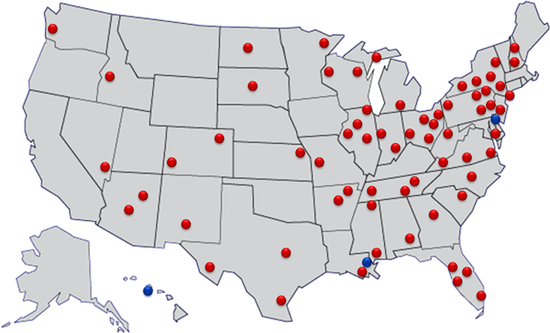
Remember when the GOP was the party of Nixon and Reagan, both Californians? That was before the Dixie cuckoo took over the nest. Larry Sabato takes a closer look at the GOP 2010 wave:
The Pacific states of California, Oregon, and Washington have become a Blue sandbar that can withstand even a Republican tsunami. Strong GOP candidates for Governor in Oregon and California were defeated. Credible Republican Senate contenders in California and Washington could not oust Democratic incumbents. With 53 House berths, not a single Golden State seat changed party hands.
Back in 1994, the last GOP landslide year, Republicans picked up three seats in California. The story is worse for Republicans in Washington State, which was ground zero for the GOP in 1994, when the party won six House seats and held their Senate seat too. All the state’s House seats save one were impervious to a Red tide this time around.
Regional polarization is once again a fixture in American politics, even in years that are overwhelmingly tilted to one party.
Palin’s Babies
Pop culture was a big influence on baby names this year. Guess who that includes:
The names Quinn (and Finn) from “Glee,” Betty from “Mad Men” and Demi and Tiana of Disney princess fame didn’t crack the top 100, but they’re rising fast. …And so are the widely publicized names of former Alaska Gov. Sarah Palin’s daughters: Bristol, Willow and Piper. (But Palin’s sons’ names, Track and Trig? Not so much.)
Missing The Forest For The Aussie
Will Wilkinson takes my rather resigned view of the Wikileaks Rubicon:
…the debate over WikiLeaks has proceeded as if the matter might conclude with the eradication of these kinds of data dumps—as if this is a temporary glitch in the system that can be fixed; as if this is a nuisance that can be made to go away with the application of sufficient government gusto. But I don't think the matter can end this way. Just as technology has made it easier for governments and corporations to snoop ever more invasively into the private lives of individuals, it has also made it easier for individuals, working alone or together, to root through and make off with the secret files of governments and corporations. WikiLeaks is simply an early manifestation of what I predict will be a more-or-less permanent feature of contemporary life, and a more-or-less permanent constraint on strategies of secret-keeping.
…To continue to focus on these questions is to miss the forest for the texture of the bark on a single elm. If we take the inevitability of future large leaks for granted, then I think the debate must eventually centre on the things that will determine the supply of leakers and leaks. Some of us wish to encourage in individuals the sense of justice which would embolden them to challenge the institutions that control our fate by bringing their secrets to light. Some of us wish to encourage in individuals ever greater fealty and submission to corporations and the state in order to protect the privileges and prerogatives of the powerful, lest their erosion threaten what David Brooks calls "the fragile community"—our current, comfortable dispensation.
Mine Our Data!
Or let us. That's Michael Agger's request for Facebook:
It would be helpful for transportation planners to know the places where people complain the most about traffic. Educators could see the data and sentiment analysis around how a community feels about its local schools. The writer Marshall Kirkpatrick at readwriteweb.com has called for Facebook to open up its data for research. He points to the fact that the discriminatory practice of redlining was discovered "when both U.S. Census information and real estate mortgage loan information were made available for bulk analysis." And he rightly speculates that "patterns of comparable importance" could be found in Facebook's enormous social graph.
Facebook's challenge is to leverage that social graph in a way that doesn't alienate us all. The site analyzes us for the benefit of its advertisers but offers only limited peaks at what its engineers are capable of.
Is The Pill To Blame For Declining Fertility?
New York Magazine makes the case. Phoebe offers a different explanation:
The unfortunate fact of female sexuality in our society is that too-young is very quickly followed by too-old – to conceive, or even to attract many men in the first place. 'You're not allowed to date, young lady' (from conservatives) or 'You're too young to settle down' (from liberals) segues almost instantaneously into 'What, no boyfriend?' The elusive window-of-opportunity – not the Pill, not the tendency of 20-somethings in crappy relationships to end those relationships – is the problem.
Solutions? Since the biological clock is unlikely to budge, it's clear we have to look, at least in part, at the younger end of the spectrum.
As it stands, all long-term romantic commitments begun prior to age 30 are viewed as having rushed into things. Without reverting to a system where women are stigmatized for not having settled down by 21, we could shift to one in which 23-year-old couples wouldn't be treated like experimenting middle-schoolers. I wouldn't suggest encouraging those who wouldn't do so otherwise to marry or similar at 20. I would suggest removing the stigma that says that to be well-educated and impressive and so on, you have to find 'that special someone' at 29-and-a-half, marry at 31, and reproduce before (horrors!) 35. I'd instead encourage the happy couples 18-25 that exist anyway not to end their relationships simply because 'there's so much more to experience.'
 The Dish