An Electric Car For Urban Life, Ctd

Tumblr_l7rthpnXJp1qz57ezo1_500

A reader writes:

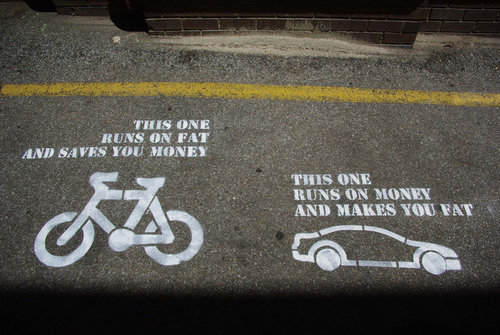
As a transportation-focused environmental advocate, it pains me to see all the fawning over electric cars and their buyers, while ignoring scores of innovations that make bicycling a viable choice for more trips: cargo bikes, folding bikes, bike sharing, workplace showers, secure bicycle parking, and so on. I suppose it's a good thing to make a car that doesn't require any oil, but energy use is only one of the problems with cars, especially in a "livable" urban environment. Show me a car that doesn't require a parking space, then I might be interested.

Another writes:

In the bike mecca of Portland, OR, many of us bike with kids a lot – even in the rain IMG_1259 (there are good rain covers for the kids).  My neighbor has a tandem bike that he frequently uses to take his nine-year-old son to school. Then he bikes to work (not too far from the school) alone on the tandem.

Here's a picture of my then-11 month old  in a bike trailer with my wife pulling. Admittedly, the biking with kids is mostly a weekend affair – to the store (throw the groceries in the trailer with the baby and/or in the bike bags if you've got two kids), to friends, etc.  It's a little heavier, but not too bad.  And we generally take the slower route on the less-traveled streets.

(Top photo via Sean Bonner)

Quote For The Day

“With our nation at war and so many Americans serving on the front lines, our troops and their families deserve the certainty that can only come when an act of Congress ends this discriminatory policy once and for all. The House of Representatives has already passed the necessary legislation. Today I call on the Senate to act as soon as possible so I can sign this repeal into law this year and ensure that Americans who are willing to risk their lives for their country are treated fairly and equally. Our troops represent the virtues of selfless sacrifice and love of country that have enabled our freedoms. I am absolutely confident that they will adapt to this change and remain the best led, best trained, best equipped fighting force the world has ever known,” – president Obama.

A Breath Of Sane Air

CHOIMATLOVICHMark Wilson:Getty

Anyone who doubts the professionalism of today's military would do well to read the Pentagon Report on DADT. First, it's a massive undertaking, involving hundreds of thousands of responses, 95 face-to-face meetings, and a range of views from everyone who might be affected. It's one of the most impressive reports I've ever read from a government agency.

It's also extremely calm and fair. If you've been in the thick of this debate as long as I have, you'll know how rare that is. The tone is empirical, and judicious. It does not gloss over some serious objections – such as moral and religious ones – and grapples directly with some of the more emotive issues, such as sharing showers or sleeping quarters. It feels in no way skewed or prejudged.

And the report is absolutely clear that straight servicemembers by large majorities have few problems with openly gay servicemembers. 69 percent of them acknowledge they have fought or worked alongside gay men and women already. A staggering 92 percent of those were fine with lifting the ban. Again: when you know someone is gay, all the fears and stereotypes tend to evaporate. This is not a surprise. The men and women of the US military are among the finest in the land; they want to do the job at hand, not deepen social division or posture politically. They are not bigots. I note one colorful quote from a special ops fighter:

“We have a gay guy [in the unit]. He’s big, he’s mean, and he kills lots of bad guys. No one cared that he was gay.”

And why would they? The other critical point is the inherent conservatism of many gay servicemembers. The last thing they would want to do is make a fuss about their orientation. The overwhelming majority will stay largely closeted in the workplace and battlefield – not out of fear but because it is irrelevant, and they are discreet kinds of people. Rand found that "even if Don’t Ask, Don’t Tell were repealed, only 15% of gay and lesbian Service members would like to have their sexual orientation known to everyone in their unit." Here are two very convincing quotes from my long acquaintance with countless gay servicemembers:

“Personally, I don’t feel that this is something I should have to ‘disclose.’ Straight people don’t have to disclose their orientation. I will just be me. I will bring my family to family events. I will put family pictures on my desk. I am not going to go up to people and say, hi there—I’m gay.”

“I think a lot of people think there is going to be this big ‘outing’ and people flaunting their gayness, but they forget that we’re in the military. That stuff isn’t supposed to be done during duty hours regardless if you’re gay or straight.”

Yes, there are higher fears among some combat troops and Marines. But here's one thing I didn't know: the British military showed far higher resistance to allowing openly gay servicemembers in advance, but realized after the change that it was a massive non-event. Now, the British military recruits at gay pride parades.

Many of these remarkable people are already risking or devoting their lives for the rest of us. This is about respecting them, in my view, and the professionalism and honor of those heterosexuals who serve alongside them and always have. One other passage rings very true to me:

In communications with gay and lesbian current and former Service members, we repeatedly heard a patriotic desire to serve and defend the Nation, subject to the same rules as everyone else. In the words of one gay Service member, repeal would simply “take a knife out of my back….You have no idea what it is like to have to serve in silence.”Most said they did not desire special treatment, to use the military for social experimentation, or to advance a social agenda… From them, we heard expressed many of the same values that we heard over and over again from Service members at large—love of country, honor, respect, integrity, and service over self. We simply cannot square the reality of these people with the perceptions about “open” service.

And as country we should not either. If we are to ask young men and women to fight for us in distant places against terrible enemies, we owe it to all of them to take the knife out of their back.

It is right; it is just; it is patriotic; and it is so overdue.

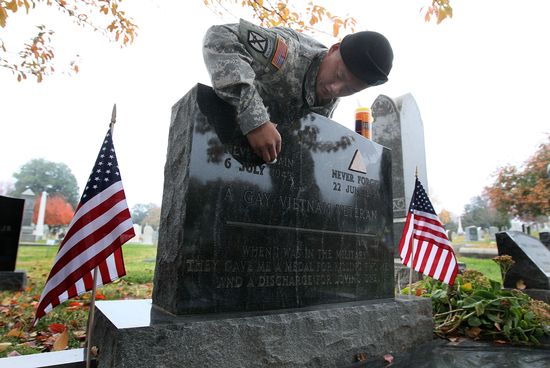
(Photo: Iraq War Army Veteran, Lt. Dan Choi, who was discharged from the military for being gay, cleans the gravestone of Sgt. Leonard Matlovich, at Congressional Cemetery on November 15, 2010 in Washington, DC. Sgt. Matlovich who died in 1988 was a Vietnam Veteran who a received both the Purple Heart and Bronze Star and was later discharged from the Air Force for being gay. An inscription on his tombstone reads 'When I was in the military, they gave me a medal for killing two men and a discharge for loving one.' Some 'Don't Ask, Don't Tell' repeal advocates consider Sgt. Matlovich's gravesite to be a memorial to all gay veterans. By Mark Wilson/Getty Images)
A Defense Of Wikileaks

It's offered by Will Wilkinson, who says that the content of the documents isn't as insubstantial as some are asserting:

For example, drawing on the documents made available by WikiLeaks, the ACLU reports that the Bush administration "pressured Germany not to prosecute CIA officers responsible for the kidnapping, extraordinary rendition and torture of German national Khaled El-Masri", a terrorism suspect dumped in Albania once the CIA determined it had nabbed a nobody. I consider kidnapping and torture serious crimes, and I think it's interesting indeed if the United States government applied pressure to foreign governments to ensure complicity in the cover-up of it agents' abuses. In any case, I don't consider this gossip.

It isn't. In some ways, it is the most important and damning revelation of the entire dump. He proceeds to zoom out:

To get at the value of WikiLeaks, I think it's important to distinguish between the government—the temporary, elected authors of national policy—and the state—the permanent bureaucratic and military apparatus superficially but not fully controlled by the reigning government. The careerists scattered about the world in America's intelligence agencies, military, and consular offices largely operate behind a veil of secrecy executing policy which is itself largely secret. American citizens mostly have no idea what they are doing, or whether what they are doing is working out well. The actually-existing structure and strategy of the American empire remains a near-total mystery to those who foot the bill and whose children fight its wars. And that is the way the elite of America's unelected permanent state, perhaps the most powerful class of people on Earth, like it.

DADT Reax

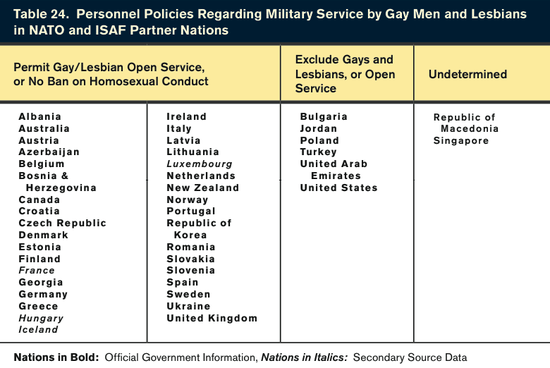
DADT_International

Full report here. My thoughts in a few here.

David Kurtz:

Gates message to Republicans in Congress was pick your poison: You can repeal this policy in a way that lets us implement it with minimal disruption or you can fail to act and the courts will act by "judicial fiat" forcing the Pentagon to react with no time to prepare, which Gates said was his "greatest fear."

Kevin Drum:

It turns out that although 30% of respondents think that repealing DADT would affect their unit's ability to train well together (a number that shows up pretty consistently on every question about the effect of repeal), only 10% think it would affect their own readiness and only 20% think it would affect their ability to train well. In other words, there's pretty good reason to think that even the 30% number is overstated. It seems to include a fair number of people who are assuming that DADT repeal would have a negative effect on other people even though it wouldn't have a negative effect on them. My guess is that a lot of this is reaction to a small number of vocal traditionalists, which makes opposition to repeal seem like a bigger deal than it is.

Adam Serwer:

Aside from the fact that allowing gays and lesbians to serve is far less divisive than racial integration of the military was at the time of its implementation, the report notes that opposition to allowing open service was far higher in countries like Israel and the UK prior to their abolishing discrimination against gays and lesbians. So while opponents are likely to use the relatively higher numbers related to the predictions of combat troops to stall repeal, the report bolsters the arguments of repeal advocates who say that allowing gays and lesbians to serve openly won't harm the military. The question now is whether or not the few Republican Senators who have indicated they might support repeal will have the courage to act now that the empirical basis for opposition to DADT repeal has been completely obliterated.

Doug Mataconis:

While there isn’t much time for the Senate to act, a switch of only three votes from September’s cloture vote would be enough to invoke cloture and defeat the filibuster attempt that will apparently be led by John McCain. Nonetheless, the strong words today from Secretary Gates and Admiral Mullen in support of repeal and urging the Senate to pass DADT repeal and let it become law may just be enough to convince at least three Senators to cross the lines and vote in favor of cloture. Based on the conclusions of this report, that’s certainly what they should do.

Greg Sargent:

Another key thing just happened in Robert Gibbs' briefing with reporters: He flatly stated the president believes there's enough time in the lame duck session for the Senate to do what it takes to repeal DADT. That's important: It could increase pressure on Harry Reid to schedule the requisite floor debate.

Brain McCabe:

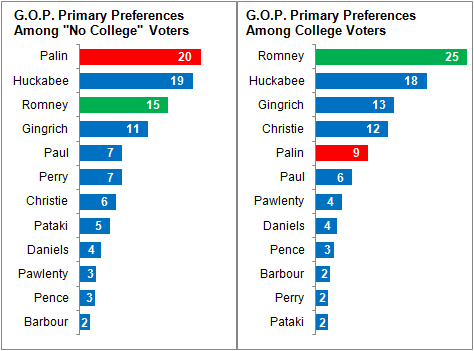
When the [DADT] policy was established, none of the three positions had majority support among Americans. Forty-four percent supported open service, 37 opposed any service, and 19 percent supported allowing gay men and lesbians to serve only if they did not reveal their sexual orientation. Today, one position has emerged as the clear preference of the majority of Americans. Seventy-five percent of Americans support open service, 17 oppose any service, and only 8 percent support the compromise position of “don’t ask, don’t tell.”

In 1993, “don’t ask, don’t tell” offered a compromise for a public deeply divided on the issue of gay men and lesbians serving the military. Today, though, that compromise position – the status quo, enshrined in the policy of “don’t ask, don’t tell” – would seem to hold very little support among the American public.

Shut Up And Sing: John Lennon And Yoko Ono

A reader writes:

No "Imagine" yet? Banal, insipid, sanctimonious and ubiquitous – is any song of this type really more nauseating?  The bit when he pityingly muses, "I wonder if you can" is particularly grating. No, John, surely I cannot reach such lofty heights of intellectual vision as you have attained.

Another writes:

I have no argument to offer, except to quote Elvis Costello: "Was it a millionaire who said 'imagine no possessions?'"

Actually, a multi-millionaire in a vast, minimalist, white mansion. Personally, I have extremely mixed feelings about this song. Most times it makes me want to vomit because of its self-serving sanctimony and silliness. I mean: Lennon did not have to imagine, he could have sold every thing he owned to the poor as Jesus recommended to the rich young man. But life in the Dakota was somehow preferable. But I must confess that occasionally – if heard purely as a utopian fantasy – it can work. Musically, it's sublime. And then you hear David Archuleta's version and you're back to cleaning the puke off your laptop.

The Nuts And Bolts Of Diplomacy

Fred Kaplan makes a powerful case that the Wikileaks documents show the Obama administration in a good light. How Obama got China and Russia to back sanctions against Iran:

In the case of China, Obama dispatched Dennis Ross, a White House adviser who had been the Middle East negotiator for Presidents Bill Clinton and George H.W. Bush (but who had no post in his son's administration), to persuade Saudi Arabia to guarantee that it would supply oil to the Chinese if Iran cut them off. As a result of that assurance, China signed up for sanctions.

In the case of the Russians, Obama placated their distress over Bush's plan to install missile-defense systems on Eastern European soil by canceling the plan. As a result of that move, which triggered a whole "re-setting" of relations between Moscow and Washington, Russia joined the sanctions as well. (Obama didn't abandon missile defenses; he only relocated the interceptors onto ships, which had the additional benefit of clarifying that they really were aimed to shoot down Iranian missiles, not Russian ones.)