The “Simplification” Of The Issues

Refugees Fleeing ISIS Offensive Pour Into Kurdistan

Every now and then, a blast of cold sanity greets the world. At least that was my reaction reading Tom Ricks respond to the idea that if Obama had somehow been able to leave 10,000 troops in Iraq, all would now be well. Au contraire:

That’s nonsense. If we had the force there, what we’d be doing now is facing this question: Do we retreat ignominiously and get the troops out of the country, or do we use them in a wayor do we find ourselves forced to use themin a way we don’t want to, supporting Maliki without reservation? Or do they just sit there inside their camp gates and everybody mocks the Americans for doing nothing?

So I think by not having troops on the ground there it greatly simplified the issues for the United States and actually gave the United States more leverage rather than less, because clearly Obama does not simply want to act on Maliki’s behalf. I think Obama sees Maliki more at fault here than he does the Sunnis.

Exactly. But what does it mean to say that we now have a “simplified” set of issues? Here’s what I think: we have a real fork in the road here.  Only the deranged believe the Iraq war was anything but a disaster. But the question now is: will further intervention make already-horrible matters worse or slightly better?

My best bet (and, of course, I could be wrong) is that it will make matters immensely worse, entangling us in a completely lose-lose scenario from which we have only just extricated ourselves. I can’t see how we intervene neutrally; I can’t see how Iraq can be put back together again without some kind of sectarian and national catharsis; and I don’t think the US should be taking a position – and an inconstant one at that – in the epochal Sunni-Shia battle that goes back centuries. In fact, I think it’s verifiably insane that we should even think of taking such a position.

So what are the obvious costs of staying out? The main one is the danger posed to the US by a Jihadist haven in Sunni Syria and Iraq. But do we have a real grasp of that danger? Recall that – thanks to Obama – the chemical weapons threat has been removed from the table, just in time. Do they want to come find us here? Well, Mr al-Baghdadi has so threatened, but not even Dick Cheney thinks he’s ready to attack the US yet. Americans who have gone on Jihad in Syria? You bet. And if we don’t have extremely close monitoring of them, we need to.

But we’ve seen from the past that terror attacks can just as likely come from Jihadist servicemembers as well as troubled Boston teens from the Caucasus. Deciding that the religious fanatics in Syria are an imminent threat to the US – as opposed to all the other possible imminent threats – makes little sense to me, given that they currently have their hands extremely full preparing to face off against Shiite militias on their sacred soil. Perhaps that’s why the Cheneys have been going around doing their mushroom cloud act again. It’s only if you’re scared shitless will you do the kind of radical re-invasion of Iraq that Cheney is – yes he is – advising.

But what if we refuse to be scared shitless? What if we take a deep breath and see the resilience of Islamist terror as something we have little control over, as the Middle East enters a convulsive new era – except to exacerbate it by invasion, torture and, after a certain point, drones. What if we treat other people’s civil wars as if they are other people’s civil wars? If the Saudis and the Iranians want to get in each others’ faces, why should we insist on getting in between them, and inevitably failing anyway? The key for us to make sure WMDs are not in any equation to prevent any real catastrophe – which is why the agreement with Iran is more important now than before. If we can do that – and we’re almost there – it seems much saner to wait and see than rush in and regret.

The deeper debate is between those of us who long to see the US with a much, much lighter footprint in that hellish region, see energy independence as a real opportunity to pivot away for good, and get on with more pressing needs at home, and more relevant questions abroad – and those who see the US as an indispensable hegemon in the Middle East for ever. Check out Dick Cheney yesterday on the Hugh Hewitt show – a hathos-fest if ever there was one:

[ISIS’] long term goal and objective appears very much to be that of driving the U.S. out of the Middle East. That’s very high on their list of priorities. And remember, that was Osama bin Laden’s objective when he came here and hit us on 9/11, to drive the U.S. out of the Middle East. Obama’s policies, in effect, have been taking us in that direction.

Well, he’s not wrong there, is he? But I bet you if you asked the average even Republican voter, they’d say that’s a thoroughly good thing. And they’d say that in part because the Bush-Cheney administration was a virtual crash-course in its merits. Trillions of dollars, hundreds of thousands of death, thousands and thousands of wounded or traumatized soldiers … and for what? You think Iraq’s Shiites have the slightest fondness for us? You think the invasion and occupation helped American power projection across the globe? You think it won over the hearts and minds of the Arab or Muslim worlds?

What Osama bin Laden wanted, it seems to me, was to bait the West into a direct fight on Muslim soil. That immediately elevated the cause of jihad, internationalized it, galvanized a generation of religious fanatics, and, even better for the radicals, broke a country in the heart of the Middle East so that sectarian violence could be exploited for further radicalization. Obama’s great achievement has been to steer the US, so far as possible, away from taking that poisoned bait. Cheney’s achievement was to fall for it, hook, line and sinker.  I say this as someone who also took the bait – with good intentions and in good faith, but blinded by trauma and ignorance. The choice we face is really between those two long-term strategies for surviving the Islamist wave. I favor Obama’s. I favor the future over the past.

(Photo: Kurdish soldiers with the Peshmerga keep guard near the frontline with Sunni militants on the outskirts of Kirkuk, an oil-rich Iraqi city on June 25, 2014 in Kirkuk, Iraq. By Spencer Platt/Getty Images)


Meanwhile, Washington Endorses USA!

And they say soccer has no future in the US:

And check this crowd out in Boston:

Just get ready for the crash. Losing to Germany in the rain just sucks. But right now, it’s an exciting 0-0.

The Dish Endorses … Nigeria!

FBL-WC2014-ETH-NGR

… to win the World Cup. Dean Karlan offers a logical reason why you should too:

The basic principle is simple, drawn from utilitarian principles: Root for the outcome that will produce the largest aggregate increase in happiness. So I came up with a simple index, calculated by a country’s passion for soccer multiplied by its average level of poverty multiplied by its population. It’s perhaps a bit crude, simply to multiply these factors by each other, but the exercise highlights some important truths about the world. …

So which country comes out on top of our utilitarian ranking? Nigeria, which advanced out of group play Wednesday. Nigeria finishes fourth in our passion ranking, and is one of the poorest countries in the tournament. Separating it from the rest of the African countries in the World Cup is its huge population — 174 million people. Simply put, the Nigerians have a lot of very passionate, low-income people who are ready to celebrate Nigerian success. Nigeria finishes with a far higher score than any other country.

Another reason to stand in solidarity with Nigerian soccer fans is the threat of terrorism they face when they get together to watch a match:

The World Cup opened in Brazil on Thursday, June 12; on June 17, a suicide bomber set off an explosion in Nigeria’s northern Yobe state capital Damaturu. At least twenty-one people who had gathered around a public screen to watch the Brazil vs. Mexico match died. The bomber is suspected to be a Boko Haram member, though no one has yet claimed responsibility. Public viewing centers, which are popular venues to watch soccer, are currently banned in Yobe state precisely because of the potential for such an attack. There are conflicting accounts about whether those killed were at a clandestine viewing center or if they had simply gathered around a communal screen.

Still, even Boko Haram can’t scare the fans away:

A fan, Tijjani Dauda, said he prefers viewing centers to watch soccer games because being with other fans brings drama to the exercise. “Football is a spectator sport,” he told Quartz. “It is not a family sport to be watched by husband, wife and their children. If we are far from the field of play, viewing centers are adequate replacements. That is why we call them ‘local stadia.’ People bring color to the games and spontaneous analysts are a delight at the centers.”

That is perhaps why Boko Haram’s campaign of terror has not stopped the Nigerians flocking to the centers. If the group decided to attack another centre, it would have a wealth to choose from. But this is one campaign terrorists are unlikely to win because of the deep seated love Nigerians hold for soccer. “The attack has not affected the following of the World Cup in Nigeria,” Ibrahim said, although he concedes that “it will, maybe, have some effect in the states where governments have banned TV viewing centers due to fears over Boko Haram attack.” But the Nigerian soccer fan is too involved to be held back by this.

(Photo: A Nigerian fan celebrates her team’s victory over Ethiopia after a 2014 World Cup qualifying match in Addis Ababa on on October 13, 2013. By Simon Maina/AFP/Getty Images)

A Breakthrough For Marijuana Research?

The one simple thing the federal government could do with respect to marijuana would be to reclassify it. As this blog has banged on about for years, the FDA’s classification of the drug as having no medical use at all and as dangerous as heroin is not just wrong; it’s insane. It violates everything we know about the drug – both in theory and practice. The usual excuse of the feds is that they don’t have enough research to come to a different conclusion, while their classification of pot as a Schedule 1 drug makes research extremely hard. So the feds have had a lovely little circular engine for maintaining Prohibition for many years now.

If you want a devastating exposure of the DEA’s anti-scientific know-nothingness, check out this exchange in the Congress from last year. Congressman Jared Polis interrogates the acting head of the DEA, Michele Leonhardt:

Perhaps because of this – and because of a huge surge in research over the last several years – things may now be changing:

U.S. regulators are studying whether restrictions on marijuana should be eased, a step toward decriminalizing the drug at the federal level.

The Food and Drug Administration is conducting an analysis at the Drug Enforcement Administration’s request on whether the U.S. should downgrade the classification of marijuana as a Schedule 1 drug, said Douglas Throckmorton, Deputy Director for Regulatory Programs at the FDA, at a congressional hearing … Throckmorton wouldn’t say when he expected the FDA to complete the analysis or whether it would recommend a change.

It seems to me that whatever side of the legalization debate you are on, having the government actually basing its policies on science rather than phobias is a good thing. At some point, if this continues, the federal government that currently regards marijuana as having no medical use at all may finally catch up to a country where 22 states have already legalized the drug as medication. But I wouldn’t hold my breath. The circular logic of Prohibition takes some time to leave the bureaucratic mind.

Aereo’s Air Ball

Jacob Kastrenakes recaps yesterday’s SCOTUS ruling against the streaming-TV service:

In a 6–3 ruling, the court found that Aereo’s service violates the Copyright Act by playing back recordings of broadcasters’ TV shows  even though it legally captures those shows over the air and obtains individual copies for each viewer. Aereo had argued that it was merely providing technology that its subscribers were renting in order to watch TV, positing that the viewers were responsible for playing back those recordings. …

The ruling is one of the most important seen by the television industry since the 1984 Betamax case but in many ways will have an opposite effect, stifling one area of innovation that was beginning to force the industry out of its comfort zone. “Insofar as there are differences, those differences concern not the nature of the service that Aereo provides so much as the technological manner in which it provides the service,” the ruling reads.

Brian Barrett is disappointed:

It’s a precedent that will make the future of streaming content both stunted and confusing. And that, beyond present and would-have-been future Aereo subscribers being pretty bummed out, is the biggest concern about today’s ruling. While the decision doesn’t prevent future technologies from developing, it does set a precedent that’s going to be very hard for future cord-cutting efforts to get around.

But Kyle Chayka sees little reason for innovators to be concerned:

Importantly, the ruling is not relevant for other cloud-based services, which may have been impacted by a judgment on Aereo’s business. The Department of Justice amicus brief advised that the Aereo decision “need not call into question the legitimacy of innovative technologies that allow consumers to use the Internet to store, hear, and view their own lawfully acquired copies of copyright works.”

David Post isn’t too concerned either:

The majority is at pains, in several places, to say that the case is just about broadcast television and the re-transmission of broadcast signals. Not about cloud storage, or streaming services, or gaming platforms, or anything else. Just broadcast TV, and what you may or may not do with over-the-air broadcast signals. Congress has made a choice about those signals; anyone who re-transmits them (like the cable companies do) has to pay royalties to the broadcasters. If that’s what it means … the decision has nothing to say about any other content-delivery or content-storage platforms that deal with the vast array of non-broadcast-TV content.

Timothy Lee, however, stresses the ambiguity in the ruling:

The problem is that the court never provides clear criteria for this “looks-like-cable-TV” rule. As Justice Scalia puts it in his dissent, “it will take years, perhaps decades, to determine which automated systems now in existence are governed by the traditional volitional-conduct test and which get the Aereo treatment. (And automated systems now in contemplation will have to take their chances.)”

In the process of ruling against Aereo, the Supreme Court has created a mess that will take lower courts years to clean up. Online services that are similar to Aereo in some respects and different in others are more likely to face lawsuits, and the lower courts will have to sort out which services are similar enough to Aereo to face copyright liability.

What’s next for Aereo? They’re “probably done”:

Aereo’s backers have said there’s “no plan B” for the company in the aftermath of today’s loss. The tens of millions of dollars the company raised so far have largely gone to pay legal costs, and the road forward for the company is probably either a fire-sale of the core technology or a quick pivot into some other, DVR-like function. Aereo’s CEO claims that “our work is not done,” but it’s tough to know what that means. Without the ability to skip out on retransmission fees, Aereo’s entire business model is gone.

Alyssa warns the TV industry against complacency:

Broadcasters should not take their victory at the Supreme Court as a sign that they will be able to operate the same way forever. Instead, broadcast and cable companies should take the Aereo ruling as a stay before Congress acts to explicitly legalize competitors such as Aereo. In the time they have been given, they should move as fast as possible to respond to the clear customer demands that Aereo exposed. …

What might the market have been like if Hulu had partnered with Roku to offer not just streaming subscriptions, but a set-top box, offering consumers a complete package as an alternative to a cable subscription? Similarly, it is remarkable that Apple and a cable company have not yet been able to come to terms to bake television subscriptions into Apple TVs. AmazonBasics, the electronics line from Amazon (the company’s chief executive, Jeff Bezos, owns The Washington Post), sells a range of relatively inexpensive television antennas, and the company El Gato makes a range of streaming television tuners that are not yet available in the United States.

Rather than leaving these innovations to others, cable companies and broadcasters should find ways to get on board and bring new products and services in-house.

Police State Watch

Alecia Phonesavanh’s baby son was severely injured by a flashbang grenade when a SWAT team raided their home to bust her husband’s nephew for a petty drug sale. She tells her terrifying story:

There’s still a hole in his chest that exposes his ribs.

At least that’s what I’ve been told; I’m afraid to look. My husband’s nephew, the one they were looking for, wasn’t there. He doesn’t even live in that house. After breaking down the door, throwing my husband to the ground, and screaming at my children, the officers – armed with M16s – filed through the house like they were playing war. They searched for drugs and never found any.

I heard my baby wailing and asked one of the officers to let me hold him. He screamed at me to sit down and shut up and blocked my view, so I couldn’t see my son. I could see a singed crib. And I could see a pool of blood. The officers yelled at me to calm down and told me my son was fine, that he’d just lost a tooth. It was only hours later when they finally let us drive to the hospital that we found out Bou Bou was in the intensive burn unit and that he’d been placed into a medically induced coma.

Sullum segues from Alecia’s ordeal to discuss a new ACLU report on the militarization of American police departments, which shows that SWAT team raids are becoming standard practice for drug searches:

Examining a sample of more than 800 SWAT deployments by 20 law enforcement agencies in 2011 and 2012, the ACLU found that 79 percent involved searches, typically for drugs. Research by Eastern Kentucky University criminologist Peter Kraska has yielded similar numbers. …

Police typically justify no-knock raids and heavy firepower by claiming the target is apt to be armed. That is what they said about Thonetheva, the Phonesavanhs’ nephew, who had no weapons when he was arrested at a different location on the day of the raid that sent Bou Bou to the hospital. (There also were no weapons in his parents’ house, where the Phonesavanhs were staying.) In the ACLU’s sample that sort of outcome was common: In at least one-third of cases where a weapon was believed to be present, none was found. Police records indicated recovery of a weapon in one out of three such cases. In the rest, the records did not address that point.

Balko remarks on the disturbing trend:

SWAT teams today are overwhelmingly used to investigate people who are still only suspected of committing nonviolent consensual crimes. And because these raids often involve forced entry into homes, often at night, they’re actually creating violence and confrontation where there was none before.

When SWAT teams are used in a way that’s consistent with their original purpose, they’re used carefully and cautiously. The ACLU report finds that, “In nearly every deployment involving a barricade, hostage, or active shooter, the SWAT report provided specific facts that gave the SWAT team reason to believe there was an armed and often dangerous suspect.” By contrast …

… incident reports for search warrant executions, especially in drug investigations, often contained no information about why the SWAT team was being sent in, other than to note that the warrant was “high risk,” or else provided otherwise unsubstantiated information such as “suspect is believed to be armed.”

The Clintons: Lucky In Their Enemies Again

If you were a Clintonista, carefully plotting your path back to power, could you hope to pick a more perfect foil than Todd “legitimate rape” Akin? And, yes, he’s baack! And with a doozy:

My comment about a woman’s body shutting the pregnancy down was directed to the impact of stress on fertilization. This is something fertility doctors debate and discuss. Doubt me? Google “stress and fertilization,” and you will find a library of research on the subject. The research is not conclusive, but there is considerable evidence that stress makes conception more difficult. And what could be more stressful than a rape?

Now all the Clintons need is a stupid impeachment effort … oh wait! Bachmann FTW!

Chart Of The Day

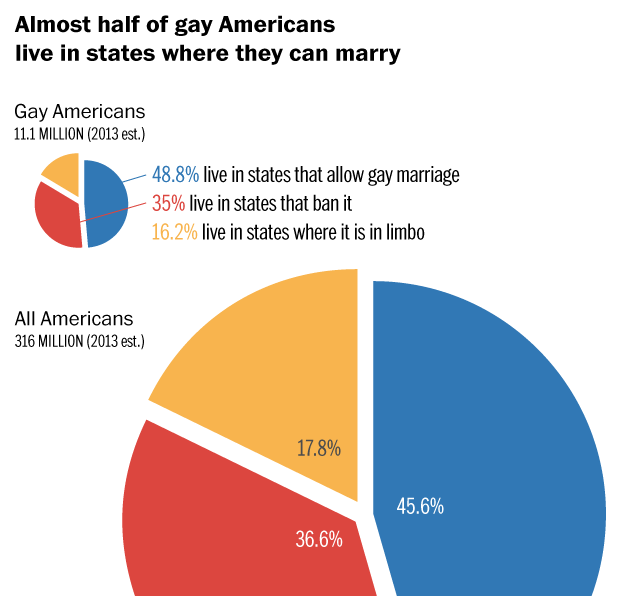
gayampercent

Philip Bump put it together:

Nearly half of the 11-plus million gay Americans (how we arrived at that figure is explained in more depth below) now live in states that allow gay marriage, and are more likely to live in such states than Americans on the whole. 48.8 percent of gay Americans live in states where they can legally marry, according to our estimates. The percentage of Americans in those states overall is at 45.6 percent. And, of course, a large portion of the country live in states where the legal status is in limbo.

Speaking of that limbo, Bazelon looks at yesterday’s court ruling out of Utah:

The 10th Circuit stayed its ruling to give the opponents of gay marriage a chance to appeal to the Supreme Court. Rick Hasen and plenty of other people think this means gay marriage is headed back to the justices as early as next term. So far, though, there’s no split over gay marriage in the lower courts since the DOMA ruling. Anyone want to subscribe to my (minority) theory that gay marriage could become the law of the land without another word from the high court? Gay marriage has so much righteous momentum behind it—maybe it doesn’t need another push from Kennedy. Though surely, with a record of 20–0 this year in the lower courts, he will be ready to give it.

I’m prepared to make that bet with Emily – although you never know. Ilya Somin sounds off:

For reasons I explained in this post, I am skeptical about the validity of the argument embraced by the Tenth Circuit majority. But I do believe they reached the right result, because laws restricting marriage to opposite-sex couples are an example of unconstitutional sex discrimination. This reasoning was endorsed by the district court opinion affirmed by the Tenth Circuit (though it also endorsed other constitutional arguments against laws restricting marriage to opposite-sex couples).

Be that as it may, [yesterday’s] decision is an important victory for advocates of same-sex marriage. But Judge Kelly’s dissent suggests that the legal battle over the issue is far from over. The question is likely to return to the Supreme Court, quite possibly sooner than many of us at first anticipated.

My reaction to the Utah ruling – and the more exciting one in Indiana – here.

About Those 300* Military Advisers

A small detail adds some context:

Two Iraqi advisers to Mr. Maliki said there would be more than 1,000 American private security guards coming to Iraq to protect the 300 military and intelligence advisers that will be here to help the Iraqi government fight ISIS, far more Americans than previously acknowledged. One adviser said the number of private guards would reach 1,700.

And the beat goes on.