The Wikileaks Cable Leak vs The War On Jihadist Terror

I’ve just read through a couple of summaries. Overall, I have to say that this brief glimpse into how the government actually works is actually reassuring. The cable extracts are often sharp, smart, candid and penetrating. Who knew the US government had so many talented diplomats?

But then, of course, there are the real dangers of this random transparency. Take the perilous situation in Yemen, where al Qaeda has a foothold and whence it is planning mass murder of Western citizens. Will the following leak make al Qaeda stronger and thereby increase the likelihood of American civilian deaths? You decide:

It has been previously reported that the Yemeni government has sought to cover up the American role in missile strikes against the local branch of Al Qaeda. But a cable’s fly-on-the-wall account of a January meeting between the Yemeni president, Ali Abdullah Saleh, and Gen. David H. Petraeus, then the American commander in the Middle East, is nonetheless breathtaking.

“We’ll continue saying the bombs are ours, not yours,” Mr. Saleh said, according to the cable sent by the American ambassador, prompting Yemen’s deputy prime minister to “joke that he had just ‘lied’ by telling Parliament” that Yemeni forces had carried out the strikes.

Mr. Saleh, who at other times resisted American counterterrorism requests, was in a lighthearted mood. The authoritarian ruler of a conservative Muslim country, Mr. Saleh complains of smuggling from nearby Djibouti, but tells General Petraeus that his concerns are drugs and weapons, not whiskey, “provided it’s good whiskey.”

Fascinating, colorful reporting – and an insight into the hypocrisy and cynicism among the elites in the Muslim Middle East. If it were reporting.
After There Was Blood

HarpendenRoad_640x424

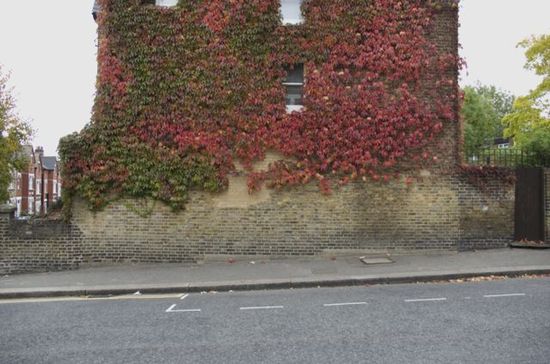
Photographer James Davies documents streets in London where shootings have occurred:

My aim in this series is to highlight the mundane. I didn't want to find the exact location where each incident happened or go into the details of each murder. The intention here is just to show the utterly ordinary places where the extraordinary took place, forever associating a street with a horrific crime.

An Intellectual History Of Cannibalism

Justin E. H. Smith interviews Catalin Avramescu, author of a book on cannibalism:

Philosophy was once the art of asking extreme, dangerous questions. The task of the philosopher is not simply to argue, as much of contemporary academic philosophy would want us to believe, but also to convince, to move, to stir and, eventually, to shake us to the core.

This is the point where the cannibal enters the scene. He asks questions about the identity of the individual when the subject is on the verge of dissolution. He explores the possibility of an ethics without morals. He is the operator of anarchy on the background of social order.

Philosophers have often entered the city under different guises, as foreigners, travelers, cynics, or unbelievers. The cannibal is just a part of a larger and complex history. He is not pleasant to look at. Yet, he opens for us the possibility of thinking anew about our values. To be on the cutting edge of thinking: that was the uncomfortable trade of the philosopher. That, I imagine, is to be a free spirit. It is to find food for thought where no one is looking. Or where everybody has been turned away.

Montaigne's essay on the subject, still shocking in its way, is here.

“I’ve Been Photographing Democratically”

Egg-4-Boring

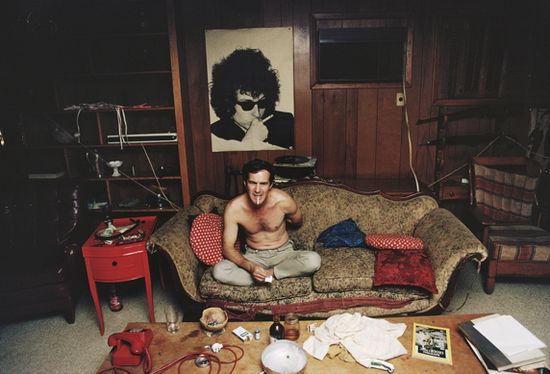
Michael Almereyda has collected a beautiful gallery of William Eggleston's unseen work in Paris Review, with commentary on the everyday people he really loved to photograph:

He was a dentist. We immediately became best friends. I can’t even say why. I’ll think about it, and if I come up with anything, you’ll be the first to know.

This was not the only photo of "T.C.":

T. C., alone in a graffiti-scrawled room, is the solitary nude in “William Eggleston’s Guide” (Museum of Modern Art, New York, 1976). The blood-red ceiling, one of Eggleston’s most iconic images, was located under T. C.’s roof in Greenwood, Mississippi, though that home, Bill takes pains to insist, is not the site on view here.

Science And The Limits Of Being Human

The great Tom Junod reflects:

We are not going to live forever. We are not going to have our life spans scientifically amplified to biblical lengths. We will not be able to take pills that will give us the musculature of superheroes or allow us to gorge ourselves while enjoying the health benefits of starvation. We will reach our limits, and, with some hard-won variation, those limits will be — they will feel like — the same limits we humans have always had. We will remain human where it counts, in our helpless and inspiring relation to our own mortality.

Does this sound obvious? It shouldn't.

Indeed, what I should have said from the start is that I believe that we are all going to die, in that science increasingly believes otherwise — and science increasingly has become a matter of belief. Its logic, once pointed at the eradication of disease and infection, is now inexorably pointed at aging and death, which is to say the ultimate questions that were once left to religion. …

As it expands its realm into matters of faith, science will become more and more faith-based, and more and more energized by the off-label indication. Its promises will become harder to believe the closer they come to being fulfilled, because belief will obligate us to make choices we are not equipped to make — choices once left to popes and their priests. And this is how science will finally become like religion in all things except its actuality.

Deep Travel

Sally Law interviews Tony Hiss on his book In Motion: The Experience of Travel:

No place, however well we know it, stays exactly the same from day to day, or even from hour to hour—there are always different combinations of people present, or different plays of light and shadow. The most famous examples of this are the more than thirty canvases Monet painted of the facade of Rouen cathedral in the eighteen-nineties. Same church, even the same viewpoint—he had rented a room across the street. But each one astonishingly different; sometimes the church looks brooding, ancient, gray-brown, cavernous, almost collapsing on itself. Other times it looks robust, sparkling, brand new, almost too brightly white to look at head-on.

“Blessedly Disconnected”

Grass

Fast Company excerpts Richard Watson's new book, Future Minds: How the Digital Age Is Changing Our Minds, Why This Matters and What We Can Do About It:

If we are very busy there is every chance that our brain will not listen to reason and we will end up supporting things that are dangerous or ideas that seek to do us, or others, harm. Fakery, insincerity, and big fat lies all prosper in a world that is too busy or distracted.

Put bluntly, if we are all too busy and self-absorbed to notice or challenge things, then evil will win by default. Or, as Milan Kundera put it: "The struggle of man against power is the struggle of memory against forgetting."

Or of reason against Palinism.

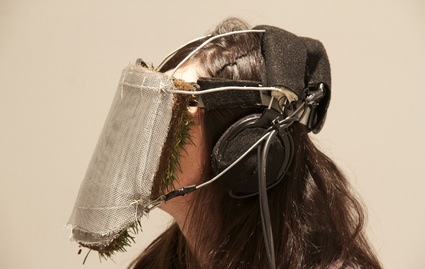
(Photo via Regine of The Open, by Mattia Casalegno, "a mask that wraps around your face and forces you to smell a fresh patch of grass and listen to your own breath.")

The Secular Donation Box

Just in time for the holidays, Susan Jacoby summarizes studies on secular versus religious donations to charities and recounts her own pledge to change the status quo:

The real giving difference between secularists and regular churchgoers comes from the fact that going to church establishes the habit of giving — not only because of moral exhortations from the pulpit, but also because of social reinforcement from peers.

Secularism is not a religion, and it does not offer the community that churches offer members.  This absence of community fosters a disconnect between proclaiming that one can be “good without God” and giving generously to help others. … It does take conscious personal effort to make giving a habit rather than an undependable, occasional act. But all I have to say to other secularists is: Try it, you’ll like it. And since the proportion of secularists and the religiously unaffiliated is growing steadily in this country, the real point is that our fellow citizens, as well as people around the world, need our help.

Digging For National Identity

Robert Draper reports on how archeologists in Israel are at war, with some searching for clues to prove a literal interpretation of the Bible and possibly use them for political means:

From the Palestinian perspective, the scurrying for archaeological evidence to justify a people's sense of belonging misses the point. As East Jerusalem resident and archaeology professor Hani Nur el-Din says, "When I see Palestinian women making the traditional pottery from the early Bronze Age, when I smell the taboon bread baked in the same tradition as the fourth or fifth millennium B.C., this is the cultural DNA. In Palestine there's no written document, no historicity—but still, it's history."

Most Israeli archaeologists would prefer that their work not be used as a political wedge. This, nonetheless, is the way of young nations. As Bar-Ilan University archaeology professor Avraham Faust observes, "The Norwegians relied on Viking sites to create a separate identity from their Swedish and Danish rulers. Zimbabwe is named after an archaeological site. Archaeology is a very convenient tool for creating national identities."