Joshua Keating reads through two recent studies and concludes that countries colonized by the British are better off than those colonized by the French.
Author: Andrew Sullivan
What Is A Family?
A reader writes:
Call me a bit old fashioned, but I don't think any social grouping that does not involve children can be called a family.
But everyone is part of a family, in that everyone is a child with parents and other relatives somewhere. Until they have children of their own, that is their family – their parents, siblings, aunts, uncles, cousins, in-laws … as far down the list of relatives as you want to go. But a couple – married or not, gay or straight – is not itself a family. The pair is part of a family – actually a part of two families, both their own parent's family and their partner's family as an in-law.
Wherever there are children being raised, there is a family, and it doesn't matter how unusual the configuration is. I'm still not sure if beagles count, though.
Another writes:
I wonder if anyone else out there would be more likely to consider the childless couples (regardless of the gender mix) a family if they were known to have pets? My husband and I were a couple for four years, but it wasn't until we got our dog that I started thinking of us as a family.
“Desire Needs A Direction”
Tom Jacobs mulls our fascination with the North Pole:
As the cardinal point on our cartographic and libidinous compasses, the North Pole anchors what might otherwise be a wild, chaotic instability: desire needs a direction. That’s why Santa lives there, of course: as a figure representing either the culmination of capitalism or the purest form of the gift economy, we can only imagine him living elsewhere, at the extremities of the world.
In a world increasingly cubicled and time-clocked, the North Pole (still?) offers a material monument that is at once abstract and enticingly material monument to pursue and seek. A monument to obtain and conquer. The remoteness and near-impossibility of “obtaining” or “conquering” it is part of its obvious allure.
Mental Health Break
The work of sculptor İlhan Koman as intrepreted by digital artist Candaş Şişman. Give it time:
F L U X from candas sisman on Vimeo.
The Master Cheater, Ctd
Macy Halford responds to the "master cheater," who confessed to authoring thousands of academic papers and student applications:
Like the Gordon Gekkos of the world, he will thrive on gaming an imperfect system (which he will continue to believe is the real problem) in which, thanks to gamers like him, it is nearly impossible to succeed honestly; and because it will be so difficult to succeed honestly, people will accept him as a necessary evil. They will call him a "tutor," in much the same way that high-class prostitutes are called "escorts." Carey Mulligan will see him on TV and curse, but Shia LeBeouf will swoon. In other words, he will be legitimate.
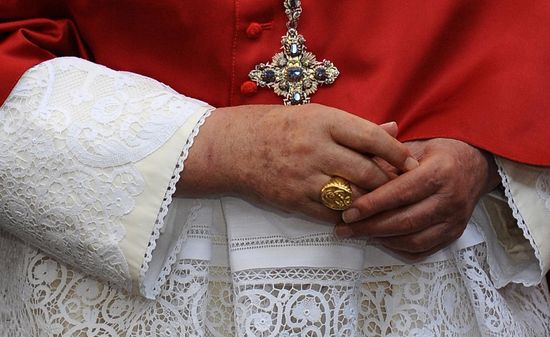
The Pope And The Male HIV-Positive Prostitute
[Re-posted from yesterday]
He really should be more careful. When pressed on the church's absolute prohibition of condoms, and asked if there could be an exception, his Holiness thought of male prostitutes for some reason:
"There may be a basis in the case of some individuals, as perhaps when a male prostitute uses a condom, where this can be a first step in the direction of a moralization, a first assumption of responsibility," Benedict said.
What this exception to the rule suggests is that sexual morality is not always black and white. Benedict has chosen a case where transmission of new life (barring a real miracle) is already impossible, and where wearing a condom (i.e. not risking infection of a sexual partner) is more responsible than not. The Vatican insists that the general doctrine remains the same.
But what this exception suggests, I think, is that condoms are ok in some circumstances for gays because there is – duh – a moral distinction between fucking someone and knowingly infecting him with a serious disease and fucking someone while avoiding infecting him with a serious disease. Now, this might seem like the bleeding obvious to anyone with a shred of moral sense – but until now, the Vatican has never dealt with such nuances, and certainly not advocated any form of gay sex that might be more moral than other forms of gay sex.
This latter point is revolutionary, in fact, as the Vatican's rather panicked official response suggests.
Yes, I know Benedict is talking of a prostitute; but once you introduce a spectrum of moral choices for the homosexual, you have to discuss a morality for homosexuals. Previously, it was simply: whatever you do is so vile none of can be moral. Now, it appears to be: even in a sexual encounter between a prostitute and his john there is a spectrum of moral conduct.
And so Pandora's box opens. If it represents a "moralization" when a male prostitute wears a condom, would it be another step in his moralization to give up prostitution for a non-mercenary sexual and emotional relationship? In such a relationship, would it be more moral for such a man to disclose his HIV status or not? If he does, would it not be more moral for him to wear a condom in sex than not?
We all know the answer to these questions. They're obvious. The new thing here is that the Church has stumbled backward into acknowledging that gay men exist, that within our lives as gay men, there are constant gradations of moral choices; and so Catholic teaching must apply to us in the gray areas of moral and sexual choices and nuances. Until now, no such guidance was really provided except general prohibition: y'all be celibate, and if you're miserable and alone, so was Jesus on the cross. Now, by conceding one small gradation of moral life, that between a rubbered prostitute and a bareback prostitute, the Pope has moved from his arid abstractions to real morality that might be able to guide real people.
Of course, in a magnificently perverse way, this teaching privileges homosexuals. It's okay for a gay prostitute to wear a condom because he was never going to procreate anyway. But for a poor straight couple in Africa, where the husband is HIV-positive and the wife HIV-negative, nothing must come in the way of being open to procreation … even if that means the infection of someone you love with a terminal disease.
It's then you realize that the Vatican's problem is not just homophobia. It's heterophobia as well.
Who Needs 500 Friends Anyway?
Ben Parr profiles a new social networking site:
Path calls itself “The Personal Network” because it’s determined to go against the example set by Twitter’s follower model; you are limited to just 50 friends on Path. It chose the 50 number based on the theories of Oxford professor of evolutionary psychology Robin Dunbar, who claims that 150 is the maximum number of social relationships any human can handle.
Face Of The Day
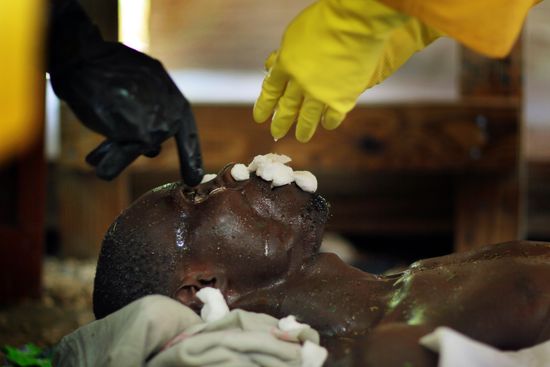
Members of a Haitian Ministry of Health body collection team place cotton balls around the face of Nixon Merise,24, as they prepare to remove his body from his home to their vehicle for disposal of it and other victims of the cholera epidemic on November 20, 2010 in Port-au-Prince, Haiti. They placed cotton balls and gauze around his face to keep fluids from flowing out. Doctors say poor sanitary conditions after January's earthquake made the country vulnerable to cholera, which is caused by bacteria transmitted through contaminated water or food. By Joe Raedle/Getty Images.
Wreathed In A Fog Of Smugness
Arch atheist PZ Myers condescends to the religious rituals he witnesses while making a pilgrimage to the Lady of Guadalupe, "the sacred Catholic heart of Mexico":
We left the subway station to join a trudging, milling mob on a hike to the basilica, which wended its way through a narrow tunnel lined with ramshackle booths where people tried to sell us all kinds of iconographic kitsch. That, I expected.
The surprise came when a horde dressed as Aztecs, half-naked with giant elaborate feathered headdresses, painted or wearing fierce masks of skulls or leopards, came charging through, forcing everyone to move off to the side to allow them to pass. They were chanting and pounding drums and waving censers about, so the whole group was wreathed in a fog of incense. […]
The syncretism is fascinating, and so far Mexico has been a delight, rich in character and history, and I've got to come back and spend more time here.But that religion is so fluid and flexible and complex doesn't make it right, and the obsessive, fanatical weirdness of this unique version of Catholicism is the product of its unfamiliarity; if you step back and look at it with eyes unfilmed by tradition, every religious ceremony looks this bizarre, and every religion thrives on hope built on despair… and some try to maximize the suffering to reinforce devotion. At least the modern Aztecs draw the line before raising obsidian knives and chopping out hearts nowadays; they seemed to be having more fun than the bloody kneed Catholics.
"Bizarre", "weird": the adjectives reflect Myers's projection, not the "fluid and flexible and complex" phenomena he also sees in front of him. You could, of course, inquire further into the resilient, mysterious and clearly powerful rituals he is witnessing. But that would require his admission that there is much human conduct here he doesn't understand – instead of the assertion that it is religion and that he therefore knows all he needs to know about it.
Death As Metamorphosis

In a previously unpublished interview from 2006, Lila Azam Zanganeh talked with John Updike, about why he appreciated Nabokov's work:
[I]t’s true there’s a lot of dying, a lot of death in Nabokov. The end of Lolita, almost every character in it is either dead or going to die. But I take dying to be for a lepidopterist like him a kind of entry into immortality, just the way a butterfly on its pin, becomes deathless, in a sense, and is preserved. [In Nabokov's novel The Eye] … he describes the transition from life to death. And it’s a kind of metamorphosis rather than a termination.
(Photo by Flickrite Fishgirl7)
 The Dish